
|
 |
 |
|
|
|
|
“I hope you rot in the deepest, darkest, and filthiest pit of hell where you really belong, being tormented day and night watching adds, CNN, MSNBC, and woke movies and series forever,” Apocalypse, Anawim, #justtothepoint.

Definition. A function f is a rule, relationship, or correspondence that assigns to each element x in a set D, x ∈ D (called the domain) exactly one element y in a set E, y ∈ E (called the codomain or range).
The pair (x, y) is denoted as y = f(x) where: x is the independent variable (input) and y is the dependent variable (output). Often, both the domain D and codomain E are the set of real numbers ℝ or subsets of ℝ.
D is the domain, the set of all possible inputs. E is the codomain or range, the set of all possible outputs.
Key property💡: Each input has exactly one output. (No input is assigned two different outputs — this is the vertical line test!)
Examples: constant, f(x) = c, horizontal line, slope = 0; linear, f(x) = mx + b, straight line, constant slope m and y-intercept b; quadratic $f(x) = ax^2 + bx + c$, u-shaped or inverted U, opens up (a > 0) or down (a < 0), vertex at x = $\frac{-b}{2a}$, symmetry about vertical axis through vertex; polynomial, $f(x) = a_n x^n + \dots + a_0$, a smooth and continuous curve, n roots (counting multiplicity), end behaviour determined by its leading term $a_n x^n$; exponential function, $f(x) = a \cdot b^x, a \ne 0, b \gt 0$, rapid growth (b > 1) or decay (0 < b < 1); trigonometric functions, $\sin(x), \cos(x), \tan (z)$ oscillatory, periodic behavior (period 2π for sin/cos, π for tan), sin and cos are bounded between -1 and 1, but tan is unbounded; step function $f(x) = \lfloor x \rfloor$, greatest integer ≤ x, constant on intervals [n, n+1), jumps at integers, its graph is a staircase shape; absolute value f(x) = |x|, V-shaped graph, slope changes at 0.
Functions can be expressed in multiple forms, each useful in different contexts: verbal description, table of values (list of pairs), algebraic formula, graph, piecewise definition, recursive definition, parametric or integral form, and series representation.
Evaluating a function means finding or computing the output value f(x) for a given input value x. f(x) = $x^2-2x +4, f(2) = 2^2 -2\cdot 2 + 4 = 4 - 4 + 4 = 4, f(0) = 0^2 -2\cdot 0 + 4 = 4, f(1) = 1^2 -2\cdot 1 + 4 = 1 -2 +4 = 3$
The x-intercept is any point on the graph that intersects or crosses the x-axis. In other words, it is the value of x when the function (y-coordinate or y-value) is zero. The y-intercept is the point where the graph intersects or crosses the y-axis. y-coordinate of the point whose x-coordinate is 0, e.g., 2x - 3y = 6. x-intercept: set y = 0 → 2x = 6 ⇒ x=3, so (3, 0). y-intercept: set x = 0 → −3y = 6 ⇒ y = −2, so (0, −2).
Graphing functions involves the visual representation of a curve that reflects the behavior of a mathematical function on a coordinate plane, also known as the Cartesian plane. The graph of a function is the set of all points (x, y) such that y = f(x).
The coordinate plane is a two-dimensional space defined by two perpendicular axes:
Each point on the plane corresponds to an ordered pair (x, y), where x is the input and y = f(x) is the corresponding output.
A very general, reliable method to graph a function y = f(x) is:
Typically, you can plot the intercepts in the axes and draw a straight line passing through them using a ruler. Two points determine a line, so this always suffices. Consider a linear function in slope–intercept form: y = mx + b.
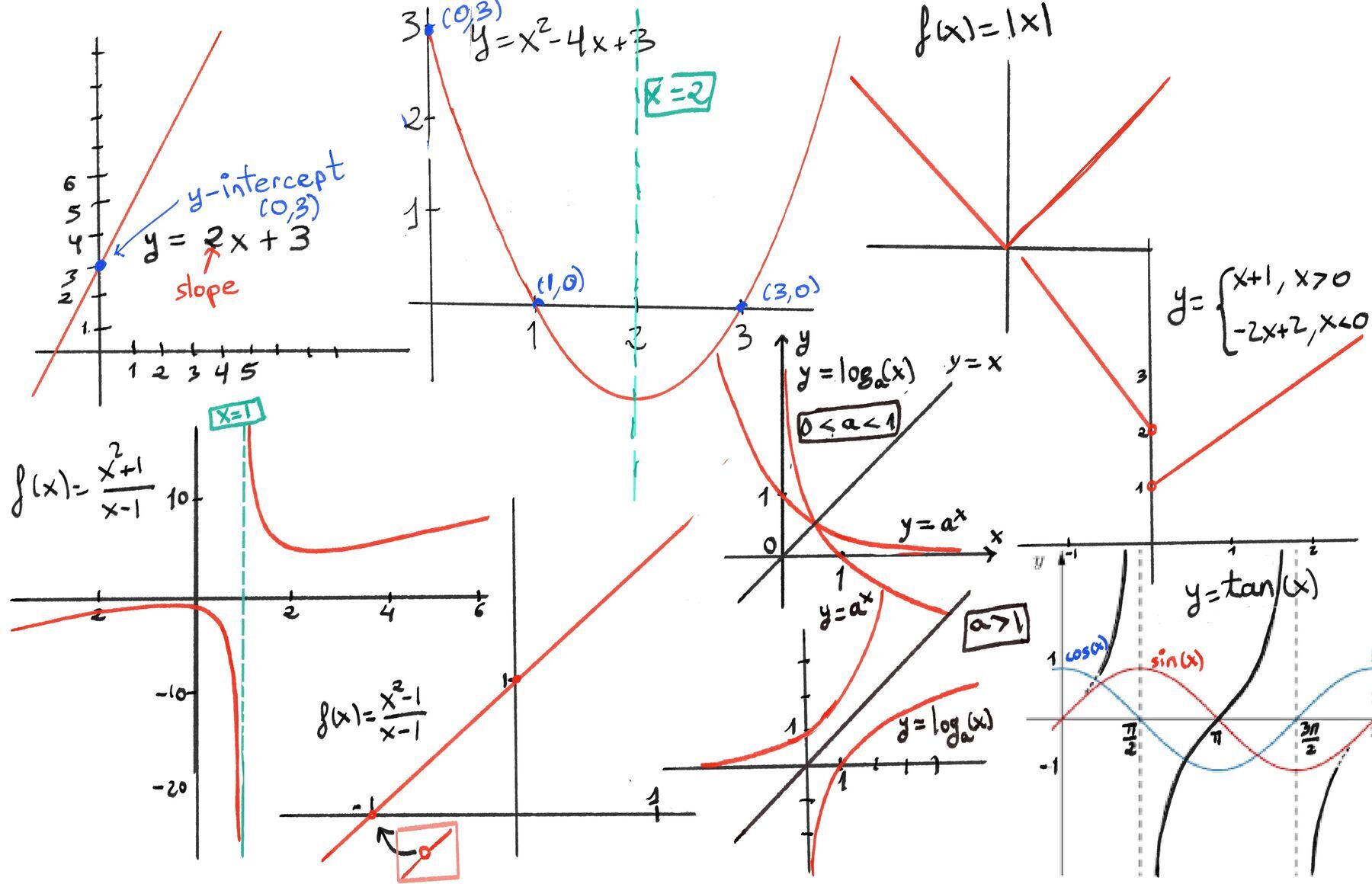
Absolute value, $f(x) = ∣x∣ = \begin{cases} x, &x \ge 0 \\\\ -x, &x \lt 0 \end{cases}$. The graph has a sharp vertex (a corner point where the definition changes) at the origin (0, 0). On each side, the function behaves like a straight line with slope +1 for $x \geq 0$ and slope -1 for x < 0. The graph, a V-shaped curve, is symmetric about the y-axis.
To plot Rational functions $f(x) = \frac{P(x)}{Q(x)}$, determine the domain (exclude points where the denominator is zero), find horizontal, vertical (where Q(x) = 0, say x = a that don’t cancel with P(x) and the function blows up, check one-sided limits $lim _{x \rightarrow a^{\pm}} f(x)$ to see whether it goes to $+\infty$ or $-\infty$), and oblique asymptotes, analyze end behaviour; and possible holes (removable discontinuities where numerator F and denominator Q share a common factor (x - a); cancel it to get the reduced function. The graph follows the reduced function but has a hole at x = a); compute a few points in each interval of the domain and sketch the curve.
$f(x)=\frac{x^2+1}{x-1}$ has a vertical asymptote x = 1. Behavior near x = 1 (f is not defined at x = 1): $\lim _{x\rightarrow 1^-}f(x)=-\infty$ and $\lim _{x\rightarrow 1^+}f(x)=+\infty$. $g(x)=\frac{x^2-1}{x-1}=\frac{(x-1)(x+1)}{x-1}$ has a hole (removable discontinuity). Cancel to get the reduced function $g_{\mathrm{red}}(x)=x+1$. The graph is the line y = x + 1 with a hole at x = 1 where the function is not defined.
Exponential $a^x, a \gt 0, a \ne 1$; domain = $\mathbb{R}$ and range = (0, $\infin$), horizontal asymptote: y = 0; Monotonicity: If a > 1: Increasing (exponential growth). If 0 < a < 1: Decreasing (exponential decay); passes through (0, 1);
Logarithm $log_a(x), a \gt 0, a \ne 1$; domain = (0, $\infin$) and range = $\mathbb{R}$; vertical asymptote: x = 0; Monotonicity: If a > 1: Increasing. If 0 < a < 1: Decreasing; and passes through (1, 0); $log_a(x)$ is the inverse of $a^x$. Their graphs are reflections across the line y = x..
Trigonometric functions are periodic. sin(x) and cos(x) are smooth, bounded oscillations between -1 and 1 (they have period 2π and range [−1, 1]). sin(x) is an odd function $\sin (-x)=-\sin (x)$ and cos(x) is an even function $\cos (-x)=\cos (x)$. tan(x) has period π, with vertical asymptotes at odd multiples of $\frac{\pi}{2}$. It repeats every $\pi$, shooting off to infinity near its vertical asymptotes.
Piecewise-defined functions. A piecewise function behaves differently in different regions of the domain, e.g., $f(x) = \begin{cases} x + 1, &x > 0 \\\\ -2x + 2, &x < 0 \end{cases}$. Treat each piece as its own function on its own interval and graph it only on its specified interval. Pay careful attention to open vs closed endpoints. Use a solid or an open dot at a point whether the function is defined or not. Piecewise graphs often show jumps, corners, or different slopes in different regions.
The graph shows a jump discontinuity at x = 0. The left-hand limit approaches 2, while the right-hand limit approaches 1. Since the function is not defined at x=0, the discontinuity is emphasized by the open circles.

JustToThePoint Copyright © 2011 - 2026 Anawim. ALL RIGHTS RESERVED. Bilingual e-books, articles, and videos to help your child and your entire family succeed, develop a healthy lifestyle, and have a lot of fun. Social Issues, Join us.
This website uses cookies to improve your navigation experience.
By continuing, you are consenting to our use of cookies, in accordance with our Cookies Policy and Website Terms and Conditions of use.