


Subgroups and the Subgroup Tests
For example is not proof but it does show that something is possible — Anon.
When exploring a large, complex algebraic structure, mathematicians often look for smaller, more manageable structures hidden inside. In group theory, these internal structures are called Subgroups.
Definition: Let $G$ be a group. A subset $H \subseteq G$ is called a subgroup if $H$ itself forms a valid group under the exact same operation used in $G$.
We use the notation $H \le G$ to mean that $H$ is a subgroup of $G$. If $H$ is strictly smaller than $G$, we call it a proper subgroup, denoted $H < G$.
Every group $G$ (with more than one element) automatically has two trivial subgroups:
- The entire group itself: $G \le G$.
- The identity subgroup: $\{e\} \le G$. Note: The set containing the identity element is different from the identity element itself.
Any subgroup other than these two is called a non-trivial proper subgroup.
Examples of Subgroups
-
Number Systems: The additive integers are a subgroup of the rationals, which are a subgroup of the reals: $(\mathbb{Z}, +) \le (\mathbb{Q}, +) \le (\mathbb{R}, +)$. Furthermore, the set of all even integers forms a subgroup of $\mathbb{Z}$, but the set of odd integers does not (an odd plus an odd is an even, breaking closure).
-
The chain of multiplicative groups. Let $\mathbb{C}^\times = \{a + bi \mid a, b \in \mathbb{R},\ (a,b) \neq (0,0)\}$, the group of all nonzero complex numbers under multiplication. Since every nonzero rational number is a nonzero real number, and every nonzero real number is a nonzero complex number, $\mathbb Q^\times \subseteq \mathbb R^\times \subseteq \mathbb C^\times$. Moreover, each set is closed under multiplication and taking multiplicative inverses, so these inclusions are actually subgroup inclusions: $\mathbb Q^\times \le \mathbb R^\times \le \mathbb C^\times.$
-
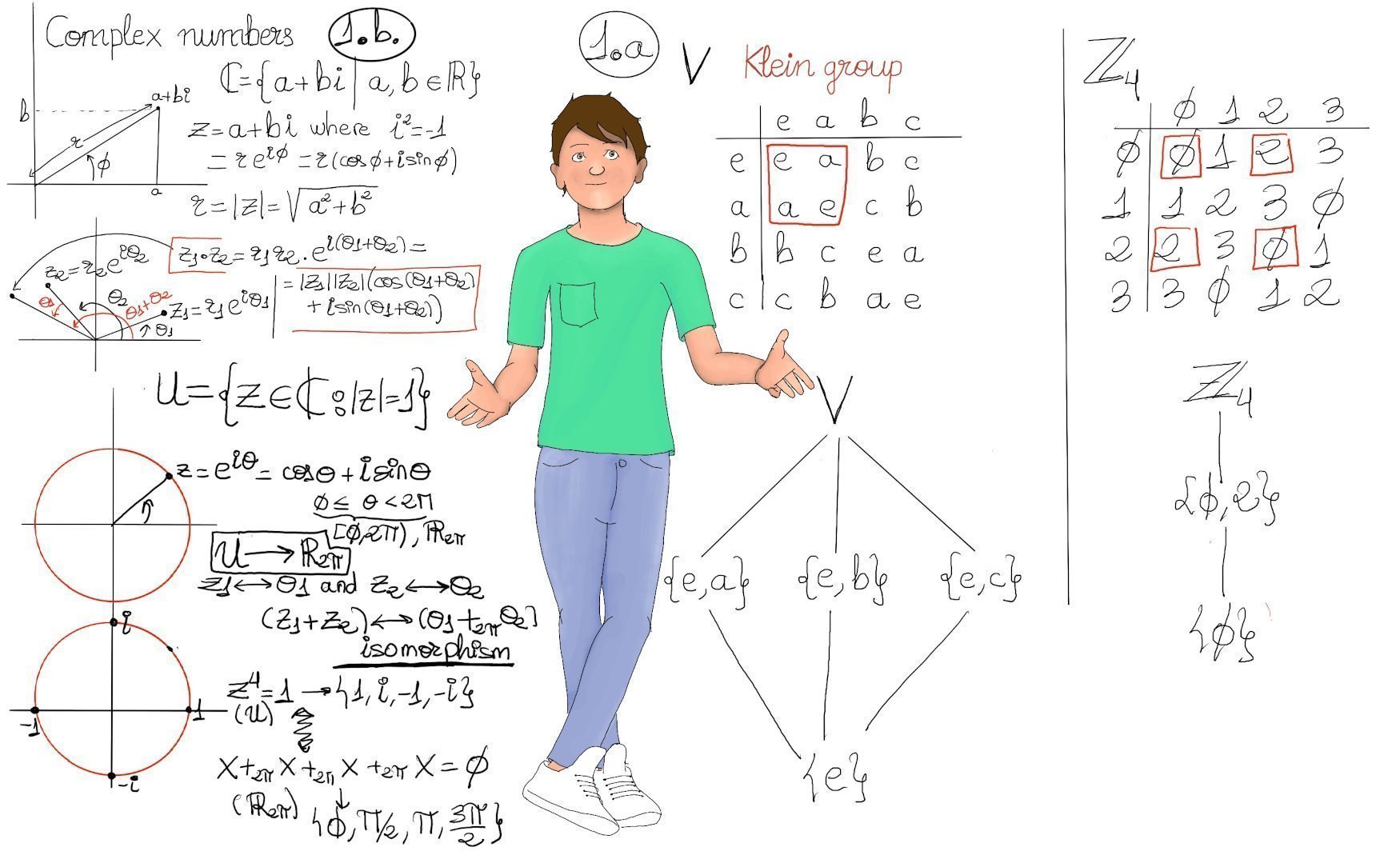
Subgroups of the Klein four-group. The Klein four-group $V_4=\{e,a,b,c\}$ has the property that every nonidentity element has order 2: $a^2=b^2=c^2=e$. Its multiplication table implies $ab=c,\qquad ac=b,\qquad bc=a.$
Therefore the subsets $\{e,a\},\qquad \{e,b\},\qquad \{e,c\}$ are subgroups because each is closed and contains inverses (indeed $a^{-1}=a$, etc.). However, $\{e,a,b\}$ is not a subgroup because $a b = c \notin \{e,a,b\}.$ Likewise, $ac = b \notin \{e,a,c\}$ and $bc = a \notin \{e,b,c\}.$
Hence, the only nontrivial proper subgroups of $V_4$ are $\{e,a\},\quad \{e,b\},\quad \{e,c\}.$
- Modular Arithmetic: In $\mathbb{Z}_6$ under addition modulo 6, the subset $\{0, 2, 4\}$ forms a proper subgroup, as does $\{0, 3\}$. However, $\{0, 1, 2, 3, 4\}$ is not a subgroup because it is not closed (e.g., $2 + 3 = 5 \notin H$).
Consider $\mathbb Z_4 = \{0,1,2,3\}$ under addition modulo $4$.
The element $2$ has order $2$ because $2 + 2 = 0 \pmod 4.$ Thus, $\{0,2\}$ is a subgroup.
The element $1$ has order $4$: $1,\quad 1+1=2,\quad 1+1+1=3,\quad 1+1+1+1=0.$ Hence, $\langle 1\rangle=\mathbb Z_4.$ Similarly, $\langle 3\rangle=\mathbb Z_4.$
Since the order of a subgroup of a finite group must divide the order of the group (Lagrange’s Theorem), every subgroup of $\mathbb Z_4$ must have size $1$, $2$, or $4$. Therefore the only subgroups are $\{0\},\qquad \{0,2\},\qquad \mathbb Z_4.$
Consequently, $\boxed{\{0,2\}\text{ is the unique nontrivial proper subgroup of }\mathbb Z_4.}$
The subsets $\{0,1\},\ \{0,3\},\ \{0,1,2\},\ \{0,2,3\}$ are not subgroups because they fail closure, $1+1=2 \notin \{0,1\}$, $3+3=2 \notin \{0,3\}$, $1+2=3 \notin \{0,1,2\}$, $2+3=1 \notin \{0,2,3\}$
-
The Special Linear Group: Let $GL_n(\mathbb{R})$ be the group of all invertible $n \times n$ matrices with real entries. Let $SL_n(\mathbb{R})$ be the subset of matrices whose determinant is exactly $1$, $SL_n(\mathbb{R}) = \{A \in GL_n(\mathbb{R}) \mid \det(A) = 1\}$. Since determinant $1$ is nonzero, every matrix in $SL_n(\mathbb R)$ is already in $GL_n(\mathbb R)$. To check the subgroup properties:
Associativity is inherited from $GL_n(\mathbb R)$.
Closure: If $A, B\in SL_n(\mathbb R)$, then $\det(AB) = \det(A)\det(B)= 1 \cdot 1 = 1,$ so $AB\in SL_n(\mathbb R)$.
Identity: $\det(I_n) = 1$, so $I_n \in SL_n(\mathbb{R})$.
Inverses: If $A\in SL_n(\mathbb R)$, then $AA^{-1}=I_n$. Taking determinants gives $\det(A)\det(A^{-1}) = \det(I_n)= 1.$ Since $\det(A)=1$, it follows that $\det(A^{-1})=1$, so $A^{-1}\in SL_n(\mathbb R)$.
Thus, $SL_n(\mathbb{R}) \le GL_n(\mathbb{R})$. -
$\{1, -1\} \le \mathbb{R}^\times$ where $\mathbb{R}^\times$ is the multiplicative group of nonzero real numbers.
-
The Quaternion Group ($Q_8$) forms a finite, non-Abelian subgroup of $GL_2(\mathbb{C})$.
$$Q_8 = \left\{ \pm \begin{pmatrix} 1 & 0 \\ 0 & 1 \end{pmatrix}, \pm \begin{pmatrix} i & 0 \\ 0 & -i \end{pmatrix}, \pm \begin{pmatrix} 0 & 1 \\ -1 & 0 \end{pmatrix}, \pm \begin{pmatrix} 0 & i \\ i & 0 \end{pmatrix} \right\}$$
Commonly denoted as $\{\pm 1, \pm i, \pm j, \pm k\}$. $i^2 = j^2 = k^2 = -1$, $ij = -ji = k$, $jk = -kj = i$, $ki = -ik = j$, $ba = -c$. $1$ is the identity of $Q_8$, it is closed under matrix multiplication, and contains the inverse of every element, so it is a subgroup of $GL(2, \mathbb{C})$ and it is non-Abelian since $ab=c$ but $ba=−c$.
- The dihedral group is a subgroup of the symmetric group, $D_n \le S_n$. Assume $n\ge 3$, and let $D_n$ mean the symmetries of a regular $n$-gon, so $|D_n|=2n$. Every symmetry permutes the polygon’s vertices.
Label the vertices $a_1,\ldots,a_n$ in counterclockwise order, and let $r$ be the rotation through $2\pi/n$. The rotations are $e,r,r^2,\ldots,r^{n-1},$ where $r^k$ rotates through $2\pi k/n$. On the vertices, $r$ acts as the cycle $\alpha=(a_1\,a_2\,\cdots\,a_n)\in S_n.$
Now take the reflection $s$ whose axis passes through $a_1$ and the center of the polygon. It fixes $a_1$ and reverses the order of the other vertices. Its corresponding permutation is $\beta$. For example, $\begin{aligned} n=5 &: \quad \beta=(a_2\,a_5)(a_3\,a_4),\\ n=6 &: \quad \beta=(a_2\,a_6)(a_3\,a_5), \end{aligned}$ with $a_1$ fixed in both cases; when $n=6$, $a_4$ is fixed too. In general, with subscripts read cyclically, $\beta(a_j)=a_{2-j}$.
These permutations satisfy $\alpha^n=e,\qquad \beta^2=e,\qquad \beta\alpha\beta=\alpha^{-1}.$
The rotations are $\alpha^k$, and the reflections are $\alpha^k\beta$, for $0 \le k \lt n$. Thus, the permutations arising from the polygon’s symmetries form $\langle \alpha, \beta\rangle = \{\alpha^k,\alpha^k \beta : 0 \le k \lt n \} \le S_n.$
Let $V = \{a_1, a_2, \dots, a_n\}$ be the set of vertices of the $n$-gon. Every symmetry $g \in D_n$ moves these vertices around. Define a mapping $\phi: D_n \to S_n$ such that $\phi(g)$ is the permutation in $S_n$ that describes how $g$ rearranges the vertices. $\phi(r) = \alpha, \phi(s) = \beta$.
To finalize the proof, you rely on the following logical steps:
- The mapping preserves the group structure (Homomorphism). If you apply a symmetry $h$ and then a symmetry $g$ (which is $g \circ h$), the final arrangement of the vertices is exactly the same as if you applied the permutation $\phi(h)$ and then the permutation $\phi(g)$. Mathematically, $\phi(g \circ h) = \phi(g) \phi(h)$. Because it preserves the group operation, $\phi$ is a homomorphism.
- The mapping is one-to-one (Injective / Faithful Action). Is it possible for two different geometric symmetries to shuffle the vertices in the exact same way? No. A rigid motion of a convex polygon is completely determined by where it sends the vertices. If a symmetry leaves every single vertex in its original position (the permutation is the identity $e \in S_n$), the symmetry must be the identity transformation in $D_n$.
Because the kernel of $\phi$ contains only the identity, $\phi$ is injective. (In the language of group actions, $D_n$ acts faithfully on the vertices). - The Image is a Subgroup. By the First Isomorphism Theorem, any injective homomorphism from a group $G$ embeds $G$ as a subgroup inside the target group. Specifically, $D_n \cong \text{Im}(\phi)$.
Since $D_n$ is generated by $r$ and $s$, its image is generated by $\phi(r)$ and $\phi(s)$, which are our permutations $\alpha$ and $\beta$. Therefore, the image of $D_n$ inside $S_n$ is $\text{Im}(\phi) = \langle \alpha, \beta \rangle = \{\alpha^k, \alpha^k\beta : 0 \le k < n\} \le S_n$
A Powerful Classification: Subgroups of $\mathbb{Z}$
What do the subgroups of the integers look like?
Theorem: Every subgroup of $(\mathbb{Z}, +)$ is of the form $n\mathbb{Z}$ (the multiples of some integer $n$).
Proof:
Let $H \le \mathbb{Z}$. If $H = \{0\}$, the theorem holds for $n=0$.
Suppose $H \neq \{0\}$. Because $H$ is a subgroup, it contains inverses, so it must contain positive integers. By the Well-Ordering Principle, $H$ contains a strictly smallest positive integer. Let’s call it $n$.
Let $m$ be any other arbitrary element in $H$. By the Division Algorithm, there exist integers $q$ and $r$ such that: $m = nq + r \quad \text{where } 0 \le r < n$
We can isolate $r$: $r = m - nq$. Because $n \in H$, and $H$ is closed under addition and inverses, any multiple of $n$ (like $nq$) is also in $H$. Since $m \in H$ and $nq \in H$, their difference $m - nq$ is also in $H$. Therefore, the remainder $r \in H$.
But wait! We defined $n$ as the smallest positive integer in $H$. Because $0 \le r < n$, the only way $r$ can belong to $H$ without violating our definition of $n$ is if $r = 0$. Thus, $m = nq$. Every element in the subgroup must be a perfect multiple of $n$. $\blacksquare$
Subgroup Tests
To prove a subset $H$ is a subgroup, we theoretically need to check all four group axioms. However, because $H$ inherits associativity from the parent group $G$, we never have to check it! Mathematicians have condensed the remaining requirements into highly efficient tests.
The Two-Step Subgroup Test. A non-empty subset $H \subseteq G$ is a subgroup if and only if it satisfies two conditions: (i) Closure: For all $a, b \in H$, the product $ab \in H$. (ii) Inverses: For all $a \in H$, the inverse $a^{-1} \in H$.
Proof:
If $H$ is a subgroup, then (i) and (ii) obviously hold.
Conversely, suppose (i) and (ii). The associativity (grouping) property is inherited from $G$.
$\forall a \in H, a^{-1} \in H$ (ii). Then, $a(a^{-1}) = (a^{-1}a) = e \in H$ (i). $e$ is a neutral element of $G$, so it is a neutral element of $H$. Therefore, $H$ has a neutral element.
Examples
- The Circle Group ($\mathbb{T}$)
Let $\mathbb{C}^*$ be the group of non-zero complex numbers under multiplication. Let $\mathbb{T}$ be the subset of complex numbers with an absolute value (modulus) of exactly $1$. Mathematically, $\mathbb{T} = \{z \in \mathbb{C}^* \mid \vert{}z\vert{} = 1\}.$
Geometrically, this is the unit circle in the complex plane. Let’s apply the Two-Step Test:
- Closure: Let $z, w \in \mathbb{T}$. By the multiplicative property of the modulus, $\vert{}zw\vert{} = \vert{}z\vert{}\vert{}w\vert{} = 1 \cdot 1 = 1$. Thus, $zw \in \mathbb{T}$.
- Inverses: Let $z \in \mathbb{T}$. The modulus of the inverse is $\vert{}z^{-1}\vert{} = \frac{1}{\vert{}z\vert{}} = \frac{1}{1} = 1$. Thus, $z^{-1} \in \mathbb{T}$.
Therefore, the Circle Group is a valid, uncountably infinite subgroup: $\mathbb{T} \le \mathbb{C}^*$.
- Let $D_n$ be the dihedral group of symmetries of a regular $n$-gon. Define $H = \{e,r,r^2,\ldots,r^{\,n-1}\}$, the set of all rotations. We claim that $H$ is a subgroup of $D_n$.
- Identity. The identity symmetry $e=r^0$ belongs to $H$.
- Closure. If $r^a,r^b\in H$, then $r^a r^b = r^{a+b}.$ Since rotations are considered modulo $n$, $r^{a+b}=r^{(a+b)\bmod n},$ which is again one of $e, r, r^2,\ldots,r^{n-1}.$
- Inverses. For every $r^k \in H, (r^k)^{-1}=r^{-k}.$ Since $r^n = e$, we may rewrite $r^{-k}=r^{n-k}$, which is also an element of $H$.
Since $H$ contains the identity, is closed under multiplication, and contains inverses, we conclude that $H \le D_n.$ In fact, $H=\langle r\rangle$, the cyclic subgroup generated by $r$, and $H \cong \mathbb Z_n$.
We can combine the Two-Step test into a single, brutally efficient algebraic check.
The One-Step Subgroup Test. A non-empty subset $H \subseteq G$ is a subgroup if and only if for all $a, b \in H$, the element $ab^{-1} \in H$.
Proof:
If $H \le G$, then $b \in H \implies b^{-1} \in H$. By closure, $ab^{-1} \in H$.
Conversely, suppose $ab^{-1} \in H$ for all $a,b \in H$.
- Let $a = b$. Then $a a^{-1} = e \in H$. Identity exists.
- Since $e \in H$, let $a = e$. Then $e b^{-1} = b^{-1} \in H$. Inverses exist.
- To prove closure, let $a, b \in H$. Since inverses exist, $b^{-1} \in H$. Using our one-step rule on the elements $a$ and $b^{-1}$, we get $a(b^{-1})^{-1} = ab \in H$. Closure holds. $\blacksquare$
If you know the subset is finite, the test becomes even easier. You don’t even need to check for inverses!
The Finite Subgroup Test. Let $H$ be a non-empty, FINITE subset of a group $G$. $H$ is a subgroup if and only if $H$ is closed under the group operation.
Proof:
We only need to prove that closure guarantees inverses in a finite set.
Let $a \in H$. If $a=e$, its inverse is $e$, which is in $H$.
Suppose $a \neq e$. Because $H$ is closed, the infinite sequence $a, a^2, a^3, a^4, \dots$ must all belong to $H$. Because $H$ is finite, this sequence must eventually repeat itself. Thus, $a^i = a^j$ for some $i > j$.
By the cancellation law, we can multiply by $a^{-j}$ to get: $a^{i-j} = e$
Since $i > j$, the exponent $(i-j)$ is at least $1$. We can factor out one $a$: $a \cdot a^{i-j-1} = e$
This proves that the element $a^{i-j-1}$ acts as the inverse of $a$. Since $a^{i-j-1}$ is just a positive power of $a$, it belongs to $H$ by closure. Therefore, every element has an inverse inside $H$. $\blacksquare$
Example: Failing the Subgroup Test
Consider the Klein Four-Group $V_4 = \{e, a, b, c\}$. Every element is its own inverse, and the product of any two distinct non-identity elements yields the third (e.g., $ab = c$).
Is $H = \{e, a, b\}$ a subgroup?
We apply the Finite Subgroup Test. Because $ab = c$, and $c \notin H$, the subset fails closure. Therefore, $\{e, a, b\}$ is not a subgroup of $V_4$.
Subgroup Relations, Intersections, and Generators
Once we understand how to identify a single subgroup using the Subgroup Tests, we can begin analyzing how multiple subgroups interact with each other. Subgroups are not just isolated islands; they nest inside one another, intersect, and form beautiful geometric hierarchies.
The relationship “is a subgroup of” behaves like a partial order, much like the “less than or equal to” ($\le$) relation for numbers.
Proposition: The subgroup relation is transitive. If $H$ is a subgroup of $K$, and $K$ is a subgroup of $G$, then $H$ is a subgroup of $G.$ Mathematically: $H \le K$ and $K \le G \implies H \le G.$
Proof:
By definition, if $H \le K$, then $H$ is a subset of $K$ ($H \subseteq K$). Since $K \le G$, $K$ is a subset of $G$ ($K \subseteq G$). By the standard rules of set theory, a subset of a subset is a subset of the whole, so $H \subseteq G$.
Now we apply the One-Step Subgroup Test to $H$ as a subset of $G$:
- Because $H \le K$, it is a valid group, meaning it contains the identity element $e$. Thus, $H$ is non-empty.
- Let $a, b$ be any two arbitrary elements in $H$. Because $H$ is a subgroup (of $K$), it is closed under the operation and inverses, which guarantees that $ab^{-1} \in H$.
- Since $H$ is a non-empty subset of $G$ and for all $a, b \in H$, the element $ab^{-1} \in H$, the One-Step Test confirms that $H \le G$. $\blacksquare$
The Subgroup Lattice: Because transitivity holds, we can map out the entire internal structure of a group using a hierarchy diagram called a Subgroup Lattice. We place the full group $G$ at the top, the trivial identity group $\{e\}$ at the bottom, and draw descending lines to show which subgroups contain smaller subgroups!
If you have two valid subgroups, what happens if you look at the elements they share?
Proposition: The intersection of any two subgroups of a group is again a subgroup. If $H \le G$ and $L \le G$, then $(H \cap L) \le G.$
Proof:
To use the One-Step Subgroup Test, we must first prove the intersection is non-empty (a commonly skipped step!).
Because $H$ and $L$ are both subgroups of $G$, they must both contain the unique identity element $e$ of the parent group $G$. Therefore, $e \in H$ and $e \in L$, which forces $e \in H \cap L$. The intersection is non-empty.
Now, let $a, b$ be any two elements in the intersection $H \cap L$.
By the definition of an intersection, this means: $a, b \in H$ and $a, b \in L$.
Since $H \le G$, the One-Step Test guarantees that $ab^{-1} \in H$. Since $L \le G$, the One-Step Test guarantees that $ab^{-1} \in L$.
Because the element $ab^{-1}$ lives in both sets, it must live in their intersection: $ab^{-1} \in H \cap L$
By the One-Step Test, $H \cap L \le G$. $\blacksquare$
Note: This theorem generalizes perfectly to infinite families of subgroups. The intersection of ANY number of subgroups, $\bigcap_{i \in I} H_i,$ is always a guaranteed subgroup of $G$.
The intersection theorem above allows us to build subgroups from scratch. Suppose you have a group $G$ and you pick a few random elements to put in a set $S$. The set $S$ is probably not a subgroup on its own (it likely lacks closure and inverses).
How do we build the strictly smallest possible subgroup that contains $S$? We take the intersection of all subgroups in $G$ that happen to contain $S$. This guarantees we only include the absolute minimum elements required to satisfy the group axioms.
Definition: Let $S$ be a subset of a group $G$. The subgroup generated by $S$, denoted $\langle S \rangle$, is the smallest subgroup of $G$ containing $S$. Every element in this subgroup can be expressed as a finite combination of the elements of $S$ and their inverses.
Let $\mathcal H =\{ H \le G : S \subseteq H \}$ be the collection of all subgroups of $G$ that contain $S$.
This collection is nonempty because $G$ itself is a subgroup of $G$ and certainly contains $S$: $G\in \mathcal H.$
Therefore we may define $\langle S\rangle = \bigcap_{H \in\mathcal H} H$.
Since the intersection of any collection of subgroups is again a subgroup, $\langle S\rangle$ is a subgroup containing $S$. Moreover, because it is contained in every subgroup that contains $S$, it is the smallest such subgroup.
What do its elements look like?
Every element of $\langle S\rangle$ can be written as a finite product of elements of $S$ and their inverses: $s_1^{\varepsilon_1} s_2^{\varepsilon_2} \cdots s_k^{\varepsilon_k},$ where $s_i\in S, \qquad \varepsilon_i\in\{1,-1\}.$
If $S=\{a\}$ is a singleton set, then the subgroup generated by $S$ is written $\langle a\rangle$ instead of $\langle\{a\}\rangle.$ So $\langle a\rangle$ means the smallest subgroup of $G$ containing the element $a$.
Cyclic Subgroups (Generated by a Single Element)
The most fundamental building block in abstract algebra is a subgroup generated by just one single element, $a \in G$. We denote this as $\langle a \rangle$.
Definition: The subset $\langle a \rangle = \{a^n \mid n \in \mathbb{Z}\}$ is called the cyclic subgroup generated by $a$.
Proof that $\langle a \rangle$ is a subgroup:
- Non-empty: For $n=0$, $a^0 = e \in \langle a \rangle$.
- Closure: Let $g, h \in \langle a \rangle$. By definition, there exist integers $m, n \in \mathbb{Z}$ such that $g = a^m$ and $h = a^n$. Their product is $gh = a^m a^n = a^{m+n}$. Since $m+n$ is an integer, $a^{m+n} \in \langle a \rangle$.
- Inverses: For any $g = a^m$, its inverse is $g^{-1} = a^{-m}$. Since $-m \in \mathbb{Z}$, $a^{-m} \in \langle a \rangle$.
Now let’s check that $a^{-m}$ really is the inverse of $a^m.$ Compute: $a^m a^{-m} = a^{m+(-m)} = a^0 = e.$
Thus, $\langle a \rangle \le G$. $\blacksquare$
Examples of Generated Subgroups
-
In Additive Notation: When the group operation is addition, $a^n$ becomes $n \cdot a$ (adding $a$ to itself $n$ times). In $\mathbb{Z}_{10}$, the subgroup generated by $2$ is: $\langle 2 \rangle = \{0, 2, 4, 6, 8\} \le \mathbb{Z}_{10}$
-
Cyclic Subgroups of $\mathbb{Z}_{12}$:
$\langle 0 \rangle = \{0\}$ (The trivial subgroup).
$\langle 1 \rangle = \{0, 1, 2, 3, 4, 5, 6, 7, 8, 9, 10, 11\} = \mathbb{Z}_{12}.$
$\langle 2 \rangle = \{0, 2, 4, 6, 8, 10\}$ (Notice this has order 6).
$\langle 3 \rangle = \{0, 3, 6, 9\}$ (Notice this has order 4), $\langle 4 \rangle = \{0, 4, 8\}$ (Notice this has order 3), $\langle 6 \rangle = \{0, 6\}$ (Notice this has order 2). -
Generating the Infinite Integers: In the group of integers $(\mathbb{Z}, +)$, the number $1$ generates everything! $\langle 1 \rangle = \{\dots, -2, -1, 0, 1, 2, \dots\} = \mathbb{Z}$.
Interestingly, $\langle -1 \rangle = \mathbb{Z}$ as well.
- Multiple Generators (Dihedral Groups): Let $r$ be a rotation by $\frac{2\pi}{n}$ in the Dihedral group $D_n$. The cyclic subgroup generated by $r$ is: $\langle r \rangle = \{e, r, r^2, \dots, r^{n-1}\}$ This only gives us the rotations! To generate the entire group $D_n$, we need a second generator: a reflection $s$. The entire group is generated by both $r$ and $s$, denoted as $\langle r, s \rangle = D_n$.
Bibliography
- NPTEL-NOC IITM, Introduction to Galois Theory.
- Algebra, Second Edition, by Michael Artin.
- LibreTexts Mathematics, Abstract and Geometric Algebra, Abstract Algebra: Theory and Applications (Judson).
- Field and Galois Theory, by Patrick Morandi. Springer.
- Michael Penn (Abstract Algebra), and MathMajor.
- Contemporary Abstract Algebra, Joseph, A. Gallian.
- Andrew Misseldine: College Algebra and Abstract Algebra.
