


Properties of Cyclic Groups
The saddest aspect of life right now is that science gathers knowledge faster than society gathers wisdom, Isaac Asimov
Properties of Cyclic Groups
Theorem. Let G be a group, let a be an arbitrary element of G, a ∈ G. If a has infinite order, |⟨a⟩| = ∞ then ai=aj iff (if and only if) i=j. If a has finite order n, |⟨a⟩| = n < ∞, then ⟨a⟩ = {e, a, a2,..., an-1}, they are all distinct elements of ⟨a⟩, and ai=aj iff (if and only if) n|(i-j), n divides i-j.
Proof.
If a has infinite order ⇒ there is no a natural number n ∈ ℕ, n > 0, such that an = e. Therefore, ai = aj ⇒ ai-j = e ⇒ i-j = 0 ⇒ i = j.
Let’s assume that |a| = n, we are going to prove that ⟨a⟩ = {e, a, a2,…, an-1}. Certainly, e, a, a2,…, an-1 are in ⟨a⟩. Suppose that ak ∈ ⟨a⟩ ⇒ ∃q, r ∈ ℤ: k = qn + r, 0 ≤ r < n ⇒ ak = aqn + r = aqnar = (an)qar = [By assumption, |a| = n, an = e] eqar = ear = ar ∈ {e, a, a2,…, an-1} since 0 ≤ r < n.
The powers {1, a, a2, ···, an-1} are all distinct. Suppose ai = aj where 0 ≤ j < i < n ⇒ ai-j = a0 = e and 0 < i -j < n ⊥ (minimality of n, an = e)
Next, let’s assume ai = aj ⇒ ai-j = e ⇒ i - j = qn + r, 0 ≤ r < n so ai-j = (an)qar = ear = ar = e, 0 ≤ r < n ⇒ Since, by definition, n is the least positive integer such that an is the identity ⇒ r = 0 ⇒ i - j = qn ⇒ n divides i-j, i.e., n | (i-j)
Conversely, if n | (i-j) ⇒∃q such that i - j = nq ⇒ ai-j = anq = (an)q = eq = e ⇒ [ai-j = e] ai = aj.
Example: ℤ20 = {0, 1, 2, 3,…, 19}. ⟨5⟩ = {5, 10, 15, 0}, |⟨5⟩|=4, so by this theorem 5i = 5j iff 4|(i-j).
0 = 50 =[54 = 20 ≡20 0] 54 =[58 = 40 ≡20 0] 58…
5 = 51 =[55 = 25 ≡20 5] 55 = 59…
10 = 52 = 56 = 510…
15 = 53 = 57 = 511…
Corollary. For any arbitrary element, say a ∈ G, its order is equal to the order of the cyclic subgroup generated by this very element, i.e., |a| = |⟨a⟩| = {e, a, a2,..., an-1}.
Theorem. Let G = ⟨a⟩ be a cyclic group generated by a. If a has finite order n, then so does G and |G| = n. Futhermore, if b ∈ G and |b| = n, then b is a generator for G.
Proof. Since a has finite order, G = ⟨a⟩ = {e, a, a2,···, an-1} and all these elements are distinct because if k, l < n, ak = al, let’s assume k > l ⇒ [G is a group, there are inverses] aka-l = e ⇒ ak-l = e ⇒ 0 < k-l < n ⊥ (it contradicts minimality of n, |a| = n). Therefore, |G| = n.
If b ∈ G, |b| = n, by similar reasoning ⟨b⟩ = {e, b, b2, …, bn-1} and they are all distinct elements. Hence, G = ⟨b⟩ = ⟨a⟩, and b is a generator∎
Proposition. Let G be an arbitrary group, let a be an element of G of order n. Then, am = e iff |a| | m. In particular, if b = am,, then the order of b divides the order of a.
Proof.
Let |a| = n. By the division algorithm, ∃q, r ∈ ℤ: m = qn + r and 0 ≤ r < n. ar = am-qn = am(an)-q = am. Then, am = e ↭ ar = e ↭ [0 ≤ r < n, |a|=n, so by the minimality of n] r = 0 ↭ m = qn
In particular, bn = [b = am] (am)n = (an)m = em = e ⇒ [By the previous statement] |b| | n = |a|∎
The idea behind these results is that multiplication in ⟨a⟩ is essentially done by addition modulo n that is, if (i+j) mod n = k, then aiaj = ak. In other words, in the finite case, it works as addition in ℤn. Otherwise, if a has infinite order, multiplication in ⟨a⟩ is essentially done by addition. It works as addition in ℤ, that is, no modular arithmetic is needed.
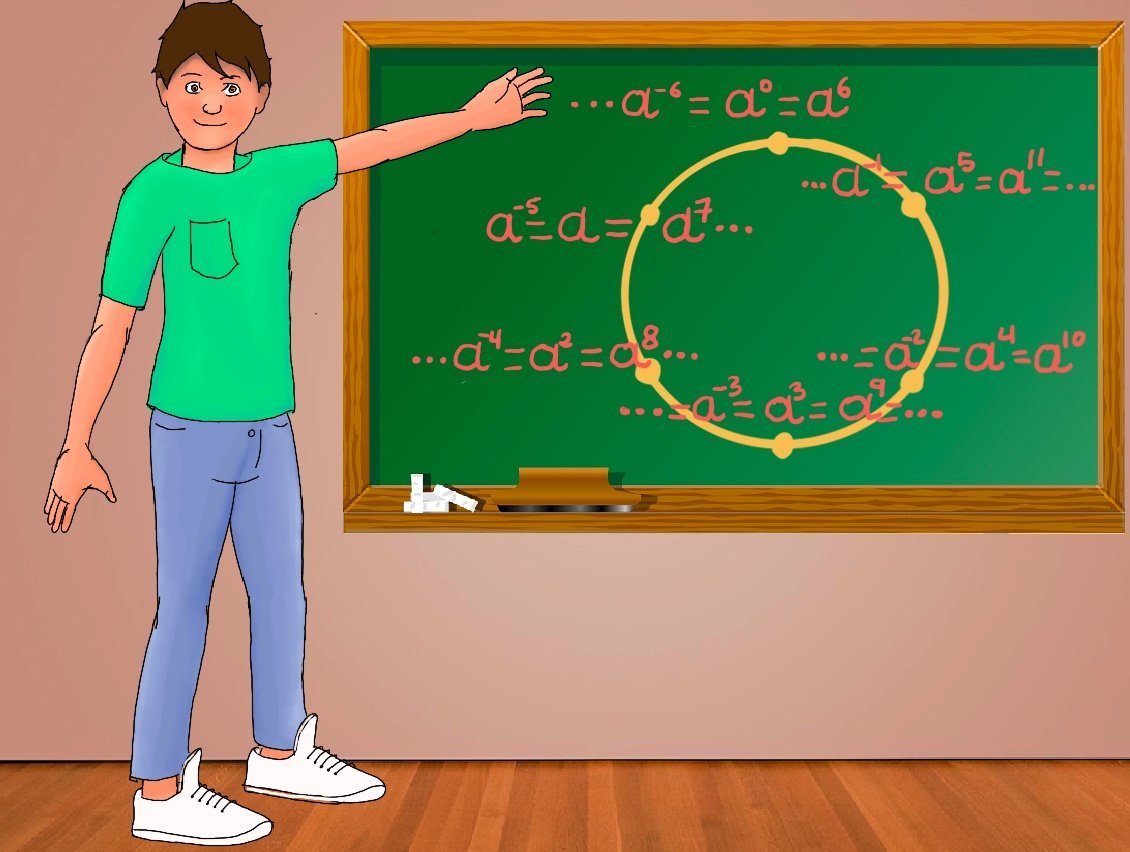
Theorem: Every cyclic group is Abelian.
Proof: If g and h ∈⟨a⟩ ⇒ g = am, h = an for some m, n ∈ Z ⇒ gh = am+n = an+m = anam = hg∎
Theorem. Every subgroup of a cyclic group is cyclic.
Proof. Let G be cyclic, there exists at least an element a ∈ G: ⟨a⟩ = G. Suppose that H is a subgroup of G, H ≤ G. There are two possibilities, namely:
-
If H is the trivial subgroup, H = {e} ⇒ H = ⟨e⟩, and H is obviously cyclic.
-
Otherwise, if H is not the trivial subgroup, H ≠ {e} ⇒ ∃g ∈ H: g ≠ e, g = an ⇒ [Well-ordering principle. Every non-empty set of positive integers contains a least element.] Let m be the smallest natural number such that h = am ∈ H
We claim that H = ⟨h⟩ = ⟨am⟩. Let h’ be an arbitrary element of H, h’ ∈ H ⇒ h’ = ak.
By the division algorithm, ∃q, r: k = mq + r where 0 ≤ r < m ⇒ ak = amq+r = amqar = (am)qar = hqar ⇒ ar = akh-q ∈ H [h’ = ak and h-q∈ H], but r < m, and h = am is the smallest element in H ⇒ r = 0 ⇒ k = mq, h’ = ak = amq = hq, and therefore, since h’ was an arbitrary element of H and it is generated by h = am ⇒ H = ⟨h⟩ = ⟨am⟩∎
Theorem. Let G be a finite cyclic group, G = ⟨g⟩. Then, G has exactly one subgroup of order d for each d | |G|, namely H = ⟨gn/d⟩ ≤ G
Proof
Let |G| = n. By assumption d | n, let us consider h = gn/d. It is obvious that hd = (gn/d)d = gn = [G = ⟨g⟩, |G| = n] e.
If a ∈ ℤ, 1 ≤ a < d ⇒ [a < d ⇒ an/d < dn/d(=n)] 1 ≤ an/d < n. Thus, ha = gna/d ≠ e because 1 ≤ an/d < n and no power less than n can get g to the identity. Then, d is the smaller power that can get h to the identity ⇒ [By definition] |h| = d ⇒ |⟨h⟩| = d. So there is at least one such subgroup.
Let’s prove uniqueness. Let k ∈ G: |k| = d. G is cyclic so ∃m: k = gm. gdm = (gm)d = kd = e ⇒ [ga =e ↭ |g| | a] n | dm ⇒ ∃l ∈ ℤ: nl = dm ⇒ (n/d)l = m ⇒ k = gm = (gn/d)l = hl ∈ ⟨h⟩ ⇒ k = hl ∈⟨h⟩ ⇒ ⟨k⟩ ⊆ ⟨h⟩, but these are two finite sets with the same order, so they are the same set ∎
Corollary. The subgroups of ℤ are exactly nℤ and the subgroups of ℤn are exactly mℤn.
Proof.
(ℤ, +) is an infinite cyclic group. nℤ = {nk | k ∈ ℤ} are all cyclic subgroups of ℤ by definition, but we have demonstrated that being ℤ cyclic (ℤ = ⟨1⟩), then all its subgroups are necessarily cyclic ⇒ These are exactly all the subgroups of ℤ, and more importantly, there are no other subgroups left.
By similar reasoning, ℤn is a cyclic finite group, all their cyclic groups are mℤn = {mk | k ∈ ℤn} by definition, and as was reasoned before, their only subgroups are cyclic subgroups, so the subgroups of ℤn are exactly mℤn.
Theorem. Let G be a finite cyclic group generated by an element a, G = ⟨a⟩, |G| = n. Then ak = e iff n divides k.
Proof.
⇒) Let’s suppose that ak = e. By the division algorithm, k = nq +r, where 0 ≤ r < n ⇒ ak = anq+r = anqar ⇒ [ak = e, anq=a0=e because an = e or it could also be argued that nq≡0 (mod n)] e = ar ⇒ r = 0 because r < n and n is the smallest integer m such that am = e ⇒ k = nq ⇒ n | k.
⇐) Conversely, let’s suppose n divides k ⇒ k = ns for some integer s ⇒ ak = ans = (an)s = es = e∎
Exercise: Suppose G is cyclic, a ∈ G, a is an element of order n, and a24 = e. What are the possibilities of n?
a24=e ⇒ k = 24 ⇒ n|24 ⇒ n needs to be 1, 2, 3, 4, 6, 8, 12 or 24.
Proposition. Let G be an arbitrary group, a ∈ G, and let m, n ∈ ℤ. If an = e and am = e, then agcd(m, n) = 1.
Proof.
By the Euclidean Algorithm, there exists r, s ∈ ℤ such that d = mr + ns, d = gcd(m, n) =notation (m, n) ⇒ ad = amr+ns = amrans = (am)r(an)s = [By assumption, am = e, an = e] eres = e∎
Bibliography
- NPTEL-NOC IITM, Introduction to Galois Theory.
- Algebra, Second Edition, by Michael Artin.
- LibreTexts, Abstract and Geometric Algebra, Abstract Algebra: Theory and Applications (Judson).
- Field and Galois Theory, by Patrick Morandi. Springer.
- Michael Penn (Abstract Algebra), and MathMajor.
- Contemporary Abstract Algebra, Joseph, A. Gallian.
- Andrew Misseldine: College Algebra and Abstract Algebra.
