


Symmetric Groups
This is not what it was meant to be, but my crash course in purgatory. I should have known better. I should have been wiser. The more things seems to change, the more they stay the same. Everything just keeps going round and round, people chasing the wind and clutching at clouds and shadows, an insane game of smoke and mirrors. Life is not just a mess mirage in a world ruled by chaos, lies, and deception, but a merry-go-round where we all go around in circles before the final curtains close. And there are never really happy endings, that’s not how the story goes, but love is always new, awesome, and makes the ride worthwhile, Desperate verses III, M. Anawim, #justtothepoint.
Permutations and the Symmetric Group
Let $A$ be any non-empty set. Loosely speaking, a permutation of $A$ is a rearrangement (or shuffle) of its elements. More formally, a permutation of a set $A$ is a bijection from $A$ onto itself—a function $f: A \to A$ that is both one-to-one (injective) and onto (surjective).
All permutations of a set $A$ form a group under function composition. The symmetric group on $A$, denoted $S_A$, is the group of all bijections from $A$ to $A$ under function composition: $S_A = \{f: A \to A \mid f \text{ is bijective}\}$.
In the special case where $A = \{1, 2, \dots, n\}$, we denote this group as $S_n$, the symmetric group of degree $n$.
Proof that $(S_A, \circ)$ is a group:
- Closure: For any $\pi, \sigma \in S_A$, the composition $\pi \circ \sigma$ (often written simply as $\pi\sigma$) is a bijection from $A$ to $A$ because the composition of two bijections is always a bijection. Thus, $\pi\sigma \in S_A$.
- Associativity: Function composition is universally associative: for all $\pi, \sigma, \eta \in S_A$, $(\pi\sigma)\eta = \pi(\sigma\eta)$.
- Identity: The identity map $\text{id}_A: A \to A$ defined by $\text{id}_A(a) = a$ for all $a \in A$ is a bijection, and $\sigma \circ \text{id}_A = \text{id}_A \circ \sigma = \sigma$.
- Inverses: Every bijection $\sigma: A \to A$ has a unique inverse function $\sigma^{-1}: A \to A$, which is also a bijection. Therefore, $\sigma^{-1} \in S_A$ and $\sigma \circ \sigma^{-1} = \sigma^{-1} \circ \sigma = \text{id}_A$. $\blacksquare$
Proposition (The Order of $S_X$): Let $X$ be a finite, non-empty set. Then $\vert{}S_X\vert{} = \vert{}X\vert{}!$
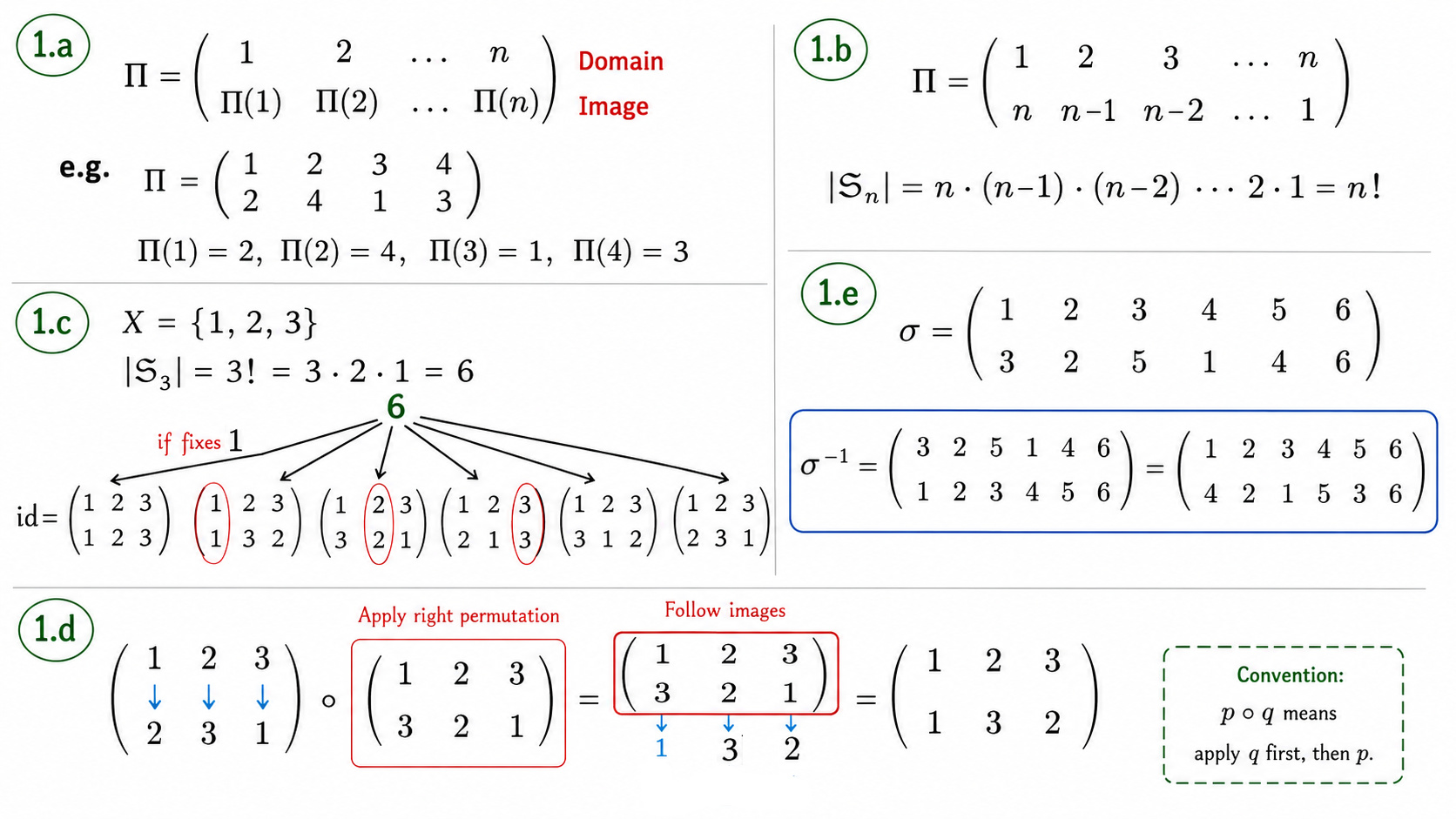
Proof (Figure 1.b):
Without loss of generality, let $X = \{1, 2, \dots, n\}$. Because $X$ is finite, the Pigeonhole Principle guarantees that a function $\sigma: X \to X$ is bijective if and only if it is injective.
Let’s rewrite the situation in pigeonhole language.
- The elements of the domain $X$ are the pigeons.
- The elements of the codomain $X$ are the holes.
- The function $\sigma: X \to X$ tells us which pigeon goes into which hole.
Now suppose $∣X∣ = n$. Injective means no two pigeons share a hole. If $\sigma$ is injective, then distinct elements of the domain have distinct images. In pigeonhole language, no two pigeons are allowed in the same hole.
We have $n$ pigeons, $n$ holes, and no sharing allowed. Can any hole remain empty?
Definitely no, because if one hole were empty, then the $n$ pigeons would have to fit into only $n-1$ holes.
But the Pigeonhole Principle states that $n$ pigeons cannot be placed into $n-1$ holes without some hole containing at least two pigeons, and that would violate injectivity. Therefore every hole must be occupied and “every hole is occupied” is exactly surjectivity.
In mathematics, the pigeonhole principle states that if n items are put into m containers, with $n \gt m$, then at least one container must contain more than one item.
To construct an injection $\sigma$:
- $\sigma(1)$ can be sent to any of the $n$ elements in $X$.
- $\sigma(2)$ can be sent to any of the remaining $n-1$ elements (excluding $\sigma(1)$).
- $\sigma(3)$ can be sent to any of the remaining $n-2$ elements (excluding $\sigma(1)$ and $\sigma(2)$).
- Continuing this process down to $\sigma(n)$, which has $1$ remaining choice, the Fundamental Counting Principle gives precisely $n(n-1)(n-2)\cdots 1 = n!$ distinct permutations. $\blacksquare$
The Fundamental Counting Principle states that if a process consists of several independent stages, and the first stage can be done in $a$ ways, the second stage in $b$ ways, the third stage in $c$ ways, then the whole process can be done in $a \cdot b \cdot c$ ways.
Example. Let $X = \{1, 2, 3\}, |S_X| = 6$ (Figure 1.c.)
Two-Line Notation, Composition, and Inverses
A convenient way to represent a permutation on a finite set is Cauchy’s two-line notation (Figure 1.a.), where the top row lists the inputs and the bottom row lists their corresponding outputs:
$\sigma = \begin{pmatrix} 1 & 2 & 3 & 4 & 5 & 6 \\ 3 & 2 & 5 & 1 & 4 & 6 \end{pmatrix}$
This means $\sigma(1)=3$, $\sigma(2)=2$, $\sigma(3)=5$, $\sigma(4)=1$, $\sigma(5)=4$, and $\sigma(6)=6$.
Composing Permutations
Because permutations are functions, we compose them from right to left: $(\sigma\eta)(x) = \sigma(\eta(x))$. Indeed, we can compose any two permutations since they have the same domain as codomain, and this composite will itself be a permutation,
For example, let: $\sigma = \begin{pmatrix} 1 & 2 & 3 & 4 \\ 2 & 3 & 4 & 1 \end{pmatrix}, \quad \eta = \begin{pmatrix} 1 & 2 & 3 & 4 \\ 1 & 3 & 4 & 2 \end{pmatrix}$
To compute $\sigma\eta$, we apply $\eta$ first and then $\sigma$:
- $1 \xrightarrow{\eta} 1 \xrightarrow{\sigma} 2$
- $2 \xrightarrow{\eta} 3 \xrightarrow{\sigma} 4$
- $3 \xrightarrow{\eta} 4 \xrightarrow{\sigma} 1$
- $4 \xrightarrow{\eta} 2 \xrightarrow{\sigma} 3$
Thus, $\sigma\eta = \begin{pmatrix} 1 & 2 & 3 & 4 \\ 2 & 4 & 1 & 3 \end{pmatrix}$ (Figure 1.d.).
Finding Inverses
Permutations always have inverses since they are bijective. To find $\sigma^{-1}$ in two-line notation, simply swap the top and bottom rows (reversing the arrows) and then sort the columns so the top row is back in numerical order: $\sigma = \begin{pmatrix} 1 & 2 & 3 & 4 & 5 & 6 \\ 3 & 2 & 5 & 1 & 4 & 6 \end{pmatrix} \implies \sigma^{-1} = \begin{pmatrix} 3 & 2 & 5 & 1 & 4 & 6 \\ 1 & 2 & 3 & 4 & 5 & 6 \end{pmatrix} = \begin{pmatrix} 1 & 2 & 3 & 4 & 5 & 6 \\ 4 & 2 & 1 & 5 & 3 & 6 \end{pmatrix}$ (Figure 1.e.).
Why $S_n$ is the Universal Prototype
If two arbitrary sets $A$ and $B$ have the same cardinality ($\vert{}A\vert{} = \vert{}B\vert{}$), then $S_A \cong S_B$.
The algebraic structure of $S_A$ depends only on the size of $A$, not on what the elements are named. In other words, it is not concerned with the elements themselves. It is about the pattern of how elements are rearranged.
Proof:
Since $\vert{}A\vert{} = \vert{}B\vert{}$, there exists a bijection $f: A \to B$ (a “relabeling” dictionary). Define the map $\phi: S_A \to S_B$ by conjugation: $\phi(\sigma) = f \circ \sigma \circ f^{-1}$
Let’s try to understand why $\phi(\sigma) = f \circ \sigma \circ f^{-1}$? Let $\sigma: a \mapsto b,\quad b\mapsto c,\quad c\mapsto a.$ What should the corresponding permutation of $B$ be?
We can think of $f$ as a relabeling dictionary, e.g., $f(a)=1,\quad f(b)=2,\quad f(c)=3.$ Let’s see what happens to 1.
- Convert $1$ back to an element of $A$. Since $f(a)=1, f^{-1}(1) = a.$
- Apply the original permutation $\sigma, a \mapsto b.$
- Translate back to $B, f(b)=2.$
Therefore $1\mapsto 2$. Doing the same: $2\mapsto 3,\qquad 3\mapsto 1.$ Thus, the corresponding permutation of $B$ is $(123)$.
Why $f \circ \sigma \circ f^{-1}$? The previous computation is exactly $1 \overset{f^{-1}}{\longmapsto} a \overset{\sigma}{\longmapsto} b \overset{f}{\longmapsto} 2.$ So the new permutation must be $f \circ \sigma \circ f^{-1}.$ There is really no other natural choice.
Equivalently, $\sigma' = \phi(\sigma)$ is the unique permutation of $B$ satisfying $\sigma'(f(a)) = f(\sigma(a))$ for all $a \in A$.
- Homomorphism: For any $\sigma, \tau \in S_A$: $\phi(\sigma \circ \tau) = f \circ (\sigma \circ \tau) \circ f^{-1} = (f \circ \sigma \circ f^{-1}) \circ (f \circ \tau \circ f^{-1}) = \phi(\sigma) \circ \phi(\tau)$
- Bijective: The map $\psi: S_B \to S_A$ defined by $\psi(\tau) = f^{-1} \circ \tau \circ f$ is a two-sided inverse to $\phi$ (since $\phi(\psi(\tau)) = f \circ f^{-1} \circ \tau \circ f \circ f^{-1} = \tau$, and similarly $\psi(\phi(\sigma)) = \sigma$).
$\phi(\psi(\tau)) = f(f^{-1}τf)f^{-1}$. Using associativity of composition: $ = (ff^{-1}) \, \tau \,(ff^{-1}).$
Since $f$ is a bijection, $ff^{-1}=\mathrm{id}_B.$ Thus, $= \mathrm{id}_B\circ\tau\circ\mathrm{id}_B = \tau.$
Thus, $\phi$ is an isomorphism, and $S_A \cong S_B$. $\blacksquare$
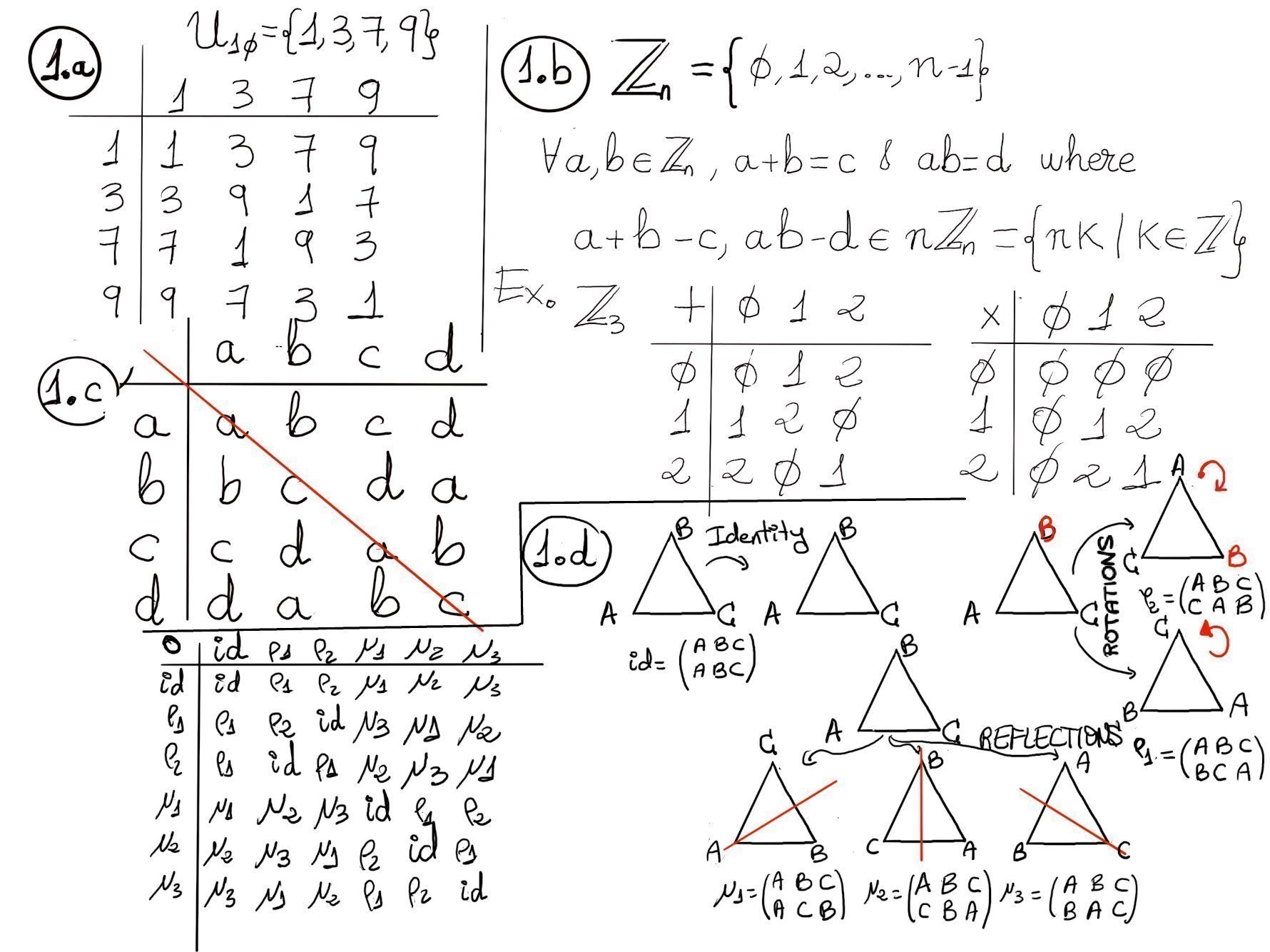
Example ($S_3 \cong D_3$): Because any $3$-element set $\{A, B, C\}$ can be relabeled as $\{1, 2, 3\}$, $S_3$ is isomorphic to the Dihedral group $D_3$ of symmetries of an equilateral triangle: $\begin{aligned} \text{id} &= \begin{pmatrix} 1 & 2 & 3 \\ 1 & 2 & 3 \end{pmatrix}, & \rho_1 &= \begin{pmatrix} 1 & 2 & 3 \\ 2 & 3 & 1 \end{pmatrix}, & \rho_2 = \rho_1^2 &= \begin{pmatrix} 1 & 2 & 3 \\ 3 & 1 & 2 \end{pmatrix} \\ \mu_1 &= \begin{pmatrix} 1 & 2 & 3 \\ 1 & 3 & 2 \end{pmatrix}, & \mu_2 = \rho_1\mu_1 &= \begin{pmatrix} 1 & 2 & 3 \\ 2 & 1 & 3 \end{pmatrix}, & \mu_3 = \rho_1^2\mu_1 &= \begin{pmatrix} 1 & 2 & 3 \\ 3 & 2 & 1 \end{pmatrix} \end{aligned}$
Notice that $\mu_1 \rho_1 = \begin{pmatrix} 1 & 2 & 3 \\ 3 & 2 & 1 \end{pmatrix} = \rho_1^2 \mu_1 \neq \rho_1 \mu_1$, proving that $S_3$ is non-Abelian (in fact, $S_n$ is non-Abelian for all $n \ge 3$). We can use the relation $\mu_1 \rho_1 = \rho_1^2 \mu_1$ to simplify products algebraically: $\mu_1 \rho_1^2 = (\mu_1 \rho_1)\rho_1 = (\rho_1^2 \mu_1)\rho_1 = \rho_1^2(\mu_1 \rho_1) = \rho_1^2(\rho_1^2 \mu_1) = \rho_1^4 \mu_1 = \rho_1 \mu_1$
Definition. A cycle is a permutation which maps a finite set {a1, a2, …, an} by a1 → a2 → … → an → a1, that is, it maps some elements (some subset of elements) to each other in a cyclic fashion, while fixing all others.
More generally, we say that a permutation σ ∈ SX is a cycle of length k if ∃a1, a2, ... ak ∈ X such that a1 → a2 → ... → ak → a1 and it fixes all other elements of X, and it is denoted or written as σ = (a1a2...ak)
A cycle of length 2 is called a transposition. A transposition is a permutation that swaps two elements and leaves everything else fixed. Two cycles are disjoint if they have no common elements between them.
Examples:
- δ1 = (1, 3) or sometimes written as (13) is the transposition that swaps 1 and 3 and leaves everything else fixed.
- μ1 = (12)(34) and ρ1 = (1234). Therefore, μ1ρ1 = (12)(34)(1234) = (1)(24)(3) = (24) - For convenience’s sake, we do not write cycles of length one.- = δ2.
- σ = $(\begin{smallmatrix}1 & 2 & 3 & 4 & 5 & 6\\\ 2 & 3 & 6 & 4 & 1 & 5\end{smallmatrix})=(12365)$ is a cycle of length 5 where the element 4 is fixed.
- σ = $(\begin{smallmatrix}1 & 2 & 3 & 4 & 5\\\ 2 & 1 & 3 & 5 & 4\end{smallmatrix})=(12)(3)(45), τ =(\begin{smallmatrix}1 & 2 & 3 & 4 & 5\\\ 5 & 4 & 1 & 2 & 3\end{smallmatrix})=(153)(24), στ = (12)(3)(45)(153)(24) = (14)(253)$
Properties of Permutations
Theorem. Every permutation on a finite set can be decomposed, expressed or written as a product of disjoint cycles, that is, no element is moved by both of them, e.g. (135) and (24) are disjoint cycles.
Proof. Let’s induct on the number of elements in the set A.
Case base. Let’s prove the result for a set with just one element. This is trivial, there is only one permutation, the identity, and it is the cycle {a}.
Suppose that a permutation on a set with less than n elements set can be written as a product of disjoint cycles. Let’s take a permutation on a set with n element, that is, σ ∈Sn.
Let m be the order of σ, a1 ∈ A and consider the set Q = {a1, σ(a1), σ2(a1),… σm-1(a1)} being constructed as follows, a2 = σ(a1), a3 = σ(σ(a1)) = σ(a2), and so on, until we arrive at a1 = σm(a1) for some m. We know that m exists because the sequence a1, σ(a1), σ2(a1) must be finite since A is finite.
If Q = A, σ is the cycle and we are done. Otherwise, |A - Q| < n, and by the induction assumption, the permutation σ on A - Q can be written as a product of disjoint cycles, say η1η2…ηk.
And therefore the permutation σ on the whole set A can be written as a product of disjoint cycles, more specifically, as (a1 σ(a1) σ2(a1)… σm-1(a1))η1η2…ηk ∎
Examples:
-
σ = $(\begin{smallmatrix}1 & 2 & 3 & 4 & 5 & 6 & 7\\\ 7 & 6 & 3 & 1 & 2 & 5 & 4\end{smallmatrix})=(174)(265)$ is a product of two disjoint 3-cycles.
-
σ = (16527348), τ = (152468)(37), στ = (16527348)(152468)(37) = (1286)(457).
Disjoint Cycles Commute. If two cycles move different sets of elements, then their effects are independent and it does not matter in which order they’re applied. More formally, If two pair of cycles σ and η are disjoint, i.e, they do no have entries in common, then ση=ησ.
Proof. Suppose σ and η are disjoint cycles, σ = {a1, a2,…, am} and η = {b1, b2,…, bn}, and {a1, a2,…, am} ∩ {b1, b2,…, bn} = ∅. Let A = {a1, a2,…, am, b1, b2,…, bn, c1, c2,…, cs} where the c’s are the elements left fixed by both σ and η.
Then, ση(i) = ησ(i) ∀i∈A because (ση)(ai) = σ(η(ai)) =[η fixes all ai, 1 ≤ i ≤ m] σ(ai)= ai+1 where am+1=a1. (ησ)(ai) = η(σ(ai)) = η(ai+1) =[η fixes all ai, 1 ≤ i ≤ m] ai+1
A similar argument shows that (ση)(bi) = (ησ)(bi).
Finally, (ση)(ci) = σ(η(ci)) = σ(ci) = ci. (ησ)(ci) = η(σ(ci)) = η(ci) = ci∎
Order of a permutation. The order of a permutation of a finite set A written in disjoint cycle form or representation is the least common multiple of the lengths of the cycles.
Proof:
-
Case 1. Let |A| = n. If α is a permutation on A and can be represented as a cycle of length n, then it has order n. Therefore, the order of α is equal to the length of its cycle, i.e., |α| = n, and the result holds for this particular case.
-
Case 2. Let us now suppose that α can be expressed as a product of two disjoint cycles, say α = α1α2 where α1 and α2 are disjoint cycles of lengths t1 and t2 respectively. |α| = t. We need to show that t = lcm (t1, t2).
Recall: lcm(t1, t2) = k ⇒ k = t1s1 = t2s2.
αk = (α1α2)k = [∴ disjoint cycles commute] α1kα2k = α1t1s1α2t2s2 = (α1t1)s1(α2t2)s2 = [A cycle of length n has order n] ee = e ⇒ |α| = t divides k = lcm(t1, t2).
Let αt = (α1α2)t = [∴ disjoint cycles commute] α1tα2t = e ⇒ α1t = α2-t. However, α1 and α2 are disjoint, they share no common symbol ⇒ α1t and α2-t share not common symbol either. If these two cycles are both equal and yet, they share no symbol, it follows that they are both the identity because every symbol that no appears in a permutation is fixed by it, so every symbol in α1t is fixed by α2-t and vice-versa.
Therefore, both t1 and t2 must divide t ⇒ lcm(t1, t2) divides t, too. Then, t = lcm(t1, t2) ∎
- The general case is quite similar. α = α1α2…αr where α1, α2,… αr are disjoint cycles of lengths m1, m2,…. and mr respectively. |α| = t. We need to show that t = lcm (m1, m2,… mr).
lcm (m1, m2,… mr) = k ⇒ k = m1s1 = m2s2 = … = mrsr
αk = (α1α2…αr)k = [∴ disjoint cycles commute] α1kα2k…αrk = α1m1s1α2m2s2…αrmrsr = (α1m1)s1(α2m2)s2…(αrmr)sr= ee…e = e ⇒ |α| = t divides lcm(m1, m2, … mr).
Let αt = (α1α2…αr)t = [∴ disjoint cycles commute] α1tα2t…αrt = e. For the same reasons of two disjoint cycles (that is, α1t does not share any symbols with α2t, α3t …, and αrt, and every symbol that no appears in α2t, …, αrt is fixed by these cycles ⇒ α1t is the identity), α1t = α2t = … = αrt = e ⇒ m1, m2,… mr divide t ⇒ lcm(m1, m2, … mr) divides t ⇒ t = lcm(m1, m2, … mr)∎
Examples:
- α = (123)(456) ⇒ |α| = lcm(3, 3) = 3.
- α = (12)(345) ⇒ |α| = lcm(2, 3) = 6.
- α = (12345) ⇒ |α| = 5.
- α = (1234)(567)(89) ⇒ |α| = lcm(4, 3, 2) = 12.
- α = (45)(237) ⇒ |α|=lcm(2, 3) = 6.
- α = $(\begin{smallmatrix}1 & 2 & 3 & 4 & 5 & 6 & 7 & 8\\\ 5 & 8 & 3 & 6 & 7 & 4 & 1 & 2\end{smallmatrix})$ = (157)(28)(46) ⇒ |α|=lcm(3, 2, 2) = 6.
- Let’s calculate |α1000| where α = (138)(27)(4965) ⇒ |α| = lcm(3, 2, 4) = 12 ⇒ α1000 = α1000 mod 12 = α4 ⇒ |α1000| = |α4| = [Theorem. Let a be an arbitrary element of order n in a group G, and let k be a positive integer. Then, ⟨ak⟩=⟨agcd(n,k)⟩ and |⟨ak⟩| = $\frac{n}{gcd(n,k)}$] = $\frac{12}{gcd(12, 4)} = \frac{12}{4} = 3$
Definition. A transposition is a permutation which interchanges or swaps two elements and leaves everything else fixed. In other words, a transposition is a cycle of length 2, e.g., (2, 3) is the transposition that swaps 2 and 3 and leaves everything else fixed.
Bibliography
- NPTEL-NOC IITM, Introduction to Galois Theory.
- Algebra, Second Edition, by Michael Artin.
- LibreTexts, Calculus. Abstract and Geometric Algebra, Abstract Algebra: Theory and Applications (Judson).
- Field and Galois Theory, by Patrick Morandi. Springer.
- Michael Penn, Andrew Misseldine, and MathMajor, YouTube’s channels.
- Contemporary Abstract Algebra, Joseph, A. Gallian.
- MIT OpenCourseWare, 18.01 Single Variable Calculus, Fall 2007 and 18.02 Multivariable Calculus, Fall 2007, YouTube.
- Calculus Early Transcendentals: Differential & Multi-Variable Calculus for Social Sciences.
