


Groups III. Symmetries. Group Actions.
To raise new questions, new possibilities, to regard old problems from a new angle, requires creative imagination and marks real advance in science, Albert Einstein.
Forcing Commutativity and Constructing Cayley Tables
In abstract algebra, the structure of a group is highly rigid. The four axioms (Closure, Associativity, Identity, and Inverses) are so deeply intertwined that imposing a seemingly small restriction on the elements can force the entire group to behave in a highly specific way.
Below, we explore how specific algebraic rules force a group to be Abelian (commutative), and how we can map out the entire structure of finite groups using Cayley Tables.
Forcing a Group to be Abelian
A group $G$ is Abelian if for every $a, b \in G$, the operation commutes: $ab = ba$. Let’s look at two famous theorems where exponent rules force commutativity.
Proposition: Suppose $G$ is a group. If $(ab)^2 = a^2b^2$ for all $a, b \in G$, then $G$ is an Abelian group.
Proof:
By definition, $(ab)^2 = (ab)(ab)$.
By the premise of the proposition, $(ab)^2 = a^2b^2 = (aa)(bb)$.
Therefore, we can set them equal to each other: $(ab)(ab) = (aa)(bb)$
By the associative property, we can regroup the terms: $a(ba)b = a(ab)b$
To isolate the middle terms, we apply the cancellation laws. First, multiply by $a^{-1}$ on the left: $(a^{-1}a)(ba)b = (a^{-1}a)(ab)b \implies (ba)b = (ab)b$. Next, multiply by $b^{-1}$ on the right: $(ba)(bb^{-1}) = (ab)(bb^{-1}) \implies ba = ab$. Since $ab = ba$ for all elements, the group is Abelian. $\blacksquare$
Proposition 2: If every non-identity element of a group $G$ has an order of exactly 2, then $G$ is Abelian.
Proof:
If an element $x \in G$ has an order of 2, it means $x^2 = e$.
Notice that this implies $x = x^{-1}$ (every element is its own inverse). Note: The identity element also satisfies $e^2 = e$, so $x^2 = e$ holds for absolutely every element in the group.
Let $a, b \in G$. Because the group is closed, the product $ab$ is also an element in $G$.
Therefore, by our premise, $(ab)^2 = e$, which means $ab = (ab)^{-1}$. We now apply the “Shoes and Socks” principle for the inverse of a product ($(xy)^{-1} = y^{-1}x^{-1}$): $ab = (ab)^{-1} = b^{-1}a^{-1}$. Because every element is its own inverse, we substitute $b^{-1} = b$ and $a^{-1} = a$: $ab = ba$. The group is Abelian. $\blacksquare$
Cayley Tables: The Geometry of Finite Groups
For finite groups, we can perfectly map out the entire algebraic structure using a grid called a Cayley Table (named after British mathematician Arthur Cayley).
A Cayley table arranges all possible products of the group’s elements in a square grid. Let $G = \{a_1, a_2, \dots, a_n\}$. The element in the $i$-th row and $j$-th column is the product $a_i \cdot a_j$.
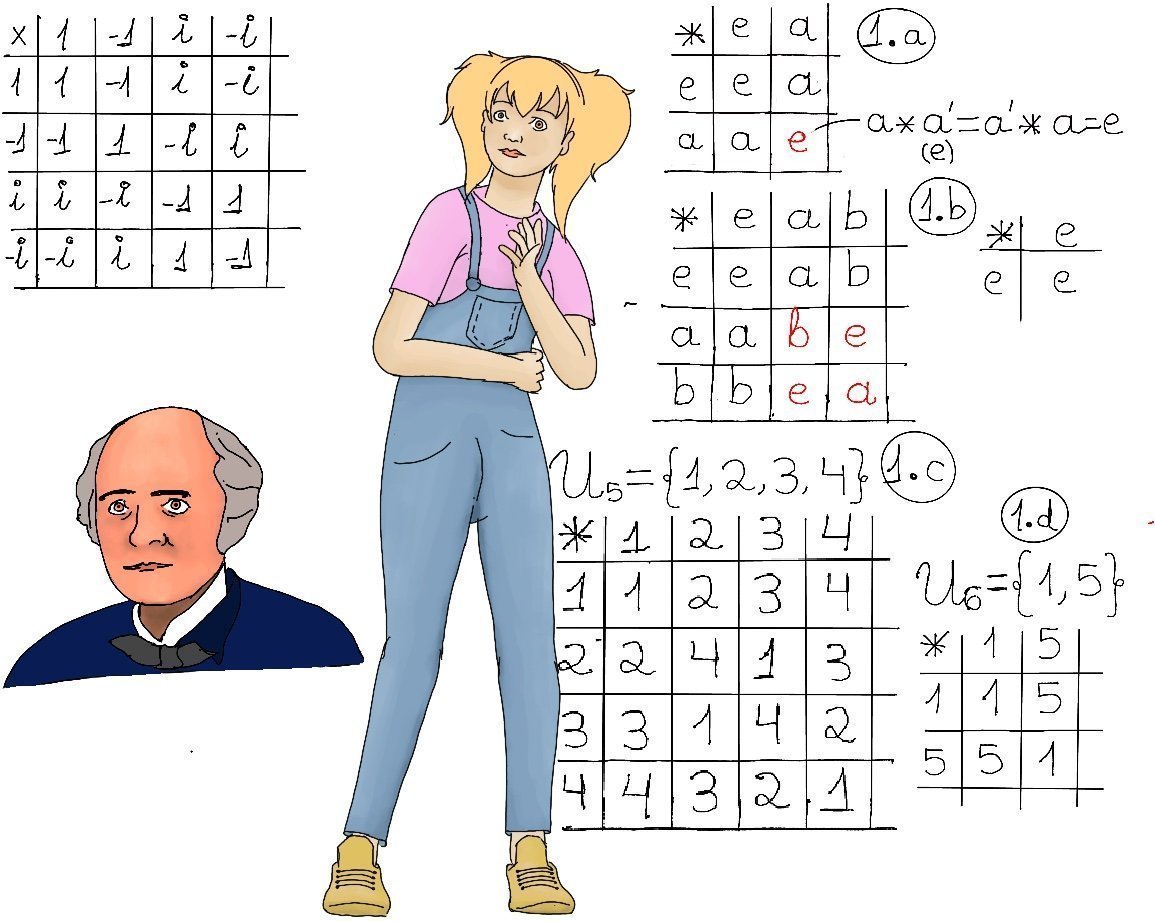
Example: Let $G = \{1, -1, i, -i\}$ under standard complex multiplication.
| $\times$ | $1$ | $-1$ | $i$ | $-i$ |
|---|---|---|---|---|
| $1$ | $1$ | $-1$ | $i$ | $-i$ |
| $-1$ | $-1$ | $1$ | $-i$ | $i$ |
| $i$ | $i$ | $-i$ | $-1$ | $1$ |
| $-i$ | $-i$ | $i$ | $1$ | $-1$ |
The Rules of the Grid
By analyzing Cayley tables, we can instantly visually verify the axioms of a group.
- The Identity Row/Column: Because the identity element $e$ does nothing, the row and column corresponding to $e$ will always perfectly match the header row and column.
- Finding Inverses: Every row and every column must contain the identity element $e$ exactly once. The intersection that produces $e$ tells you which two elements are inverses of each other (e.g., $i \times -i = 1$).
- The Sudoku Property (Latin Square): There are never duplicate elements in any row or column. Proof: Suppose a row for element $a$ contains a duplicate, meaning $a \cdot x = a \cdot y$ for some $x \neq y$. By left-cancellation (multiplying by $a^{-1}$), we get $x = y$, which is a contradiction ($\bot$). Because there are $n$ elements in the group, and no duplicates are allowed, every element must appear exactly once in every row and column.
- Commutativity as Symmetry: A group is Abelian (commutative) if and only if the table is perfectly symmetric across the main diagonal (top-left to bottom-right). If you fold the table in half along the diagonal, the overlapping elements will match.
Constructing Small Finite Groups
Using the Sudoku property and the group axioms, we can deduce the exact structure of small finite groups from scratch.
Note: Two groups are isomorphic if they have the exact same structure, just with different names for the elements. Up to isomorphism, there is only one way to build groups of orders 1, 2, and 3.
Order 0. It is simply not possible, a minimal set that might give rise to a group needs to contain, at the very least, the identity by definition.
Order 1 ($\vert{}G\vert{} = 1$): A group must contain an identity element. If it only has one element, it must be $G = \{e\}$, and the only possible operation is $e \cdot e = e$. This is the Trivial Group (Figure 1.b).
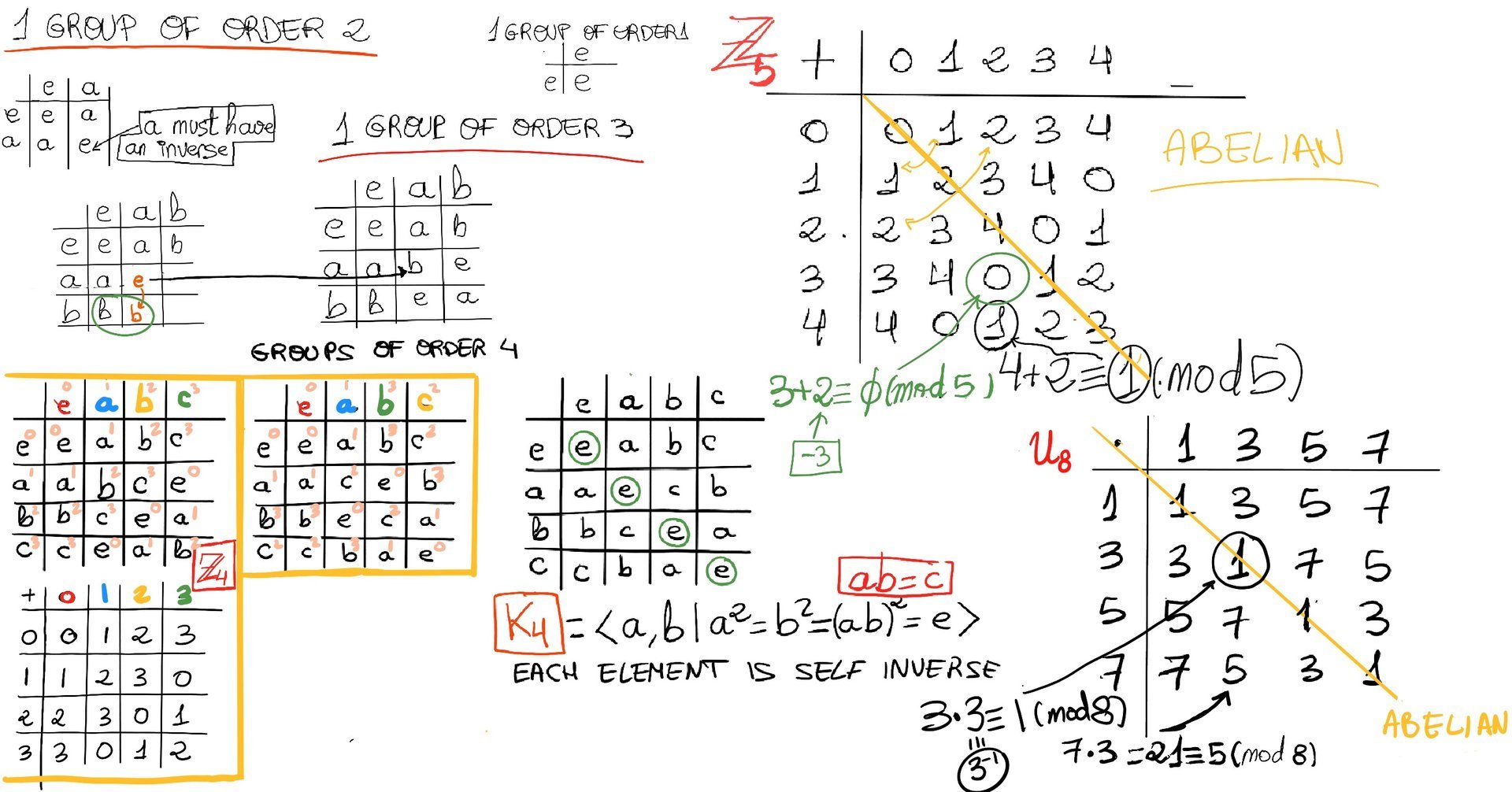
Order 2 ($\vert{}G\vert{} = 2$): Let $G = \{e, a\}$. Because of the Sudoku property, $e$ and $a$ must appear exactly once in each row and column.
| $*$ | $e$ | $a$ |
|---|---|---|
| $e$ | $e$ | $a$ |
| $a$ | $a$ | $e$ |
The element $a$ is forced to be its own inverse ($a \cdot a = e$). This group is perfectly isomorphic to $\mathbb{Z}_2$ under addition modulo 2 (evens and odds).
Order 3 ($\vert{}G\vert{} = 3$): Let $G = \{e, a, b\}$. The identity row and column are filled automatically.
| $*$ | $e$ | $a$ | $b$ |
|---|---|---|---|
| $e$ | $e$ | $a$ | $b$ |
| $a$ | $a$ | ? | ? |
| $b$ | $b$ | ? | ? |
Look at the row for $a$. The missing elements are $e$ and $b$. Could $a \cdot a = e$? If $a \cdot a = e$, then by the Sudoku property, $a \cdot b$ must equal $b$. But we already have a $b$ in that column (from $e \cdot b = b$)! This would cause a duplicate in the column, which is illegal. Therefore, it is mathematically forced that $a \cdot a = b$. The rest of the table fills itself out immediately by the Sudoku property:
| $*$ | $e$ | $a$ | $b$ |
|---|---|---|---|
| $e$ | $e$ | $a$ | $b$ |
| $a$ | $a$ | $b$ | $e$ |
| $b$ | $b$ | $e$ | $a$ |
This group is isomorphic to $\mathbb{Z}_3$ (addition modulo 3).
Order 4 ($\vert{}G\vert{} = 4$): When we reach 4 elements, the absolute rigidity breaks slightly. There are exactly two valid ways to complete a Latin Square that satisfies associativity for 4 elements. Up to isomorphism, there are exactly two groups of order 4:
- The Cyclic Group ($\mathbb{Z}_4$): Clock arithmetic modulo 4. It has one element of order 2, and two elements of order 4.
- The Klein 4-Group ($V_4$): The symmetry group of a non-square rectangle (horizontal flip, vertical flip, $180^\circ$ rotation). In this group, every non-identity element has an order of exactly 2. And, as we have already proved in Proposition 2, this forces the group to be Abelian.
Group Actions: The Mathematical Language of Symmetry
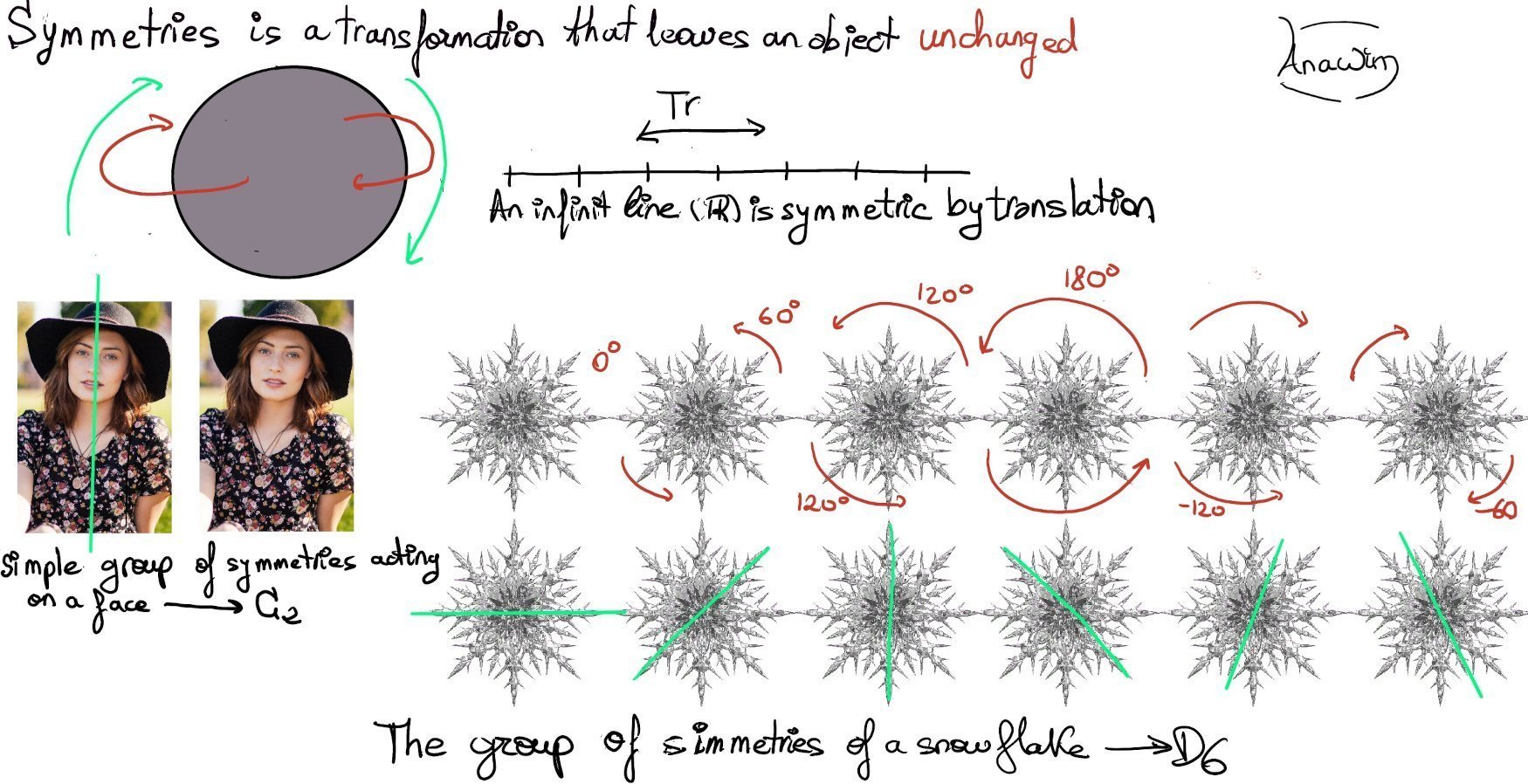
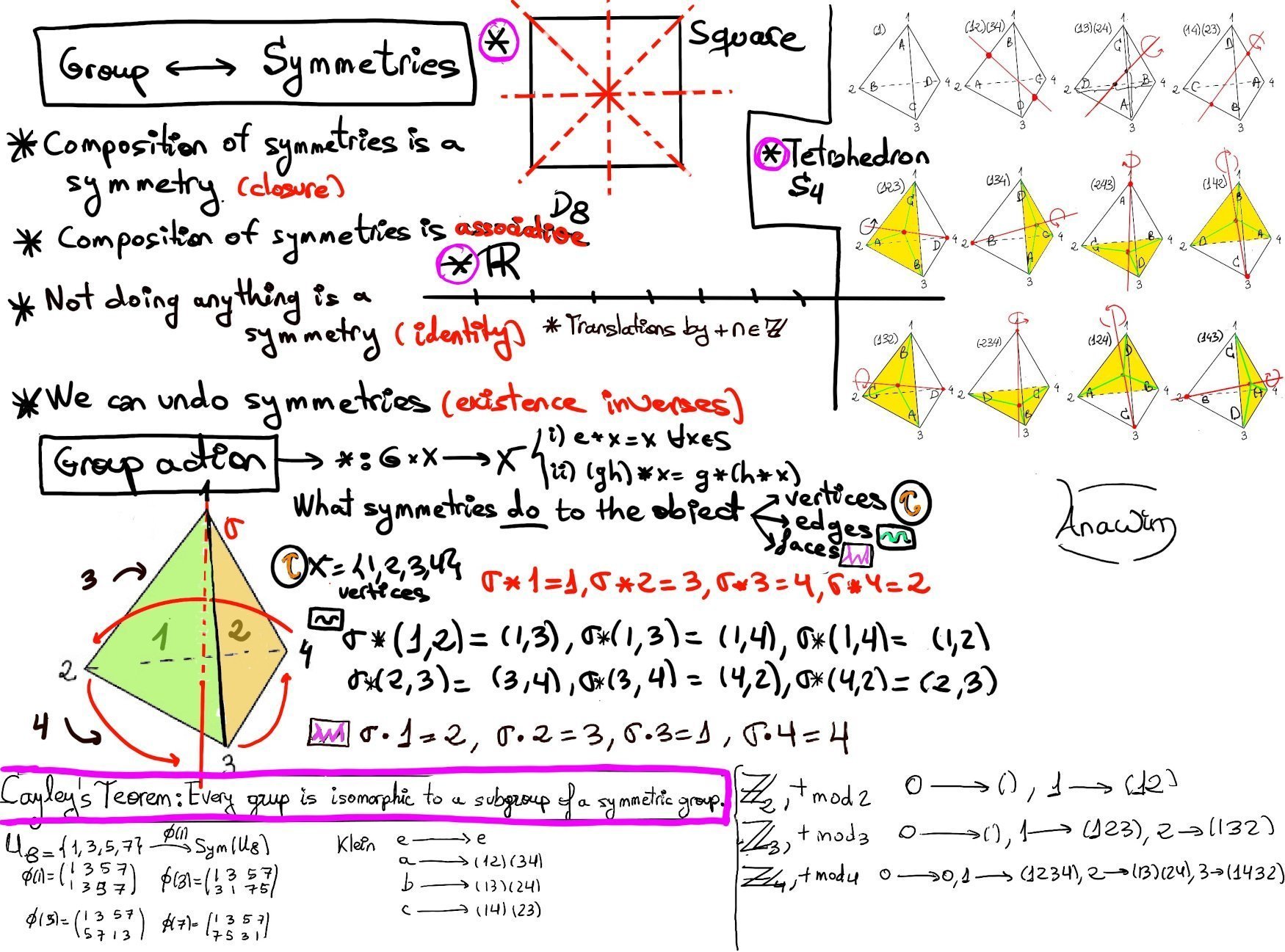
On its own, a Group is merely a static collection of algebraic rules (Closure, Associativity, Identity, and Inverses). However, the true power of Group Theory emerges when we take a group and “deploy” it to physically manipulate elements of another set. This is called a Group Action.
Group theory is the mathematical language of symmetry. When a group acts on a set, we can think of the group elements as active physical transformations (like rotations or reflections) that shift the elements of the set around.
A Motivating Example: The Tetrahedron
Consider the symmetries of a regular tetrahedron (a 3D pyramid with 4 triangular faces). Let $G$ be the group of all valid 3D rotations of the tetrahedron. We can choose to let this group act on different physical components of the shape.
Let $\sigma \in G$ be a $120^\circ$ rotation around the vertical axis passing through the top vertex (Vertex 1) and the center of the bottom face.
- Acting on Vertices: Let $X_V = \{1, 2, 3, 4\}$ be the set of vertices. Because the axis passes through Vertex 1, it remains stationary. The other three vertices on the base cycle around. $\sigma \cdot 1 = 1, \quad \sigma \cdot 2 = 3, \quad \sigma \cdot 3 = 4, \quad \sigma \cdot 4 = 2$
- Acting on Edges: Let $X_E = \{(1,2), (1,3), (1,4), (2,3), (3,4), (4,2)\}$ be the set of 6 edges. The same rotation shifts the edges: $\sigma \cdot (1,2) = (1,3), \quad \sigma \cdot (2,3) = (3,4), \quad \dots$
- Acting on Faces: Let $X_F = \{1, 2, 3, 4\}$ represent the 4 faces. The bottom face (Face 4) remains stationary, while the three side faces cycle. $\sigma \cdot 4 = 4, \quad \sigma \cdot 1 = 2, \quad \sigma \cdot 2 = 3, \quad \sigma \cdot 3 = 1$
Notice that a single abstract group element ($\sigma$) can perform wildly different actions depending on what set it is acting upon!
The Formal Definition of a Group Action
Definition: A group action of a group $G$ on a set $A$ is a function from $G \times A \to A$ (usually denoted by $g \cdot a$ or simply $ga$) that satisfies two strict axioms:
- Compatibility: $g_1 \cdot (g_2 \cdot a) = (g_1 g_2) \cdot a$ for all $g_1, g_2 \in G$ and $a \in A$. Doing $g_2$ then $g_1$ must yield the exact same result as doing the combined group operation $g_1 g_2$ once.
- Identity: $e \cdot a = a$ for all $a \in A$. The identity element of the group must leave every element of the set completely untouched.
Proposition. Let the group G act on a set A. For each fixed element of G, say g ∈ G, we get a permutation σg: A → A defined by σg(a) = g·a. Besides, the map from Φ: G → SA defined by g → σg is a homomorphism. It is called the permutation representation associated to the given action.
Proof. We know that the map f: A → B is a bijection if and only if there exists g: B → A, the inverse of f, such that f∘g is the identity map on B and g∘f is the identity map on A.
∀g ∈ G, ∃g-1, we claim that σg-1 is the inverse of σ.
(σg-1∘σg)(a) = [By definition of function composition] σg-1(σg(a)) = σg-1(g·a) = g-1·(g·a) = [By property 1 of a group action] (g-1g)·a = e·a = [By property 2 of a group action] a
Since g was chosen arbitrary, we may interchange the roles of g and g-1 ⇒ σg is a permutation of A.
is the map Φ: G → SA a homomorphism? We have already proved that σg ∈ SA.
Φ(g1g2) = Φ(g1)∘Φ(g2)?
∀a ∈ A, Φ(g1g2)(a) = σg1g2(a) = (g1g2)·a = [By property 1 of an action] g1·(g2·a) = σg1(σg2(a)) = (Φ(g1)∘Φ(g2))(a)
Basically, a group action just means that every element g in G acts as a permutation on A in a way that is consistent with the group operation in G. Let Φ: G → SA be any homomorphism from a group G to the symmetric group on a set, then the map from G x A to A defined by ∀g ∈ G, a ∈ A, g·a = Φ(g)(a) is a group action of G on A, and therefore actions on a group and homomorphisms from this group into the symmetric group SA are basically the same construct or, more formally, in bijective correspondence.
Examples:
- Let G be a group, A a non empty set, the trivial action is defined as g·a = a ∀g ∈ G, a ∈ A. Observe that distinct elements of the group G induce the same permutation, that is, the identity permutation. The associated permutation representation Φ: G → SA is the trivial homomorphism. It maps every element g ∈ G to the identity permutation.
Definition. If G acts on a set A and distinct elements of G induce distinct permutations of A, that is, when g1 ≠ g2 in G, there is an a ∈ A such that g1·a ≠ g2·a, the action is called faithful. The kernel of the action of G on A is {g ∈ G | ga = a ∀a ∈ A}
-
The symmetric group (G =) SA acting on A, SA x A → A, by σ·a = σ(a) ∀σ ∈ SA, a ∈ A. The associated permutation representation Φ: SA → SA is the identity map.
-
We can make ℝn act on itself by translations, for v ∈ ℝn, let Tv: ℝn → ℝn, defined by Tv(w) = w + v. The axioms for a group action are: T0(w) = w and Tv1(Tv2(w)) = Tv1+v2(w). These are true properties of vector addition: w + 0 = w, (w + v2) + v1 = w + (v1 + v2).
-
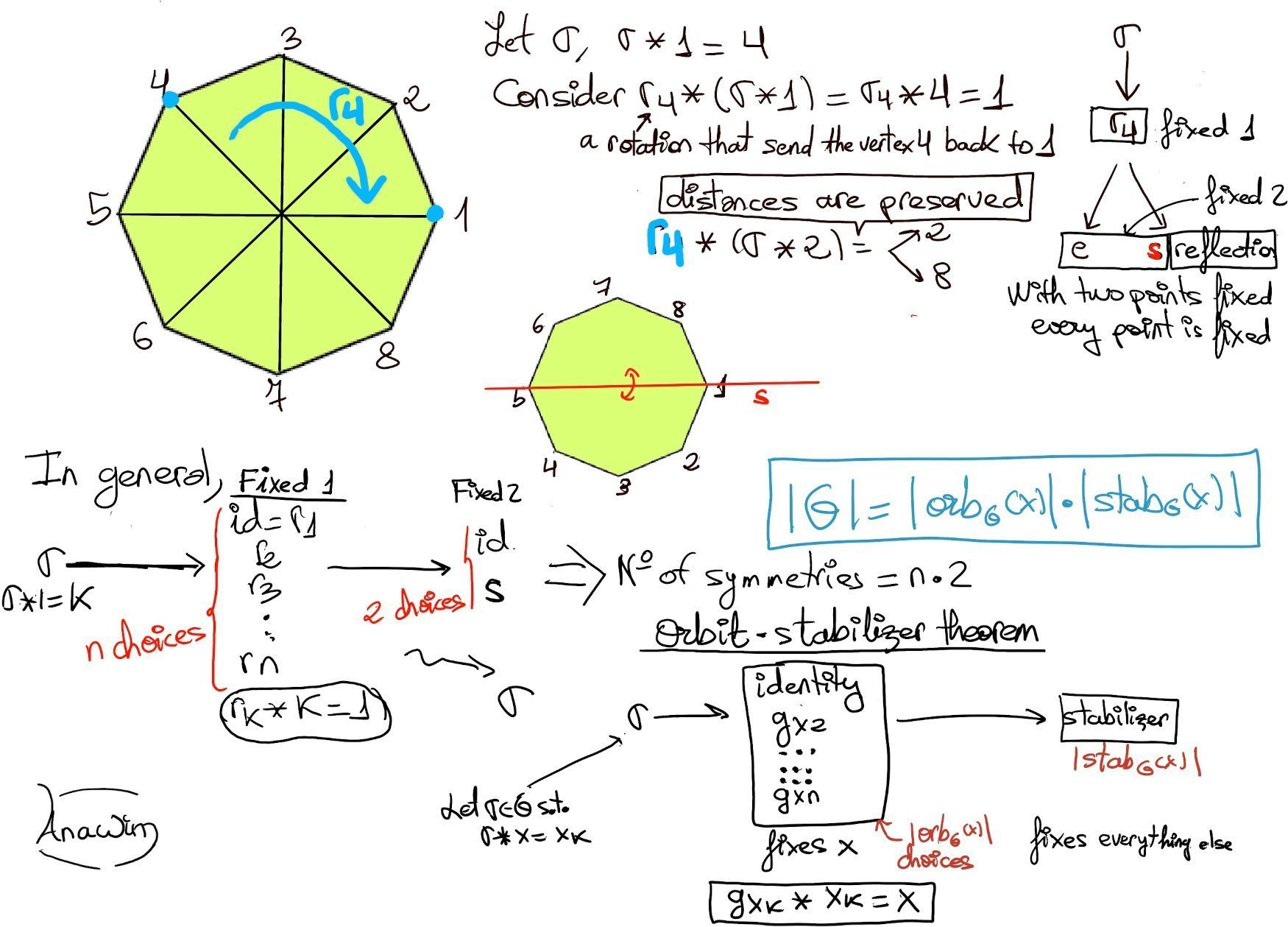
For n ≥ 3, Dn acts on a regular n-gon as rigid motions. We can also view Dn as acting just on the n vertices of a regular n-gon. This does not lose any information at all, since knowing where each and every vertex go under a rigid motion determines completely where everything else goes. By focusing on the action of Dn on the n vertices, and labelling them by 1, 2, ···, n, we make Dn act on {1, 2, ···, n} (See the previous illustration).
-
We can make G act on itself by left multiplication. We let A = G and g·a = ga is merely the usual product of g and a in G.
-
Let G = ℤ/4ℤ act on itself by additions. For instance, addition by 1 has the effect 0 → 1 → 2 → 3 → 0. Addition by 1 on ℤ/4ℤ is a 4-cycle (0123). Addition by 2 has the effect 0 → 2 → 4, 1 → 3, it is a product of two 2-cycles, (02)(13). The composition of these two permutations is (0123)(02)(13) = (0321) which is the permutation of G described by addition by 3.
Bibliography
- NPTEL-NOC IITM, Introduction to Galois Theory.
- Algebra, Second Edition, by Michael Artin.
- LibreTexts, Calculus. Abstract and Geometric Algebra, Abstract Algebra: Theory and Applications (Judson).
- Field and Galois Theory, by Patrick Morandi. Springer.
- Michael Penn, Andrew Misseldine, and MathMajor, YouTube’s channels.
- Contemporary Abstract Algebra, Joseph, A. Gallian.
- MIT OpenCourseWare, 18.01 Single Variable Calculus, Fall 2007 and 18.02 Multivariable Calculus, Fall 2007, YouTube.
- Calculus Early Transcendentals: Differential & Multi-Variable Calculus for Social Sciences.
