


Cyclic Groups and Generators: The Clockwork of Algebra
I am scared because we have caveman instincts and emotions, medieval institutions, modern global oligarchy, narratives and fake news spreading like wildfire, tech giants censorship and bias, and the technology of gods, and it is terrifying, Anawim, justtothepoint.com.

Introduction
Some groups are highly complex, requiring multiple different rules and components to describe their behavior. Other groups are beautifully simple, running like a perfectly predictable clock.
If you can build an entire group by taking just one single element and repeatedly applying the group operation to it, you have found a Cyclic Group.
Generating a Subgroup
Before we define a cyclic group, we must understand how a single element can generate a subgroup.
Definition: Let $G$ be a group and let $a \in G$. The cyclic subgroup generated by $a$, denoted $\langle a \rangle$, is the set of all possible integer powers of $a$. $\langle a \rangle = \{a^n \mid n \in \mathbb{Z}\}$
Additive Notation: If the group operation is addition, “powers” of $a$ become “multiples” of $a$. The definition becomes $\langle a \rangle = \{na \mid n \in \mathbb{Z}\}$.
Proposition: $\langle a \rangle$ is always a valid subgroup of $G$. Furthermore, it is strictly the smallest possible subgroup of $G$ that contains the element $a$.
Proof:
To prove it is a subgroup, we use the Two-Step Subgroup Test:
-
Identity: By definition of zero exponents, $a^0 = e$, so the identity element is in $\langle a \rangle$.
-
Closure: Let $x, y \in \langle a \rangle$. This means $x = a^m$ and $y = a^n$ for some integers $m, n \in \mathbb{Z}$. Their product is $xy = a^m a^n = a^{m+n}$. Because the sum of two integers is obviously an integer, $a^{m+n} \in \langle a \rangle$.
-
Inverses: Let $x = a^m \in \langle a \rangle$. Its inverse is $x^{-1} = a^{-m}$. Because $-m \in \mathbb{Z}$, the inverse belongs to $\langle a \rangle$.
Note: We’re comfortable with $a^2 = a \cdot a$, where $\cdot$ is the group operation. The next step is understanding what negative powers mean. For a group $G$, every element $a$ has an inverse $a^{-1}$ satisfying $a \cdot a^{-1} = e$ where $e$ is the identity. Once $a^{-1}$ exists, we define: $a^{-2}=(a^{-1})^2 = a^{-1} \cdot a^{-1}$, $a^{-3}=(a^{-1})^3 = a^{-1} \cdot a^{-1} \cdot a^{-1}$, and in general $a^{-m}=(a^{-1})^m.$
Why is it the smallest? Any valid subgroup $H \le G$ that contains the element $a$ must, by the absolute laws of closure and inverses, contain $a \cdot a = a^2$, $a^3$, $a^{-1}$, and so on. Therefore, $H$ is forced to contain the entire set $\langle a \rangle$. You can formally define $\langle a \rangle$ as the intersection of all subgroups in $G$ that contain $a$. $\blacksquare$
Note: We can extend this to multiple generators. The subgroup $\langle g_1, g_2, \dots, g_r \rangle$ is the set of all possible finite products of these elements and their inverses. It is the smallest subgroup containing all of them.
Examples of Generated Subgroups
- In the Integers $(\mathbb{Z}, +)$: Since the operation on $\mathbb Z$ is addition, the cyclic subgroup generated by $n$ is $\langle n\rangle= \{kn \mid k \in \mathbb Z\} = \{\ldots,-2n,-n,0,n,2n,\ldots\}.$
This set is often denoted $n\mathbb Z= \{rn \mid r \in \mathbb Z\}.$ Hence, $\boxed{\langle n\rangle=n\mathbb Z.}$
Why is $\langle n\rangle=\langle -n\rangle$? Because $\langle -n\rangle = \{r(-n) \mid r \in \mathbb Z\} = \{-rn \mid r \in \mathbb Z\}.$ But as $r$ ranges over all integers, so does $−r$. Therefore, $\{-rn \mid r \in \mathbb Z\} = \{sn \mid s \in \mathbb Z\}$.
Two particular examples are: $\langle 2 \rangle = \{\dots, -4, -2, 0, 2, 4, 6, \dots\} = 2\mathbb{Z}$ and $\langle 3 \rangle = \{\dots, -6, -3, 0, 3, 6, 9, \dots\} = 3\mathbb{Z}$
- In the Rationals $(\mathbb{Q}^\times, \cdot)$: $\langle 2 \rangle = \{\dots, \frac{1}{4}, \frac{1}{2}, 1, 2, 4, 8, \dots\}$
Consider $(\mathbb{Q}^{\times},\cdot)$, the multiplicative group of nonzero rational numbers. Let $H = \{2^n \mid n \in \mathbb Z\} =\{\ldots, \tfrac14, \tfrac12, 1, 2, 4, 8, \ldots \}.$ Then, $H$ is the cyclic subgroup generated by $2$: $H = \langle 2\rangle \le \mathbb Q^\times.$
Proof. Let $a, b \in H$. Then there exist $m, n \in \mathbb Z$ such that $a=2^m, \qquad b=2^n$. Therefore, $ab^{-1} = 2^m(2^n)^{-1} = 2^m 2^{-n} =2^{m-n}.$
Since $m-n \in \mathbb Z$, we have $2^{m-n}\in H$. Hence $ab^{-1} \in H, \forall a, b \in H$, so by the subgroup test $H \le \mathbb Q^\times.$
The reason this subgroup is called cyclic is that every element is obtained from a single generator $2$: $\langle 2\rangle = \{2^n\mid n\in\mathbb Z\}.$
Notice how negative powers are essential: $2^{-1} = \frac12,\qquad 2^{-2} = \frac14, \qquad 2^{-3} = \frac18.$ Without allowing negative exponents, $H$ would not contain inverses and would fail to be a subgroup of $Q^\times$.
Also observe that $\langle 2\rangle = \langle \tfrac12\rangle,$ just as in $(\mathbb Z,+)$ we have $\langle n \rangle = \langle -n \rangle$.
- In Modulo Arithmetic $(\mathbb{Z}_6, +)$: $\langle 2 \rangle = \{0, 2, 4\}$ and $\langle 3 \rangle = \{0, 3\}$.
Defining a Cyclic Group
Definition: A group $G$ is called cyclic if there exists at least one element $a \in G$ that generates the entire group. That is, $G = \langle a \rangle$.
We call the element $a$ a generator of the group.
The order of an element $a$, denoted $\vert{}a\vert{}$, is the number of elements inside the subgroup it generates ($\vert{}\langle a \rangle\vert{}$). Equivalently, $|a| = \min \{n \in \mathbb N \mid a^n=e \},$ if such a positive integer $n$ exists. If no such $n$ exists, then $a$ has infinite order and we write $|a| = \infty.$
Why are these definitions equivalent?
Suppose the smallest positive integer with $a^n = e$ is $n$. Then, $a^{n+k} = a^n a^k = ea^k =a^k,$ so the powers begin to repeat every $n$ steps: $e,\ a,\ a^2,\ \ldots,\ a^{n-1},\ a^n=e,\ a^{n+1} = a, \ldots$
Hence $\langle a\rangle = \{e,a,a^2,\ldots,a^{n-1}\}$ contains exactly $n$ distinct elements. Therefore, $|\langle a\rangle| = n.$ This shows that the size of the generated subgroup equals the smallest positive exponent producing the identity.
If $∣a∣ = n$, then $\langle a\rangle = \{e,a,a^2,\ldots,a^{n-1}\},$ and exponents are computed modulo $n$: $a^i = a^j \quad \Longleftrightarrow \quad i \equiv j \pmod n.$
The Ultimate Structure of Cyclic Groups
Cyclic groups are incredibly rigid. Up to isomorphism (structural renaming), there are only two types of cyclic groups in the entire mathematical universe:
- Infinite Cyclic Groups: Every infinite cyclic group is structurally identical to the integers under addition, $(\mathbb{Z}, +)$. In $\mathbb{Z}$, the only generators are $1$ and $-1$, because every integer can be written uniquely as $n \cdot 1$ or $(-n) \cdot (-1)$.
- Finite Cyclic Groups: Every finite cyclic group of order $n$ is structurally identical to clock arithmetic, $(\mathbb{Z}_n, +)$.
Generators of $\mathbb{Z}_n$
In $\mathbb{Z}_n$, the element $1$ is always a generator. But it is rarely the only one.
For example, in $\mathbb{Z}_5 = \{0, 1, 2, 3, 4\}$, let’s look at the element $2$: $\langle 2 \rangle = \{0, 2, 4, 1, 3\} = \mathbb{Z}_5$. The element $2$ is also a generator!
Theorem: An element $p \in \mathbb{Z}_n$ is a generator of $\mathbb{Z}_n$ if and only if $p$ is coprime to $n$, meaning $\gcd(p, n) = 1$.
Proof:
Suppose $\gcd(p, n) = 1$. By Bézout’s Identity (the Extended Euclidean Algorithm), there must exist integers $a$ and $b$ such that: $ap + bn = 1$.
In the world of modulo $n$ arithmetic, any multiple of $n$ becomes zero. Therefore, this equation reduces to: $ap \equiv 1 \pmod n$.
This means that if we add $p$ to itself $a$ times, we reach the element $1$. Therefore, $1 \in \langle p \rangle$. Because the subgroup $\langle p \rangle$ contains $1$, and $1$ generates the entire group $\mathbb{Z}_n$, it forces $\langle p \rangle$ to be the entire group. Thus, $p$ is a generator. $\blacksquare$
- The subgroup structure of $\mathbb Z_6$. Recall that $\mathbb Z_6 = \mathbb Z/6\mathbb Z = \{0, 1, 2, 3, 4, 5 \}$ under addition modulo $6$.
$\langle 0\rangle=\{0\}, \langle 1\rangle = \mathbb Z_6, \langle 5\rangle = \mathbb Z_6$, since $5 \equiv -1 \pmod 6$
Indeed, $\langle 5\rangle = \langle -1\rangle.$ Now repeated addition of $-1$ gives $0, \, -1, \, -2, \, -3, \, -4, \, -5$ which modulo $6$ becomes $0, 5, 4, 3, 2, 1$. So every element of $\mathbb Z_6$ appears, proving $\langle 5 \rangle = \mathbb Z_6.$
$\langle 2 \rangle = \{0, 2, 4\}, \langle 4 \rangle = \{0, 4, 2 \}$, and $\langle 3 \rangle = \{0, 3 \}$.
Thus, the proper nontrivial subgroups are $\{0,2,4\} \quad\text{and}\quad \{0,3\}.$
Indeed, $2\mathbb Z_6 = \{0, 2, 4\} = \langle 2 \rangle = \langle 4 \rangle \le \mathbb Z_6.$
Notice the orders: $|0|=1, \qquad |3| = 2,\qquad |2| = |4| = 3,\qquad |1| = |5| = 6.$ Each order divides $6$.
- Rotations in the dihedral group $D_n$. Let $D_n = \langle r, s \mid r^n=1,\ s^2=1,\ sr=r^{-1}s \rangle.$
The rotations are $H = \{1, r, r^2, \ldots, r^{n-1}\}.$ Since every element of $H$ is a power of $r$, $H = \langle r\rangle$.
Therefore, $H$ is cyclic and $∣H∣ = n$. In fact, $H$ is a normal subgroup of $D_n$ of index $2$, since $|D_n| = 2n.$
Geometrically, $r$ is the rotation by $2\pi/n$, and every rotation is obtained by repeatedly applying $r$.
- Why does every nonzero element generate $\mathbb Z_5$? $\mathbb Z_5 = \langle 1 \rangle = \langle 2 \rangle = \langle 3 \rangle = \langle 4 \rangle.$
Let’s check one example: $\langle 2 \rangle = \{0, 2, 4, 6, 8\} = \{0, 2, 4, 1, 3\} = \mathbb Z_5.$ Similarly, $\langle 3 \rangle = \{0, 3, 6, 9, 12 \} = \{0, 3, 1, 4, 2\} = \mathbb Z_5.$
The underlying reason is that $\gcd(k, 5) = 1, \forall k \in \mathbb Z_5, k \ne 0$.
The Group of Units $U(n)$
The multiplicative group of integers modulo $n$ that are coprime to $n$, denoted $U(n)$ or $\mathbb{Z}_n^*$, is often (but not always) cyclic.
-
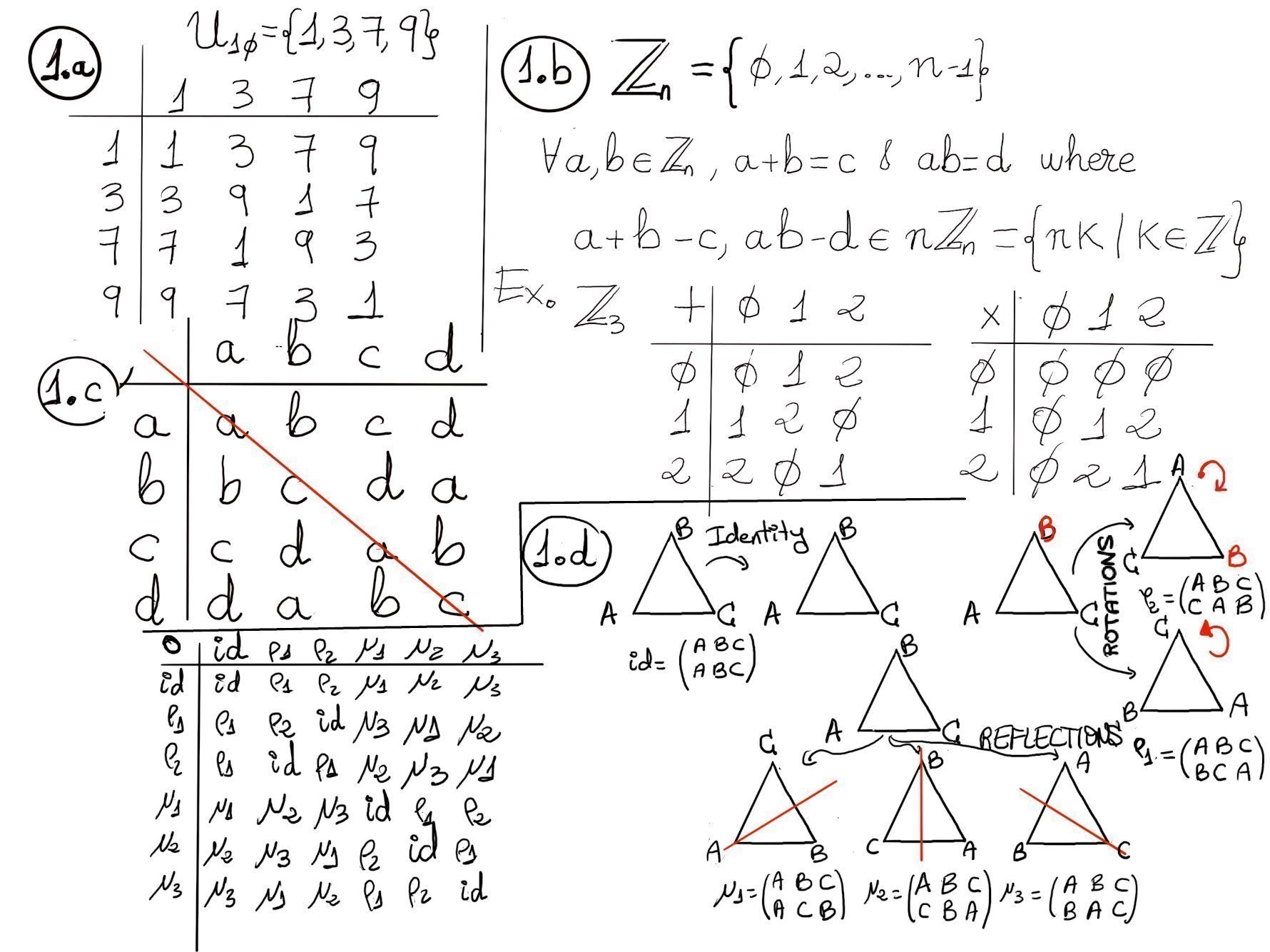
$U(10) = \{1, 3, 7, 9\}$. Because $3^1 \equiv 3, 3^2 \equiv 9, 3^3 \equiv 7, 3^4 \equiv 1 \pmod{10}$, the element 3 generates the whole group! Thus, $U(10) = \langle 3 \rangle = \langle 7 \rangle$.
-
$U(9) = \{1, 2, 4, 5, 7, 8\}$. This is a cyclic group of order 6, generated by $2$.
When Groups Are Not Cyclic
Not every group is a cyclic group. If a finite group lacks an element whose order matches the size of the group, it cannot be cyclic.
Counterexample 1: $U(8)$
The group $U(8) = \{1, 3, 5, 7\}$. The order of the group is 4. Let’s check the order of every element:
- $3^2 \equiv 9 \equiv 1 \pmod 8$
- $5^2 \equiv 25 \equiv 1 \pmod 8$
- $7^2 \equiv 49 \equiv 1 \pmod 8$
Every single non-identity element has an order of 2! Because no element has an order of 4, no element can generate the entire group. Therefore, $U(8)$ is not cyclic. It is indeed structurally identical to the Klein 4-Group.
Counterexample 2: The Dihedral Group $D_3$
The symmetry group of an equilateral triangle, $D_3$, contains 6 elements: the identity $e$, two rotations $\{r, r^2\}$, and three reflections $\{s_1, s_2, s_3\}$.
- The rotations only generate subgroups of order 3: $\langle r \rangle = \{e, r, r^2\}$.
- The reflections only generate subgroups of order 2: $\langle s_1 \rangle = \{e, s_1\}$.
Because no single element has an order of 6, $D_3$ is not cyclic. You need at least two elements (a rotation and a reflection) to generate the entire group.
Subgroup Lattices
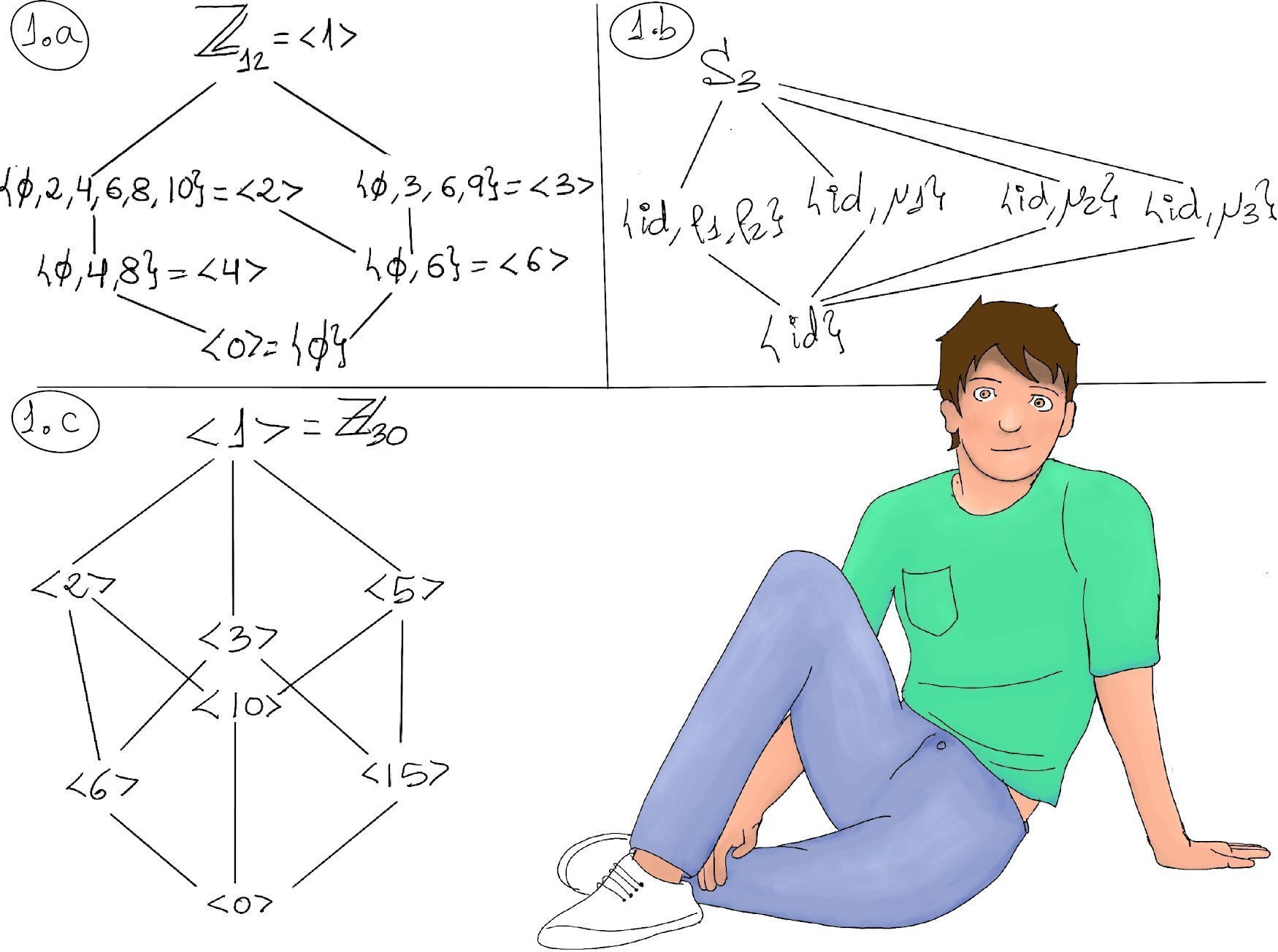
To visualize the internal structure of a group, mathematicians use a Subgroup Lattice (or Hasse Diagram).
This is a graph where:
- The nodes are the subgroups of $G$.
- The full group $G$ is at the absolute top, and the trivial identity subgroup $\{e\}$ is at the absolute bottom.
- An edge (line) is drawn upward from subgroup $H$ to subgroup $K$ if $H \le K$ and there are no intermediate subgroups between them (meaning $H \le L \le K$ is impossible), typically drawn in a clear, hierarchical layout (aka an eye-pleasing fashion).
Bibliography
- NPTEL-NOC IITM, Introduction to Galois Theory.
- Algebra, Second Edition, by Michael Artin.
- LibreTexts, Abstract and Geometric Algebra, Abstract Algebra: Theory and Applications (Judson).
- Field and Galois Theory, by Patrick Morandi. Springer.
- Michael Penn (Abstract Algebra), and MathMajor.
- Contemporary Abstract Algebra, Joseph, A. Gallian.
- Andrew Misseldine: College Algebra and Abstract Algebra.
