
|
 |

|
|
|
|
|
|
Remember that obvious does not mean right, perfect is enemy of good, gray is the color of truth, there are always two sides to a story, love hurts, there is no success without pain and sacrifice, and the truth will set you free, but first it will piss you off and more often than not reality sucks, Apocalypse, Anawim, #justtothepoint.
💍 A ring R is a non-empty set with two binary operations, addition (a + b) and multiplication (ab), such that ∀ a, b, c ∈ R:
Let R be a ring and let A ⊆ R be a subring. In a ring, cosets are always respect to addition, r ∈ R, r + A = {r + a | a ∈ A}.
Notice that since (R, +) is an Abelian group, if A is a subgroup under addition ⇒ A is an Abelian subgroup under addition, and therefore, A is a normal subgroup of R, i.e., A ◁ R and we can form a quotient group (R/A, +). The quotient group is an Abelian group with respect to addition.
What condition do we need to satisfy on the subring A so that R/A = {r + A | r ∈ R} is a ring?
Basically, given a, b ∈ R, we need (a + A)(b + A) = ab + A to be well defined, that is, this operation does not depend on the chosen representatives.
Let a + S = c + S and b + S = d + S, (a + S)(b + S) = ab + S = cd + S or equivalently ab -cd ∈ S?
a + S = c + S ⇒ a -c ∈ S ⇒ ∃s1 ∈ S, a - c = s1 ⇒ a = c + s1. Similarly, ∃s2 ∈ S, b = d + s2.
ab = (c + s1)(d + s2) = cd + cs2 +s1d + s1s2 ⇒ ab -cd = cs2 +s1d + s1s2. So we need ab -cd ∈ S ↭ cs2 +s1d + s1s2 ∈ S ↭[s1s2 ∈ S, S is a subring] cs2, s1d ∈ S. This is called the absorption property.
A subring A of a ring R is a left ideal of R if it absorbs multiplication from the left from R, that is, ∀r ∈ R, ∀a ∈ A, ra ∈ A.
A subring A of a ring R is a right ideal of R if it absorbs multiplication from the right from R, that is, ∀r ∈ R, ∀a ∈ A, ar ∈ A.
A subring A of a ring R is called a (two-sided) ideal of R if it absorbs multiplication from the left and right from R, that is, ∀r ∈ R, a ∈ A, ra ∈ A and ar ∈ A. In other words, ∀r ∈ R, rA = {ra | a ∈ A} ⊆ A and Ar = {ar | a ∈ A} ⊆ A.
Let A ⊂ R, A ≠ R, R be a ring, A is an ideal of R if the following conditions are satisfied:
Let R be a commutative ring with unity. A principal ideal is an ideal generated by a single element a of R through multiplication by every element of R, ⟨a⟩ = Ra = {ra | r ∈ R} = {ar | r ∈ R}., e.g., ⟨x⟩ = ⟨x, x2⟩ is a principal ideal of ℤ[x], but ⟨x, 3⟩ is not.
Proof. ⟨a⟩ is an ideal.
∀i ∈ ⟨a⟩ ⇒ ∃r’ ∈ R such that i = r’a. ∀r ∈ R, ir = (r’a)r = [R is a commutative ring] (ar’)r = a(r’r) ∈ ⟨a⟩.
Remark. If R is non-commutative or does not contain 1, the situation is most complicated, the closest concept would be $\bigcap_{I~ ideal, a ∈ I} I$.
Suppose m ∈ ℤ, a ∈ nℤ ⇒ ∃a’ ∈ ℤ: a = na’ ⇒ ma = m(na’) = n(ma’) ∈ nℤ ∎
Therefore, the principal ideals in ℤ are of the form ⟨n⟩ = nℤ.
Take f(x) ∈ ℤ[x], g(x) ∈ I, deg(f(x)·g(x)) = deg(f(x)) + deg(g(x)) ≥ deg(g(x)) ≥ 2 ⇒ deg(f(x) + g(x)) ≥ 2 ⇒ f(x) + g(x) ∈ I ∎
For R = ℤ, the ideal ⟨4, 6⟩ = {4a + 6b | a, b ∈ ℤ} = {2a | a ∈ ℤ} = ⟨2⟩
It’s not an ideal because it’s not true that ri ∈ I for every r ∈ R and i ∈ S. Consider $r(x) = \begin{cases} 1, &x ∈ ℚ \\\ -1, &x ∉ ℚ \end{cases}$ and i = ex, $ri(x) = \begin{cases} e^x, &x ∈ ℚ \\\ -e^x, &x ∉ ℚ \end{cases}$ is not differentiable. In fact it’s not even continuous ⇒ ri ∉ I ⇒ I is not an ideal of R. However, it’s a subring since it’s nonempty and the product and difference of differentiable functions are differentiable functions, too.
Proposition. Suppose R is a commutative ring with unity. ⟨a⟩ = R ↭ a ∈ R is a unit.
Proof:
⇒) Suppose that ⟨a⟩ = R ⇒[By assumption, R is a commutative ring with unity] 1 ∈ ⟨a⟩ ⇒ ∃r∈R: ar = 1 ⇒ a is a unit (it has a multiplicative inverse, namely r).
⇐) Suppose a ∈ R is a unit ⇒ ∃r∈R: ar = 1 ⇒ 1 ∈ ⟨a⟩ ⇒ ∀b ∈ R, b = b·1 ∈ ⟨a⟩ ⇒ R = ⟨a⟩.
Corollary. The only ideals of a field F are the zero ideal and the unit ideal.
Proof.
Let I be an ideal of F. If I is the zero ideal, we are done.
Suppose I is a non-zero ideal of F ⇒ ∃a ∈ I, a ≠ 0 (the zero identity -addition- of F) ⇒[F is field and in a field, all non-zero elements are units] a is a unit ⇒[Proposition. Suppose R is a commutative ring with unity. ⟨a⟩ = R ↭ a ∈ R is a unit.] I = F, i.e., I is the unit ideal.
Proposition. Every ideal of ℤ is a principal ideal.
Proof: Suppose that I ⊆ ℤ is an ideal of ℤ.
Let R be a ring and let I be an ideal of R. In particular, R is an Abelian group under addition, and I is a normal subgroup of R, I ◁ R, therefore we could form the factor group R/I = {r + I | r ∈ R}.
As in the groups case the cosets partition the ring into disjoint subsets. The element r is called the coset representative of the coset. Besides, r1 and r2 represent the same coset ↭ r1 - r2 ∈ I. The ideal I itself is a coset, 0 + I.
Theorem. Let R be a ring and let I be a subring of R. The set of cosets R/I = {r + I | r ∈ R} is a ring under the operations (s + I) + (t + I) = (s + t) + I and (s + I)(t + I) = st + I iff I is an ideal of R.
Proof.
⇐) We only need to check that these operations are well-defined. Suppose that I is an ideal.
Let’s suppose s + I = s’ + I, t + I = t’ + I ⇒[s - s’ ∈ I, t - t’ ∈ I] s = s’ + a, t = t’ + a’, where a, a’ ∈ I.
(s - s’) + (t - t’) = (s + t) - (s’ + t’) ∈ I (I is closed under addition and s - s’ ∈ I, t - t’ ∈ I) ⇒[aH = bH ↭ a-1b ∈H ↭Additive notation a-b ∈ H] (s + t) + I = (s’ + t’) + I.
st + I = (s’+a)(t’ + a’) + I = s’t’ + at’ + s’a’ + aa’ + I =[I is an ideal, a, a’ ∈ I, and therefore it absorbs at’ + s’a’ + aa’] s’t’ + I , hence st + I = s’t’ + I. We already know that the set of cosets forms a group under addition and it is trivial to prove that the multiplication is associative and distributive over addition.
⇒) Suppose for the sake of contradiction, R/I is a ring and yet I is not an ideal of R ⇒ ∃a ∈ I, r ∈ R: ar ∉ I or ra ∉ I. Without loss of generality, let’s suppose that ar ∉ I, a ∈ I ⇒[a + H = H = 0 + H ↭ a ∈ H] a + I = 0 + I.
(a + I)(r + I) = ar + I, (0 + I)(r + I) = 0r + I = 0 + I = I. Then, ar + I = I ⊥ ar ∉ I, so the multiplication is not well-defined.
(2 + 4ℤ) + (3 + 4ℤ) = 5 + 4ℤ = 1 + 4 + 4ℤ =[aH = H ↭ a ∈ H. In addition notation, a + H = H ↭ a ∈ H] 1 + 4ℤ. (2 + 4ℤ)(3 + 4ℤ) = 6 + 4ℤ = 2 + 4 + 4ℤ = 2 + 4ℤ.
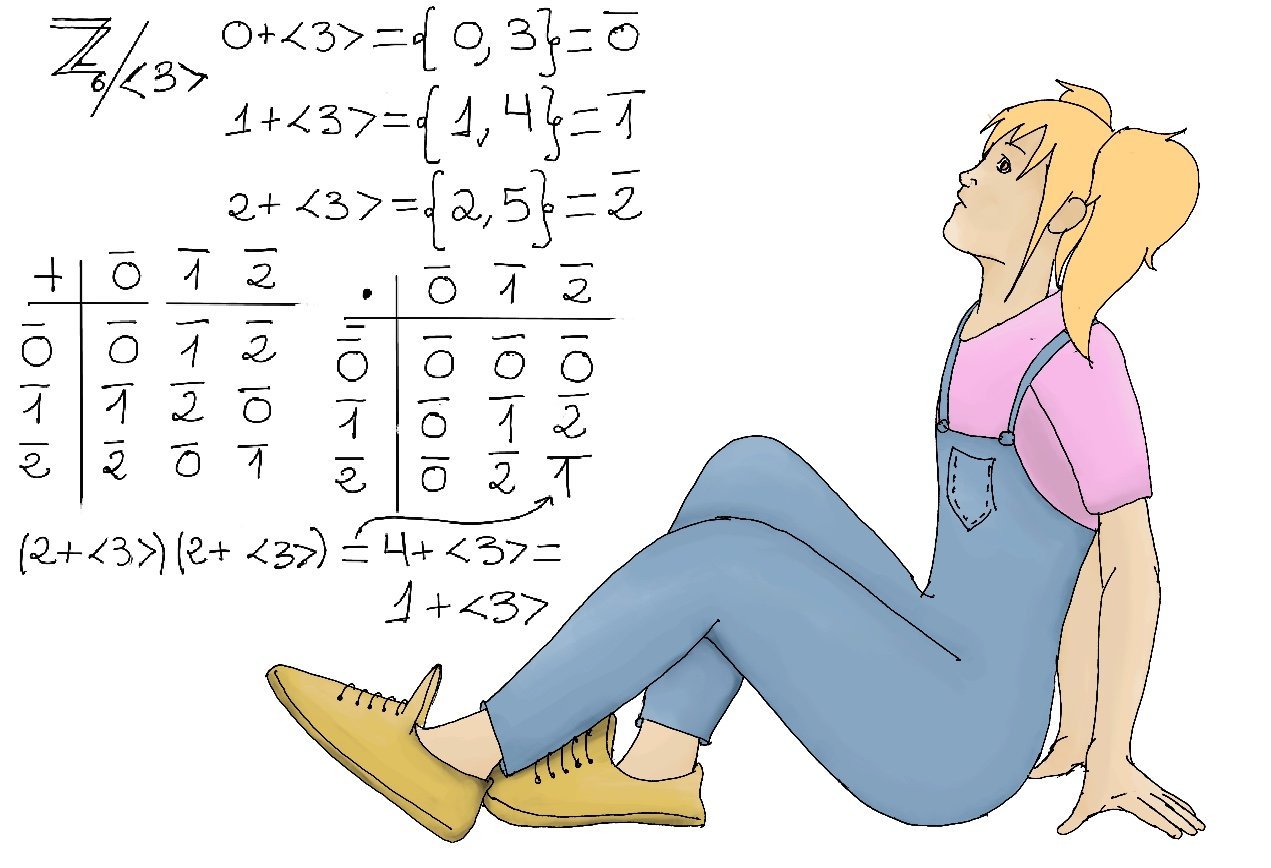
0 + ⟨3⟩ = {0, 3} = [0]
1 + ⟨3⟩ = {1, 4} = [1]
2 + ⟨3⟩ = {2, 5} = [2]
(1 + ⟨3⟩) + (1 + ⟨3⟩) = (1 + 1) + ⟨3⟩ = 2 + ⟨3⟩
(1 + ⟨3⟩)(1 + ⟨3⟩) = (1 · 1) + ⟨3⟩ = 1 + ⟨3⟩
ℤ[x]/I where I = {a2x2 + a3x3+···+anxn| n ≥ 2, ai ∈ ℤ}, e.g., (x4+2x2+4x+2) + I =[x4+2x2 ∈ I] (4x+2) + I. In general, all cosets have the form (ax + b) + I = [Some authors will use another notation] $\overline {ax + b}$. ((ax +b) + I)((cx +d) + I) = (acx2 + (ad + bc)x + bd) + I = [acx2 ∈ I] ((ad + bc)x + bd) + I.
Let R = M2(ℤ) = {$(\begin{smallmatrix}a_1 & a_2\\\ a_3 & a_4\end{smallmatrix})$ | ai ∈ ℤ}, and let I be the subset of R with even entries. I is an ideal of R (it is a similar reasoning behind 2ℤ being an ideal of the ring ℤ).
Subring. Let x, y ∈ I : x = $(\begin{smallmatrix}2a_1 & 2a_2\\\ 2a_3 & 2a_4\end{smallmatrix})$, y = $(\begin{smallmatrix}2b_1 & 2b_2\\\ 2b_3 & 2b_4\end{smallmatrix})$. Then, x - y = $(\begin{smallmatrix}2a_1 & 2a_2\\\ 2a_3 & 2a_4\end{smallmatrix}) - (\begin{smallmatrix}2b_1 & 2b_2\\\ 2b_3 & 2b_4\end{smallmatrix}) = (\begin{smallmatrix}2(a_1-b_1) & 2(a_2-b_2)\\\ 2(a_3-b_3) & 2(a_4-b_4)\end{smallmatrix})$∈ I, x · y = $(\begin{smallmatrix}2a_1 & 2a_2\\\ 2a_3 & 2a_4\end{smallmatrix}) · (\begin{smallmatrix}2b_1 & 2b_2\\\ 2b_3 & 2b_4\end{smallmatrix}) = (\begin{smallmatrix}4(a_1b_1+a_2b_3) & 4(a_1b_2+a_2b_4)\\\ 4(a_3b_1+a_4b_3) & 4(a_3b_2+a_4b_4)\end{smallmatrix})$∈ I.
Absorption. x ∈ I, y ∈ R, xy = $(\begin{smallmatrix}2b_1 & 2b_2\\\ 2b_3 & 2b_4\end{smallmatrix})(\begin{smallmatrix}a_1 & a_2\\\ a_3 & a_4\end{smallmatrix}) = (\begin{smallmatrix}2(b_1a_1 + b_2a_3) & 2(b_1a_2 + b_2a_4)\\\ 2(b_3a_1 + b_4a_3) & 2(b_3a_2 + b_4a_4)\end{smallmatrix})$ ∈ I. Analogously, yx ∈ I (this step is absolutely necessarily given that R is a non-commutative ring), therefore I is indeed an ideal of R.
Futhermore, every member of R can be written in the form $(\begin{smallmatrix}2q_1 +r_1 & 2q_2 + r_2\\\ 2q_3 + r_3 & 2q_4 + r_4\end{smallmatrix})$. Therefore, $(\begin{smallmatrix}2q_1 +r_1 & 2q_2 + r_2\\\ 2q_3 + r_3 & 2q_4 + r_4\end{smallmatrix})+I = (\begin{smallmatrix}r_1 & r_2\\\ r_3 & r_4\end{smallmatrix})+(\begin{smallmatrix}2q_1 & 2q_2\\\ 2q_3 & 2q_4\end{smallmatrix})+I = (\begin{smallmatrix}r_1 & r_2\\\ r_3 & r_4\end{smallmatrix})+ I$ since an ideal absorbs its own elements.
In other words, R/I = {$(\begin{smallmatrix}r_1 & r_2\\\ r_3 & r_4\end{smallmatrix}) + I|r_i∈${0, 1}}, |R/I| = 24 = 16, e.g., $(\begin{smallmatrix}3 & 6\\\ 5 & -3\end{smallmatrix})+I = (\begin{smallmatrix}1 & 0\\\ 1 & 1\end{smallmatrix}) + (\begin{smallmatrix}2 & 6\\\ 4 & -4\end{smallmatrix}) + I = (\begin{smallmatrix}1 & 0\\\ 1 & 1\end{smallmatrix}) + I$ since an ideal absorbs its own elements as it was stated previously.
Proposition. Given a ring R with ideals I, J ⊆ R, I + J = {i + j | i ∈ I, j ∈ J}, IJ = {i1j1 + ··· + injn | ik ∈ I, jk ∈ J, ∀k: 1 ≤ k ≤ n}, I ∩ J, I + J, IJ are all ideals.
Proof.
It is left as an exercise to prove that I ∩ J, I + J, IJ are all subrings.
∀r ∈ R, a ∈ I ∩ J ⇒[a∈ I, a∈ J, I and J ideals] ra ∈ I, ar ∈ I, ra ∈ J, ar ∈ J ⇒ ra ∈ I ∩ J and ar ∈ I ∩ J ⇒ I ∩ J is an ideal of R.
∀r ∈ R, a ∈ I + J ⇒ a = i + j, i ∈ I, j ∈ J ⇒ ra = r(i + j) =[Distributivity] ri + rj ∈ I + J, ri ∈ I, rj ∈ J. Mutatis mutadis, ar ∈ I + J, and hence I + J is an ideal.
∀r ∈ R, a ∈ IJ ⇒ a = i1j1 + ··· + injn, ik ∈ I, jk ∈ J, ∀k: 1 ≤ k ≤ n ⇒ ra = r(i1j1 + ··· + injn) =[Distributivity] r(i1j1) + ··· + r(injn) =[Associativity] (ri1)j1 + ··· + (rin)jn ∈ IJ because rik ∈ I (By assumption, I is a ring), jk ∈ J, ∀k: 1 ≤ k ≤ n. Mutatis mutandis, ar ∈ IJ.
Proposition. Let m, n ∈ ℕ, l = lcm(m, n), d = gcd(m, n). Then, mℤ ∩ nℤ = lℤ, mℤ + nℤ = dℤ ↭ mℤ ∩ nℤ = ⟨m⟩ ∩ ⟨n⟩ = ⟨l⟩, ⟨m⟩ + ⟨n⟩ = ⟨d⟩.
Proof.
Suppose, a ∈ mℤ ∩ nℤ ⇒ a ∈ mℤ and a ∈ nℤ ⇒ ∃x, y ∈ ℤ such that a = mx = ny ⇒ m | a and n | a ⇒[l = lcm(m, n)] l | a ⇒ ∃z ∈ ℤ, a = lz ⇒ a ∈ ⟨l⟩ = lℤ ⇒ mℤ ∩ nℤ ⊆ lℤ.
Suppose, a ∈ lℤ ⇒ ∃x ∈ ℤ, a = lx ⇒[Since l = lcm(m, n), ∃b, c ∈ ℤ: l = mb = nc] a = (mb)x = (nc)x ⇒[Associativity] a = m(bx) = n(cx) ∈ mℤ ∩ nℤ ⇒[We have already proved that mℤ ∩ nℤ ⊆ lℤ] mℤ ∩ nℤ = lℤ.
Suppose a ∈ mℤ + nℤ ⇒ ∃x, y ∈ ℤ such that a = mx + ny ⇒[d = gcd(m, n) ⇒∃z, w ∈ ℤ: m = dz, n = dw] a = (dz)x + (dw)y =[Associativity] d(zx) + d(wy) =[Distributivity] d(zx + wy) ∈ ⟨d⟩ = dℤ ⇒ mℤ + nℤ ⊆ dℤ.
Suppose a ∈ dℤ ⇒ ∃t ∈ ℤ: a = dt ⇒[d = gcd(m, n) ⇒∃x, y ∈ ℤ: d = mx + ny] a = (mx + ny)t =[Distributivity] (mx)t + (ny)t =[Associativity] m(xt) + n(yt) ∈ mℤ + nℤ ⇒[We have already proved that mℤ + nℤ ⊆ dℤ] mℤ + nℤ = dℤ ∎
Proposition. Let R be an integral domain. ⟨a⟩ = ⟨b⟩ ↭ ∃u ∈ R, u unit such that a = bu.
Proof.
⇒) Suppose ⟨a⟩ = ⟨b⟩ ⇒[R is an integral domain, i.e., a commutativity ring with unity ⇒ 1 ∈ R] a = 1·a ∈ ⟨a⟩ ⇒[By assumption, ⟨a⟩ = ⟨b⟩, hence a ∈ ⟨b⟩] ∃r ∈ R: a = br.
Similarly b ∈ ⟨b⟩ = ⟨a⟩, ∃s ∈ S: b = as ⇒ a = br = (as)r =[Associativity] a(sr) ⇒ a = a(sr) ⇒[Cancellation laws apply in integral domains] sr = 1 ⇒ s and r are units and a = br.
⇐) Suppose ∃u ∈ R, u unit such that a = bu.
∀r ∈ ⟨a⟩ ⇒ ∃x ∈ R: r = ax ⇒[a = bu] r = (bu)x =[Associativity] b(ux) ∈ ⟨b⟩ ⇒ ⟨a⟩ ⊆ ⟨b⟩.
a = bu ⇒[u is a unit ⇒ ∃u-1 ∈ R such that uu-1 = u-1u = 1] b = au-1. ∀s ∈ ⟨b⟩ ⇒ ∃y ∈ R: s = by ⇒[b = au-1] s = (au-1)b =[Associativity] a(u-1b) ∈ ⟨a⟩ ⇒ ⟨b⟩ ⊆ ⟨a⟩ ⇒ ⟨a⟩ = ⟨b⟩ ∎

JustToThePoint Copyright © 2011 - 2026 Anawim. ALL RIGHTS RESERVED. Bilingual e-books, articles, and videos to help your child and your entire family succeed, develop a healthy lifestyle, and have a lot of fun. Social Issues, Join us.
This website uses cookies to improve your navigation experience.
By continuing, you are consenting to our
use of cookies, in accordance with our Cookies Policy and
Website Terms and Conditions of use.