To raise new questions, new possibilities, to regard old problems from a new angle, requires creative imagination and marks real advance in science, Albert Einstein.
Any fool can make things complicated, it requires a genius to make things simple, E.F. Schumacher

The Complex Exponential Function
The complex exponential function, denoted as $e^z$ or $\exp(z)$, is one of the most important functions in all of mathematics. It is the unique entire function that extends the real exponential function $e^x$ to the complex plane. This function is not only entire but also periodic.
To define the complex exponential function, we seek a function $f: \mathbb{C} \to \mathbb{C}$ that satisfies two key properties:
- Additivity (Functional Equation): $f(z_1 + z_2) = f(z_1) \cdot f(z_2)$ for all $z_1, z_2 \in \mathbb{C}$.
- Consistency with the Real Exponential: $f(x) = e^x$ for all $x \in \mathbb{R}$.
Let $z = x + iy$ with $x, y \in \mathbb{R}$. Using properties (1) and (2): $f(z) = f(x + iy) \overset{(1)}{=} f(x) \cdot f(iy) \overset{(2)}{=} e^x \cdot f(iy).$
Writing $f(iy) = A(y) + iB(y)$ where $A$ and $B$ are real-valued functions of $y$, $f(z) = e^x A(y) + ie^x B(y),$ so $u(x, y) = e^x A(y)$ and $v(x, y) = e^x B(y)$.
For $f$ to be analytic (differentiable everywhere), its real and imaginary parts must satisfy the Cauchy–Riemann equations.
Computing partial derivatives: $u_x = e^x A(y), \quad u_y = e^x A'(y), \quad v_x = e^x B(y), \quad v_y = e^x B'(y).$
The equation $u_x = v_y$ gives $e^x A(y) = e^x B'(y)$, hence $A(y) = B'(y) (\star)$.
Similarly, the equation $u_y = -v_x$ gives $e^x A'(y) = -e^x B(y)$, hence $A'(y) = -B(y) (\star\star)$.
Differentiating $A(y) = B'(y) (\star)$, we get $B''(y) = A'(y)$ and substituting $A'(y) = -B(y) (\star\star)$: $B''(y) = A'(y) = -B(y) \quad \Longrightarrow \quad B''(y) + B(y) = 0.$
This is a linear, homogeneous, constant-coefficient ODE with characteristic equation $r^2 + 1 = 0$, giving roots $r = \pm i$.
Recall. For complex conjugate roots $a \pm bi$, the general solution is $y(t) = e^{at}(\alpha\cos(bt) + \beta\sin(bt))$, where $\alpha, \beta \in \mathbb{R}$.
With $a = 0$ and $b = 1$ ($r = \pm i$), the general solution is: $B(y) = \alpha\cos y + \beta\sin y, \qquad A(y) =[(\star)] B'(y) = -\alpha\sin y + \beta\cos y.$
From property (2), $f(0) = e^0 = 1$. But $f(0) = e^0 A(0) + ie^0 B(0) = A(0) + iB(0)$, so $A(0) = 1 \quad \text{and} \quad B(0) = 0.$
From $A(0) = 1$: $-\alpha\sin 0 + \beta\cos 0 = \beta = 1$.
From $B(0) = 0$: $\alpha\cos 0 + \beta\sin 0 = \alpha = 0$.
Therefore $A(y) = \cos y$ and $B(y) = \sin y$, and we finally arrive at the definition of the complex exponential function: $\boxed{e^z = e^x(\cos y + i\sin y), \qquad z = x + iy.}$
The exponential function is well-defined for all $z \in \mathbb{C}$, entire, non-zero, consistent with the real exponential, periodic with period $2\pi i$ ($e^{z+2\pi i}=e^z$), satisfies $\frac{d}{dz}e^z = e^z$, and can be represented as a power series $\boxed{e^z = \sum_{n=0}^∞ \frac{z^n}{n!}}$ with infinite radius of convergence.
Logarithm Multifunction: A Comprehensive Exploration
Introduction to Logarithms in Real Numbers
In real analysis, the logarithm is a fundamental function defined for positive real numbers. For a base $ b > 0 $ ($b \neq 1$), the logarithm $ \log_b(x) $ answers the question: “To what power or exponent must we raise or elevate the base b to obtain x?”.
More formally, $\log_b(x) = y \text{ if and only if } b^y = x$, e.g., $\log_{10}(100) = 2$ because $10^2 = 100$, $\log_{2}(8) = 3$ because $2^3 = 8$, $\ln(e^3) = 3$ (natural logarithm with base $e$), etc.
The logarithm is the inverse of the exponential function. Since the real exponential function $f(x) = e^x$ is bijective (one-to-one and onto) from $\mathbb{R}$ to $(0, \infty)$, its inverse is well-defined and single-valued.
Key Properties
- Positivity of the argument: $\log_b(x)$ is undefined for $x \le 0$ in the real numbers. The equation $b^y = x$ has no real solution when $x \leq 0$, since $b^y > 0$ for all real $y$.
- Base restriction. The base $b$ must satisfy $b > 0$ and $b \neq 1$. If $b = 1$, then $1^y = 1$ for all $y$, so the equation $1^y = x$ has no solution for $x \neq 1$ and infinitely many for $x = 1$.
- Inverse relationship: The logarithm is the inverse of the exponential function $b^y$, $b^{\log_b(x)} = x$ for all $x > 0$. Logarithms undo the work of exponents, making them essential for solving equations where variables are in the exponent.
- Monotonicity: If $b > 1$, $\log_b(x)$ is strictly increasing. If $0 < b < 1$, then $\log_b$ is strictly decreasing.
- It is a single-valued function in the real domain, meaning each input x > 0 maps to exactly one output.
- Continuity and differentiability. $\log_b(x)$ is continuous and infinitely differentiable on $(0, \infty)$, with $\frac{d}{dx}\ln x = \frac{1}{x}$.
- Logarithmic Rules: For $M, N > 0$ and any real $k$. Product Rule: $log_b(MN) = \log_b M + \log_b N$, Quotient Rule: $\log_b(M/N) = \log_b M - \log_b N$, Power Rule: $\log_b(M^k) = k \log_b M$, and Change of Base: $\log_b M = \frac{\log_a M}{\log_a b}$.
Common Logarithmic Bases
- Base 10: Used in pH scale, the Richter scale, decibels, etc.
- Natural Base (e) ($e \approx 2.71828$): Appears frequently in Calculus, particularly in continuous growth rates.
- Base 2: Used in Computer science and information theory.
Logarithm multifunction
In complex analysis, we work exclusively with the natural logarithm (base $e$), and we write $\log$ for the complex logarithm.
When extending logarithms to the complex domain, the function becomes multi-valued. This arises because complex numbers are represented in polar form as: $z = r e^{i\theta}$ where:
- r = |z| > 0 is the modulus (a positive real number) representing its distance from the origin in the complex plane.
- $\theta = \arg(z)$ denotes the multi-valued set of all arguments of z that differ by multiples of 2π.
Taking the logarithm of $z = re^{i\theta}$ formally yields $\boxed{\ln(re^{i\theta}) = \ln r + i\theta}$, but since $\theta$ is only determined up to multiples of $2\pi$, the logarithm inherits this ambiguity.
Let $z \in \mathbb{C} \setminus \{0\}$. We seek to solve the equation $e^w = z$ for $w$.
- Write $z$ in polar form: $z = r e^{i\Theta}$, where $r = |z|$ and $\theta = \operatorname{Arg}(z)$.
- Let $w = u + iv$.
- Substitute into the equation: $e^{u+iv} = e^u \cdot e^{iv} = r \cdot e^{i\theta}$
- Equating the modulus and the phase:
Modulus: $e^u = r \implies u = \ln(r) = \ln|z|$ where $\ln$ is the standard real natural log (base e).
Phase: $e^{iv} = e^{i\theta}$. This implies $v$ and $\theta$ differ by an integer multiple of $2\pi$. $v = \theta + 2\pi k, \quad k \in \mathbb{Z}$
- Therefore, all solutions are: $\boxed{w = \ln|z| + i(\theta + 2\pi k)}, \qquad k \in \mathbb{Z}.$
Combining these, we arrive at the general definition.
Definition
For a non-zero complex number z, the complex logarithm is defined as the set: $\log(z) := \{\ln|z| + i\theta : \theta \in \arg(z)\} = \{\ln|z| + i(\operatorname{Arg}(z) + 2\pi k) : k \in \mathbb{Z}\}$ where:
- |z| is the modulus of z, representing its distance from the origin in the complex plane.
- $\theta$ is the argument of z, representing the angle between the positive real axis and the line connecting the origin to z.
Every element of $\log(z)$ is a solution to $e^w = z$. The values form an infinite discrete set of points in the $w$-plane, all sharing the same real part $\ln|z|$ and spaced $2\pi$ apart in their imaginary parts.
Because the argument function $\arg(z)$ has no continuous single-valued selection on $\mathbb{C} \setminus \{0\}$ and since $\log(z) = \ln|z| + i\arg(z)$, there is likewise no continuous single-valued logarithm on all of $\mathbb{C} \setminus \{0\}$. In other words, the logarithm function is a multifunction. The obstruction is topological (a loop around 0 changes $\arg(z)$ by 2π, and consequently changes $\log(z)$ by $2\pi i$).
Recall. A multifunction, also known as a multivalued function, is a mathematical object that assigns multiple values to each input. In other words, it’s a function that can have more than one output for a given input. Multifunctions are useful in modeling real-world phenomena where a single input can result in multiple possible outcomes.
Examples
| $z$ |
$\|z\|$ |
$\operatorname{Arg}(z)$ |
$\log(z)$ |
| $1$ |
$1$ |
$0$ |
$\{2\pi ki : k \in \mathbb{Z}\}$ |
| $-1$ |
$1$ |
$\pi$ |
$\{(2k+1)\pi i : k \in \mathbb{Z}\}$ |
| $i$ |
$1$ |
$\pi/2$ |
$\{(\pi/2 + 2\pi k)i : k \in \mathbb{Z}\}$ |
| $e$ |
$e$ |
$0$ |
$\{1 + 2\pi ki : k \in \mathbb{Z}\}$ |
| $-e^2$ |
$e^2$ |
$\pi$ |
$\{2 + (2k+1)\pi i : k \in \mathbb{Z}\}$ |
Branches of the Logarithm
To obtain a single-valued, continuous, and holomorphic logarithm, we must restrict the domain by removing a ray from the origin — a branch cut. This makes the domain simply connected, eliminating the topological obstruction.
Definition. For any $\alpha \in \mathbb{R}$, define the ray $R_\alpha = \{re^{i\alpha} : r \geq 0\}$. On the simply connected slit domain $\mathbb{C} \setminus R_\alpha$ (formed by removing a ray or slit from the complex plane; it is simply connected, i.e., it has no holes that you can wrap around), we define a branch of the logarithm with branch cut along $R_\alpha$: $\operatorname{Log}_\alpha(z) = \ln|z| + i\,\theta_\alpha(z),$ where $\theta_\alpha(z)$ is the unique continuous argument function taking values in $(\alpha, \alpha + 2\pi)$.
For any branch $\operatorname{Log}_\alpha$:
- The real part $\operatorname{Re}(\operatorname{Log}_\alpha(z)) = \ln|z|$ ranges over all of $\mathbb{R}$ (since $|z|$ ranges over $(0, \infty)$).
- The imaginary part $\operatorname{Im}(\operatorname{Log}_\alpha(z)) = \theta_\alpha(z) \in (\alpha, \alpha + 2\pi)$.
Therefore, the image of $\operatorname{Log}_\alpha$ lies in the horizontal strip: $\operatorname{Log}_\alpha(\mathbb{C} \setminus R_\alpha) = \{u + iv : u \in \mathbb{R},\; v \in (\alpha, \alpha + 2\pi)\}.$
Different branches map to different horizontal strips, all of width $2\pi$, tiling the $w$-plane.
The Standard Branches
- Branch cut along the positive real axis ($\alpha = 0$). The branch $f_k(z) = \ln|z| + i\,\theta(z), \qquad \theta(z) \in (2k\pi, 2(k+1)\pi),$ maps $\mathbb{C} \setminus [0, \infty)$ to the horizontal strip $\{u + iv : v \in (2k\pi, 2(k+1)\pi)\}$.
For $k = 0$: $\theta(z) \in (0, 2\pi)$, and the image strip is $\{u + iv : v \in (0, 2\pi)\}$.
- Branch cut along the negative real axis ($\alpha = -\pi$). The principal logarithm: $\operatorname{Log}(z) = \ln|z| + i\operatorname{Arg}(z), \qquad \operatorname{Arg}(z) \in (-\pi, \pi),$ maps $\mathbb{C} \setminus (-\infty, 0]$ to the strip $\{u + iv : v \in (-\pi, \pi)\}$.
Geometric Mapping of the Exponential Function
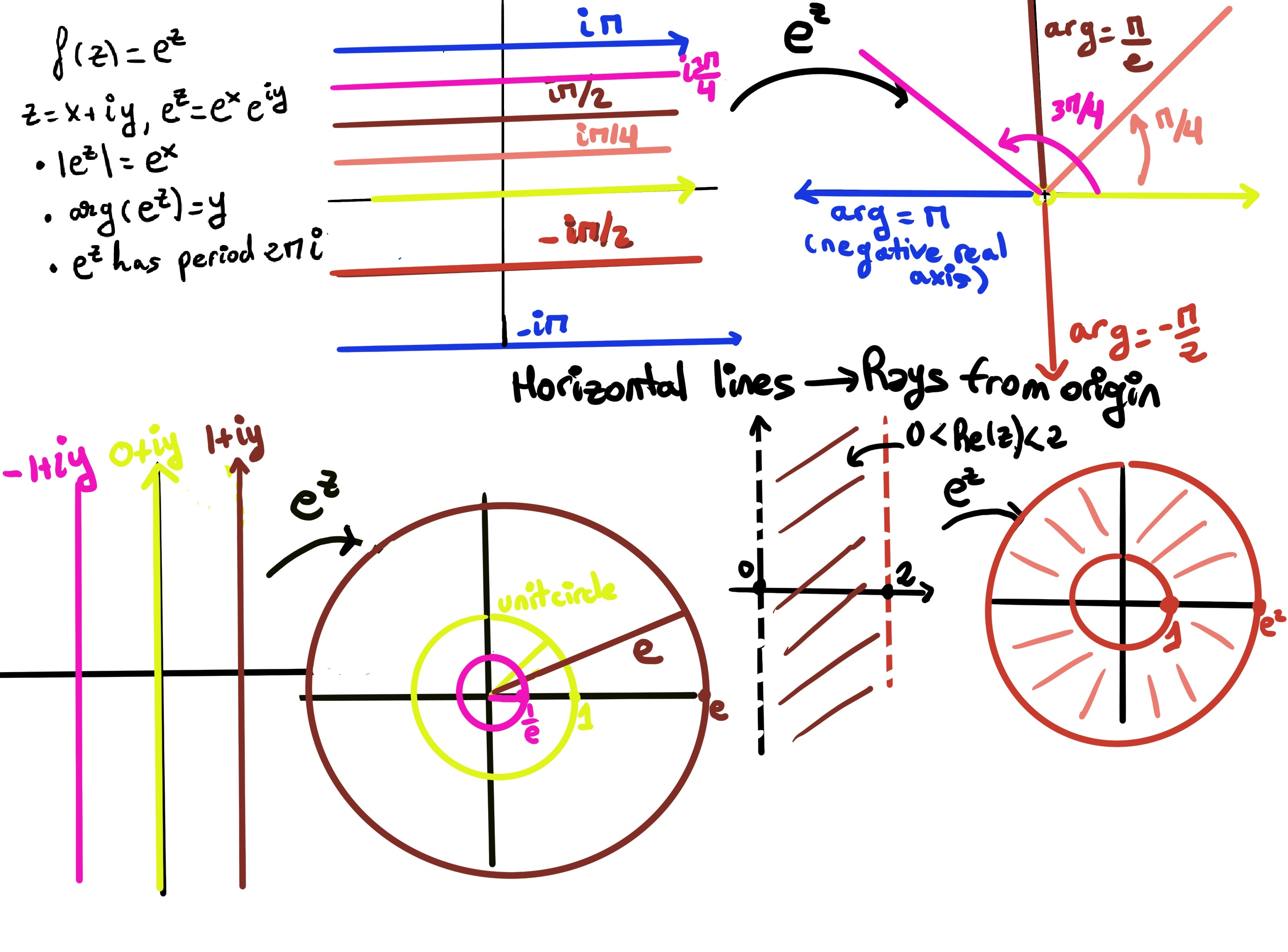
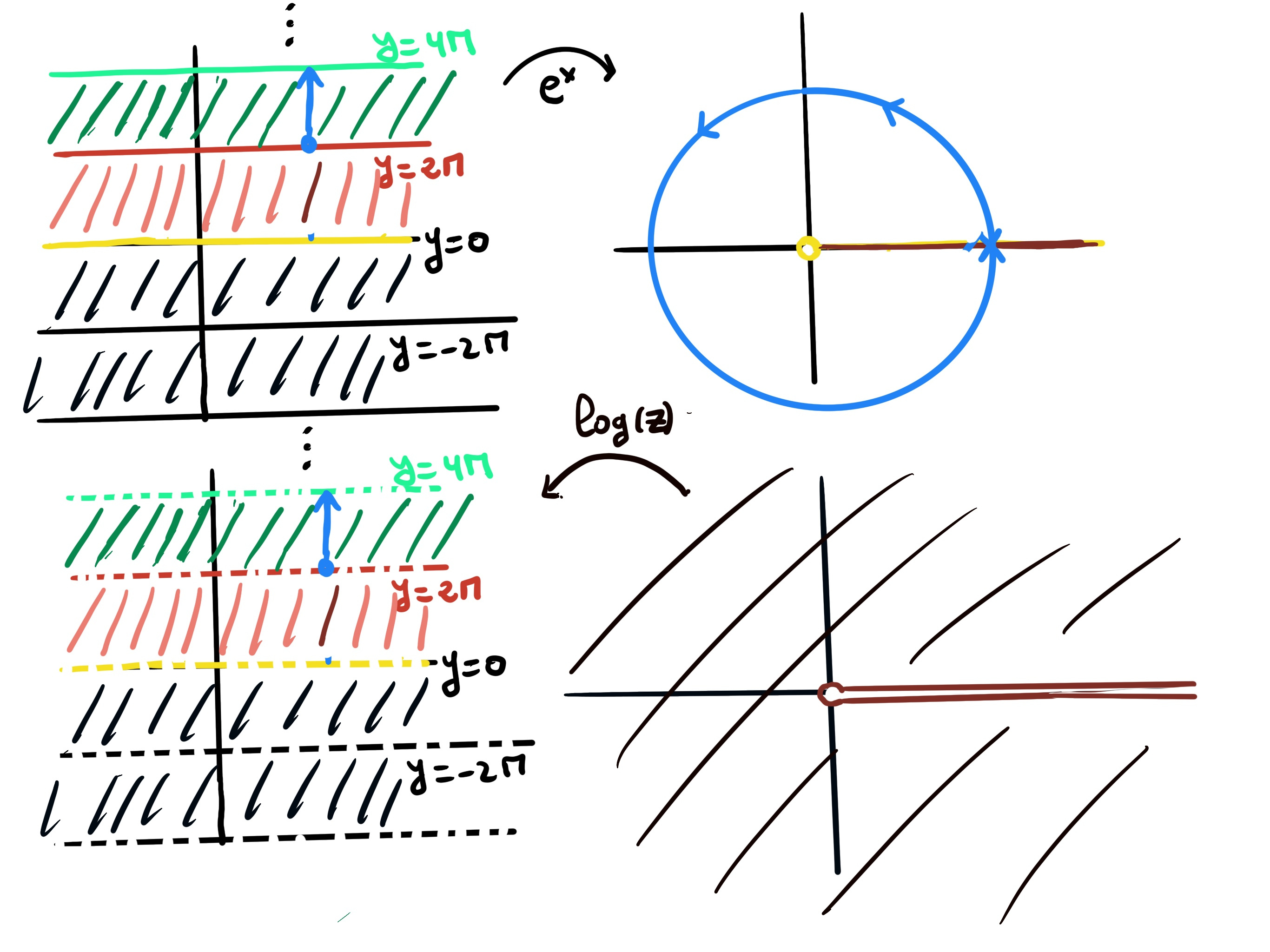
Understanding the logarithm as the inverse of the exponential $e^z$ provides essential geometric insight. For $z = x + iy$, $e^z = e^x(\cos y + i\sin y).$
Let’s analyze how the exponential $e^{z} = e^{x}(\cos y + i \sin y)$ transform the complex plane:
- Horizontal lines y = c (constant imaginary part) map to rays from the origin at angle c, with radius $e^{x}$, varying from $0$ to $\infty$ as $x$ ranges over $\mathbb{R}$. In particular, the lines $y = 0, \pm 2\pi, \pm 4\pi, \ldots$ all map to the positive real axis $(0, \infty)$.
- Vertical lines x = c (constant real part) map to circles centered at the origin with radius $e^c$, traversed as $y$ varies. Each full interval of length $2\pi$ in $y$ traces the circle exactly once.
- Horizontal strips of width $2\pi$: each strip $\{x + iy : x \in \mathbb{R},\; 2n\pi < y < 2(n+1)\pi\}$ maps bijectively onto $\mathbb{C} \setminus [0, \infty)$. The boundaries $y = 2n\pi$ map to the positive real axis.
- The crucial observation is that the exponential function has period $2\pi i$ in the imaginary direction, $e^{z + 2\pi i} = e^z$ for all $z \in \mathbb{C}$.
The map $z \mapsto e^z$ is not injective on $\mathbb{C}$ — infinitely many inputs yield the same output.
However, restricting to any single horizontal strip of width $2\pi$ makes $e^z$ bijective onto $\mathbb{C} \setminus [0, \infty)$. This allows us to define an inverse function that is continuous and single-valued.
The inverse of this restricted exponential is precisely a branch of the logarithm.
The positive real axis serves as the branch cut - the unavoidable discontinuity where the logarithm “jumps” between branches. Crossing the cut from above to below changes the argument by $2\pi$, moving from one strip to the next.
| Horizontal strip in $w$-plane |
Branch of $\log$ |
Branch cut |
| $\{u + iv : v \in (0, 2\pi)\}$ |
$f_0(z) = \ln\|z\| + i\theta_0(z)$ |
$[0, \infty)$ |
| $\{u + iv : v \in (2\pi, 4\pi)\}$ |
$f_1(z) = \ln\|z\| + i\theta_1(z)$ |
$[0, \infty)$ |
| $\{u + iv : v \in (-2\pi, 0)\}$ |
$f_{-1}(z) = \ln\|z\| + i\theta_{-1}(z)$ |
$[0, \infty)$ |
| $\{u + iv : v \in (-\pi, \pi)\}$ |
$\operatorname{Log}(z) = \ln\|z\| + i\operatorname{Arg}(z)$ |
$(-\infty, 0]$ |
Analyticity of the Logarithm Branches
Proposition. Each branch $f_k : \mathbb{C} \setminus [0, \infty) \to \mathbb{C}$, defined by $f_k(z) = \ln|z| + i\theta_k(z)$ where $\theta_k(z) \in (2k\pi, 2(k+1)\pi)$, is holomorphic (analytic), with derivative $f_k'(z) = \frac{1}{z}.$
Proof:
- Since $f_k$ is a branch of the logarithm (the inverse of the exponential function), we have the fundamental identity: $e^{f_k(z)} = z \qquad \text{for all } z \in \mathbb{C} \setminus [0, \infty).$
- Set up the difference quotient. For $z$ and $z + h$ both in $\mathbb{C} \setminus [0, \infty)$: $\frac{f_k(z+h) - f_k(z)}{(z+h) - z} = \frac{f_k(z+h) - f_k(z)}{e^{f_k(z+h)} - e^{f_k(z)}}.$
- Change of variable. Since $f_k$ is continuous, $h \to 0$ implies $f_k(z+h) \to f_k(z)$. Let’s define the substitution $p = f_k(z+h) - f_k(z)$, so $p \to 0$ as $h \to 0$. The difference quotient becomes: $\frac{p}{e^{f_k(z) + p} - e^{f_k(z)}} = \frac{p}{e^{f_k(z)}(e^p - 1)} = \frac{1}{e^{f_k(z)}} \cdot \frac{p}{e^p - 1}.$
- Evaluate the limit. Using the fundamental limit $\lim_{p \to 0} \frac{p}{e^p - 1} = 1$ (which follows from $\lim_{p \to 0} \frac{e^p - 1}{p} = 1$, the definition of the derivative of $e^p$ at $p = 0$): $f_k'(z) = \frac{1}{e^{f_k(z)}} \cdot 1 = \frac{1}{z}. \quad\square$
Alternative Proof via the Inverse Function Theorem
- Let $w = \operatorname{Log}_\alpha(z)$, so $z = e^w$. The domain of $w$ is the horizontal strip $S_\alpha = \{u + iv : v \in (\alpha, \alpha + 2\pi)\}$.
- The exponential function $f(w) = e^w$ is entire (holomorphic on all of the complex plane $\mathbb{C}$).
- Its derivative $f'(w) = e^w$ is never zero (since $e^w \neq 0$ for all $w \in \mathbb{C}$).
- On this horizontal strip, f is injective and its image is $\mathbb{C}\setminus R_{\alpha}$, so the exponential restricts to a bijection $f : S_\alpha \to \mathbb{C} \setminus R_\alpha$. By the holomorphic inverse function theorem, the inverse $f^{-1} = \operatorname{Log}_\alpha$ is also holomorphic.
- The derivative of the inverse is given by $\frac{d}{dz}\operatorname{Log}_\alpha(z) = \frac{1}{f'(w)}$ where $z = f(w) = e^w$, hence, $\frac{d}{dz}\operatorname{Log}_\alpha(z) = \frac{1}{e^w} = \frac{1}{z}. \quad\square$
Summary
For any branch $\operatorname{Log}_\alpha$ on the slit domain $\mathbb{C} \setminus R_\alpha$:
- On a cut plane $\mathbb{C} \setminus \{re^{i\alpha} : r \geq 0\}$, the entire complex plane except for a ray (a “cut”), we can define a single, continuous value for the argument $\theta_\alpha(z) \in (\alpha, \alpha + 2\pi)$ for every point in the domain.
- The function $\operatorname{Log}_\alpha$ is the branch of the logarithm where the argument of $z$ is restricted to $(\alpha, \alpha + 2\pi)$. Specifically, $\boxed{\operatorname{Log}_\alpha(z) = \ln|z| + i \theta_\alpha(z)}, \qquad \theta_\alpha(z) \in (\alpha, \alpha + 2\pi).$
- $\operatorname{Log}_\alpha$ is holomorphic on $\mathbb{C} \setminus R_\alpha$, with $\boxed{\frac{d}{dz}\operatorname{Log}_\alpha(z) = \frac{1}{z}.}$
- The image of $\operatorname{Log}_\alpha$ is the horizontal strip $\{u + iv : u \in \mathbb{R},\; v \in (\alpha, \alpha + 2\pi)\}$.
- All branches share the same derivative $1/z$ but differ by additive constants of the form $2\pi i k$: $\operatorname{Log}_\alpha(z) - \operatorname{Log}_\beta(z) \in \{2\pi i k : k \in \mathbb{Z}\}$ for any $z$ in the intersection of their domains.
To identify the constant, write each branch in terms of modulus and argument: $\operatorname{Log}_{\alpha}(z)=\ln |z|+i \arg_{\alpha }(z),\qquad \operatorname{Log}_{\beta }(z)=\ln |z| + i \arg_{\beta }(z).$
Subtracting: $F(z)=i(\arg_{\alpha }(z)-\arg _{\beta }(z)).$
Since any two choices of the same argument differ by an integer multiple of $2\pi$, we get: $\arg_{\alpha }(z)-\arg _{\beta }(z)\in 2\pi \mathbb{Z}$, and we finally conclude: $F(z)\in \{ 2\pi ik:k\in \mathbb{Z}\}$.
Properties of the Complex Logarithm
- Consistency with the Real Logarithm. For $x \in \mathbb{R}$ with $x > 0$: $|x| = x$, $\operatorname{Arg}(x) = 0$, so $\operatorname{Log}(x) = \ln x + i \cdot 0 = \ln x.$.
The principal branch of the complex logarithm extends the real natural logarithm.
- Exponential Inverse Property.
For any value $w \in \log(z)$: $e^{\log(z)} = z \qquad \text{(always true for any branch or value of } \log).$
However, the converse requires care: $\log(e^z) = z + 2\pi i k \qquad \text{for some } k \in \mathbb{Z}.$
For the principal branch: $\operatorname{Log}(e^z) = z$ if and only if $\operatorname{Im}(z) \in (-\pi, \pi]$.
- Logarithmic Laws (Multi-Valued)The classical laws hold in the multi-valued sense (as equalities of sets): $\log(z_1 z_2) = \log(z_1) + \log(z_2) \qquad \text{(set equality)}$, $\log\!\left(\frac{z_1}{z_2}\right) = \log(z_1) - \log(z_2) \qquad \text{(set equality)}$, $\log(z^n) = n\log(z) \qquad \text{for } n \in \mathbb{Z} \;\text{(set equality)}$.
- These laws do not hold in general for $\operatorname{Log}$, e.g., $\operatorname{Log}(z_1 z_2) \neq \operatorname{Log}(z_1) + \operatorname{Log}(z_2) \quad \text{in general.}$
The discrepancy is always an integer multiple of $2\pi i$: $\operatorname{Log}(z_1 z_2) = \operatorname{Log}(z_1) + \operatorname{Log}(z_2) + 2\pi i N,$ where $N \in \{-1, 0, 1\}$ is determined by whether $\operatorname{Arg}(z_1) + \operatorname{Arg}(z_2)$ falls outside $(-\pi, \pi]$.
Let $z_1 = z_2 = -1$. Then $\operatorname{Log}(-1) = i\pi$, so $\operatorname{Log}(z_1) + \operatorname{Log}(z_2) = 2\pi i$. But $z_1 z_2 = 1$, so $\operatorname{Log}(1) = 0$. The discrepancy is $0 - 2\pi i = -2\pi i$, corresponding to $N = -1$.
- Logarithm of Special Values, $\operatorname{Log}(1) = 0, \operatorname{Log}(-1) = i\pi, \operatorname{Log}(i) = i\pi/2, \operatorname{Log}(-i) = -i\pi/2, \operatorname{Log}(e) = 1, \operatorname{Log}(r) =[\text{r > 0}] = \ln r, \operatorname{Log}(re^{i\theta}) =[\theta \in (-\pi,\pi)] = \ln r + i\theta$.
- On the disk $|z| < 1$ (or equivalently for $|w - 1| < 1$ with $w = 1 + z$): $\boxed{\operatorname{Log}(1 + z) = \sum_{n=1}^{\infty} \frac{(-1)^{n+1}}{n} z^n} = z - \frac{z^2}{2} + \frac{z^3}{3} - \frac{z^4}{4} + \cdots$
This is the complex extension of the real Mercator series $\ln(1+x)$, valid for $|z| < 1$. At $z = 1$ (i.e., $w = 2$), the series converges conditionally to $\ln 2$.