
|
 |

|
|
|
|
|
|
Assumption is the mother of all screw-ups, Anonymous.

The square root function is a fundamental mathematical function written as $f(x) = \sqrt{x}$ with wide-ranging applications in mathematics, science, and engineering.
It gives or returns the non-negative number that, when multiplied by itself, equal the input x. For example, $\sqrt{16}$ = 4 because 4 × 4 = 16, $\sqrt{49}$ = 47 because 7 × 7 = 49, $\sqrt{64}$ = 8 because 8 × 8 = 64.
A complex number is expressed as $z = a + bi$, where $a$ and $b$ are real numbers ($a, b \in \mathbb{R}$) and $i$ is the imaginary unit ($ i^2 = -1 $). The square root of a complex number $ z $ is any number $ w $ such that $ w^2 = z $.
Unlike real numbers, every non-zero complex number has exactly two distinct square roots, and these roots are negatives of each other. The number $0$ has the unique square root $0$. This is fundamentally different from the real case, where negative numbers have no real square roots at all.
Proof. Suppose $w \neq 0$. If $w^2 = z$ and $w'^2 = z$, then $w^2 - w'^2 = 0$, so $(w - w')(w + w') = 0$. Thus, either $w' = w$ or $w' = -w$. Since $w \neq 0$ (as $z \neq 0$), the two roots $w$ and $-w$ are distinct.
The most straightforward and elegant method to compute complex square roots uses polar form. For any nonzero complex number z, we can write it as $z = re^{i\theta}$ where r = |z| > 0 is the modulus (a positive real number, distance from the origin) and $\theta = \arg(z)$ is the argument (angle from the positive real axis), typically taken in (-π, π] or [0, 2π).
Taking the square root means finding $w$ with $w^2 = z$. If $w = \rho e^{i\phi}$, then: $w^2 = \rho^2 e^{2i\phi} = re^{i\theta}.$
Comparing moduli and arguments: $\rho^2 = r \;\Longrightarrow\; \rho = \sqrt{r}, \qquad 2\phi = \theta + 2\pi k \;\Longrightarrow\; \phi = \frac{\theta}{2} + \pi k.$
For $k = 0$ and $k = 1$, we obtain the two distinct square roots: $\boxed{w_1 = \sqrt{r}\,e^{i\theta/2}, \qquad w_2 = \sqrt{r}\,e^{i(\theta/2 + \pi)} = -w_1.}$
In trigonometric form: $w_1 = \sqrt{r}\left(\cos\frac{\theta}{2} + i\sin\frac{\theta}{2}\right), \qquad w_2 = \sqrt{r}\left(\cos\!\left(\frac{\theta}{2} + \pi\right) + i\sin\!\left(\frac{\theta}{2} + \pi\right)\right).$
Since angles are defined modulo $2\pi$, halving $\theta$ produces two distinct values modulo $2\pi$: $\frac{\theta}{2} \quad \text{and} \quad \frac{\theta}{2} + \pi.$
These differ by $\pi$ radians — exactly half a full rotation — placing them on diametrically opposite sides of the origin in the complex plane. For $k = 2$, we get $\frac{\theta}{2} + 2\pi$, which is the same angle as $\frac{\theta}{2}$ (mod $2\pi$), so no new root appears.
In other words, the modulus of the root is the square root of the original modulus. The angle of the root is half the original angle. The second root lies diametrically opposite the first root - the two roots are antipodal separated by $\pi$ radians on a circle of radius $\sqrt{r}$.
For $z = a + bi$ with $b \neq 0$, we can express the square roots directly in terms of $a$, $b$, and $|z|$.
If z = a + bi with z ≠ 0, assume the square roots of z to be w = u + iv, that is $\sqrt{a + bi} = u + iv$
Now, squaring both side of the equation, we have: $a + bi = u^2 -v^2 + 2iuv$. Comparing real and imaginary parts of the above equation, we have: $a = u^2 -v^2, b = 2uv$
We also know that $(u^2 + v^2)^2 = (u^2 - v^2)^2 + 4u^2v^2 = a^2 + b^2 \leadsto u^2 + v^2 = \sqrt{a^2 + b^2 }$ taking the positive root since $u^2 + v^2 > 0$.
Now, we have the system: $u^2 + v^2 = |z|, \qquad u^2 - v^2 = a.$
Adding and subtracting: $u^2 = \frac{|z| + a}{2}, \qquad v^2 = \frac{|z| - a}{2}.$
Both quantities are non-negative: $|z| + a \geq 0$ because $|z| \geq |a| \geq -a$, and $|z| - a \geq 0$ because $|z| \geq |a| \geq a$.
The sign relationship comes from $b = 2uv$: $u$ and $v$ have the same sign when $b > 0$, and opposite signs when $b < 0$.
Using the sign function $\operatorname{sgn}(b)$: $\boxed{\sqrt{a + bi} = \pm\left(\sqrt{\frac{|z| + a}{2}} + i\,\operatorname{sgn}(b)\sqrt{\frac{|z| - a}{2}}\right)}$ where $|z| = \sqrt{a^2 + b^2}$ and the $\pm$ gives both roots.
Special case $b = 0$. If $z = a \in \mathbb{R}$: (i) $a \geq 0$: $\sqrt{a} = \pm\sqrt{a}$ (the familiar real square roots). (ii) $a < 0$: $\sqrt{a} = \pm i\sqrt{|a|}$.
Unlike real numbers, every non-zero complex number has exactly two distinct square roots. The challenge is defining a consistent function, $\sqrt{z}$, that selects one of these two values.
This selection cannot be made continuously on all of $\mathbb{C} \setminus \{0\}$: Start at $z = 1$ with the square root $w = 1$. Traverse the unit circle $z = e^{i\theta}$ as $\theta$ increases from $0$ to $2\pi$: $w(\theta) = e^{i\theta/2}.$
(i) At $\theta = 0$: $w = e^0 = 1$. (ii) At $\theta = 2\pi$ (back to $z = 1$): $w = e^{i\pi} = -1$. The function has not returned to its starting value — it has jumped to the other root. This demonstrates that no continuous single-valued square root exists on $\mathbb{C} \setminus \{0\}$. Traversing the loop a second time returns $w$ to $+1$: the square root has a monodromy of order 2 (if you go around a loop twice, the sign flips twice: $+1\rightarrow -1\rightarrow +1$).
The multi-valuedness of the square root is inherited from the logarithm. The most fundamental definition of $z^{1/2}$ is: $\boxed{z^{1/2} = e^{\frac{1}{2}\log(z)}}$.
Since $\log(z) = \ln r + i(\theta + 2\pi k)$ for $k \in \mathbb{Z}$: $z^{1/2} = e^{\frac{1}{2}(\ln r + i(\theta + 2\pi k))} = \sqrt{r}\,e^{i\theta/2}\,e^{i\pi k} = \boxed{\sqrt{r} e^{i\theta/2} (-1)^k.}$
$e^{i\pi n} = (-1)^n$.
A branch cut is a curve (or line) in the complex plane that we agree not to cross. Thus, the infinitely many values of $\log(z)$ collapse to exactly two values for $z^{1/2}$. Choosing a branch of the logarithm determines a branch of the square root.
Definition. The principal square root is defined by: $\boxed{\sqrt{z} = e^{\frac{1}{2}\operatorname{Log}(z)} = \sqrt{|z|} e^{i\operatorname{Arg}(z)/2}},$ where $\operatorname{Log}(z) = \ln|z| + i\operatorname{Arg}(z)$ is the principal logarithm with $\operatorname{Arg}(z) \in (-\pi, \pi]$.
Domain. $\mathbb{C} \setminus (-\infty, 0]$ — the complex plane with the negative real axis (and the origin) removed. This is the branch cut, inherited from the principal logarithm. Those two previous values correspond to the two branches of the square root function:
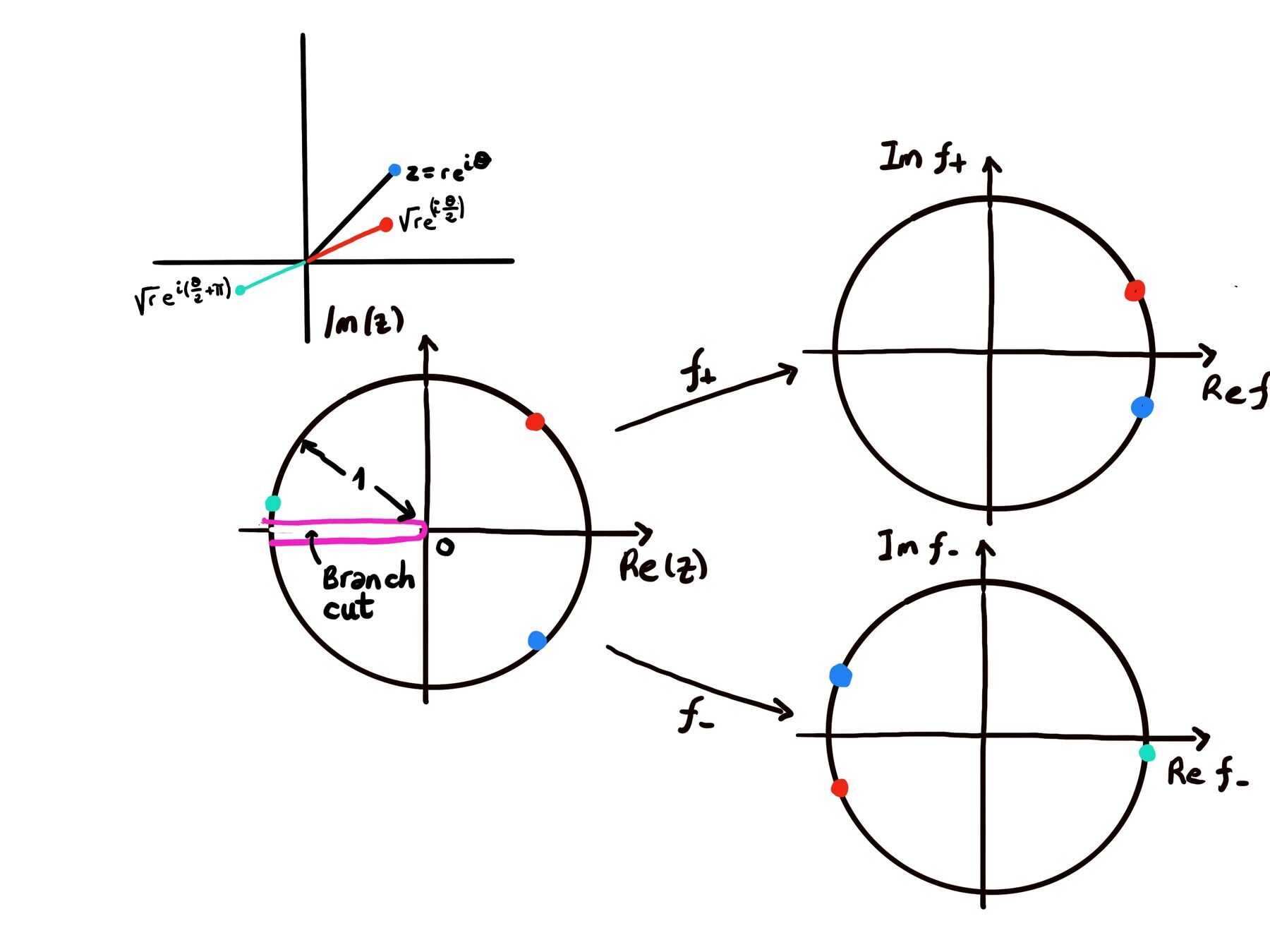
Properties of the principal branch $f_+(z) = \sqrt{z}$:
By restricting the argument of z to $(-\pi, \pi)$, we force the argument of $\sqrt{z}$ into $(-\pi /2,\pi /2)$, which is a region that does not wrap around the origin. No looping, no branch switching -the principal square root is single‑valued on the slit plane.
Since $z \ne 0$, we may rewrite $\frac{\sqrt{z}}{2z}$ as $\frac{1}{2\sqrt{z}}$ because $\sqrt{z} \cdot \sqrt{z}$.
A more fundamental way to define the square root is via the complex exponential and logarithm functions: $z^{1/2} = e^{\frac{1}{2}log(z)}$
The multi-valued nature of the square root comes directly from the multi-valued nature of the logarithm: log(z) = ln(r) + i(θ + 2πk).
Substituting this into the formula gives: $z^{1/2} = e^{\frac{1}{2}log(z)} = e^{\frac{1}{2} \left( \ln r + i(\theta + 2\pi k) \right)} = \sqrt{r}·e^{i\frac{\theta + 2\pi k}{2}} = \sqrt{r}·e^{i\frac{\theta}{2}}·e^{i\pi k} = \sqrt{r}·e^{i\frac{\theta}{2}}·(-1)^k$.
This shows that an even k (like k = 0, 2,…) results in one root ($e^{i\pi k} = 1$), while an odd k (like k=1,3,…) results in the other ($e^{i\pi k} = - 1$). Choosing the principal branch of the logarithm corresponds to choosing the principal branch of the square root.
The core issue is that the complex logarithm, log(z), is a multi-valued function. For any complex number $z = re^{i\theta}$, its logarithm is log(z) = ln(r) + i(θ + 2πk) where k can be any integer (k ∈ ℤ). Each value of k produces a different value for the logarithm.
When we define $z^α := e^{α·log(z)}$. We define an analytic branch of $z^α$ by choosing a branch of Log(z), this multi-valuedness carries over: $z^α = e^{α·(ln(r) + i(θ + 2πk))} = e^{α·(ln(r) + iθ)}e^{α·i2πk}$
Let’s analyze the two parts of this product:
The number of distinct values depends on α:
To create a proper, single-valued, and analytic (differentiable) function from $z^α$, we must make a consistent choice. By choosing a branch for log(z), we are essentially fixing the value of k (usually k = 0) and restricting the domain of the argument θ. The principal branch of zᵅ is defined by using the principal branch of the logarithm, Log(z) = ln∣z∣ + iArg(z), where Arg(z) ∈ (−π, π].
This gives the principal Value of $z^α$: $z^α = e^{α·Log(z)}$ where Arg(z) is the principal argument in (−π,π]. A key feature of the principal root is that its real part is always non-negative. It maps the entire complex plane (minus the branch cut) to the right half-plane.
Example:
The full-multivalued set is iⁱ = {$e^{-\frac{\pi}{2}}·e^{i·i2πk} = e^{-\frac{\pi}{2}-2πk} | k \in \mathbb{Z}$}
The full-multivalued set is (-1)ⁱ = {$e^{-\pi}·e^{i·i2πk} = e^{-(\pi + 2\pi k)} = e^{-(\pi + 2\pi k)} = e^{-(2k+1)\pi} | k \in \mathbb{Z}$}

JustToThePoint Copyright © 2011 - 2026 Anawim. ALL RIGHTS RESERVED. Bilingual e-books, articles, and videos to help your child and your entire family succeed, develop a healthy lifestyle, and have a lot of fun. Social Issues, Join us.
This website uses cookies to improve your navigation experience.
By continuing, you are consenting to our
use of cookies, in accordance with our Cookies Policy and
Website Terms and Conditions of use.