
|
 |

|
|
|
|
|
|
No pressure, no diamonds, Thomas Carlyle.
The derivative of a function at a chosen input value, when it exists, is the slope of the tangent line to the graph of the function at that point. It is the instantaneous rate of change —the exact ratio of the instantaneous change in the dependent variable ($y$) to that of the independent variable ($x$).
Definition. A function $f(x)$ is differentiable at a point $a$ of its domain if its domain contains an open interval containing $a$, and the following limit exists: $\boxed{f'(a) = L = \lim_{h \to 0} \frac{f(a+h) - f(a)}{h}}$
Formal Definition: More rigorously, for every positive real number $\epsilon > 0$, there exists a positive real number $\delta > 0$, such that for every $h$ satisfying $0 < |h| < \delta$, the difference between the secant slopes at points sufficiently near a are guaranteed to be ε-close to the derivative: $\left| L - \frac{f(a+h) - f(a)}{h} \right| < \epsilon$

To avoid calculating limits from scratch every time, we use established differentiation rules. Let $f(x)$ and $g(x)$ be differentiable functions, and $n$ be a real number:
Common Transcendental Derivatives:
The critical points of a function $f$ are the $x$-values within the domain of $f$ where the derivative is zero ($f'(x) = 0$) or where the derivative is undefined.
Because continuous functions cannot change signs without passing through zero, the sign of $f'$ must stay constant between two consecutive critical points. This leads to the First Derivative Test:
First Derivative Test. If the derivative of a function changes sign around a critical point, the function is said to have a local or relative extremum (maximum or minimum) at that point.
Note: If $f'$ does not change sign around a critical point, it is usually an inflection point, not an extremum.
Geometrically, $f'(x)$ is the slope of the tangent line to the graph at the point $(x, f(x))$. Physically, $f'(x)$ represents the instantaneous rate of change.
The average rate of change calculates how the output changes over a wide interval of inputs. This can be visualized as the slope of a secant line cutting through two points on a graph. In differential calculus, we shrink that interval to zero to find the instantaneous rate.
Example (Population Dynamics). Average Growth Rate = $\frac{\text{Total Births} - \text{Total Deaths}}{\text{Years}}$.
By taking the limit as the time interval approaches zero, the instantaneous rate of change in population is the derivative of the population function with respect to time, denoted as $\frac{dP}{dt}$.
Whether you are calculating the speed of a falling object, the inflation of a balloon, or the sliding of a ladder, follow these general steps:
Assume we have collected the following position data:
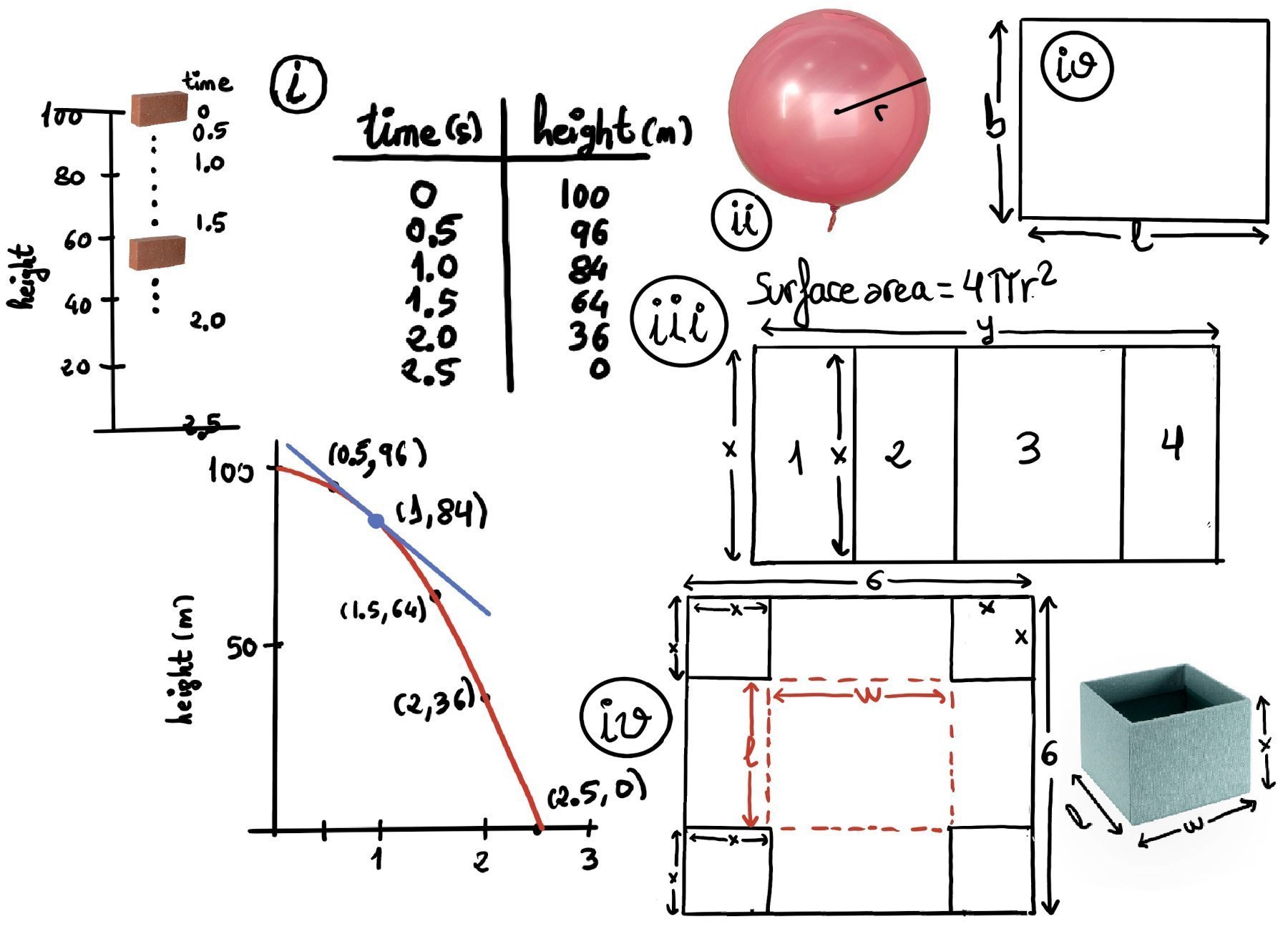
We can answer several questions purely using algebra and average rates of change:
Question: How fast was the brick falling exactly 1 second after it was dropped? This is asking for the instantaneous velocity, $v(1)$ or $y'(1)$.
Using averages gives us decent approximations:
We can deduce the instantaneous velocity is between $-24$ m/s and $-40$ m/s. Mathematically, it is the exact limit: $\lim_{\Delta t \to 0} \frac{\Delta y}{\Delta t}$.
Question: How fast was the brick falling exactly one second after it was dropped? This is asking for the instantaneous velocity, $v(1)$ or $y'(1)$.
The Algebraic Solution: Looking closely at the data points, the position decreases quadratically. The data perfectly fits the standard kinematic equation $y(t) = 100 - 16t^2$.
Now that we have the algebraic form of the function, we can calculate the derivative directly using the Power Rule!
The exact instantaneous velocity of the brick at exactly 1 second is $-32$ m/s, which lands perfectly in the middle of our numerical approximations!
When we know the derivative of a function at a specific point, we can use it to estimate nearby values using the tangent line. This is known as linear approximation.
Example: The Baking Yam
The temperature, $T$, in degrees Celsius, of a cold yam placed in a hot oven is given by $T = f(t)$, where $t$ is the time in minutes since the yam was put in the oven.
In related rates problems, we calculate the rate of change of one quantity by relating it to other quantities whose rates of change are known, usually using the Chain Rule to differentiate with respect to time ($t$).
Expanding Circle (2D Geometry)
$\star$ Problem: The radius of a circle is increasing at a rate of 3 m/s. Find the rate of change of the circle’s area when $r = 10$ m.
$\star$ Given Rate: $\frac{dr}{dt} = 3$ m/s
$\star$ Goal: $\frac{dA}{dt}\Big|_{r=10}$
$\star$ Equation: The area of a circle is $A = \pi r^2$.
$\star$ Differentiate with respect to $t$: $\frac{dA}{dt} = \frac{d}{dt}(\pi r^2) = 2\pi r \frac{dr}{dt}$
$\star$ Finally, solve: Substitute the known values at the specific instant: $\frac{dA}{dt}\Big|_{r=10} = 2\pi (10) \cdot (3) = 60\pi \text{ m}^2\text{/s}$
Expanding Cube (3D Geometry)
$\star$ Problem: The length of a cube’s side is increasing at a rate of 5 m/s. Find the rate of change of the cube’s volume when the length is 20 m.
$\star$ Given Rate: $\frac{dl}{dt} = 5$ m/s
$\star$ Goal: $\frac{dV}{dt}\Big|_{l=20}$
$\star$ Equation: The volume of a cube is equal to the length of a side cubed, $V = l^3$.
$\star$ Differentiate with respect to $t$: $\frac{dV}{dt} = 3l^2 \frac{dl}{dt}$
$\star$ Finally, solve: $\frac{dV}{dt}\Big|_{l=20} = 3(20)^2 \cdot 5 = 15 \cdot 400 = 6000 \text{ m}^3\text{/s}$
Approaching the Intersection (The Pythagorean Constraint)
$\star$ Problem: A car and a lorry are approaching an intersection on roads that are perpendicular to each other. The car is 0.8 miles away and traveling at 60 mph. The lorry is 0.6 miles from the intersection and traveling at 30 mph. Find the rate of change of the distance between the two vehicles (Figure 1.e).
$\star$ Given Rates: Because the vehicles are approaching the intersection, their distances to it are decreasing. Therefore, their rates of change are negative! Let the lorry be on the x-axis and the car on the y-axis: $\frac{dx}{dt} = -30$ mph, $\frac{dy}{dt} = -60$ mph.
$\star$ Goal: $\frac{ds}{dt}$ (where $s$ is the distance between them).
$\star$ Current Distance ($s$): By the Pythagorean theorem (we can never thank Pythagoras enough 😃), $x^2 + y^2 = s^2$.
$0.6^2 + 0.8^2 = s^2 \implies 0.36 + 0.64 = s^2 \implies s = \sqrt{1} = 1$ mile.
$\star$ Differentiate with respect to $t$: $x^2 + y^2 = s^2 \implies 2x\frac{dx}{dt} + 2y\frac{dy}{dt} = 2s\frac{ds}{dt}$
Divide the entire equation by 2 to simplify: $x\frac{dx}{dt} + y\frac{dy}{dt} = s\frac{ds}{dt}$
$\star$ Finally, solve: $0.6(-30) + 0.8(-60) = (1)\frac{ds}{dt}$. Simplify, $-18 - 48 = \frac{ds}{dt} \implies \frac{ds}{dt} = -66 \text{ mph}$.
$\star$ Interpretation: The distance between them is shrinking at 66 mph.
The Clown’s Balloon (Spherical Constraint)
$\star$ Problem: A balloon is being inflated in a pricey theme park by a funny, but selfish clown (these details are extremely important as it won’t be discussed later on). The radius of the balloon is increasing at a rate of 12 m/hr. Find the rate at which the surface area of the balloon is increasing at the instant when the radius is 150 m (Figure 2).
$\star$ Given Rate: $\frac{dr}{dt} = 12$ m/hr
$\star$ Goal: $\frac{dA}{dt}\Big|_{r=150}$
$\star$ Equation: The surface area of a sphere is given by the formula: $A = 4\pi r^2$ where A is the surface area and r is the radius of the sphere.
$\star$ Differentiate with respect to $t$: $\frac{dA}{dt} = 4\pi \left( 2r \frac{dr}{dt} \right) = 8\pi r \frac{dr}{dt}$
$\star$ Finally, solve; so the rate at which the surface area is increased when the radius is 150m equals $\frac{dA}{dt}\Big|_{r=150} = 8\pi (150) \cdot 12 = 14400\pi \approx 45239 \text{ m}^2\text{/hr}$
The Conical Tank (Similar Triangles)
$\star$ Problem: Consider a conical tank. Its radius at the top is 4 feet, and it is 10 feet high. It is being filled with water at the rate of 2 cubic feet per minute. How fast is the water level rising when the water is 5 feet deep?
The diagram is shown in Figure 1.f. 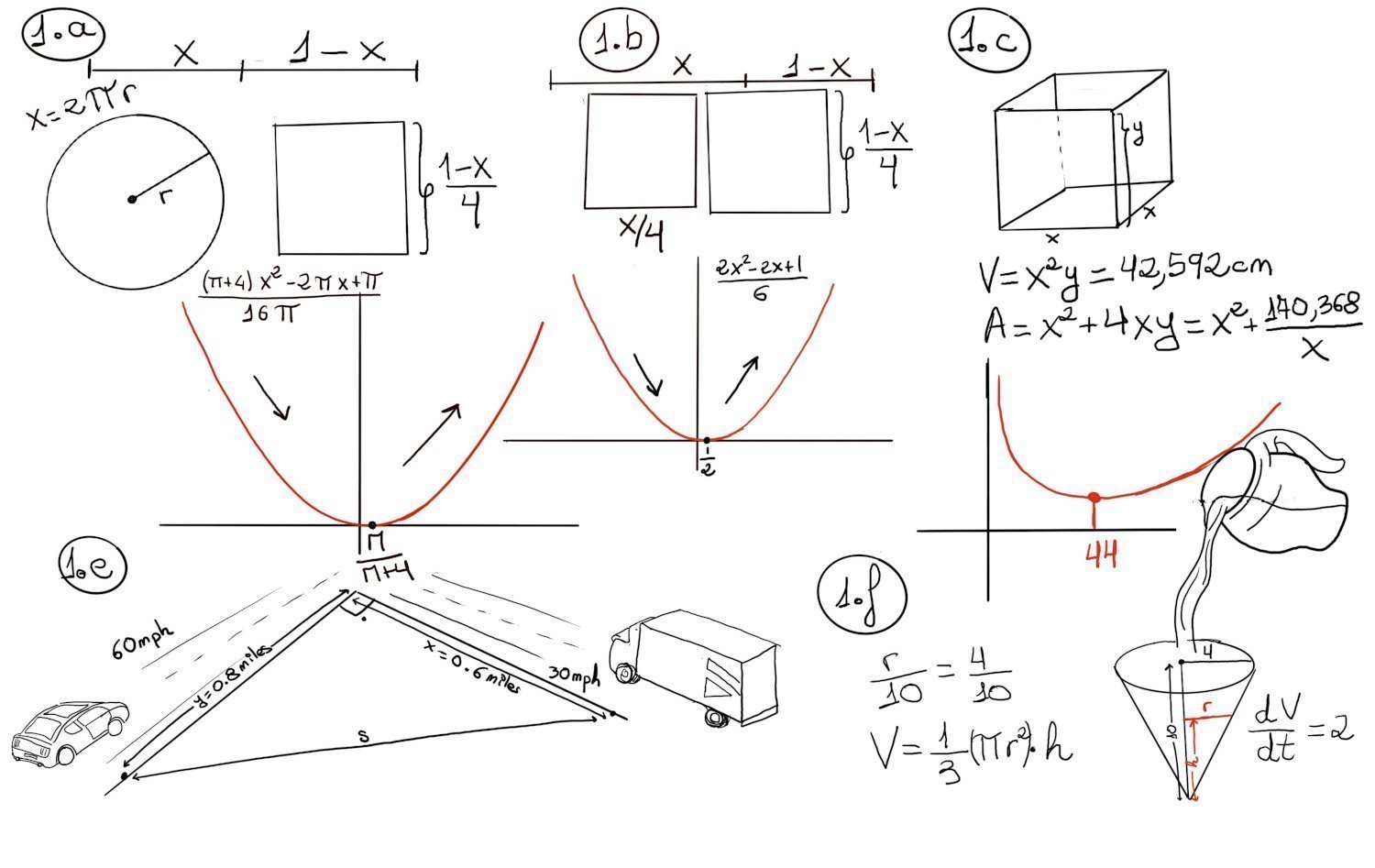
$\star$ Given Rate: $\frac{dV}{dt} = 2$ ft$^3$/min
$\star$ Goal: $\frac{dh}{dt}\Big|_{h=5}$
$\star$ Equation: The volume of a cone is $V = \frac{1}{3}\pi r^2 h$.
Crucial Step: We have too many variables ($V, r,$ and $h$). We must eliminate $r$ before differentiating. We use the geometry of the cone to establish a relationship. The cross-section of the water forms a triangle that is similar to the cross-section of the entire tank.
Because similar triangles have proportional sides: $\frac{r}{h} = \frac{4}{10} \implies r = \frac{2h}{5}$
Substitute this into the volume formula: $V = \frac{1}{3}\pi \left(\frac{2h}{5}\right)^2 h =[\text{Simplify}] \frac{1}{3}\pi \left(\frac{4h^2}{25}\right) h = \frac{4\pi}{75}h^3$
$\star$ Differentiate with respect to $t$: $\frac{dV}{dt} = \frac{4\pi}{75} \cdot 3h^2 \frac{dh}{dt} = \frac{4\pi}{25}h^2 \frac{dh}{dt}$
$\star$ Solve: Substitute $\frac{dV}{dt} = 2$ and $h = 5$: $2 = \frac{4\pi}{25}(5)^2 \frac{dh}{dt} =\frac{4\pi}{25}(25) \frac{dh}{dt} = 4\pi \frac{dh}{dt}$
$\frac{dh}{dt} = \frac{2}{4\pi} = \frac{1}{2\pi} \text{ ft/min}$

JustToThePoint Copyright © 2011 - 2026 Anawim. ALL RIGHTS RESERVED. Bilingual e-books, articles, and videos to help your child and your entire family succeed, develop a healthy lifestyle, and have a lot of fun. Social Issues, Join us.
This website uses cookies to improve your navigation experience.
By continuing, you are consenting to our
use of cookies, in accordance with our Cookies Policy and
Website Terms and Conditions of use.