The odoriferous fumes being emitted from the vast depths of your cavernous armpits are quite sufficient to act as a pesticide agent for all the cocaine fields in the entire country of Columbia or a pretext for another mandatory masking, Anawim, justtothepoint.com

Definite Integrals and Improper Integration
A definite integral is a fundamental concept in calculus used to calculate the exact area under a curve between two fixed limits on the x-axis. It is written or represented by the notation: $\int_{a}^{b} f(x)dx$ where:
- $a$ and $b$ are the lower and upper limits of integration.
- $f(x)$ is the integrand (the function being integrated).
- $dx$ indicates the variable of integration.
Conceptually, the definite integral of a real-valued function $f(x)$ on an interval $[a, b]$ is defined as the net signed area of the region bounded by the function's graph, the x-axis, and the vertical lines $x = a$ and $x = b$ and it is illustrated in Figure 1.a.
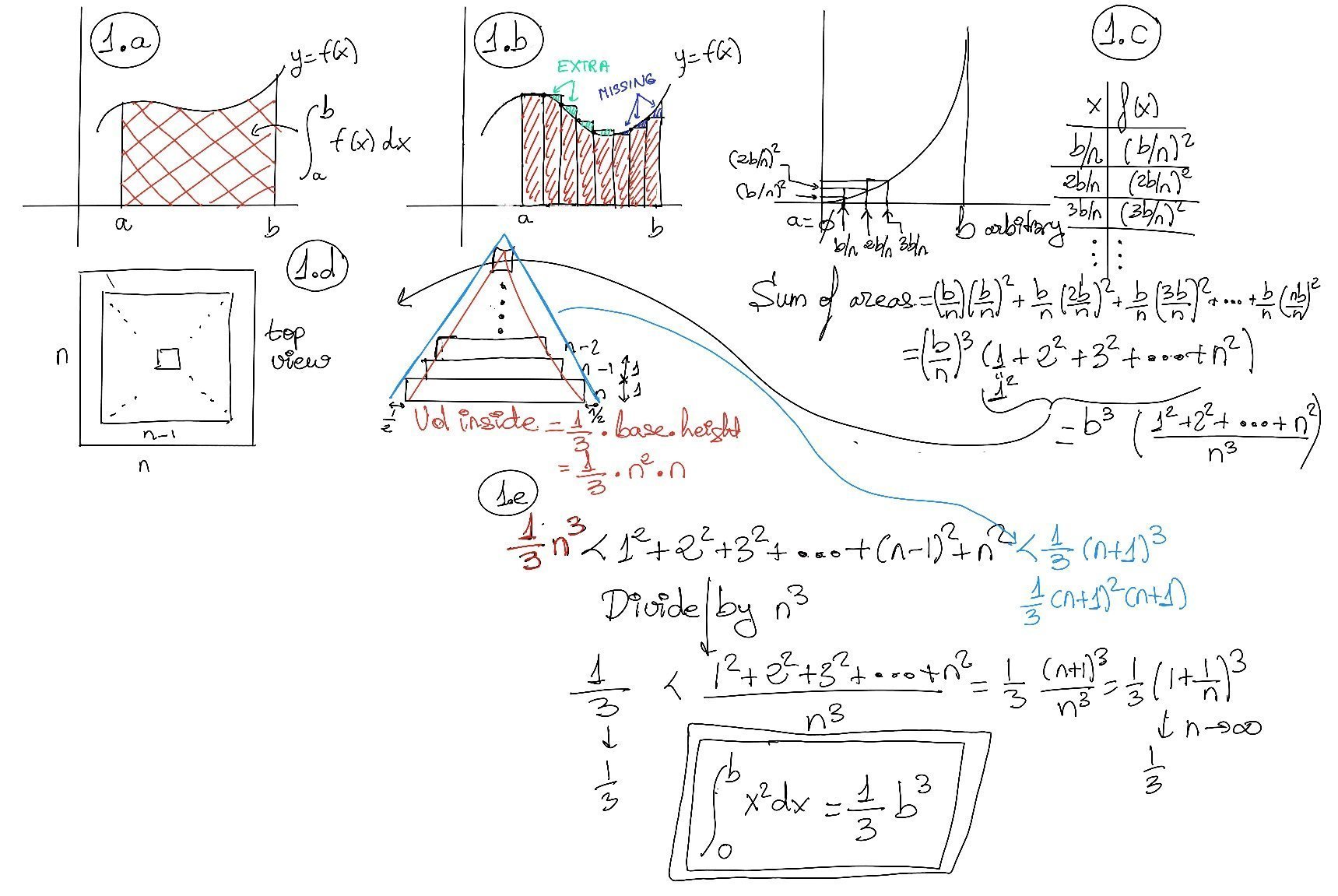
The Fundamental Theorem of Calculus
The connection between derivatives and integrals is established by the Fundamental Theorem of Calculus. It states that if you have a continuous function $f(x)$ on an closed interval $[a,b]$, the integral of that function is equal to the change in its antiderivative $F(x)$ (where $F'(x) = f(x)$) between the ends of the interval. Mathematically, this is expressed as $\boxed{\int_{a}^{b} f(x)dx = F(b) - F(a) = F(x) \bigg\vert{}_{a}^{b}}$
Improper integration
Standard definite integrals require specific, finite limits of integration and a function that is continuous (and thus bounded) across that entire interval.
Improper integrals break these rules. They arise in two main scenarios:
- Infinite Intervals: The limits of integration extend to infinity, e.g., $[a, \infty)$, $(-\infty, b]$, or $(-\infty, \infty)$.
- Infinite Discontinuities (Singularities): The integrand becomes undefined (approaches infinity or negative infinity) at one or more points within the interval of integration.
Because we cannot plug “infinity” directly into an antiderivative, evaluating improper integrals requires rewriting them using limits (as the integration bounds approach infinity or as singularities are approached).
$\boxed{\int_{a}^{\infty} f(x)dx = \lim_{b \to \infty} \int_{a}^{b} f(x)dx}$
Core Convergence Theorems
Before comparing functions, it is essential to establish a baseline of known integrals. The most common benchmark is the p-series integral.
- Standard p-series: $\int_{1}^{\infty} \frac{1}{x^p} dx$ converges if $p > 1$ and diverges if $p \le 1$.
- Vertical Asymptote p-series: $\int_{0}^{1} \frac{1}{x^p} dx$ converges if $p < 1$ and diverges if $p \ge 1$.
- Exponential Decay: $\int_{0}^{\infty} \frac{1}{e^{ax}} dx$ converges if $a > 0$ and diverges if $a \le 0$.
The Direct Comparison Test
The idea behind the direct comparison test is highly visual: if the area under a larger function is finite, the area under a smaller function bounded beneath it must also be finite.
Theorem: Suppose that $f$ and $g$ are continuous functions with $f(x) \ge g(x) \ge 0$ for all $x \ge a$.
- Convergence: If $\int_{a}^{\infty} f(x) dx$ is convergent, then $\int_{a}^{\infty} g(x) dx$ is convergent. The smaller area is trapped by a finite boundary.
- Divergence: If $\int_{a}^{\infty} g(x) dx$ is divergent, then $\int_{a}^{\infty} f(x) dx$ is divergent. If the smaller area goes to infinity, the larger one must as well.
The Limit Comparison Test
Sometimes, finding an exact bound for the Direct Comparison Test is algebraically difficult. The Limit Comparison test is a more robust tool that looks at the asymptotic behavior of the functions as they approach infinity.
Theorem: Assume $f$ and $g$ are positive continuous functions. If $f(x)$ behaves similarly to $g(x)$ as $x \to \infty$, meaning: $\lim_{x \to \infty} \frac{f(x)}{g(x)} = c$ where $c > 0$ (and $c \neq \infty$), then both improper integrals $\int_{a}^{\infty} f(x) dx$ and $\int_{a}^{\infty} g(x) dx$ share the same fate: they both converge, or they both diverge.
Proof of the Limit Comparison Test
- Given $\lim_{x \to \infty} \frac{f(x)}{g(x)} = c$, by the formal definition of a limit, for any $\epsilon > 0$ (let’s choose $\epsilon = \frac{c}{2}$), there exists an $a$ such that for all $x > a$: $\left\vert{} \frac{f(x)}{g(x)} - c \right\vert{} < \frac{c}{2}$
- Breaking down the absolute value: $-\frac{c}{2} < \frac{f(x)}{g(x)} - c < \frac{c}{2}$
- Multiplying the entire inequality by $g(x)$ (which is valid since g is a positive continuous function, $g(x) > 0$): $-\frac{c}{2}g(x) < f(x) - cg(x) < \frac{c}{2}g(x)$
- Adding $cg(x)$ to all terms isolates $f(x)$: $\frac{c}{2}g(x) < f(x) < \frac{3c}{2}g(x), \forall x \gt a$.
- Taking the integral from $a$ to $\infty$ yields: $\frac{c}{2}\int_{a}^{\infty} g(x) dx < \int_{a}^{\infty} f(x) dx < \frac{3c}{2}\int_{a}^{\infty} g(x) dx$
These strict inequalities prove that $f(x)$ is bounded both above and below by multiples of $g(x)$. Therefore, $\int f(x) dx$ must converge if $\int g(x) dx$ converges (bounded above), and must diverge if $\int g(x) dx$ diverges (bounded below). Q.E.D.
Solved Examples
- $\int_{1}^{\infty} \frac{1}{x^2+x+1} dx$
- For all $x \ge 1$, $x^2 + x + 1 > x^2$.
- Taking reciprocals: $\frac{1}{x^2+x+1} < \frac{1}{x^2}$.
- Since $\int_{1}^{\infty} \frac{1}{x^2} dx$ converges (Standard p-series with $p = 2 > 1$), our original integral converges by the Direct Comparison Test.
The comparison of these improper integrals can be visualized by comparing the area under each function (Figure i). The idea is quite simple, if the area under the larger function is finite (i.e. the improper integral $\int_{a}^{\infty} f(x)dx$ converges), the area under the smaller function must also be finite (i.e., $\int_{a}^{\infty} g(x)dx$ converges) -Figure ii-. Likewise, if the area under the smaller function is infinite (i.e., $\int_{a}^{\infty} g(x)dx$ diverges), then the area under the larger function must also be infinite (i.e. the improper integral $\int_{a}^{\infty} f(x)dx$ diverges).

- $\int_{0}^{\infty} \frac{1}{\sqrt{x^2+10}} dx$
- Split the integral at $x=1$ to evaluate the tail toward infinity: $\int_{0}^{1} \frac{1}{\sqrt{x^2+10}} dx + \int_{1}^{\infty} \frac{1}{\sqrt{x^2+10}} dx$.
- The first part evaluates to a finite number. For the tail, as $x \to \infty$, the $+10$ becomes negligible (completely insignificant), so $\frac{1}{\sqrt{x^2+10}} \approx \frac{1}{\sqrt{x^2}} = \frac{1}{x}$.
- Because $\int_{1}^{\infty} \frac{1}{x} dx$ diverges (Standard p-series with $p = 1$), the original integral diverges by the Limit Comparison Test.
- $\int_{1}^{\infty} \frac{x^2-1}{2x^5+3x+12} dx$
- We can bound this: $\frac{x^2-1}{2x^5+3x+12} \le \frac{x^2}{2x^5} = \frac{1}{2x^3}, \forall x \gt 1$.
- Since $\frac{1}{2} \int_{1}^{\infty} \frac{1}{x^3} dx$ converges (Standard p-series with $p = 3 > 1$), the integral converges by Direct Comparison.
- $\int_{2}^{\infty} \frac{x^2+x+1}{x^3-\sqrt[3]{x}} dx$
- For all $x \ge 2$, we can shrink (or grow) the denominator to make the fraction smaller (or bigger, depending how this inequality is read): $\frac{x^2+x+1}{x^3-\sqrt[3]{x}} \ge \frac{x^2}{x^3-\sqrt[3]{x}} \ge \frac{x^2}{x^3} = \frac{1}{x}$.
- $\int_{2}^{\infty} \frac{1}{x} dx$ diverges (Standard p-series with $p = 1$). Because our function is greater than or equal to a divergent function, it diverges.
- $\int_{1}^{\infty} \frac{\sin^2(x)}{x^2} dx$
- The numerator oscillates, but we know $0 \le \sin^2(x) \le 1$.
- Therefore, $\frac{\sin^2(x)}{x^2} \le \frac{1}{x^2}$ on $[1, \infty)$.
- Since $\int_{1}^{\infty} \frac{1}{x^2} dx$ converges (Standard p-series with $p = 2$), the original integral converges.
- Rational Function with a Square Root, $\int_{0}^{\infty} \frac{1}{\sqrt{x^3+7}} dx$
- As $x$ approaches infinity, the constant $+7$ becomes negligible. This allows us to use the Limit Comparison Test by comparing the integrand to its dominant terms: $\frac{1}{\sqrt{x^3+7}} \approx \frac{1}{\sqrt{x^3}} = \frac{1}{x^{3/2}}$
- Because we are looking at the behavior as $x \to \infty$, we compare our integral to $\int_{0}^{\infty} \frac{1}{x^{3/2}} dx$.
- By the $p$-series theorem, we know that $\int_{1}^{\infty} \frac{1}{x^p} dx$ converges if $p > 1$. Here, $p = \frac{3}{2} \ge 1$. Since the benchmark integral converges, our original integral $\int_{0}^{\infty} \frac{1}{\sqrt{x^3+7}} dx$ converges as well.
- Bounding a Polynomial Fraction, $\int_{1}^{\infty} \frac{x-2}{x^3+1} dx$
We can use the Direct Comparison Test by establishing a strict inequality for all $x \in [1, \infty)$.
- First, make the numerator larger: $\frac{x-2}{x^3+1} < \frac{x}{x^3+1}$
- Next, make the denominator smaller: $\frac{x}{x^3+1} < \frac{x}{x^3}$
- Simplify the resulting bound: $\frac{x}{x^3} = \frac{1}{x^2}$
- Putting it all together, we have established that on $[1, \infty)$: $\frac{x-2}{x^3+1} < \frac{1}{x^2}$
- The integral of our larger bounding function, $\int_{1}^{\infty} \frac{1}{x^2} dx$, converges (by the $p$-series theorem where $p = 2 \ge 1$). Because our target function is bounded beneath a convergent function, the original integral converges.
- Trigonometric Bounding on a Finite Interval, $\int_{0}^{\frac{\pi}{2}} \frac{\cos(x)}{\sqrt{x}} dx$
- First, the reader should realize that this is an improper integral not because of infinity, but because of the vertical asymptote at $x = 0$.
- We know that for all real numbers, $\cos(x) \le 1$. Therefore, on the interval $[0, \frac{\pi}{2}]$: $\frac{\cos(x)}{\sqrt{x}} \le \frac{1}{\sqrt{x}}$
- Let’s evaluate the integral of the bounding function directly: $\int_{0}^{\frac{\pi}{2}} \frac{1}{\sqrt{x}} dx = \lim_{a \to 0^+} \int_{a}^{\frac{\pi}{2}} x^{-1/2} dx = \lim_{a \to 0^+} \left[ 2\sqrt{x} \right]_{a}^{\frac{\pi}{2}}$
$= \lim_{a \to 0^+} \left( 2\sqrt{\frac{\pi}{2}} - 2\sqrt{a} \right) = 2\sqrt{\frac{\pi}{2}} = \sqrt{2\pi}$
- Because the integral of the upper bound $\frac{1}{\sqrt{x}}$ converges to a finite number ($\sqrt{2\pi}$), our original integral converges by the Direct Comparison Test.
- The Gaussian Integral, $\int_{-\infty}^{\infty} e^{-x^2} dx$
- Because $e^{-x^2}$ is an even function (symmetric across the y-axis), we can split and rewrite the integral: $\int_{-\infty}^{\infty} e^{-x^2} dx = 2\int_{0}^{\infty} e^{-x^2} dx = 2\int_{0}^{1} e^{-x^2} dx + 2\int_{1}^{\infty} e^{-x^2} dx$
- The first term, $2\int_{0}^{1} e^{-x^2} dx$, is just the area under a continuous curve on a closed interval, which is a finite number.
- For the second term, $2\int_{1}^{\infty} e^{-x^2} dx$, we know that on $[1, \infty)$, $e^{x^2} \ge x^2$ (exponentials grow much faster than polynomials).
- By taking the reciprocals, the inequality flips: $e^{-x^2} = \frac{1}{e^{x^2}} \le \frac{1}{x^2}$
- Since $\int_{1}^{\infty} \frac{1}{x^2} dx$ is a convergent $p$-series ($p=2$), the tail end of our exponential function $\int_{1}^{\infty} e^{-x^2} dx$ must also converge. Because both halves are finite, the entire integral converges.
Historical Note: The Gaussian integral, also known as the Euler–Poisson integral, is the integral of the Gaussian function $f(x)=e^{-x^{2}}$ over the entire real line. Its exact exact value is a fundamental result in mathematics and physics: $\boxed{\int_{-\infty}^{\infty} e^{-x^2} dx = \sqrt{\pi}}$
- Limit Comparison with Mixed Terms, $\int_{1}^{\infty} \frac{1+\frac{1}{e^x}}{x} dx$
As $x$ approaches infinity, $e^x$ becomes infinitely large, making the term $\frac{1}{e^x}$ approach $0$. Therefore, the numerator approaches $1 + 0 = 1$. The integrand behaves asymptotically like the harmonic series: $\frac{1+\frac{1}{e^x}}{x} \approx \frac{1}{x}$
The benchmark integral $\int_{1}^{\infty} \frac{1}{x} dx$ is a well-known $p$-series ($p=1$) that diverges. By the Limit Comparison Test, our original integral also diverges.
- Factoring for a Tighter Bound, $\int_{1}^{\infty} \frac{x-1}{x^4+2x^2} dx$
For all $x \ge 1$, we can establish a clear bounding inequality: $\frac{x-1}{x^4+2x^2} \le \frac{x}{x^4+2x^2} = \frac{x}{x(x^3+2x)} = \frac{1}{x^3+2x} \le \frac{1}{x^3}$
This means that: $\int_{1}^{\infty} \frac{x-1}{x^4+2x^2} dx \le \int_{1}^{\infty} \frac{1}{x^3} dx$
Because $\int_{1}^{\infty} \frac{1}{x^3} dx$ converges ($p$-series with $p = 3 > 1$), our original integral converges by the Direct Comparison Test.
Bibliography
This content is licensed under a Creative Commons Attribution-NonCommercial-ShareAlike 4.0 International License and is based on MIT OpenCourseWare [18.01 Single Variable Calculus, Fall 2007].
- NPTEL-NOC IITM, Introduction to Galois Theory.
- Algebra, Second Edition, by Michael Artin.
- LibreTexts, Calculus. Abstract and Geometric Algebra, Abstract Algebra: Theory and Applications (Judson).
- Field and Galois Theory, by Patrick Morandi. Springer.
- Michael Penn, and MathMajor.
- Contemporary Abstract Algebra, Joseph, A. Gallian.
- YouTube’s Andrew Misseldine: Calculus. College Algebra and Abstract Algebra.
- MIT OpenCourseWare 18.01 Single Variable Calculus, Fall 2007 and 18.02 Multivariable Calculus, Fall 2007.
- Calculus Early Transcendentals: Differential & Multi-Variable Calculus for Social Sciences.