
|
 |

|
|
|
|
|
|
An expert is a person who has made all the mistakes that can be made in a very narrow field, Neils Bohr.

Very loosely speaking, a limit is the value to which a function grows close as the input gets closer and closer to some other given value.
A limit involves what is going on around a given point, say $a$. It is the value that a function approaches as its input approaches that point $a$, but it does not care at all what the function actually is at this particular point, $f(a)$. The function might not even exist at $a$!
Limits are the very foundation of calculus and mathematical analysis. Without limits, we can’t define instantaneous rates of change (derivatives) or the exact accumulation of quantities (integrals).
The concept of a limit is mathematically expressed as: $\lim_{x \to a} f(x) = L$. This is read as “the limit of $f(x)$ as $x$ approaches $a$ equals $L$.”
The value of the function $f(x)$ can be made arbitrarily close to $L$ (and I mean as close as you want, e.g., $L \pm 0.1$, $L \pm 0.01$, $L \pm 0.001$ —I hope you get the idea 😄) simply by picking values of $x$ that are sufficiently close to $a$ (from either side, but never exactly $a$).
When you are asked to evaluate a limit, there is a natural hierarchy of strategies you should attempt.
Direct Substitution: The very first thing you should always try when calculating a limit is just plugging the $x$-value directly into the function. If the function is continuous at that point, you’re done!
Example: $\lim_{x \to 3} (2x^2 - 4x + 1) = 2(3)^2 - 4(3) + 1 = 18 - 12 + 1 = 7$.
Factorization: If substitution gives you a division by zero, check if you can cancel out the “problem” by factoring the expression. This technique reveals the hidden limit by removing the mathematical “hole” in the graph.
Example: $\lim_{x \to 1} \frac{x^2 - 2x + 1}{x - 1} = \lim_{x \to 1} \frac{(x - 1)^2}{x - 1} = \lim_{x \to 1} (x - 1) = 0$.
L’Hôpital’s Rule: When substitution yields nonsense (an indeterminate form) and algebra fails you, calculus rides to the rescue.
Indeterminate forms are expressions whose mathematical limits cannot be determined simply by substituting the $x$-value into the function. The classic culprits are:
L’Hôpital’s Rule is a brilliant mathematical technique used to evaluate limits of those first two primary indeterminate forms ($\frac{0}{0}$ and $\frac{\infty}{\infty}$). For the others, we usually have to do some algebraic manipulation to force them into a fraction first!
Let’s look at a concrete example: $\lim_{x \to 1} \frac{x^3 - 1}{x^2 - 1}$.
Plugging in $x = 1$ yields $\frac{0}{0}$, an indeterminate form.
But watch what happens if we cleverly manipulate the fraction by dividing the top and bottom by $(x-1)$: $\lim_{x \to 1} \frac{\frac{x^3 - 1}{x - 1}}{\frac{x^2 - 1}{x - 1}}$
Look closely at the numerator. It is literally the definition of the derivative of $f(x) = x^3$ at $x=1$: $\lim_{x \to 1} \frac{f(x) - f(1)}{x - 1} = f'(1)$
The same is true for the denominator with $g(x) = x^2$.
So, evaluating the limit of the ratio of the functions is the same as evaluating the ratio of their derivatives!
$\lim_{x \to 1} \frac{3x^2}{2x} = \frac{3}{2}$
More generally, let f, g be differentiable at a, with f(a) = g(a) = 0, and assume $g'(a) \neq 0$. Then, for $x\neq a$, $\frac{f(x)}{g(x)} = \frac{\dfrac{f(x)-f(a)}{x-a}}{\dfrac{g(x)-g(a)}{x-a}}.$
Taking the limit as $x \to a$, and using the fact that f’ and g’ are continuous at a (or at least that the limits of the difference quotients exist and equal f’(a) and g’(a) respectively), we get $\lim_{x\to a}\frac{f(x)}{g(x)} = \frac{\lim_{x\to a}\dfrac{f(x)-f(a)}{x-a}}{\lim_{x\to a}\dfrac{g(x)-g(a)}{x-a}} = \frac{f'(a)}{g'(a)}$, provided the denominator limit (g’(a)) is nonzero.
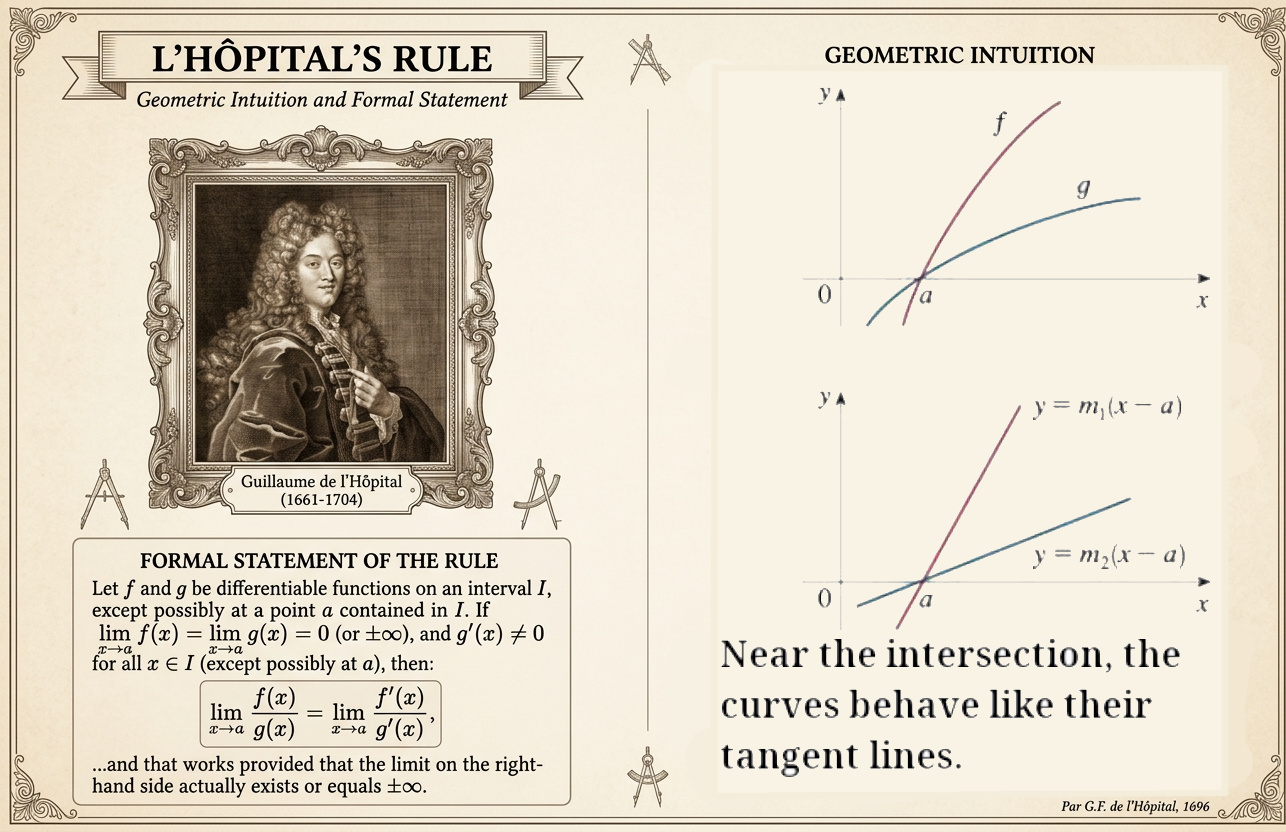
Let $f$ and $g$ be differentiable functions on an interval $I$, except possibly at a point $a$ contained in $I$. If $\lim_{x \to a} f(x) = \lim_{x \to a} g(x) = 0$ (or $\pm \infty$), and $g'(x) \neq 0$ for all $x \in I$ (except possibly at $a$), then: $\boxed{\lim_{x \to a} \frac{f(x)}{g(x)} = \lim_{x \to a} \frac{f'(x)}{g'(x)}}$, and that works provided that the limit on the right-hand side actually exists or equals $\pm \infty$.
Let’s look at how L’Hôpital’s rule tackles different flavors of indeterminate forms.
$\lim_{x \to 0} \frac{e^x - 1}{x^2 + x}$
Check: Plug in 0 → $\frac{1-1}{0} = \frac{0}{0}$.
L’Hôpital: $\lim_{x \to 0} \frac{\frac{d}{dx}(e^x - 1)}{\frac{d}{dx}(x^2 + x)} = \lim_{x \to 0} \frac{e^x}{2x + 1} = \frac{1}{1} = 1.$
$\lim_{x \to \infty} \frac{3x^2 - 2x + 1}{4x^3 - 6x + 1}$
Check: As $x \to \infty$, we get $\frac{\infty}{\infty}$.
L’Hôpital (1st time): $\lim_{x \to \infty} \frac{6x - 2}{12x^2 - 6}$ (Still $\frac{\infty}{\infty}$)
L’Hôpital (2nd time): $\lim_{x \to \infty} \frac{6}{24x} = 0.$
When you encounter forms like $0 \cdot \infty$ or $\infty - \infty$, you cannot apply L’Hôpital’s rule immediately. You must rewrite them as fractions first.
($0 \cdot -\infty$): $\lim_{x \to 0^+} x \ln(x)$
Check: $0 \cdot (-\infty)$.
Transformation: Rewrite $x$ as $\frac{1}{1/x}$. Now we have $\lim_{x \to 0^+} \frac{\ln(x)}{1/x}$, which is $\frac{-\infty}{\infty}$.
L’Hôpital: $\lim_{x \to 0^+} \frac{1/x}{-1/x^2} = \lim_{x \to 0^+} (-x) = 0.$
($\infty - \infty$): $\lim_{x \to 1^+} \left( \frac{x}{x - 1} - \frac{1}{\ln(x)} \right)$
Check: $\infty - \infty$. Find a common denominator to force a fraction.
Transformation: $\lim_{x \to 1^+} \frac{x\ln(x) - (x - 1)}{(x - 1)\ln(x)}$. This is now $\frac{0}{0}$.
L’Hôpital (1st time): $\lim_{x \to 1^+} \frac{\ln(x) + x(\frac{1}{x}) - 1}{\ln(x) + (x - 1)(\frac{1}{x})} = \lim_{x \to 1^+} \frac{\ln(x)}{\ln(x) + 1 - \frac{1}{x}}$. (Still $\frac{0}{0}$).
L’Hôpital (2nd time): $\lim_{x \to 1^+} \frac{1/x}{1/x + 1/x^2}$. Plug in $x=1 \to \frac{1}{1 + 1} = \frac{1}{2}.$
When dealing with trigonometric limits near zero, Taylor series approximations can often bypass L’Hôpital entirely! For $x \approx 0$:
So, instead of L’Hôpital, you could evaluate $\lim_{x \to 0} \frac{\sin(3x)}{\sin(2x)}$ simply as $\frac{3x}{2x} = \frac{3}{2}$. Similarly: $\lim_{x \to 0} \frac{\cos(x) - 1}{x^2} \approx \frac{(1 - x^2/2) - 1}{x^2} = \frac{-x^2/2}{x^2} = -\frac{1}{2}$.
Obviously, $\lim_{x \to 0}\frac{cos(x)-1}{x^2}$ =[L’Hôpital’s Rule, indeterminate form 0/0] $\lim_{x \to 0}\frac{-sin(x)}{2x}$ = [There may be instances where we would need to apply L’Hôpital’s Rule multiple times] $\lim_{x \to 0}\frac{-cos(x)}{2} = \frac{-1}{2}.$. Similarly, $\lim_{x \to 0}\frac{sin(3x)}{sin(2x)}$ =[L’Hôpital’s Rule, indeterminate form 0/0] $\lim_{x \to 0}\frac{3cos(3x)}{2cos(2x)} =\frac{3cos(0)}{2cos(0)}=\frac{3}{2}.$
L’Hôpital’s Rule is powerful, but it is not a magic wand for every fraction. You must verify the indeterminate form ($\frac{0}{0}$ or $\frac{\infty}{\infty}$) first!
The False Application:
If you blindly apply L’Hôpital’s Rule without checking: $\lim_{x \to 0} \frac{1 + \cos(x)}{1 - \sin(x)} = \frac{1 + 1}{1 - 0} = 2$.
This is completely wrong. Why? Because if we just use direct substitution initially: $\frac{0 + \sin(0)}{0 + \cos(0)} = \frac{0}{1} = 0$.
Because the limit was not indeterminate to begin with, L’Hôpital’s Rule yields a false result.
Consider $\lim_{x \to 0^+} \frac{\sin(x)}{x^2}$.
If we try L’Hôpital: $\lim_{x \to 0^+} \frac{\cos(x)}{2x}$.
If we apply L’Hôpital a second time (without checking!): $\lim_{x \to 0^+} \frac{-\sin(x)}{2} = 0$.
There is something very fishy 🐟🐬 here. If we use the approximation $\sin(x) \approx x$, we get $\frac{x}{x^2} = \frac{1}{x}$, which clearly shoots to $\infty$ as $x \to 0^+$.
What went wrong? The step where we got $\frac{\cos(x)}{2x}$ evaluates to $\frac{1}{0}$. This is not an indeterminate form —it’s a massive clue that the limit approaches infinity! Because $\frac{1}{0}$ is not $\frac{0}{0}$ or $\frac{\infty}{\infty}$, applying L’Hôpital that second time was illegal.
$\lim_{x \to 0^+} (\frac{1}{x}-\frac{1}{1-\cos(x)}) =$[We are evaluating a limits of an indeterminate form. It seems that L’Hôpital’s Rule does not apply.] $ \lim_{x \to 0^+} (\frac{1-cos(x)-x}{x - x\cos(x)}) =$ [L’Hospital Rule, 0/0] $\lim_{x \to 0^+} \frac{\sin(x)-1}{1-(\cos(x)+x(-\sin(x)))} = \lim_{x \to 0^+} \frac{sin(x)-1}{1-\cos(x) + x\sin(x)} = \frac{-1}{1-1+0}=-\infty.$
$\lim_{x \to 0^+} \csc(x) \cdot \ln(1-\sin(x)) =$[We are evaluating a limits of an indeterminate form, ∞·0. It seems that L’Hôpital’s Rule does not apply. Rewrite the product] $\lim_{x \to 0^+} \frac{\ln(1-\sin(x))}{\sin(x)}$ = [L’Hôpital’s Rule] $\lim_{x \to 0^+} \frac{\frac{1}{1-\sin(x)}\cdot-\cos(x)}{\cos(x)} = \lim_{x \to 0^+} \frac{-1}{1-\sin(x)} = \frac{-1}{1} = -1.$
$\lim_{x \to 0^+} (\frac{1}{sin(x)}-\frac{1}{x})$ [It seems that L’Hôpital’s Rule does not apply, ∞-∞] = $\lim_{x \to 0^+} \frac{x-sin(x)}{xsin(x)} = $[L’Hôpital’s Rule, 0/0] $\lim_{x \to 0^+} \frac{1-cos(x)}{sin(x)+x·cos(x)} = $[L’Hôpital’s Rule, 0/0] $\lim_{x \to 0^+} \frac{-(-sin(x))}{cos(x)+cos(x)+x(-sin(x))} = \lim_{x \to 0^+} \frac{-sin(x)}{2cos(x)-xsin(x)} = \frac{0}{2} = 0.$

JustToThePoint Copyright © 2011 - 2026 Anawim. ALL RIGHTS RESERVED. Bilingual e-books, articles, and videos to help your child and your entire family succeed, develop a healthy lifestyle, and have a lot of fun. Social Issues, Join us.
This website uses cookies to improve your navigation experience.
By continuing, you are consenting to our
use of cookies, in accordance with our Cookies Policy and
Website Terms and Conditions of use.