Beneath this mask there is more than flesh. Beneath this mask there is an idea, Mr. Creedy, and ideas are bulletproof, V for Vendetta.
Core Calculus Concepts: The Antiderivative
In calculus, an antiderivative (or indefinite integral) of a function $f(x)$ is a function $G(x)$ that can be differentiated to obtain the original function. In mathematical terms, if $G'(x) = f(x)$, then, $G(x) = \int f(x)dx$
This operation is the fundamental inverse of differentiation.
Trigonometry Fundamentals
Trigonometry deals with the relationships between the sides and angles of triangles, particularly right-angled ones. These relationships form the foundation for much of advanced calculus.
Main Definitions & Identities
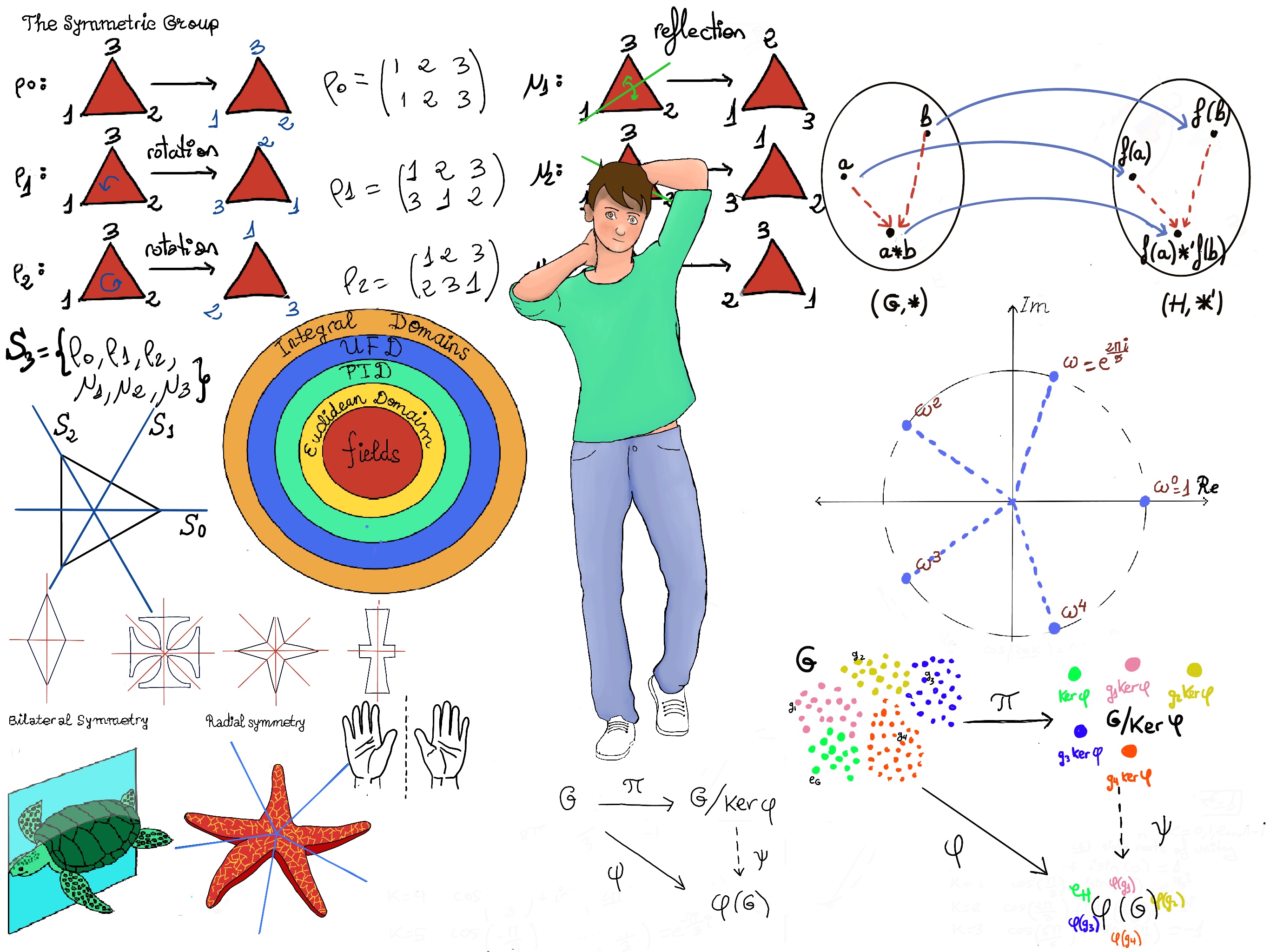
Here are some of the main important trigonometric definitions and formulas.
-
Functions of Right Triangles. $\sin(\theta) = \frac{\text{opposite}}{\text{hypotenuse}}, \cos(\theta) = \frac{\text{adjacent}}{\text{hypotenuse}}, \tan(\theta) = \frac{\sin(\theta)}{\cos(\theta)} = \frac{\text{opposite}}{\text{adjacent}}$.
$\cot(\theta) = \frac{1}{\tan(\theta)}, \sec(\theta) = \frac{1}{\cos(\theta)}, \csc(\theta) = \frac{1}{\sin(\theta)}$
-
Pythagorean Identities.
These are derived directly from the Pythagorean theorem ($a^2 + b^2 = c^2$) applied to the unit circle.
$\sin^2(θ) + \cos^2(θ) = 1, 1 + \tan^2(θ) = \sec^2(θ), 1 + \cot^2(θ) = \csc^2(x)$
-
Complementary angles: $\sin\left(\frac{\pi}{2} - x\right) = \cos(x), \cos\left(\frac{\pi}{2} - x\right) = \sin(x), \tan\left(\frac{\pi}{2} - x\right) = \cot(x), \cot\left(\frac{\pi}{2} - x\right) = \tan(x), \sec\left(\frac{\pi}{2} - x\right) = \csc(x), \csc\left(\frac{\pi}{2} - x\right) = \sec(x).$
-
Addition and Subtraction Formulas: $\sin(x \pm y) = \sin(x)\cos(y) \pm \cos(x)\sin(y), \cos(x \pm y) = \cos(x)\cos(y) \mp \sin(x)\sin(y), \tan(x \pm y) = \frac{\tan(x) \pm \tan(y)}{1 \mp \tan(x)\tan(y)}.$
-
Double Angle Formulas: $\sin(2θ) = 2\sin(θ)\cos(θ), \cos(2θ) = \cos^2(θ) - \sin^2(θ) = 2\cos^2(θ) - 1 = 1 - 2\sin^2(θ), tan(2θ) = \frac{2\tan(θ)}{1 - \tan^2(θ)}.$
-
Deriving Half-Angle Formulas:
From the double angle formula for cosine: $\cos(2\theta) = 2\cos^2(\theta) - 1$
We can isolate $\cos^2(\theta)$: $2\cos^2(\theta) = 1 + \cos(2\theta)$
$\cos^2(\theta) = \frac{1 + \cos(2\theta)}{2}$
This leads directly to the half-angle formulas useful for integration power reduction.
-
Half-Angle Formulas: $\sin^2\left(\frac{θ}{2}\right) = \frac{1 - \cos(θ)}{2} ↭ \sin(\frac{θ}{2}) = ±\sqrt{\frac{1 - \cos(θ)}{2}}, \cos^2\left(\frac{θ}{2}\right) = \frac{1 + \cos(θ)}{2} ↭ \cos(\frac{θ}{2}) = ±\sqrt{\frac{1 + \cos(θ)}{2}}, \tan\left(\frac{θ}{2}\right) = \frac{1 - \cos(θ)}{\sin(θ)} = \frac{\sin(θ)}{1 + \cos(θ)}.$
-
Derivatives of Trigonometric Formulas.
$\frac{d}{dx}\sin(x) = \cos(x), \frac{d}{dx}\cos(x) = -\sin(x), \frac{d}{dx}\tan(x) = \sec^2(x)$
$\frac{d}{dx}\sec(x) = \sec(x)\tan(x), csc'(x) = -\csc(x) \cot(x), \cot'(x) = -\csc^2(x)$.
-
Integration formulas for trigonometry.
$\int \sin(x)dx = -\cos(x) + C; \int \cos(x)dx = \sin(x) + C; \int \tan(x)dx = -\ln|\cos(x)| + C$.
$\int \cot(x)dx = \ln|\sin(x)| + C; \int \sec(x)dx = \ln|\sec(x) + \tan(x)| + C; \int \csc(x)dx = -\ln|\csc(x) + \cot(x)| + C, \int sec(x)tan(x)dθ = sec(x) + C$
Trigonometry substitution for integrals.
Trigonometric substitution is a powerful technique used in calculus to simplify and solve integrals involving radical expressions by exploiting Pythagorean identities.
- Identify the form of the radical expression in the integral.
- Choose a trigonometric function based on the form of the expression, e.g., if $\sqrt{a^2-x^2}$ is present consider using $x = a\cos(\theta)$ or $x = a\sin(\theta)$ to get $a\sin(\theta)$ or $a\cos(\theta)$ respectively.
Similarly, if $\sqrt{a^2+x^2}$ is present, consider taking $x = a\tan(\theta)$ to get $asec(\theta)$.
Recall $sec^2(x) = 1 + tan^2(x) \implies a^2+x^2 = a^2(1 + \tan^2(\theta)) = a^2 sec^2(\theta)$.
Finally, if $\sqrt{x^2-a^2}$ is present consider using $x = a\sec(\theta)$, because $x^2-a^2 = a^2(\sec^2(\theta)-1) = a^2\tan^2(\theta)$.
- Substitute the chosen trigonometric function into the expression, expressing the indefinite variable x in terms of the trigonometric function.
- Adjust the differential dx based on the chosen substitution, e.g., if $x = a\sin(theta) \implies dx = a\cos(\theta)d\theta$.
- Substitute and simplify the expression involving trigonometric functions and the adjusted differential into the original integral.
- Integrate the simplified expression with respect to the new variable ($\theta$).
- After integration is completed, back-substitute the original variable x in terms of $\theta$. Simplify the expression further, if necessary, and include any constants of integration.
Completing the square
It is another technique often used in calculus to simplify complex expressions to make integration more manageable.
- Identify the “problematic” expression, e.g., if the integral is $\int \frac{dx}{\sqrt{x^2+4x}}$, the difficult expression would be $x^2+4x$.
- If the coefficient of the quadratic term is not 1, factor it out, that is, divide every term by the coefficient of the quadratic term.
- Complete the square, rewrite our expression as $(x + a)^2 + c$, e.g., $x^2 + 4x = (x + 2)^2 -4$.
- Make the substitution, e.g., $u = x + 2, du = dx$, so $x^2 + 4 = (x + 2)^2 -4 = u^2 -4$, and rewrite the integral, $\frac{du}{\sqrt{u^2-4}}$.
- Simplify the integral, integrate, and back-substitute the original variable.
In our case, we use trigonometric substitution, as it was previously mentioned, $u = 2\sec(\theta), du = 2\sec(\theta)\tan(\theta)d\theta$.
$\int \frac{du}{\sqrt{u^2-4}}$ =[$u^2-4 = 4\sec^2(\theta) -4 = 4(\sec^2(\theta)-1) = 4\tan^2(\theta)$] $\int \frac{2\sec(\theta)\tan(\theta)d\theta}{\sqrt{4\tan^2(\theta)}} = \int \frac{2\sec(\theta)\tan(\theta)d\theta}{2\tan(\theta)} = \int \sec(\theta)d\theta$ = $ln|\sec(\theta)+\tan(\theta)| + C $
Back-substitute. $u=2\sec(\theta) \implies \sec(\theta)=\frac{u}{2}, u^2-4 = 4\tan^2(\theta)\implies \tan^2(\theta) = \frac{u^2-4}{4}$.
Therefore, $\int \frac{du}{\sqrt{u^2-4}} = ln|\sec(\theta)+\tan(\theta)| + C = ln|\frac{u}{2}+\frac{\sqrt{u^2-4}}{2}| + C$ =[$u = x + 2$] $ln|\frac{x+2}{2}+\frac{\sqrt{x^2+4x}}{2}|+C.$
Exercises
- Evaluate: $\int \tan(x)dx$
- Rewrite tangent in terms of sine and cosine: $\int \frac{\sin(x)}{\cos(x)}dx$
- Use standard u-substitution. Let $u = \cos(x)$.
Then, $du = -\sin(x)dx$, which means $-du = \sin(x)dx$.
- Substitute these into the integral: $\int \frac{-du}{u} = -\int \frac{1}{u}du = -\ln\vert{}u\vert{} + C$
- Back-substitute $u = \cos(x)$: $-\ln\vert{}\cos(x)\vert{} + C$
- Evaluate $\int \sqrt{1-x^2}dx$
- This requires trig substitution (Form: $\sqrt{a^2 - x^2}$ where $a=1$).
Let $x = \sin(\theta) \Rightarrow dx = \cos(\theta)d\theta$.
$\int \sqrt{1-\sin^2(\theta)}\cos(\theta)d\theta = \int \sqrt{\cos^2(\theta)}\cos(\theta)d\theta = \int \cos^2(\theta)d\theta$
- Use the half-angle (power-reducing) formula: $\cos^2(\theta) = \frac{1}{2}(1+\cos(2\theta))$.
$\frac{1}{2}\int (1+\cos(2\theta))d\theta = \frac{1}{2}\left(\theta+\frac{1}{2}\sin(2\theta)\right)+C$
- Expand $\sin(2\theta)$ using the double-angle formula ($\sin(2\theta) = 2\sin(\theta)\cos(\theta)$):
$\frac{1}{2}\theta + \frac{1}{2}\sin(\theta)\cos(\theta) + C$
- Backtracking the substitution (using a reference triangle, Figure 3):
Since $x = \sin(\theta)$, we know $\theta = \sin^{-1}(x)$.
From a right triangle where the opposite side is $x$ and hypotenuse is $1$, the adjacent side is $\sqrt{1-x^2}$. Therefore, $\cos(\theta) = \sqrt{1-x^2}$.
- Substituting these back in yields the final answer: $\frac{1}{2}\sin^{-1}(x) + \frac{1}{2}x\sqrt{1-x^2} + C$

- Evaluate $\int \sec(x)dx$.
- This is definitely not an easy one to come up with on your own 😃! The secret is to multiply the numerator and the denominator by a very specific term: $\sec(x) + \tan(x)$.
Multiply the function by $1$ in the form of $\frac{\sec(x) + \tan(x)}{\sec(x) + \tan(x)}$:
$\int \sec(x) \left( \frac{\sec(x) + \tan(x)}{\sec(x) + \tan(x)} \right) dx = \int \frac{\sec^2(x) + \sec(x)\tan(x)}{\sec(x) + \tan(x)} dx$
- Now, use a standard $u$-substitution. Let $u = \sec(x) + \tan(x)$.
Taking the derivative, we know that $(\tan(x))' = \sec^2(x)$ and $(\sec(x))' = \sec(x)\tan(x)$.
Therefore, $du = (\sec(x)\tan(x) + \sec^2(x))dx$.
Notice that our $du$ perfectly matches the entire numerator! The integral simplifies beautifully: $\int \frac{1}{u}du = \ln\vert{}u\vert{} + C$
- Substituting $u$ back in gives the final result: $\int \sec(x)dx = \ln\vert{}\sec(x) + \tan(x)\vert{} + C$
- Advanced Trigonometric Substitution. Evaluate $\int \frac{\sqrt{x^2+1}}{x}dx$
- Because we see the form $\sqrt{x^2 + 1}$, we use the substitution $x = \tan(\theta)$. This means $dx = \sec^2(\theta)d\theta$.
- Substitute and Simplify: $\int \frac{\sqrt{\tan^2(\theta)+1}}{\tan(\theta)}\sec^2(\theta)d\theta$
Recall the Pythagorean identity: $\sec^2(\theta) = 1 + \tan^2(\theta)$.
$\int \frac{\sqrt{\sec^2(\theta)}}{\tan(\theta)}\sec^2(\theta)d\theta = \int \frac{\sec(\theta)}{\tan(\theta)}\sec^2(\theta)d\theta$
- Manipulate the Trigonometry: $\int \frac{\sec(\theta)}{\tan(\theta)}\sec^2(\theta)d\theta = \int \csc(\theta) (1 + \tan^2(\theta)) = \int (\csc(\theta) + \csc(\theta)\tan^2(\theta))d\theta = \int \csc(\theta)d\theta + \int \sec(\theta)\tan(\theta)d\theta$
- Integrate:
A standard result is: $\int \csc(\theta)d\theta = \ln\vert{}\csc(\theta)+\cot(\theta)\vert{}$.
Using log properties, this can also be written (equivalently) as: $\int \csc(\theta)d\theta = \ln\vert{}\csc(\theta)-\cot(\theta)\vert{}$.
Integrate $\int \sec(\theta)\tan(\theta)d\theta = \sec(\theta)$
Combine the results, $= \ln\vert{}\csc(\theta)-\cot(\theta)\vert{} + \sec(\theta) + C$
- Backtrack the Substitution (Figure 2):
$\frac{x}{1} = tan(θ).$ By the Pythagorean theorem, $1^2+x^2 = h^2 \implies h = \sqrt{1+x^2}$.
Using this triangle, we find the remaining functions:
$\csc(\theta) = \frac{\text{Hypotenuse}}{\text{Opposite}} = \frac{\sqrt{x^2+1}}{x}$
$\cot(\theta) = \frac{\text{Adjacent}}{\text{Opposite}} = \frac{1}{x}$
$\sec(\theta) = \frac{\text{Hypotenuse}}{\text{Adjacent}} = \sqrt{x^2+1}$
- Substitute these into our integrated answer:
$\int \frac{\sqrt{x^2+1}}{x}dx = \ln\vert{}\csc(\theta)-\cot(\theta)\vert{} + \sec(\theta) + C = ln|\frac{\sqrt{1+x^2}}{x}-\frac{1}{x}|+\frac{\sqrt{1+x^2}}{1}+C = ln|\frac{\sqrt{1+x^2}-1}{x}|+\sqrt{1+x^2}+C.$
Integrating Powers of Sine and Cosine
When dealing with integrals of the form $\int \sin^n(x)\cos^m(x)dx$, the strategy depends on whether the powers ($n$ and $m$) are odd or even.
Case 1: Odd Powers (Peel and Substitute)
If one of the powers is odd, “peel off” one of those trig functions to serve as your $du$, convert the rest using $\sin^2(x) + \cos^2(x) = 1$, and use standard $u$-substitution.
- $\int \sin^n(x)\cos(x)dx$
- Here, cosine has an odd power ($1$).
Let $u = \sin(x)$, so $du = \cos(x)dx$.
- $\int u^ndu = \frac{u^{n+1}}{n+1} + C = \frac{\sin^{n+1}(x)}{n+1} + C$
- $\int \sin^3(x)\cos^2(x)dx$
- Sine has an odd power ($3$).
Peel off one $\sin(x)$ to keep for $du$: $\int \sin^2(x)\cos^2(x)\sin(x)dx$
Convert the remaining sines to cosines: $\sin^2(x) = 1 - \cos^2(x)$.
$\int (1-\cos^2(x))\cos^2(x)\sin(x)dx = \int (\cos^2(x)-\cos^4(x))\sin(x)dx$
- Let $u = \cos(x)$, so $du = -\sin(x)dx$ (which means $-du = \sin(x)dx$).
$\int (u^2-u^4)(-du) = \int (u^4 - u^2)du = \frac{u^5}{5} - \frac{u^3}{3} + C = \frac{\cos^5(x)}{5} - \frac{\cos^3(x)}{3} + C$
- Odd power. Peel off one sine.
$\int (1-\cos^2(x))\sin(x)dx$
- Let $u = \cos(x)$, $du = -\sin(x)dx$.
$\int (1-u^2)(-du) = \int (u^2 - 1)du = \frac{u^3}{3} - u + C$
$= \frac{\cos^3(x)}{3} - \cos(x) + C$
If both powers are even, you cannot easily peel one off. Instead, reduce the powers using the half-angle formulas: $\sin^2(x) = \frac{1 - \cos(2x)}{2}$ and $\cos^2(x) = \frac{1 + \cos(2x)}{2}$.
- Apply the half-angle formula, $\int \frac{1+\cos(2x)}{2}dx = \int \frac{1}{2}dx + \int \frac{\cos(2x)}{2}dx$
- Let $u = 2x$, $du = 2dx$ for the second term.
$= \frac{x}{2} + \frac{\sin(2x)}{4} + C$
- $\int \sin^2(x)\cos^2(x)dx$
- Apply the half-angle formulas to both: $\int \left(\frac{1-\cos(2x)}{2}\right) \left(\frac{1+\cos(2x)}{2}\right)dx$
- Multiply them together (difference of squares): $= \int \frac{1-\cos^2(2x)}{4}dx$
- We still have an even power! Apply the half-angle formula again on $\cos^2(2x) = \frac{1+\cos(4x)}{2}$: $= \frac{1}{4} \int \left(1 - \frac{1+\cos(4x)}{2}\right)dx = \frac{1}{4} \int \left(\frac{1}{2} - \frac{\cos(4x)}{2}\right)dx$
$= \int \left(\frac{1}{8} - \frac{\cos(4x)}{8}\right)dx$
$= \frac{x}{8} - \frac{\sin(4x)}{32} + C = \frac{1}{8}\left(x - \frac{\sin(4x)}{4}\right) + C$
Bibliography
This content is licensed under a Creative Commons Attribution-NonCommercial-ShareAlike 4.0 International License and is based on MIT OpenCourseWare [18.01 Single Variable Calculus, Fall 2007].
- NPTEL-NOC IITM, Introduction to Galois Theory.
- Algebra, Second Edition, by Michael Artin.
- LibreTexts, Calculus and Calculus 3e (Apex). Abstract and Geometric Algebra, Abstract Algebra: Theory and Applications (Judson).
- Field and Galois Theory, by Patrick Morandi. Springer.
- Michael Penn, Andrew Misseldine, blackpenredpen, and MathMajor, YouTube’s channels.
- Contemporary Abstract Algebra, Joseph, A. Gallian.
- MIT OpenCourseWare, 18.01 Single Variable Calculus, Fall 2007 and 18.02 Multivariable Calculus, Fall 2007, YouTube.
- Calculus Early Transcendentals: Differential & Multi-Variable Calculus for Social Sciences.