Winners never quit and quitters never win. Football is like life - it requires perseverance, self-denial, hard work, sacrifice, dedication and respect for authority, Vince Lombardi.
Core Calculus Concepts: The Antiderivative
In calculus, an antiderivative (or indefinite integral) of a function $f(x)$ is a function $G(x)$ that can be differentiated to obtain the original function. In mathematical terms, if $G'(x) = f(x)$, then, $G(x) = \int f(x)dx$
This operation is the fundamental inverse of differentiation.
There are several techniques used for integration, each suited to different types of integrals. The most common methods include U-Substitution (or change of variables), Integration by Parts, Trigonometric Substitution, Partial Fraction Decomposition, Improper Integrals, and the use of special functions.
Before diving into Integration by Parts, let’s briefly touch on the first major tool in your toolkit: U-Substitution. The general form of an integrand that requires U-Substitution is $\int f(g(x))g'(x) \, dx$. This can be cleanly rewritten as $\int f(u) \, du$. A big hint to use U-Substitution is when you spot a composition of functions where the derivative of the inner function is also present in the integrand (essentially, it’s the reverse chain rule).
Integration by parts
Integration by parts is a powerful technique used primarily to integrate the product of two functions. Just as U-Substitution is the reverse of the chain rule, Integration by Parts is the reverse of the product rule.
The product rule for derivatives states that the derivative of a product of two functions is the first times the derivative of the second, plus the second times the derivative of the first: $(uv)' = u'v + uv'$
If we rearrange this to isolate $uv'$ ($uv' = (uv)' - u'v$) and integrate both sides with respect to $x$, we get the fundamental formula for integration by parts: $\boxed{\int u \, dv = uv - \int v \, du}$, e.g., $\int \ln(x) dx = [u = \ln(x), u' = \frac{1}{x}dx, v = x, v' = dx] x\ln(x) -\int \frac{1}{x} x dx = x\ln(x) -x + C.$

Solved exercises
$\int \frac{\ln(x)}{x^2}$
- We are going to use Integration by Parts ($\int u \, dv = uv - \int v \, du$)
- Let $u = \ln(x)$ $\implies du = \frac{1}{x} dx$ and $dv = \frac{1}{x^2} dx$ $\implies v = -\frac{1}{x}$
- Now apply the parts formula: $\int \frac{\ln(x)}{x^2} dx = \ln(x) \left(-\frac{1}{x}\right) - \int \left(-\frac{1}{x}\right) \left(\frac{1}{x}\right) dx = -\frac{\ln(x)}{x} + \int \frac{1}{x^2} dx = -\frac{\ln(x)}{x} - \frac{1}{x} + C$
- Conclusion: $\int \frac{\ln(x)}{x^2} = -\frac{\ln(x) + 1}{x} + C$
$\int x\sec^2(x)$
- We are going to use Integration by Parts ($\int u \, dv = uv - \int v \, du$)
- Let $u = x$ $\implies du = dx$ and $dv = \sec^2(x) dx$ $\implies v = \tan(x)$
- Now apply the parts formula: $\int x\sec^2(x) dx = x\tan(x) - \int \tan(x) dx$
Recall that the integral of $\tan(x)$ is $-\ln\vert{}\cos(x)\vert{}$.
$= x\tan(x) - (-\ln\vert{}\cos(x)\vert{}) + C$
- Conclusion: $\int x\sec^2(x) = x\tan(x) + \ln\vert{}\cos(x)\vert{} + C$
$\int e^x\sin(x)$
- We are going to use Repeated Integration by Parts ($\int u \, dv = uv - \int v \, du$)
- First Pass. Let $u = \sin(x)$ $\implies du = \cos(x) dx$ and $dv = e^x dx$ $\implies v = e^x$
- Now apply the parts formula: $\int e^x\sin(x) dx = e^x\sin(x) - \int e^x\cos(x) dx$
- Second Pass (for $\int e^x\cos(x) dx$):
Let $u = \cos(x)$ $\implies du = -\sin(x) dx$ and $dv = e^x dx$ $\implies v = e^x$
$\int e^x\cos(x) dx = e^x\cos(x) - \int e^x(-\sin(x)) dx = e^x\cos(x) + \int e^x\sin(x) dx$
- Substituting back: $\int e^x\sin(x) dx = e^x\sin(x) - \left( e^x\cos(x) + \int e^x\sin(x) dx \right)$
$2 \int e^x\sin(x) dx = e^x\sin(x) - e^x\cos(x)$. This is a Cyclic Integral.
- Conclusion (Solve for $I = \int e^x\sin(x) dx$): $\int e^x\sin(x) = \frac{1}{2}e^x(\sin(x) - \cos(x)) + C$
Definite Integral of $x^{\frac{1}{2}}\ln(2x)$ from 1 to 4
- We are going to use Repeated Integration by Parts ($\int u \, dv = uv - \int v \, du$)
- Let $u = \ln(2x)$ $\implies du = \frac{1}{x} dx$ and $dv = x^{\frac{1}{2}} dx$ $\implies v = \frac{2}{3}x^{\frac{3}{2}}$
- Now apply the parts formula: $\int_{1}^{4} x^{\frac{1}{2}}\ln(2x) dx = \left[ \frac{2}{3}x^{\frac{3}{2}}\ln(2x) \right]_{1}^{4} - \int_{1}^{4} \frac{2}{3}x^{\frac{3}{2}}\left(\frac{1}{x}\right) dx$
$= \left[ \frac{2}{3}x^{\frac{3}{2}}\ln(2x) \right]_{1}^{4} - \frac{2}{3}\int_{1}^{4} x^{\frac{1}{2}} dx = \left[ \frac{2}{3}x^{\frac{3}{2}}\ln(2x) - \frac{4}{9}x^{\frac{3}{2}} \right]_{1}^{4}$
- Evaluating limits:
Upper bound (4): $\frac{2}{3}(8)\ln(8) - \frac{32}{9} = 16\ln(2) - \frac{32}{9}$
Lower bound (1): $\frac{2}{3}(1)\ln(2) - \frac{4}{9} = \frac{2}{3}\ln(2) - \frac{4}{9}$
- Conclusion: $\int_{1}^{4} x^{\frac{1}{2}}\ln(2x) = \frac{46}{3}\ln(2) - \frac{28}{9} \approx 7.51$
$\int \arcsin(x)$
- We are going to use Integration by Parts ($\int u \, dv = uv - \int v \, du$) followed by U-Substitution.
- Let $u = \arcsin(x)$ $\implies du = \frac{1}{\sqrt{1-x^2}} dx$ and $dv = dx$ $\implies v = x$
- $\int \arcsin(x) dx = x\arcsin(x) - \int \frac{x}{\sqrt{1-x^2}} dx$
- To calculate $\int \frac{x}{\sqrt{1-x^2}} dx$, we are going to use U-Substitution: Let $w = 1 - x^2$, so $dw = -2x dx \implies -\frac{1}{2}dw = x dx$.
- $- \int \frac{x}{\sqrt{1-x^2}} dx = - \left( -\frac{1}{2} \right) \int w^{-\frac{1}{2}} dw = \frac{1}{2} (2w^{\frac{1}{2}}) = \sqrt{1-x^2}$
- Conclusion: $\int \arcsin(x) = x\arcsin(x) + \sqrt{1-x^2} + C$
Volume of an Exponential Wineglass
Problem: Find the volume of the solid generated by rotating $y = e^x$ around the y-axis between $y = 1$ and $y = e$.
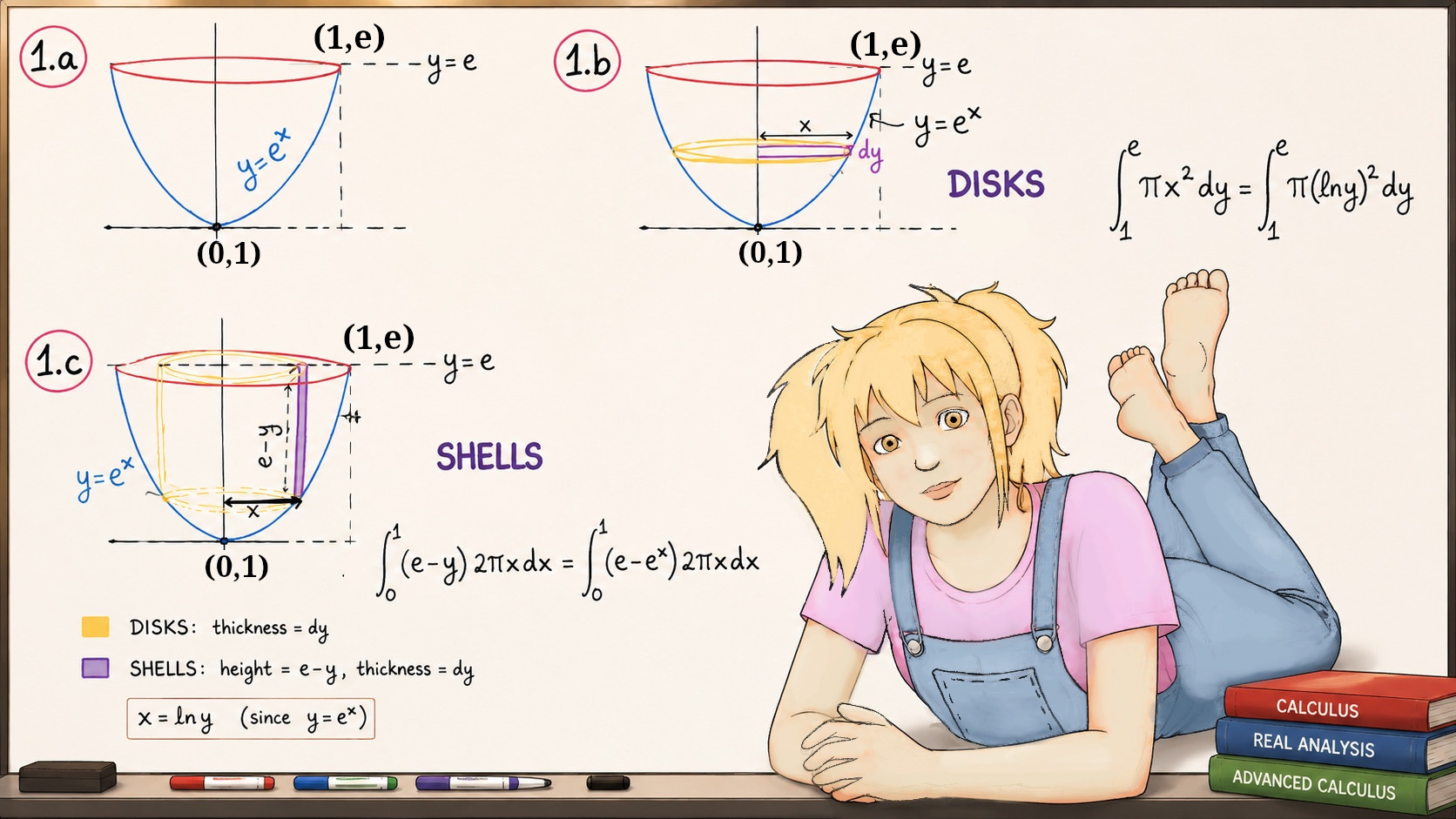
We can solve this using two different perspectives to verify the result:
- Method A: Horizontal Slicing (Disk Method). Since we are rotating around the y-axis, we integrate with respect to $y$.
- Function: $y = e^x \implies x = \ln(y)$. Radius: $R(y) = \ln(y)$
- $V = \int_{1}^{e} \pi x^2 = \int_{1}^{e} \pi (\ln(y))^2 dy = \pi \int_{1}^{e} (\ln(y))^2 dy$
- $\int (\ln(y))^2 dy$. First integration by parts reduces the power of the logarithm.
Let $u = (\ln(y))^2, dv = dy$. Then, $du = \frac{2\ln(y)}{y}dy$, and v = y.
This gives, $\int (\ln(y))^2 dy = y(\ln(y))^2 - 2\int \ln(y) dy$.
- Second integration by parts removes the remaining logarithm.
Let $u = \ln(y), dv = dy$. Then, $du = \frac{1}{y}dy, v = y$.
This gives, $\int \ln(y) dy = y\ln(y) - \int dy = y\ln(y) - y.$
- Substitute back: $\int (\ln(y))^2 dy = y(\ln(y))^2 - 2(y\ln(y) - y) = y(\ln(y))^2 - 2y\ln(y) + 2y + C$
- Evaluating from 1 to $e$: $V = \pi \left[ e(1)^2 - 2(e(1) - e) \right] - \pi \left[ 1(0)^2 - 2(1(0) - 1) \right] = \pi e - 2\pi$
- Volume: $\pi(e-2)$
Similarly,
- Method B: Vertical Slicing (Cylindrical Shells).
When rotating around the y-axis, we integrate with respect to $x$. The limits for $x$ corresponding to $y=1$ and $y=e$ are $x=0$ to $x=1$.
Radius: $x$ and Height: $e - y = (e - e^x)$
- $V = \int_{0}^{1} 2\pi x (e - e^x) dx = 2\pi e \int_{0}^{1} x dx - 2\pi \int_{0}^{1} xe^x dx$
- Evaluating the integrals: $= 2\pi e \left[ \frac{x^2}{2} \right]_{0}^{1} - 2\pi \left[ xe^x - e^x \right]_{0}^{1} = \pi e - 2\pi(e - e) + 2\pi(0 - 1) = \pi e - 2\pi = \pi(e-2)$. Both methods obviously confirm the same result.
$\int x\arctan(x)$
- We are going to use Integration by Parts ($\int u \, dv = uv - \int v \, du$) and Algebraic Manipulation.
- Let: $u = \arctan(x)$ $\implies du = \frac{1}{1+x^2} dx$ and $dv = x \, dx$ $\implies v = \frac{x^2}{2}$
- Apply the integration by parts formula: $\int x\arctan(x) dx = \frac{x^2}{2}\arctan(x) - \int \frac{x^2}{2} \left(\frac{1}{1+x^2}\right) dx = \frac{x^2}{2}\arctan(x) - \frac{1}{2} \int \frac{x^2}{1+x^2} dx$
- Algebraic Trick: To solve the remaining integral, rewrite the numerator $x^2$ by adding and subtracting 1: $\frac{x^2}{1+x^2} = \frac{x^2 + 1 - 1}{1+x^2} = \frac{x^2+1}{1+x^2} - \frac{1}{1+x^2} = 1 - \frac{1}{1+x^2}$.
- Substitute this back into the integral: $\int x\arctan(x) dx = \frac{x^2}{2}\arctan(x) - \frac{1}{2} \int \left( 1 - \frac{1}{1+x^2} \right) dx = \frac{x^2}{2}\arctan(x) - \frac{1}{2}x + \frac{1}{2}\arctan(x) + C$
- Conclusion (Factoring out the arctangent terms): $\int x\arctan(x) = \frac{1}{2}(x^2+1)\arctan(x) - \frac{x}{2} + C$
$\int x^3\ln(x)$
- We are going to use Integration by Parts ($\int u \, dv = uv - \int v \, du$).
- Using the LIATE rule (Logarithmic, Inverse trig, Algebraic, Trigonometric, Exponential) to choose $u$, we select the logarithmic function first.
Let $u = \ln(x)$ $\implies du = \frac{1}{x} dx$ and $dv = x^3 \, dx$ $\implies v = \frac{x^4}{4}$
- Apply the integration by parts formula: $\int x^3\ln(x) dx = \ln(x)\left(\frac{x^4}{4}\right) - \int \frac{x^4}{4} \left(\frac{1}{x}\right) dx = \frac{x^4}{4}\ln(x) - \frac{1}{4} \int x^3 dx$
- Now, integrate the remaining algebraic term: $= \frac{x^4}{4}\ln(x) - \frac{1}{4} \left(\frac{x^4}{4}\right) + C = \frac{x^4}{4}\ln(x) - \frac{x^4}{16} + C$
- Conclusion. Factoring out $\frac{1}{4}$: $\int x^3\ln(x) = \frac{1}{4} \left( x^4\ln(x) - \frac{x^4}{4} \right) + C$
Prove that $\int_{0}^{\infty} x^ne^{-x}dx = n!$ for all $n \ge 0$
- This integral is famously known as the Gamma function, $\Gamma(n+1)$. We will prove this equality using mathematical induction.
- Base Case: $n = 0$
Evaluate the integral when $n=0$:
$\int_{0}^{\infty} x^0 e^{-x} dx = \int_{0}^{\infty} e^{-x} dx$
To solve this improper integral, we evaluate the limit as $t$ approaches infinity:
$\lim_{t \to \infty} \left[ -e^{-x} \right]_{0}^{t} = \lim_{t \to \infty} \left( -e^{-t} - (-e^{0}) \right) = \lim_{t \to \infty} \left( -\frac{1}{e^t} + 1 \right) = 0 + 1 = 1$
Since $0! = 1$, the base case holds.
- Inductive Hypothesis. Assume that the equality holds for some arbitrary integer $k \ge 0$: $\int_{0}^{\infty} x^k e^{-x} dx = k!$
- Inductive Step: $n = k+1$. We must show that the equality holds for $k+1$. Let’s evaluate $\int_{0}^{\infty} x^{k+1}e^{-x}dx$ using Integration by Parts ($\int u \, dv = uv - \int v \, du$):
Let $u = x^{k+1}$ $\implies du = (k+1)x^k dx$ and $dv = e^{-x} dx$ $\implies v = -e^{-x}$
Applying the integration by parts formula: $\int_{0}^{\infty} x^{k+1}e^{-x} dx = \left[ -x^{k+1}e^{-x} \right]_{0}^{\infty} - \int_{0}^{\infty} (-e^{-x})(k+1)x^k dx$
This breaks down into two distinct parts:
- Part 1: The Boundary Terms $\left[ -x^{k+1}e^{-x} \right]_{0}^{\infty} =$
$\lim_{x \to \infty} \left( \frac{-x^{k+1}}{e^x} \right) - \left( \frac{-0^{k+1}}{e^0} \right)$
At $x=0$, the term is simply $0-0=0$. As $x \to \infty$, the exponential term $e^x$ in the denominator grows substantially faster than any polynomial $x^{k+1}$ in the numerator.
You can prove this rigorously by applying L’Hôpital’s rule $k+1$ times: $\lim_{x \to \infty} \frac{x^{k+1}}{e^x} \xrightarrow{\text{L'H}} \lim_{x \to \infty} \frac{(k+1)x^k}{e^x} \xrightarrow{\text{L'H}} \dots \xrightarrow{\text{L'H}} \lim_{x \to \infty} \frac{(k+1)!}{e^x} = 0$
Therefore, the entire boundary term evaluates to 0.
- Part 2: The Remaining Integral
Substitute the result of Part 1 back into our equation, and factor out the constant $(k+1)$ from the integral:
$0 + (k+1) \int_{0}^{\infty} x^k e^{-x} dx$
By our Inductive Hypothesis, we already know that $\int_{0}^{\infty} x^k e^{-x} dx = k!$. Substituting this in yields:
$(k+1) \cdot k!$
By the definition of factorials, $(k+1) \cdot k! = (k+1)!$.
- Conclusion: Since the base case is true, and assuming it holds for $k$, proves it holds for $k+1$, by the principle of mathematical induction: $\boxed{\int_{0}^{\infty} x^ne^{-x}dx = n! \quad \text{for all } n \ge 0}$
Bibliography
This content is licensed under a Creative Commons Attribution-NonCommercial-ShareAlike 4.0 International License and is based on MIT OpenCourseWare [18.01 Single Variable Calculus, Fall 2007].
- NPTEL-NOC IITM, Introduction to Galois Theory.
- Algebra, Second Edition, by Michael Artin.
- LibreTexts, Calculus. Abstract and Geometric Algebra, Abstract Algebra: Theory and Applications (Judson).
- Field and Galois Theory, by Patrick Morandi. Springer.
- Michael Penn, and MathMajor.
- Contemporary Abstract Algebra, Joseph, A. Gallian.
- YouTube’s Andrew Misseldine: Calculus. College Algebra and Abstract Algebra.
- MIT OpenCourseWare 18.01 Single Variable Calculus, Fall 2007 and 18.02 Multivariable Calculus, Fall 2007.
- Calculus Early Transcendentals: Differential & Multi-Variable Calculus for Social Sciences.