Just because something isn’t a lie does not mean that it isn’t deceptive. A liar knows that he is a liar, but one who speaks mere portions of truth in order to deceive is a craftsman of destruction, Criss Jami.
Core Calculus Concepts: The Antiderivative
In calculus, an antiderivative (or indefinite integral) of a function $f(x)$ is a function $G(x)$ that can be differentiated to obtain the original function. In mathematical terms, if $G'(x) = f(x)$, then, $G(x) = \int f(x)dx$
This operation is the fundamental inverse of differentiation.
The Concept of Arc Length
In calculus, the arc length refers to the total length of a curve in a two-dimensional plane.
To find this length, we can imagine breaking the curve into infinitesimally small line segments. The integral represents the continuous sum of all these segments.
To find the length of each tiny segment, we apply the Pythagorean theorem: $(\Delta s)^2 \approx (\Delta x)^2 + (\Delta y)^2$
When we scale this down to the infinitesimal level, the relationship becomes exact: $ds^2 = dx^2 + dy^2$
By factoring out $dx^2$ from the terms under the square root, we can express the arc length in terms of the derivative $\frac{dy}{dx}$: $ds = \sqrt{dx^2+dy^2} = \sqrt{dx^2 \left(1+\left(\frac{dy}{dx}\right)^2\right)} = \sqrt{1+\left(\frac{dy}{dx}\right)^2} dx$(Figure 2.a.).

If a function $y = f(x)$ is differentiable on the interval [a, b], and its derivative $f'(x)$ is also continuous on [a, b], the total arc length $L$ from x = a to x = b is: $\boxed{L = \int_{a}^{b} \sqrt{1+f'(x)^2} dx}$
Note: $\int_{s_0}^{s_n} ds = \int_{a}^{b} \sqrt{1+(\frac{dy}{dx})^2}dx = \int_{a}^{b} \sqrt{1+f'(x)^2}dx$ where $y = f(x)$
Solved exercises
A Straight Line
Let’s verify the formula using a simple straight line: $y = mx$.
- First, find the derivative: $y' = m$
- Set up the infinitesimal segment $ds$: $ds = \sqrt{1+(y')^2} dx = \sqrt{1+m^2} dx$
- To find the length of the line between x = 0 and x = 10, we integrate: $\int_{0}^{10} \sqrt{1+m^2} dx = \left[ x\sqrt{1+m^2} \right]_{0}^{10} = 10\sqrt{1+m^2}$ (Figure 2.b.)
A Fractional Power Curve
Determine the length of the curve $f(x) = 1 + 6x^{3/2}$ between x = 0 and x = 1.
- Find the derivative $f'(x)$: $f'(x) = 6 \cdot \frac{3}{2} x^{1/2} = 9\sqrt{x}$
- Set up $ds$: $ds = \sqrt{1+(9\sqrt{x})^2} dx = \sqrt{1+81x} dx$
- Now, integrate to find the arc length. We will use a u-substitution where $u = 1+81x$, which means $du = 81 dx$. We also need to update our bounds: when x = 0, u = 1; when x = 1, u = 82.
$L = \int_{0}^{1} \sqrt{1+81x} dx = \frac{1}{81}\int_{1}^{82} \sqrt{u} du$
$L = \frac{1}{81} \left[ \frac{2}{3}u^{3/2} \right]_{1}^{82} = \frac{2}{243} \left( 82^{3/2} - 1 \right) \approx 6.1$
The Unit Circle
Let’s calculate the arc length of the upper half of the unit circle, defined by $y = \sqrt{1-x^2}$.
- First, find the derivative: $y' = \frac{-x}{\sqrt{1-x^2}}$
- Next, simplify the expression for $ds$: $1 + (y')^2 = 1 + \left(\frac{-x}{\sqrt{1-x^2}}\right)^2 = 1 + \frac{x^2}{1-x^2} = \frac{1-x^2+x^2}{1-x^2} = \frac{1}{1-x^2}$
$ds = \sqrt{\frac{1}{1-x^2}} dx = \frac{1}{\sqrt{1-x^2}} dx$
- To find the length $\alpha$ from x = 0 to x = a, set up the integral: $\alpha = \int_{0}^{a} \frac{1}{\sqrt{1-x^2}} dx$.
- We can solve this using the trigonometric substitution $x = \sin(\theta)$, which means $dx = \cos(\theta) d\theta$.
Update the bounds: when x = 0, $\theta = 0$; when x = a, $\theta = \arcsin(a)$.
$\alpha = \int_{0}^{\arcsin(a)} \frac{\cos(\theta)}{\sqrt{1-\sin^2(\theta)}} d\theta = \int_{0}^{\arcsin(a)} \frac{\cos(\theta)}{\cos(\theta)} d\theta = \int_{0}^{\arcsin(a)} 1 d\theta$
$\alpha = \theta \bigg\vert{}_{0}^{\arcsin(a)} = \arcsin(a)$
- Conclusion. Therefore, the integral evaluates to $\arcsin(a)$, which represents the arc length of the upper half of the unit circle from 0 to a.
Integrating with Respect to y
Sometimes, it is easier to calculate arc length by integrating along the y-axis. The formula translates directly: $\boxed{L = \int \sqrt{1+(x')^2} dy}$.
Determine the length of the curve $x = \frac{2}{3}(y-1)^{3/2}$ between y = 1 and y = 4.
- Find the derivative with respect to y: $x' = \frac{dx}{dy} = \frac{2}{3} \cdot \frac{3}{2}(y-1)^{1/2} = \sqrt{y-1}$
- Set up the infinitesimal segment $ds$: $ds = \sqrt{1 + (x')^2} dy = \sqrt{1 + (\sqrt{y-1})^2} dy = \sqrt{1 + y - 1} dy = \sqrt{y} dy$
- Now, integrate to find the total length between 1 and 4: $L = \int_{1}^{4} \sqrt{y} dy = \left[ \frac{2}{3}y^{3/2} \right]_{1}^{4} = \frac{2}{3}(4^{3/2} - 1^{3/2}) = \frac{2}{3}(8 - 1) = \frac{14}{3}$
Surface Area of Revolution
When you take a 2D curve and revolve it around an axis (like the x-axis or y-axis), you create a 3D solid. The surface area of that solid can be found by adding up the areas of infinitesimally thin ribbons (frustums) along the curve.
The area of each tiny ribbon is given by its circumference multiplied by its slant length $ds$. Therefore, $dA = 2\pi r \cdot ds$, where $r$ is the radius of rotation.
Revolving Around the x-axis
If $f(x)$ is a nonnegative continuous function over the interval $[a, b]$, the surface area formed by revolving the graph of $y = f(x)$ around the x-axis is given by: $S = \int_{a}^{b} (2\pi y) ds = \int_{a}^{b} 2\pi y \sqrt{1+(f'(x))^2} dx = \int_{a}^{b} 2\pi f(x) \sqrt{1+(f'(x))^2} dx$
- Find the surface area generated by revolving $f(x) = \sqrt{x}$ over the interval $[1, 4]$ around the x-axis.
- Derivative: $f'(x) = \frac{1}{2\sqrt{x}}$ (Figure 2.d.).
- Set up the integral: $S = \int_{1}^{4} 2\pi (\sqrt{x}) \sqrt{1 + \left(\frac{1}{2\sqrt{x}}\right)^2} dx$
$S = 2\pi \int_{1}^{4} \sqrt{x} \sqrt{1 + \frac{1}{4x}} dx = 2\pi \int_{1}^{4} \sqrt{x \left(1 + \frac{1}{4x}\right)} dx = 2\pi \int_{1}^{4} \sqrt{x + \frac{1}{4}} dx$
- U-Substitution: Let $u = x + \frac{1}{4}$, so $du = dx$.
Change the bounds: when $x = 1$, $u = \frac{5}{4}$; when $x = 4$, $u = \frac{17}{4}$.
$S = 2\pi \int_{5/4}^{17/4} \sqrt{u} du = 2\pi \left[ \frac{2}{3}u^{3/2} \right]_{5/4}^{17/4} = \frac{4\pi}{3} \left[ u^{3/2} \right]_{5/4}^{17/4} \approx 30.846$

The Difficult Case: $y = x^2$ revolved around the x-axis
Let’s look at revolving $y = x^2$ on $[0, 1]$ around the x-axis.
Here $y' = 2x$, so $ds = \sqrt{1+4x^2}dx$. Therefore, $S = \int_{0}^{1} 2\pi(x^2) \sqrt{1+4x^2} dx$
This integral requires a rigorous trigonometric substitution!
Let $2x = \tan(\theta)$, Figure i. Then, $x = \frac{\tan(\theta)}{2}$ and $dx = \frac{\sec^2(\theta)}{2} d\theta$.
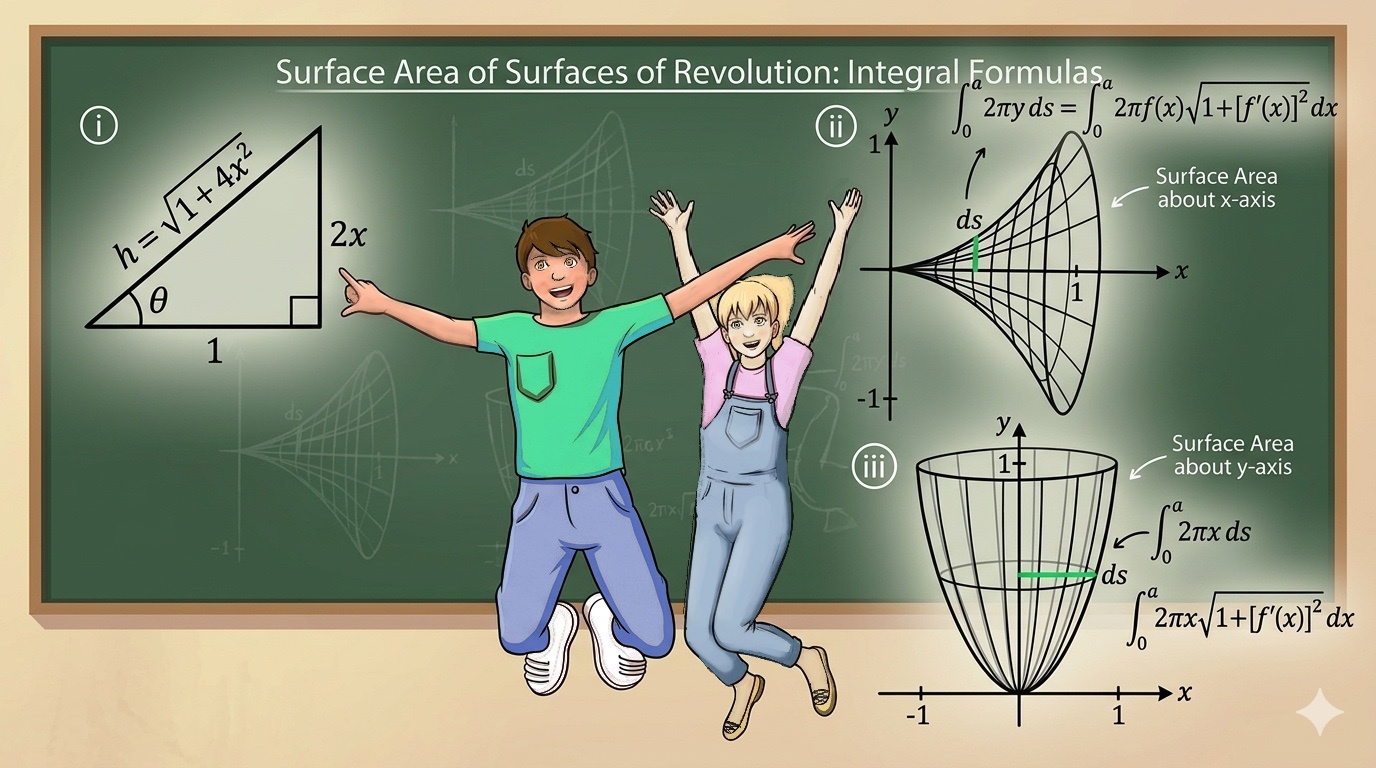
Also, $h = \sqrt{1+4x^2} = \sqrt{1+\tan^2(\theta)} = \sec(\theta)$.
Substituting these in: $S = 2\pi \int \left(\frac{\tan^2(\theta)}{4}\right) \sec(\theta) \left(\frac{\sec^2(\theta)}{2}\right) d\theta = \frac{\pi}{4} \int \tan^2(\theta)\sec^3(\theta) d\theta$
Since $\tan^2(\theta) = \sec^2(\theta) - 1$: $S = \frac{\pi}{4} \int (\sec^2(\theta) - 1)\sec^3(\theta) d\theta = \frac{\pi}{4} \int (\sec^5(\theta) - \sec^3(\theta)) d\theta$ [🚀 ]
Solving $\int \sec^3(\theta)d\theta$ and $\int \sec^5(\theta)d\theta$ requires integration by parts looping back on itself.
- $\int \sec^3(\theta)d\theta = \frac{1}{2}(\sec(\theta)\tan(\theta) + \ln\vert{}\sec(\theta) + \tan(\theta)\vert{}) + C$
- $\int \sec^5(\theta)d\theta = \frac{1}{4}\sec^3(\theta)\tan(\theta) + \frac{3}{8}(\sec(\theta)\tan(\theta) + \ln\vert{}\sec(\theta) + \tan(\theta)\vert{}) + C$
$\int \sec^3(x)dx =$
- Rewrite: $\int \sec^3(x)dx = \int \sec^2(x)\sec(x)dx$ =
This suggests using integration by parts, because $\sec^2(x)$ is the derivative of $\tan(x)$, and $\sec(x)$ is relatively simple to differentiate.
- Recall integration by parts: $\int u dv = uv - \int vdu.$
Let $u = \sec(x)$ (so we’ll differentiate this) and $dv = \sec^2(x)dx$ (so we’ll integrate this).
Then, $du = \sec(x)\tan(x)dx$ (since $\frac{d}{dx}\sec(x) = \sec(x)\tan(x)$) and $v = \tan(x)$ (since ($\int \sec^2(x)dx = \tan(x)$)).
So: $\int \sec^3(x)dx = \sec(x)\tan(x) - \int \tan^2(x)\sec(x)dx.$
- Using trig identities to simplify.
We use the identity: $\tan^2(x) = \sec^2(x) - 1.$
Substitute: $\int \tan^2(x)\sec(x)dx = \int (\sec^2(x) - 1)\sec(x)dx = \int (\sec^3(x) - \sec(x))dx$.
So our expression becomes: $\int \sec^3(x)dx = \sec(x)\tan(x) - \int (\sec^3(x) - \sec(x))dx.$
Distribute the minus sign: $\int \sec^3(x)dx = \sec(x)\tan(x) - \int \sec^3(x)dx + \int \sec(x)dx.$
- Now the key move: notice that $\int \sec^3(x)dx$ appears on both sides.
Let: $I = \int \sec^3(x)dx.$ Then, the equation is: $I = \sec(x)\tan(x) - I + \int \sec(x)dx.$
- Solving for the integral I.
Bring the (-I) to the left: $I + I = \sec(x)\tan(x) + \int \sec(x)dx$ so: $2I = \sec(x)\tan(x) + \int \sec(x)dx.$
Therefore: $I = \frac{1}{2}\left(\sec(x)\tan(x) + \int \sec(x)dx\right).$
So we’ve reduced $\int \sec^3(x)dx$ to $\int \sec(x)dx$, which is a standard integral.
- Evaluating $\int \sec(x)dx$
A known result is: $\int \sec(x)dx = \ln\big|\sec(x) + \tan(x)\big| + C.$
Substitute this into the expression for I: $I = \frac{1}{2}\left(\sec(x)\tan(x) + \ln\big|\sec(x) + \tan(x)\big|\right) + C.$
So the final result is: $\boxed{ \int \sec^3(x)dx = \frac{1}{2}\left(\sec(x)\tan(x) + \ln\big|\sec(x) + \tan(x)\big|\right) + C}.$
$\int \sec^5(x)dx.$
- Rewrite: $\int \sec^5(x)dx = \int \sec^3(x)\sec^2(x)dx.$
This suggests integration by parts with $\sec^2(x)dx$ as dv, since $\int \sec^2(x)dx = \tan(x)$.
- Integration by parts.
Let $u = \sec^3(x), dv = \sec^2(x)dx$.
Then, $v = \tan(x), du = 3\sec^2(x)\sec(x)\tan(x)dx = 3\sec^3(x)\tan(x)dx$.
Apply integration by parts: $\int \sec^5(x)dx = \int \sec^3(x)\sec^2(x)dx = u v - \int v du = \sec^3(x)\tan(x) - \int \tan(x)\cdot 3\sec^3(x)\tan(x)dx$
So: $\int \sec^5(x)dx = \sec^3(x)\tan(x) - 3\int \tan^2(x)\sec^3(x)dx$
- Use the identity $\tan^2(x) = \sec^2(x) - 1$
Substitute: $\tan^2(x) = \sec^2(x) - 1$ into the integral: $\int \sec^5(x)dx = \sec^3(x)\tan(x) - 3\int (\sec^2(x) - 1)\sec^3(x)dx$
Expand: $\int \sec^5(x)dx = \sec^3(x)\tan(x) - 3\int \sec^5(x)dx + 3\int \sec^3(x)dx$
- Now the integral $\int \sec^5(x)dx$ appears on both sides —this is the key algebraic step.
Let $I_5 = \int \sec^5(x)dx,\quad I_3 = \int \sec^3(x)dx$
Then, $I_5 = \sec^3(x)\tan(x) - 3I_5 + 3I_3$
Bring the $-3I_5$ to the left: $I_5 + 3I_5 = \sec^3(x)\tan(x) + 3I_3 \implies 4I_5 = \sec^3(x)\tan(x) + 3I_3$
So: $I_5 = \frac{1}{4}\left(\sec^3(x)\tan(x) + 3I_3\right)$
- Substitute the known result for $\int \sec^3(x)dx$.
From before: $I_3 = \int \sec^3(x)dx = \frac{1}{2}\left(\sec(x)\tan(x) + \ln\big|\sec(x) + \tan(x)\big|\right) + C$
Ignore the constant for the moment (it will be absorbed into the final C) and plug into the expression for ($I_5$):
$I_5 = \frac{1}{4}\left(\sec^3(x)\tan(x) + 3 \cdot \frac{1}{2}\left(\sec(x)\tan(x) + \ln\big|\sec(x) + \tan(x)\big|\right)\right)$
Simplify the factor: $3 \cdot \frac{1}{2} = \frac{3}{2}$, so: $I_5 = \frac{1}{4}\left(\sec^3(x)\tan(x) + \frac{3}{2}\left(\sec(x)\tan(x) + \ln\big|\sec(x) + \tan(x)\big|\right)\right)$
Then, distribute the $\frac{1}{4}$: $\boxed{ \int \sec^5(x)dx = \frac{1}{4}\sec^3(x)\tan(x) + \frac{3}{8}\sec(x)\tan(x) + \frac{3}{8}\ln\big|\sec(x) + \tan(x)\big|C}$
Back to our original integral [🚀], $\frac{π}{4}\int_{0}^{1} (sec^2(θ)-1)sec^3(θ)dθ = \frac{π}{4}\int_{0}^{1} (sec^5(θ)-sec^3(θ))dθ$ =[🚀] $\frac{π}{4} ( \frac{1}{4}(sec^3(θ)tan(θ) + \frac{3}{8}(sec(θ)tan(θ)+ln|sec(θ)+tan(θ)|)) - (\frac{1}{2}(sec(θ)tan(θ)+ln|sec(θ)+tan(θ)|) )\bigg|_{0}^{1}$, but we are by no means done, we need to backtrack substitutions, so consider that $\tan(\theta) = 2x, θ = tan^{-1}(2x)$, and so on… (It is left to the reader as a “very easy and short” exercise…😄)
Revolving Around the y-axis
When revolving around the y-axis, the radius of the solid is no longer the height of the function $f(x)$. The radius is simply the x-coordinate, $x$ (Figure iii).
The surface area formed by revolving the graph of $y = f(x)$ around the y-axis is given by: $S = \int_{a}^{b} 2\pi x ds = \int_{a}^{b} 2\pi x \sqrt{1+(f'(x))^2} dx$
Let’s use the same parabola, $y = x^2$ on $[0, 1]$, but revolve it around the y-axis this time.
$S = \int_{0}^{1} 2\pi x \sqrt{1+(2x)^2} dx = \int_{0}^{1} 2\pi x \sqrt{1+4x^2} dx$
This is a much easier u-substitution! Let $u = 1 + 4x^2$, so $du = 8x dx$ (which means $x dx = \frac{du}{8}$).
Bounds: when $x=0, u=1$; when $x=1, u=5$.
$S = 2\pi \int_{1}^{5} \frac{1}{8} \sqrt{u} du = \frac{\pi}{4} \left[ \frac{2}{3}u^{3/2} \right]_{1}^{5} = \frac{\pi}{6}(5\sqrt{5} - 1) \approx 5.33$
Surface Area of a Sphere
We can use the surface of revolution formula to prove the surface area of a sphere with radius $a$ (Figure 2.e.).
- Start with the equation for the top half of a circle: $y = \sqrt{a^2-x^2}$.
The derivative is $y' = \frac{-x}{\sqrt{a^2-x^2}}$.
- Calculate $ds$: $1 + (y')^2 = 1 + \frac{x^2}{a^2-x^2} = \frac{a^2-x^2+x^2}{a^2-x^2} = \frac{a^2}{a^2-x^2}$
$ds = \sqrt{\frac{a^2}{a^2-x^2}} dx$
- Now apply the formula for revolution around the x-axis: $S = \int_{x_1}^{x_2} 2\pi y ds = \int_{x_1}^{x_2} 2\pi (\sqrt{a^2-x^2}) \left(\sqrt{\frac{a^2}{a^2-x^2}}\right) dx$
Notice how beautifully the square root terms cancel out! $S = \int_{x_1}^{x_2} 2\pi a dx = 2\pi a [x]_{x_1}^{x_2} = 2\pi a (x_2 - x_1)$
- For a hemisphere: Integrate from $x_1 = 0$ to $x_2 = a$: $S = 2\pi a (a - 0) = 2\pi a^2$
- For the full sphere: Integrate from $x_1 = -a$ to $x_2 = a$: $S = 2\pi a (a - (-a)) = 2\pi a (2a) = 4\pi a^2$
Bibliography
This content is licensed under a Creative Commons Attribution-NonCommercial-ShareAlike 4.0 International License and is based on MIT OpenCourseWare [18.01 Single Variable Calculus, Fall 2007].
- NPTEL-NOC IITM, Introduction to Galois Theory.
- Algebra, Second Edition, by Michael Artin.
- LibreTexts, Calculus. Abstract and Geometric Algebra, Abstract Algebra: Theory and Applications (Judson).
- Field and Galois Theory, by Patrick Morandi. Springer.
- Michael Penn, and MathMajor.
- Contemporary Abstract Algebra, Joseph, A. Gallian.
- YouTube’s Andrew Misseldine: Calculus. College Algebra and Abstract Algebra.
- MIT OpenCourseWare 18.01 Single Variable Calculus, Fall 2007 and 18.02 Multivariable Calculus, Fall 2007.
- Calculus Early Transcendentals: Differential & Multi-Variable Calculus for Social Sciences.