This is not what it was meant to be, but my crash course in purgatory. I should have known better. I should have been wiser. The more things seems to change, the more they stay the same. Everything just keeps going round and round, people chasing the wind and clutching at clouds and shadows, an insane game of smoke and mirrors.
Life is not just a messy mirage in a world ruled by chaos, lies, and deception, but a merry-go-round where we all go around in circles before the final curtains close. And there are never really happy endings, that’s not how the story goes, but love is always new, awesome, and makes the ride worthwhile, Desperate verses III, M. Anawim, #justtothepoint.
Definite Integrals and Improper Integration
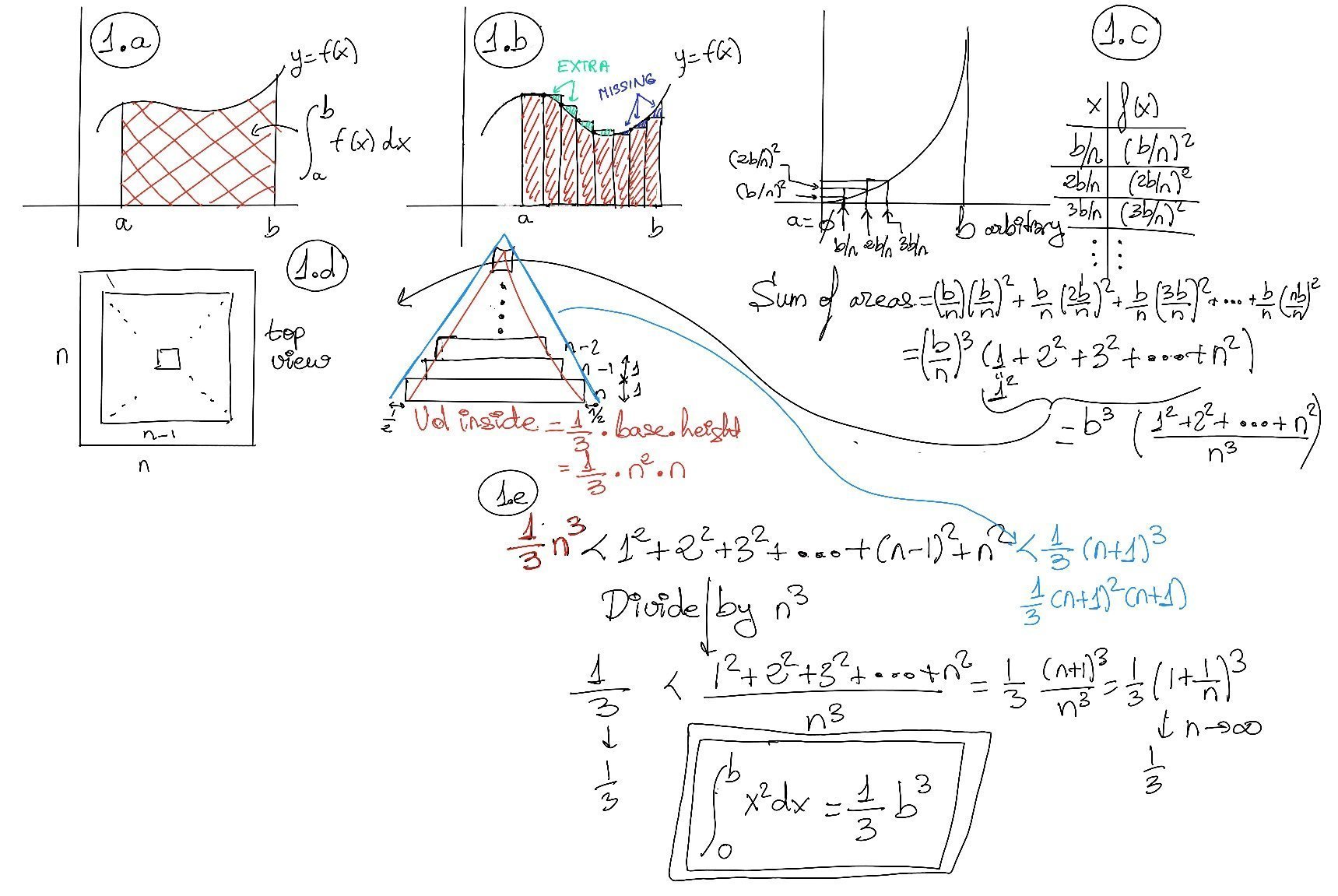
A definite integral is a fundamental concept in calculus used to calculate the exact area under a curve between two fixed limits on the x-axis. It is written or represented by the notation: $\int_{a}^{b} f(x)dx$ where:
- $a$ and $b$ are the lower and upper limits of integration.
- $f(x)$ is the integrand (the function being integrated).
- $dx$ indicates the variable of integration.
Conceptually, the definite integral of a real-valued function $f(x)$ on an interval $[a, b]$ is defined as the net signed area of the region bounded by the function's graph, the x-axis, and the vertical lines $x = a$ and $x = b$ and it is illustrated in Figure 1.a.
The Fundamental Theorem of Calculus
The connection between derivatives and integrals is established by the Fundamental Theorem of Calculus. It states that if you have a continuous function $f(x)$ on an closed interval $[a,b]$, the integral of that function is equal to the change in its antiderivative $F(x)$ (where $F'(x) = f(x)$) between the ends of the interval. Mathematically, this is expressed as $\boxed{\int_{a}^{b} f(x)dx = F(b) - F(a) = F(x) \bigg\vert{}_{a}^{b}}$
Improper integration
Standard definite integrals require specific, finite limits of integration and a function that is continuous (and thus bounded) across that entire interval.
Improper integrals break these rules. They arise in two main scenarios:
- Infinite Intervals: The limits of integration extend to infinity, e.g., $[a, \infty)$, $(-\infty, b]$, or $(-\infty, \infty)$.
- Infinite Discontinuities (Singularities): The integrand becomes undefined (approaches infinity or negative infinity) at one or more points within the interval of integration.
Because we cannot plug “infinity” directly into an antiderivative, evaluating improper integrals requires rewriting them using limits (as the integration bounds approach infinity or as singularities are approached.).
$\boxed{\int_{a}^{\infty} f(x)dx = \lim_{b \to \infty} \int_{a}^{b} f(x)dx}$
Convergence vs. Divergence
-
Convergence: An improper integral converges if the limit defining it exists and is finite. This means that even though the region stretches out infinitely, the total area under the curve adds up to a specific, finite number.
In other words, improper integrals are said to be convergent if the limit exists and is finite and that limit is the value of the improper integral.
-
Divergence: An improper integral diverges if the limit defining it does not exist. It may diverge to $\infty$ (or $-\infty$), meaning the area is infinitely large. In that case, one may assign the value of $\infty$ (or $-\infty$) to the integral.
However, other improper integrals may simply diverge in no particular direction. This is called divergence by oscillation, never settling on a single value (like integrating $\sin(x)$ from $0$ to $\infty$).
Solved Exercises
Here are step-by-step solutions to common improper integration problems, demonstrating how to handle infinite bounds and undefined functions.
An Infinite Interval on Both Sides, $\int_{-\infty}^{\infty} \frac{1}{1+x^2}dx$
- First, split the integral at $0$ to handle the two infinite bounds separately: $\int_{-\infty}^{\infty} \frac{1}{1+x^2}dx = \int_{-\infty}^{0} \frac{1}{1+x^2}dx + \int_{0}^{\infty} \frac{1}{1+x^2}dx$
- Let’s evaluate the left side using a limit: $\int_{-\infty}^{0} \frac{1}{1+x^2}dx = \lim_{a \to -\infty} \int_{a}^{0} \frac{1}{1+x^2}dx$.
- The antiderivative of $\frac{1}{1+x^2}$ is $\arctan(x)$. Therefore, $\lim_{a \to -\infty} \int_{a}^{0} \frac{1}{1+x^2}dx = \lim_{a \to -\infty} \arctan(x) \bigg\vert{}_{a}^{0} = \lim_{a \to -\infty} [\arctan(0) - \arctan(a)]$
- Since $\arctan(0) = 0$ and $\lim_{a \to -\infty} \arctan(a) = -\frac{\pi}{2}$: $ \lim_{a \to -\infty} [\arctan(0) - \arctan(a)] = 0 - \left(-\frac{\pi}{2}\right) = \frac{\pi}{2}$
- By symmetry, the right side from $0$ to $\infty$ is also $\frac{\pi}{2}$. Therefore, the integral converges: $\int_{-\infty}^{\infty} \frac{1}{1+x^2}dx = \frac{\pi}{2} + \frac{\pi}{2} = \pi$
U-Substitution with an Infinite Bound, $\int_{1}^{\infty} \frac{e^{\frac{1}{x}}}{x^2}dx$
- We rewrite this using a limit: $\int_{1}^{\infty} \frac{e^{\frac{1}{x}}}{x^2}dx = \lim_{b \to \infty} \int_{1}^{b} \frac{e^{\frac{1}{x}}}{x^2}dx$.
- Let’s use u-substitution. Let $u = \frac{1}{x}$, then $du = -\frac{1}{x^2}dx$, which means $-du = \frac{1}{x^2}dx$.
- Adjust the limits: when $x = 1 \rightarrow u = 1$; as $x \to \infty \rightarrow u \to 0$. Substitute everything back in our integral, we get: $\int_{1}^{b} \frac{e^{\frac{1}{x}}}{x^2}dx = \int_{1}^{0} -e^udu$
- Using the properties of integrals to flip the bounds and remove the negative sign: $\int_{1}^{0} -e^udu = \int_{0}^{1} e^udu = e^u \bigg\vert{}_{0}^{1} = e^1 - e^0 = e - 1$. The integral converges to $e - 1$.
Integration by Parts and L’Hôpital’s Rule, $\int_{1}^{\infty} \frac{\ln(x)}{x^2}dx$
- Rewrite with a limit: $\int_{1}^{\infty} \frac{\ln(x)}{x^2}dx = \lim_{b \to \infty} \int_{1}^{b} x^{-2}\ln(x)dx$
- Use Integration by Parts ($\int u dv = uv - \int v du$): $u = \ln(x) \implies du = \frac{1}{x}dx$, $dv = x^{-2}dx \implies v = -x^{-1} = -\frac{1}{x}$.
- Apply the formula: $= \lim_{b \to \infty} \left[ \left(-\frac{\ln(x)}{x}\right)\bigg\vert{}_{1}^{b} - \int_{1}^{b} \left(-\frac{1}{x}\right)\left(\frac{1}{x}\right)dx \right] = \lim_{b \to \infty} \left[ -\frac{\ln(x)}{x}\bigg\vert{}_{1}^{b} + \int_{1}^{b} x^{-2}dx \right] = \lim_{b \to \infty} \left[ -\frac{\ln(x)}{x} - \frac{1}{x} \right] \bigg\vert{}_{1}^{b}$.
- Evaluate from $1$ to $b$: $= \lim_{b \to \infty} \left( -\frac{\ln(b)}{b} - \frac{1}{b} \right) - \left( -\frac{\ln(1)}{1} - \frac{1}{1} \right)$.
Since $\ln(1) = 0$, the second term becomes $(0 - 1) = -1$.
$= \lim_{b \to \infty} \left( -\frac{\ln(b)}{b} - \frac{1}{b} \right) + 1$
- As $b \to \infty$, $\frac{1}{b} \to 0$. To evaluate $\lim_{b \to \infty} \frac{\ln(b)}{b}$ (which is an $\frac{\infty}{\infty}$ indeterminate form), we use L’Hôpital’s Rule: $\lim_{b \to \infty} \frac{\frac{d}{db}\ln(b)}{\frac{d}{db}b} = \lim_{b \to \infty} \frac{\frac{1}{b}}{1} = 0$.
- Therefore, the whole expression evaluates to: $(0 - 0) + 1 = 1$. The integral converges to $1$.
An Infinite Discontinuity (Vertical Asymptote), $\int_{0}^{2} \frac{2x}{x^2-4}dx$
- Here, the interval is finite ($0$ to $2$), but the function has a vertical asymptote at $x = 2$ because the denominator becomes zero ($2^2 - 4 = 0$). We must approach $2$ from the left ($2^-$).
Rewrite with a limit: $\int_{0}^{2} \frac{2x}{x^2-4}dx = \lim_{b \to 2^-} \int_{0}^{b} \frac{2x}{x^2-4}dx$.
- Use u-substitution. Let $u = x^2 - 4$. Then, $du = 2x \, dx$. Substitute: $\lim_{b \to 2^-} \int_{0}^{b} \frac{2x}{x^2-4}dx = \lim_{b \to 2^-} \int \frac{1}{u}du = \lim_{b \to 2^-} \ln\vert{}u\vert{}$
- Bring $x$ back: $= \lim_{b \to 2^-} \ln\vert{}x^2-4\vert{} \bigg\vert{}_{0}^{b}$
- Evaluate from 0 to b: $= \lim_{b \to 2^-} (\ln\vert{}b^2-4\vert{} - \ln\vert{}0^2-4\vert{}) = \lim_{b \to 2^-} \ln\vert{}b^2-4\vert{} - \ln(4)$
- As $b$ approaches $2$, the term $(b^2 - 4)$ approaches $0$. The natural log of a number approaching zero goes to $-\infty$. $(-\infty) - \ln(4) = -\infty$ Because the limit does not result in a finite number, this improper integral diverges.
Using U-Substitution at Infinity
Improper integrals often require substitution first. The key is remembering to update your bounds (or wait until the end to substitute back) before taking the limit.
- Converging to a Constant, $\int_{0}^{\infty} \frac{x}{1+x^4} dx$
- Set up the limit: $\int_{0}^{\infty} \frac{x}{1+x^4} dx = \lim_{b \to \infty} \int_{0}^{b} \frac{x}{1+(x^2)^2} dx$
- Substitute: Let $u = x^2$. This means $du = 2x dx \implies \frac{1}{2}du = x dx$.
- Adjust the bounds: When $x=0$, $u=0$. When $x \to \infty$, $u \to \infty$.
$\frac{1}{2} \lim_{b \to \infty} \int_{0}^{b} \frac{1}{1+u^2} du$
- Integrate and evaluate: $\frac{1}{2} \lim_{b \to \infty} \left[ \tan^{-1}(u) \right]_0^b = \frac{1}{2} \lim_{b \to \infty} (\tan^{-1}(b) - \tan^{-1}(0))$
Since $\tan^{-1}(\infty) = \frac{\pi}{2}$, we get: $\int_{0}^{\infty} \frac{x}{1+x^4} dx = \frac{1}{2} \left(\frac{\pi}{2} - 0\right) = \frac{\pi}{4}$
- Diverging to Infinity, $\int_{0}^{\infty} \frac{x^2}{\sqrt{x^3+4}} dx$
- Set up the limit and substitute. $\int_{0}^{\infty} \frac{x^2}{\sqrt{x^3+4}} dx = \lim_{x \to \infty} \int_{0}^{x}\frac{x^2}{\sqrt{x^3+4}} dx$
Let $u = x^3+4$. This makes $du = 3x^2 dx$, so $x^2 dx = \frac{1}{3}du$.
- Adjust the bounds: As $x=0$, $u=4$. As $x \to \infty$, $u \to \infty$.
$\lim_{b \to \infty} \int_{4}^{b} \frac{1}{3} \frac{1}{\sqrt{u}} du$
- Integrate using the power rule: ($u^{-1/2} \to 2u^{1/2}$)
$\lim_{b \to \infty} \frac{1}{3} \left[ 2\sqrt{u} \right]_4^b = \frac{2}{3} \lim_{b \to \infty} (\sqrt{b} - \sqrt{4})$
- Evaluate the limit: The square root of infinity is infinity.
$\frac{2}{3} (\infty - 2) = \infty$. This integral also diverges.
Exponential Decay and By-Parts
- General Exponential Decay ($k > 0$) $\int_{0}^{\infty} e^{-kx} dx$
- Set up the limit and integrate: $\int_{0}^{\infty} e^{-kx} dx = \lim_{b \to \infty} \int_{0}^{b} e^{-kx} dx = \lim_{b \to \infty} \left[ \frac{-1}{k} e^{-kx} \right]_0^b$
- Evaluate: Because the constant $k$ is greater than zero, $e^{-kb}$ approaches $0$ as $b \to \infty$.
$\left( 0 \right) - \left( \frac{-1}{k}e^0 \right) = \frac{1}{k}$
- Integration by Parts with Negative Bounds, $\int_{-\infty}^{0} x e^x dx$
- Set up the limit: $\int_{-\infty}^{0} x e^x dx = \lim_{a \to -\infty} \int_{a}^{0} x e^x dx$
- Apply integration by parts: ($u = x$, $dv = e^x dx \implies du = dx$, $v = e^x$).
$\lim_{a \to -\infty} \left[ x e^x - \int e^x dx \right]_a^0 = \lim_{a \to -\infty} \left[ e^x(x - 1) \right]_a^0$
- Evaluate the bounds: $(e^0(0 - 1)) - \lim_{a \to -\infty} (e^a(a - 1)) = -1 - \lim_{a \to -\infty} (a e^a -e^a)$.
Howerver, $\lim_{a \to -\infty} e^a = 0$.
Therefore, $ = -1 - \lim_{a \to -\infty} a e^a$
- Resolve the infinite limit: The term $a e^a$ creates an $-\infty \cdot 0$ indeterminate form. We rewrite it as a fraction to use L’Hôpital’s Rule ($-\infty/\infty$):
$\lim_{a \to -\infty} \frac{a}{e^{-a}} \xrightarrow{\text{L'H}} \lim_{a \to -\infty} \frac{1}{-e^{-a}} = 0$
- Final Answer: $-1 - 0 = -1$.
Oscillating Divergence
When dealing with improper integrals, divergence doesn’t just mean “growing to infinity.” An integral also diverges if it fails to settle on a final value.
- $\int_{0}^{\infty} \sin(x) dx$
- Set up the limit and integrate: $\int_{0}^{\infty} \sin(x) dx = \lim_{b \to \infty} \int_{0}^{b} \sin(x) dx = \lim_{b \to \infty} \left[ -\cos(x) \right]_0^b$
- Evaluate: $\lim_{b \to \infty} (-\cos(b) + \cos(0)) = \lim_{b \to \infty} (1 - \cos(b))$
Because $\cos(b)$ indefinitely oscillates between $-1$ and $1$, the limit never approaches a single numerical value. The limit does not exist, so the improper integral diverges.
The General p-Test
The $p$-test dictates a vital rule for functions structured as $\frac{1}{x^p}$. Whether the infinite horizontal tail traps a finite area depends entirely on the exponent $p$.
Let’s evaluate the conditions for $\int_{1}^{\infty} \frac{1}{x^p} dx$:
- Case 1: $p = 1$, the Harmonic Case.
$\int_{1}^{\infty} \frac{1}{x} dx = \lim_{b \to \infty} \left[ \ln\vert{}x\vert{} \right]_1^b = \lim_{b \to \infty} (\ln(b) - 0) = \infty$
Conclusion: Diverges. The curve approaches zero, but not fast enough to pinch off the area.
Using the power rule: $\lim_{b \to \infty} \int_{1}^{b} x^{-p} dx = \lim_{b \to \infty} \left[ \frac{x^{-p+1}}{-p+1} \right]_1^b = \lim_{b \to \infty} \left( \frac{b^{1-p}}{1-p} - \frac{1^{1-p}}{1-p} \right)$
- If $p < 1$: The exponent $(1-p)$ is positive. Therefore, $b^{\text{positive}} \to \infty$. It diverges to $\infty$.
- If $p > 1$: The exponent $(1-p)$ is negative, which pushes $b$ to the denominator. $b^{\text{negative}} = \frac{1}{b^{\text{positive}}} \to 0$. It converges to $\frac{1}{p-1}$.
Bibliography
This content is licensed under a Creative Commons Attribution-NonCommercial-ShareAlike 4.0 International License and is based on MIT OpenCourseWare [18.01 Single Variable Calculus, Fall 2007].
- NPTEL-NOC IITM, Introduction to Galois Theory.
- Algebra, Second Edition, by Michael Artin.
- LibreTexts, Calculus. Abstract and Geometric Algebra, Abstract Algebra: Theory and Applications (Judson).
- Field and Galois Theory, by Patrick Morandi. Springer.
- Michael Penn, and MathMajor.
- Contemporary Abstract Algebra, Joseph, A. Gallian.
- YouTube’s Andrew Misseldine: Calculus. College Algebra and Abstract Algebra.
- MIT OpenCourseWare 18.01 Single Variable Calculus, Fall 2007 and 18.02 Multivariable Calculus, Fall 2007.
- SFU, Calculus Early Transcendentals: Differential & Multi-Variable Calculus for Social Sciences.