
|
 |

|
|
|
|
|
|
We shall go on to the end, we shall fight in France, we shall fight on the seas and oceans, we shall fight with growing confidence and growing strength in the air, we shall defend our island, whatever the cost may be. [···] We shall fight on the beaches, we shall fight on the landing grounds, we shall fight in the fields and in the streets, we shall fight in the hills; we shall never surrender, Winston Churchill.
The maxima and minima of a function, known collectively as extrema, are the largest and smallest values of the function. They fall into two categories:
Key Distinction: The definition of absolute extrema entails that an absolute extremum, unlike a relative extremum, may fall on an endpoint of a closed interval.
A critical point is a point in the domain of the function where the function is either not differentiable or the derivative is equal to zero ($f'(x) = 0$). The value of the function at a critical point (the $y$-value) is called a critical value.
The squeeze or sandwich theorem. If a function f lies between two functions g and h, and the limits of each of them at a particular point are both equal to L, then the limit of f at that particular point is also equal to L.
Formal definition. Let f, g, and h be functions defined on an interval I that contains x = a, except possibly at x = a itself. Suppose that for every x in I not equal to a, we have $g(x) \le f(x) \le h(x)$, and also suppose that $\lim_{x \to a} g(x) = \lim_{x \to a} h(x) = L.$ Then, it must also be true that: $\lim_{x \to a} f(x) = L.$
The Extreme Value Theorem. If f is a continuous function on an closed interval $[a, b]$, then f has both maximum and minimum values on $[a, b]$. It states that if a function is continuous on a closed bounded interval, then it is guaranteed to hit a highest point and a lowest point somewhere within that interval (either at a peak/valley or at the endpoints a or b).
Fermat’s Theorem. If a function $f(x)$ is defined on the interval $(a, b)$, has a local extremum (a relative maximum or minimum) at $x = c$, and $f'(c)$ exists, then $x = c$ is a critical point of $f(x)$ and $f'(c) = 0$. (Figure 1.a.)

Proof:
Let’s assume that $f(x)$ has a relative maximum on the interval at $x = c$. The proof for a relative minimum is nearly identical, so there is no loss of generality here.
By the definition of the derivative: $f'(c) = \lim_{h \to 0} \frac{f(c+h) - f(c)}{h}$
Because $c$ is a relative maximum, we know that $f(c) \ge f(c+h)$ for all values of $h$ close to $0$. This means the numerator, $f(c+h) - f(c)$, must be $\le 0$.
Since we assume the limit exists, we can evaluate the one-sided limits:
For the overall two-sided limit to exist, both one-sided limits must equal the same value. The only number that is both $\le 0$ and $\ge 0$ is $0$. Therefore, $f'(c) = 0$. ∎
Just because $f'(c) = 0$ does not automatically mean that $c$ is a local maximum or minimum. We can have a critical point c such that f(c) is not a local maximum or minimum.
Consider the function $f(x) = x^3$ (Figure i). The derivative is $f'(x) = 3x^2$, which means $f'(0) = 0$. However, the point $(0, 0)$ is neither a local maximum nor a minimum; it is simply an inflection point where the graph briefly flattens out before continuing upward.

For a constant function like $f(x) = c$ (Figure ii):
Consider this piecewise function (Figure iii):
$f(x) = \begin{cases} \vert{}x\vert{}, & x < 1 \\ -(x - 2)^2 + 2, & x \ge 1 \end{cases}$
Its derivative is:
$f'(x) = \begin{cases} -1, & x < 0 \\ 1, & 0 < x < 1 \\ -2(x - 2), & x > 1 \end{cases}$
This function has three critical points:
2 is a local maximum. Since f’(2) exists, we already knew that f’(2) = 0.
If a function $f$ is continuous on a closed interval $[a, b]$, the Extreme Value Theorem guarantees that $f$ has both an absolute maximum and an absolute minimum value on that interval.
By Fermat’s theorem, every local extremum in the interior of a differentiable function is necessarily a critical point. Therefore, to find the absolute extremes, we only need to check the critical points and the boundaries.
Find the maximum value of $f(x) = x^2 - 7x + 12$ on the interval $[0, 1]$ (Figure iv).
Find any absolute extrema for $f(x) = \vert{}x\vert{}$ on the interval $[-1, 1]$ (Figure 1).
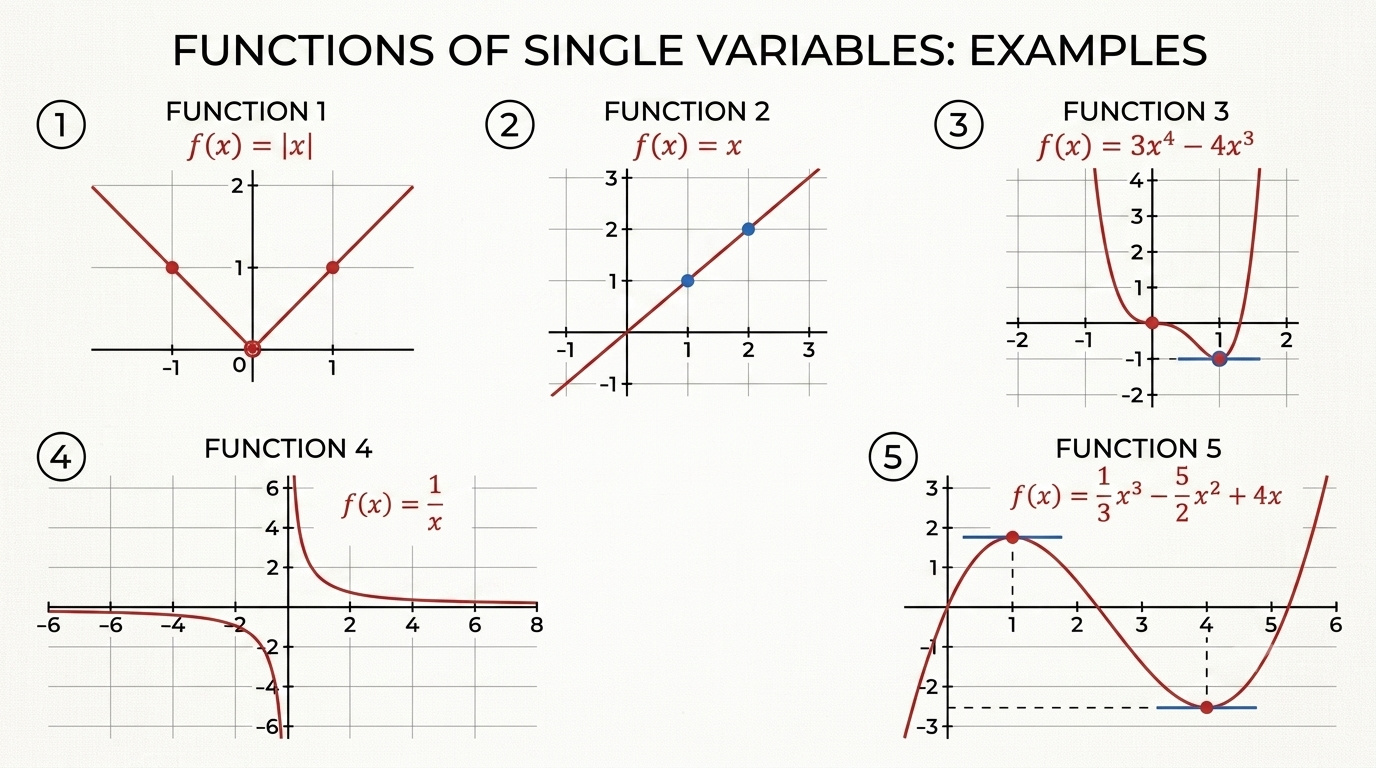
In Figures 1-5, we see several different possibilities for critical points. In some cases, the functions have local extrema (maximum -1-, -2- or minimum -3-) at critical points, whereas in other cases (4, 5) the functions do not.
Find any absolute extrema for $f(x) = x$ on the interval $[1, 2]$ (Figure 2).
Find any absolute extrema for $f(x) = 3x^4 - 4x^3$ on the interval $[-1, 2]$ (Figure 3).
Find any absolute extrema for $f(x) = \frac{1}{x}$ on the interval $[-1, 1]$ (Figure 4).
The function $f(x) = \frac{1}{x}$ is not continuous at $x = 0$, which falls inside our closed interval $[-1, 1]$. Because continuity is broken, we cannot apply the Extreme Value Theorem.
Furthermore, investigating the behavior around $x = 0$ reveals vertical asymptotes: $\lim_{x \to 0^+} \frac{1}{x} = \infty$, $\lim_{x \to 0^-} \frac{1}{x} = -\infty$.
Because the function grows infinitely large in both the positive and negative directions within the interval, $f(x)$ does not have any absolute extrema on $[-1, 1]$.
Problem: Find any absolute extrema for $f(x) = \frac{1}{3}x^3 - \frac{5}{2}x^2 + 4x$ on the interval $[0, 5]$ (Figure 5).

JustToThePoint Copyright © 2011 - 2026 Anawim. ALL RIGHTS RESERVED. Bilingual e-books, articles, and videos to help your child and your entire family succeed, develop a healthy lifestyle, and have a lot of fun. Social Issues, Join us.
This website uses cookies to improve your navigation experience.
By continuing, you are consenting to our
use of cookies, in accordance with our Cookies Policy and
Website Terms and Conditions of use.