
|
 |

|
|
|
|
|
|
The man who asks a question is a fool for a minute, the man who does not ask is a fool for life, Confucius
Calculating volumes with integrals is tricky and involves a variety of techniques such as slicing, the shell method, and the washer method.
The shell method is highly effective when rotating a region around the y-axis but integrating with respect to $x$. The volume formula is $\boxed{V = 2\pi \int_{a}^{b} (\text{radius})(\text{height}) \,dx}$.
Calculate the volume generated by the curve $y = x^2$ when it is revolved around the y-axis and bounded above by $y = a$ (Figure 1.d).

To calculate the volume generated by revolving the curve $y = x^2$ around the y-axis, the method of cylindrical shells is a great choice.
Setup the Shell:
We are slicing the volume into infinitely thin vertical cylinders (shells).
Thickness: $dx$
Radius ($r$): The distance from the y-axis to the shell is $x$.
Height ($h$): The top of the region is bounded by $y = a$ and the bottom by the curve $y = x^2$. Therefore, the height is $a - x^2$.
Find the Limits of Integration:
The region starts at the y-axis ($x=0$) and extends to the intersection of $y = x^2$ and $y = a$, which occurs at $x = \sqrt{a}$.
Integrate:
$V = \int_{0}^{\sqrt{a}} 2\pi x (a - x^2) \,dx = 2\pi \int_{0}^{\sqrt{a}} (ax - x^3) \,dx = 2\pi \left[ \frac{ax^2}{2} - \frac{x^4}{4} \right]_{0}^{\sqrt{a}}$
Evaluate the antiderivative at the upper and lower bounds: $V = 2\pi \left( \frac{a(\sqrt{a})^2}{2} - \frac{(\sqrt{a})^4}{4} \right) = 2\pi \left( \frac{a^2}{2} - \frac{a^2}{4} \right)$
$V = 2\pi \left( \frac{a^2}{4} \right) = \frac{\pi a^2}{2}$
Find the volume of the solid generated when the region bounded by $y = x^2+1$, $y = -x+1$, and $x = 1$ is revolved about the y-axis (Figure $\alpha$) (Figure $\alpha$).

Because it is revolved about the y-axis, we use cylindrical shells.
Find Points of Intersection:
Find where the upper and lower curves meet to establish bounds.
$x^2 + 1 = -x + 1 \implies x^2 + x = 0 \implies x(x + 1) = 0$
The curves intersect at $x = 0$ and $x = -1$. Since the region is bounded on the right by $x = 1$, we evaluate from $x = 0$ to $x = 1$.
Setup the Shell:
Radius ($r$): $x$
Height ($h$): The upper curve minus the lower curve: $(x^2 + 1) - (-x + 1) = x^2 + x$
Integrate:
$V = 2\pi \int_{0}^{1} x(x^2 + x) \,dx = 2\pi \int_{0}^{1} (x^3 + x^2) \,dx = 2\pi \left[ \frac{x^4}{4} + \frac{x^3}{3} \right]_{0}^{1}$
$V = 2\pi \left( \frac{1}{4} + \frac{1}{3} \right) = 2\pi \left( \frac{7}{12} \right) = \frac{7\pi}{6}$
When revolving around the x-axis and integrating with respect to $x$, we use disks ($V = \pi \int R^2 \,dx$) or washers ($V = \pi \int (R^2 - r^2) \,dx$). If revolving around the y-axis and integrating with respect to $y$, the same formulas apply, but functions must be written as $x = f(y)$.
Find the volume of the solid of revolution bounded by the graph of $f(x) = \sqrt{x}$, $x = 1$ and $x = 4$, and rotated about the x-axis (Figure B).

The solid of revolution is formed by revolving the region around the x-axis. The cross-sections are solid circles.
$V = \pi \left( \frac{16}{2} - \frac{1}{2} \right) = \frac{15\pi}{2}$
Find the volume of the solid generated when the region bounded by $y = e^{\frac{x}{2}}$, $y = e^{-\frac{x}{2}}$, $x = \ln(2)$, and $x = \ln(3)$ is revolved about the x-axis (Figure 5).
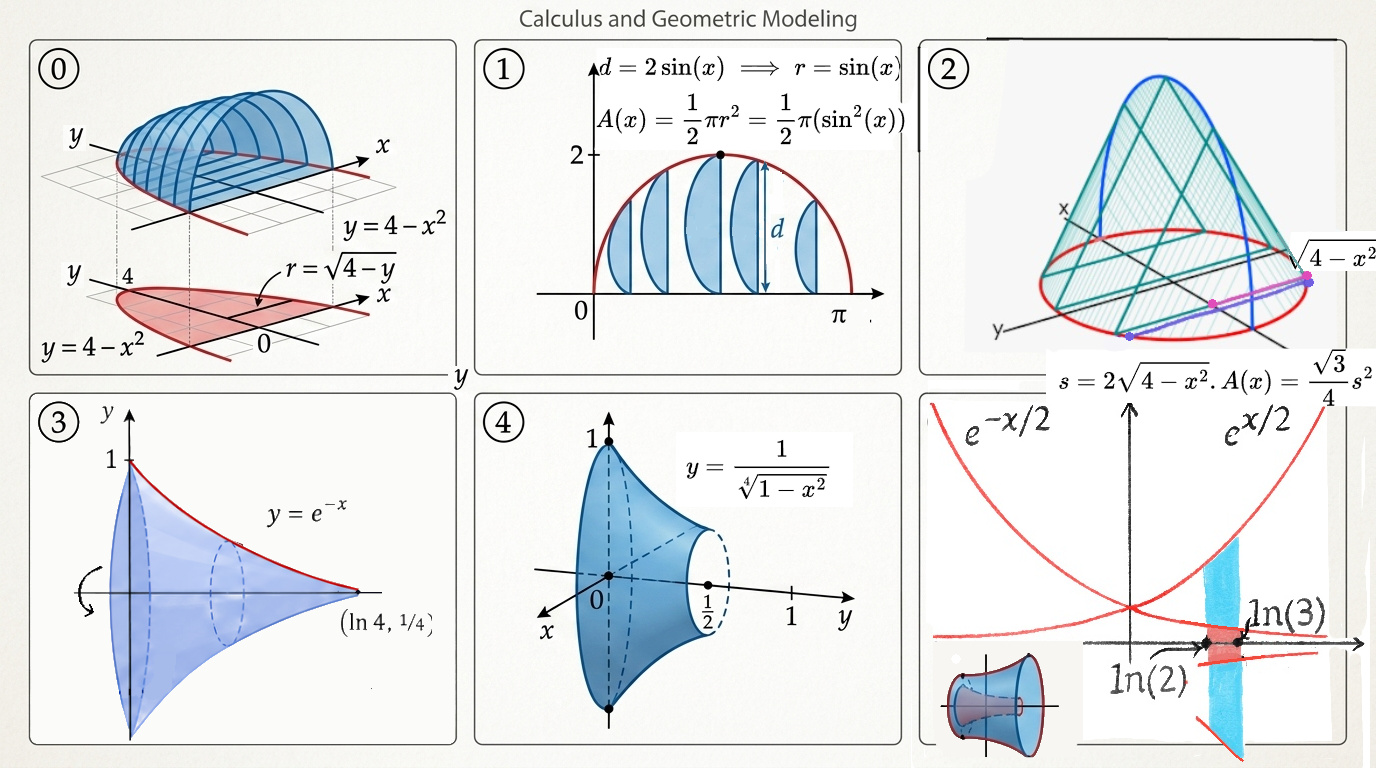
We have a hollow center, so we use the Washer Method.
Integrate: $V = \pi \int_{\ln(2)}^{\ln(3)} \left( \left( e^{\frac{x}{2}} \right)^2 - \left( e^{-\frac{x}{2}} \right)^2 \right) \,dx = \pi \int_{\ln(2)}^{\ln(3)} (e^x - e^{-x}) \,dx$
$V = \pi \left[ e^x + e^{-x} \right]_{\ln(2)}^{\ln(3)} = \pi \left( (e^{\ln(3)} + e^{-\ln(3)}) - (e^{\ln(2)} + e^{-\ln(2)}) \right)$
Recall that $e^{-\ln(a)} = e^{\ln(a^{-1})} = \frac{1}{a}$. Therefore, $V = \pi \left( \left( 3 + \frac{1}{3} \right) - \left( 2 + \frac{1}{2} \right) \right) = \pi \left( 1 + \frac{1}{3} - \frac{1}{2} \right) = \pi \left( \frac{6}{6} + \frac{2}{6} - \frac{3}{6} \right) = \frac{5\pi}{6}$
Find the volume of revolution if the region enclosed in the first quadrant by $y = x$ and $y = \sqrt{x}$ is rotated about the x-axis (Figure $\beta$).
Find Intersections: $x = \sqrt{x} \implies x^2 = x \implies x^2 - x = 0 \implies x(x-1) = 0$
The limits are $x = 0$ and $x = 1$. In the first quadrant between $0$ and $1$, $\sqrt{x} \ge x$, making it the outer radius.
Integrate: $V = \pi \int_{0}^{1} \left( (\sqrt{x})^2 - (x)^2 \right) \,dx = \pi \int_{0}^{1} (x - x^2) \,dx$
$V = \pi \left[ \frac{x^2}{2} - \frac{x^3}{3} \right]_{0}^{1} = \pi \left( \frac{1}{2} - \frac{1}{3} \right) = \pi \left( \frac{3 - 2}{6} \right) = \frac{\pi}{6} \approx 0.5236 \text{ units}^3$
Find the volume of the solid generated when the region bounded by $y = x$, $y = 2x$, and $y = 6$ is revolved about the y-axis (Figure $\epsilon$).
Since we are revolving around the y-axis, we can slice horizontally. This requires writing our functions in terms of $y$:
$V = \frac{3\pi}{4} \left[ \frac{y^3}{3} \right]_{0}^{6} = \frac{3\pi}{4} \left( \frac{6^3}{3} \right) = \frac{3\pi}{4} (72) = 54\pi \approx 169.646 \text{ units}^3$
When dealing with a base on the xy-plane and geometric cross-sections popping out of the plane, the volume is the integral of the cross-sectional area: $V = \int A(x) \,dx$.
Find the volume of the solid whose base is bounded by the curves $y = x^2$ and $y = 2 - x^2$, and whose cross sections perpendicular to the x-axis are squares (Figure C).
Find Intersections: $x^2 = 2 - x^2 \implies 2x^2 - 2 = 0 \implies 2(x^2 - 1) = 0 \implies x = \pm 1$
Find Area of Cross-Section ($A(x)$): The length of the side of each square is the upper curve minus the lower curve: $s = (2 - x^2) - x^2 = 2 - 2x^2$.
Therefore, the area of each square is $A(x) = s^2 = (2 - 2x^2)^2 = 4 - 8x^2 + 4x^4$
Integrate (Utilizing Even Symmetry): $V = \int_{-1}^{1} (4 - 8x^2 + 4x^4) \,dx = 2 \int_{0}^{1} (4 - 8x^2 + 4x^4) \,dx = 2 \left[ 4x - \frac{8}{3}x^3 + \frac{4}{5}x^5 \right]_{0}^{1}$
$V = 2 \left( 4 - \frac{8}{3} + \frac{4}{5} \right) = 2 \left( \frac{60}{15} - \frac{40}{15} + \frac{12}{15} \right) = 2 \left( \frac{32}{15} \right) = \frac{64}{15}$
Recall. An isosceles right triangle is a special three-sided shape with one 90-degree angle and two equal 45-degree angles. Its two shorter sides are equal in length, and its longest side (the hypotenuse) is equal to the length of a short side multiplied by the square root of 2.
Find Area of Cross-Section ($A(x)$): An isosceles right triangle with leg length $L$ has an area of $\frac{1}{2}L^2$. The leg in the xy-plane stretches from the x-axis to the curve, so $L = \sqrt{\cos(x)}$.
Therefore, $A(x) = \frac{1}{2} \left( \sqrt{\cos(x)} \right)^2 = \frac{1}{2} \cos(x)$
Integrate (Utilizing Even Symmetry): $V = \int_{-\frac{\pi}{2}}^{\frac{\pi}{2}} A(x) \,dx = 2 \int_{0}^{\frac{\pi}{2}} \frac{1}{2} \cos(x) \,dx$
$V = \int_{0}^{\frac{\pi}{2}} \cos(x) \,dx = \left[ \sin(x) \right]_{0}^{\frac{\pi}{2}} = \sin\left(\frac{\pi}{2}\right) - \sin(0) = 1 - 0 = 1$

JustToThePoint Copyright © 2011 - 2026 Anawim. ALL RIGHTS RESERVED. Bilingual e-books, articles, and videos to help your child and your entire family succeed, develop a healthy lifestyle, and have a lot of fun. Social Issues, Join us.
This website uses cookies to improve your navigation experience.
By continuing, you are consenting to our
use of cookies, in accordance with our Cookies Policy and
Website Terms and Conditions of use.