
|
 |
|
|
|
|
|
|
Of course I’m in shape. Round is a shape.

Antiderivatives are the inverse operation of derivatives and form the foundation of integral calculus.
Given a function $f(x)$, an antiderivative (also known as an indefinite integral), denoted as $F(x)$, is a function that can be differentiated to obtain the original function, i.e., $F'(x) = f(x)$; e.g., $3x^2 - 1$ is the derivative of $x^3 - x + 7$, which means $x^3 - x + 7$ is an antiderivative of $3x^2 - 1$.
Symbolically, the process of finding antiderivatives is called integration, and we write it as: $F(x) = \int f(x)dx$
The Fundamental Theorem of Calculus bridges the gap between derivatives and integrals.
It states that the definite integral of a function $f$ over an interval $[a, b]$ is equal to the change in any of its antiderivatives $F$ between the ends of that interval: $\boxed{\int_{a}^{b} f(x)dx = F(b) - F(a) = F(x) \bigg\vert{}_{a}^{b}}$
If we consider $f$ to be a continuous rate of change (meaning $f(x) = F'(x)$), this theorem can be restated as the Net Change Theorem: The definite integral of a rate of change of a function on $[a, b]$ is the total change of the function itself on that interval.
The Second Fundamental Theorem of Calculus. If $f$ is a continuous function and c is a constant, then f has a unique antiderivative A that satisfies $A(c) = 0$, and that antiderivative is given by the rule $A(x) = \int_{c}^{x} f(t)dt$.
Calculating volumes with integrals is tricky and involves a variety of techniques such as slicing, the shell method, and the washer method.
A teacher has a paperweight made so that its base is the region between the x-axis and one arch of the curve $y = 2\sin(x)$ (units in cm). Each cross-section cut perpendicular to the x-axis is a semicircle whose diameter is the distance from the x-axis to the curve. Calculate the volume (Figure 1).
Meaning: (i) We slice the solid with planes of the form 𝑥 = constant. (ii) Those planes are perpendicular to the x-axis and contain the y-axis and z-axis directions. (iii) In each such plane, the base segment from the x-axis to the curve is just the vertical line from 𝑦 = 0 to 𝑦 = 2sin(x). Its length is $d(x) =2\sin(x)$. That segment is the diameter of a semicircle lying in that plane.
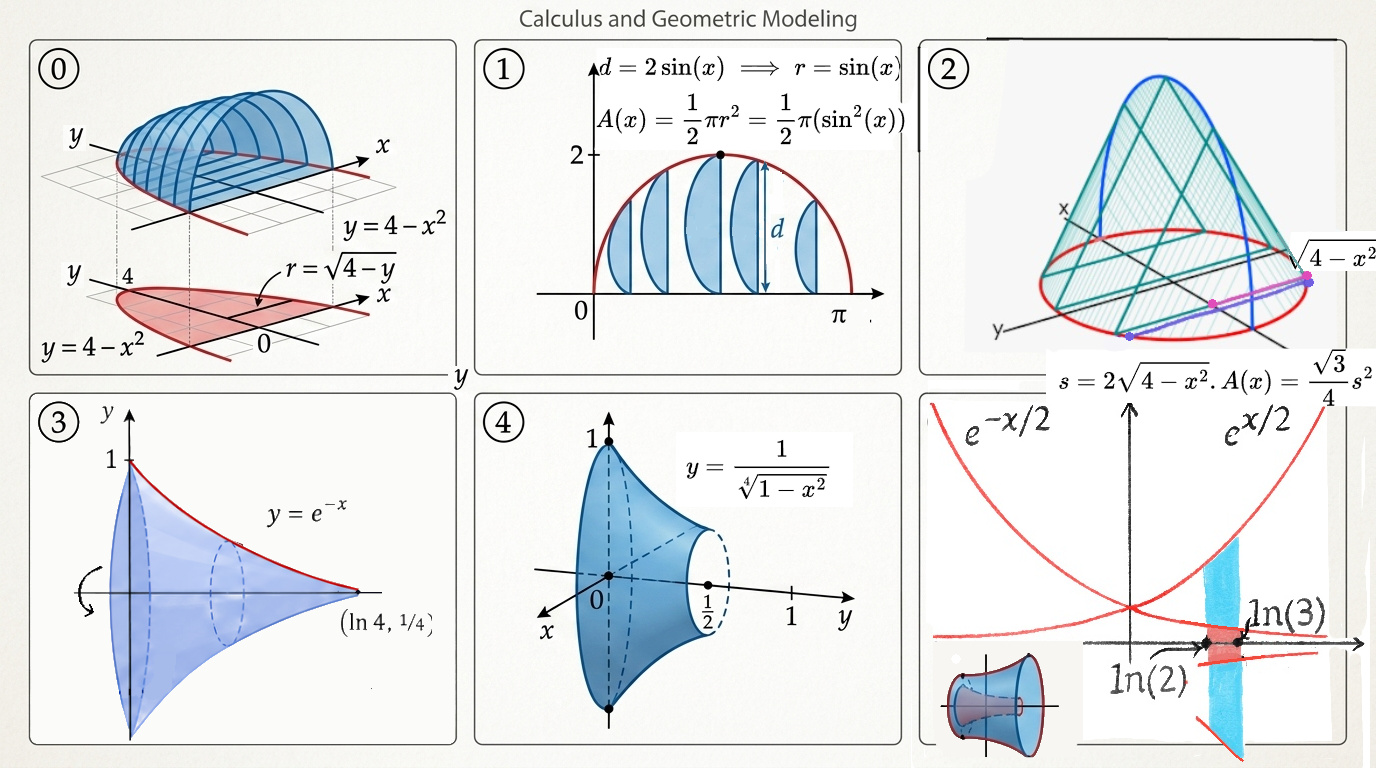
Find the volume of a solid whose base is the region inside the circle $x^2 + y^2 = 4$. Cross-sections perpendicular to the x-axis are equilateral triangles (Figure 2).
Determine the bounds: The circle has a radius of $r = 2$, so $x \in [-2, 2]$.
Find the area of a slice, $A(x)$:
The area of an equilateral triangle with side length $s$ is $A = \frac{\sqrt{3}}{4}s^2$ where A is the area and s is the length of one side of the equilateral triangle.
The side $s$ spans the circle vertically, from $-\sqrt{4-x^2}$ to $\sqrt{4-x^2}$, so $s = 2\sqrt{4-x^2}$.
Therefore, $A(x) = \frac{\sqrt{3}}{4} \left( 2\sqrt{4-x^2} \right)^2 = \frac{\sqrt{3}}{4} \left( 4(4-x^2) \right) = \sqrt{3}(4-x^2)$
Integrate:
$V = \int_{-2}^{2} \sqrt{3}(4-x^2) \,dx = \sqrt{3} \left[ 4x - \frac{1}{3}x^3 \right]_{-2}^{2}$
$V = \sqrt{3} \left( \left(8 - \frac{8}{3}\right) - \left(-8 + \frac{8}{3}\right) \right) = \sqrt{3} \left( 16 - \frac{16}{3} \right) = \frac{32\sqrt{3}}{3}$
Calculate the volume of the solid whose base is the triangle with vertices $(0, 0)$, $(2, 0)$, and $(0, 2)$. Cross-sections are perpendicular to the base and parallel to the y-axis and are semicircles (Figure E).

Find the bounding line: The line connecting $(0, 2)$ and $(2, 0)$ has a slope of $-1$ and a y-intercept of $2$. The equation is $y = 2 - x$.
Note: The equation of the line passing through two points $(x_1, y_1)$ and $(x_2, y_2)$ is $y -y_1 = \frac{y_2-y_1}{x_2-x_1}(x-x_1)$ ⇒ The line that crosses between (0, 2) and (2, 0) is $y-2=\frac{-2}{2}(x-0) \iff y - 2 = -x \iff y = 2 -x$.
Set up in terms of $y$: Because slices are perpendicular to the base, we integrate with respect to $y$. We rewrite the line as $x = 2 - y$.
The bounds are $y = 0$ to $y = 2$.
Find the area of a slice, $A(y)$: The diameter of the semicircle is the distance from the y-axis to the line, which is $x = 2 - y$. The radius is $r = \frac{2-y}{2}$.
$A(y) = \frac{1}{2}\pi r^2 = \frac{1}{2}\pi \left( \frac{2-y}{2} \right)^2 = \frac{\pi}{8} (2-y)^2$
Integrate: $V = \int_{0}^{2} \frac{\pi}{8}(2-y)^2 \,dy$
Using u-substitution ($u = 2-y$, $du = -dy$): $V = \frac{\pi}{8} \left[ -\frac{(2-y)^3}{3} \right]_{0}^{2} = \frac{\pi}{8} \left( 0 - \left( -\frac{8}{3} \right) \right) = \frac{\pi}{3}$
Compute the volume of the solid whose base is the region between the inverted parabola $y = 4-x^2$ and the x-axis, and whose vertical cross-sections perpendicular to the y-axis are semicircles (Figure 0).
Calculate the volume of a right circular cone with height $h$ and base radius $R$ (Figure ii).
 .
A cone is a three-dimensional solid geometric shape having a circular base and a pointed edge at the top called the apex. A right circular cone is a cone where the axis of the cone is the line meeting the vertex to the midpoint of the circular base. We will integrate along the height of the cone (x-axis) starting from the base ($x=0$) to the apex ($x=h$). The cross sections are simply circles, but the radius varies from the base of the cone to the apex.
Find the volume of the solid generated when the region $R$ bounded by $y = e^{-x}$, $y = 0$, $x = 0$, and $x = \ln(4)$ is revolved about the x-axis (Figure 3).
Find the volume of the solid generated when the region bounded by $y = 2x - x^2$ and the x-axis is revolved about the y-axis.
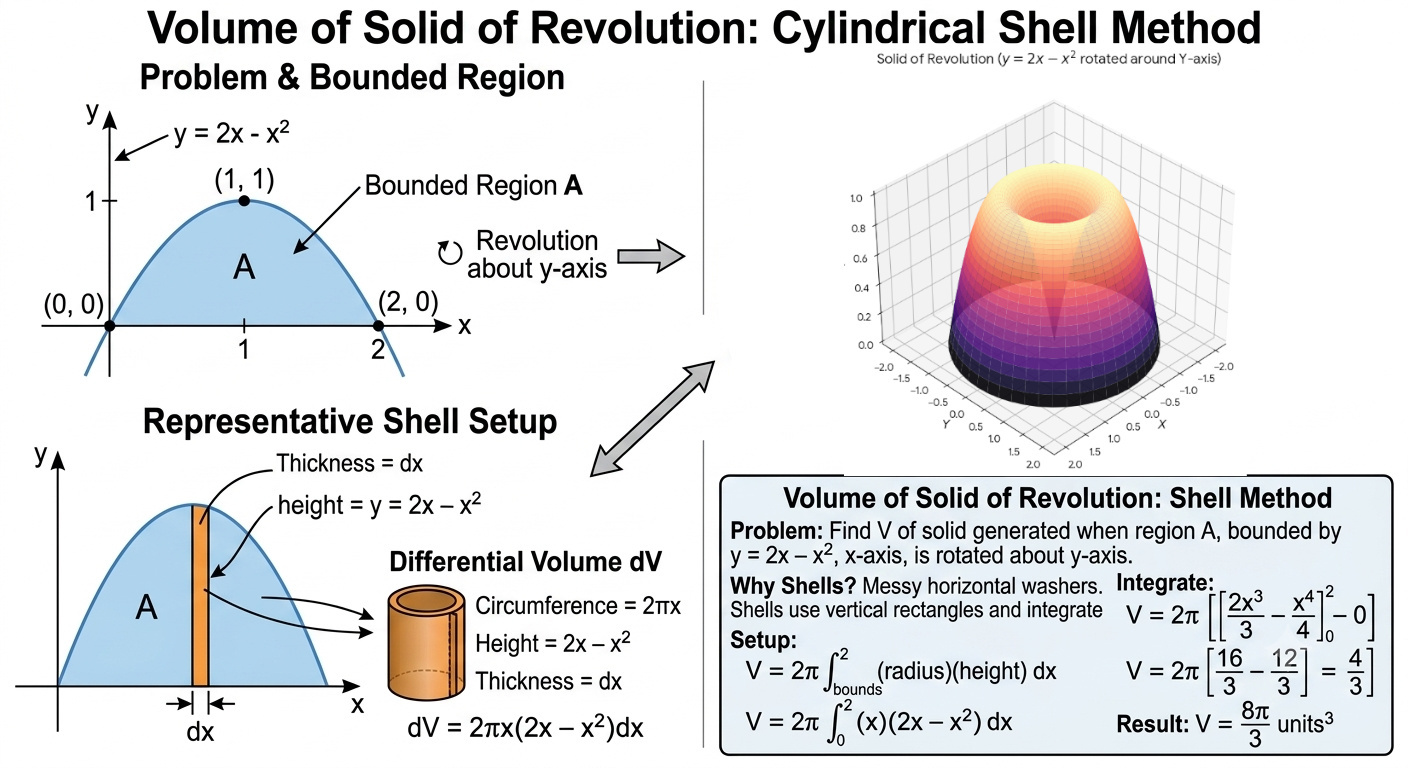
Let $f$ be continuous and non-negative, and let $R$ be the region bounded above by the graph of $f(x)$, below by the x-axis, on the left by $x = a$, and on the right by $x = b$. The volume $V$ of the solid of revolution formed by revolving $R$ around the x-axis is given by: $\boxed{V = \int_{a}^{b} \pi [f(x)]^2 \,dx}$
Because we are rotating around the x-axis, the cross-sections are circles with area $A(x) = \pi r^2$, where the radius $r$ is the height of the function $f(x)$ at any given point $x$.
Problem: Find the volume of the solid generated when the region bounded by $y = \frac{1}{\sqrt[4]{1-x^2}}$, $y = 0$, $x = 0$, and $x = \frac{1}{2}$ is revolved about the x-axis (Figure 4).
Setup:
Since the region is revolved around the x-axis, the radius of each circular cross-section is $r = f(x) = \frac{1}{\sqrt[4]{1-x^2}}$.
$V = \int_{0}^{\frac{1}{2}} \pi [f(x)]^2 \,dx = \int_{0}^{\frac{1}{2}} \pi \left( \frac{1}{\sqrt[4]{1-x^2}} \right)^2 \,dx$
Simplification & Integration:
When you square the fourth root, it simplifies to a square root: $(\sqrt[4]{u})^2 = (u^{1/4})^2 = u^{1/2} = \sqrt{u}$.
$V = \pi \int_{0}^{\frac{1}{2}} \frac{1}{\sqrt{1-x^2}} \,dx$
This is the standard derivative form for the arcsine function.
Therefore, $V = \pi \left[ \arcsin(x) \right]_{0}^{\frac{1}{2}}$
Evaluation:
Evaluate the antiderivative at the upper and lower bounds.
$V = \pi \left( \arcsin\left(\frac{1}{2}\right) - \arcsin(0) \right)$
$V = \pi \left( \frac{\pi}{6} - 0 \right) = \frac{\pi^2}{6}$
Problem: Find the volume of the solid of revolution bounded by the graph of $f(x) = x^2 - 4x + 5$, $x = 1$, and $x = 4$, and rotated about the x-axis, (Figure A).
Setup:
The radius is $r = f(x) = x^2 - 4x + 5$.
$V = \int_{1}^{4} \pi [f(x)]^2 \,dx = \pi \int_{1}^{4} (x^2 - 4x + 5)^2 \,dx$
Expansion & Integration:
First, you must expand the trinomial squared: $(x^2 - 4x + 5)(x^2 - 4x + 5)$.
Multiplying this out yields: $x^4 - 4x^3 + 5x^2 - 4x^3 + 16x^2 - 20x + 5x^2 - 20x + 25$
Combine like terms: $V = \pi \int_{1}^{4} (x^4 - 8x^3 + 26x^2 - 40x + 25) \,dx$
Now, apply the power rule to integrate term by term: $V = \pi \left[ \frac{x^5}{5} - \frac{8x^4}{4} + \frac{26x^3}{3} - \frac{40x^2}{2} + 25x \right]_{1}^{4}$
Simplify, $V = \pi \left[ \frac{x^5}{5} - 2x^4 + \frac{26x^3}{3} - 20x^2 + 25x \right]_{1}^{4}$
Evaluation:
Substitute the upper bound ($x=4$) and lower bound ($x=1$):
At $x = 4$: $\frac{4^5}{5} - 2(4^4) + \frac{26(4^3)}{3} - 20(4^2) + 25(4) = \frac{1024}{5} - 512 + \frac{1664}{3} - 320 + 100$
Using a common denominator of 15, this evaluates exactly to $\frac{412}{15}$.
At $x = 1$: $\frac{1}{5} - 2 + \frac{26}{3} - 20 + 25 = \frac{1}{5} + \frac{26}{3} + 3$
Using a common denominator of 15, this evaluates exactly to $\frac{178}{15}$.
Conclusion:
$V = \pi \left( \frac{412}{15} - \frac{178}{15} \right) = \pi \left( \frac{234}{15} \right) = \frac{78\pi}{5}$
The exact volume is $\frac{78\pi}{5}$, which is approximately $49.009$.

JustToThePoint Copyright © 2011 - 2026 Anawim. ALL RIGHTS RESERVED. Bilingual e-books, articles, and videos to help your child and your entire family succeed, develop a healthy lifestyle, and have a lot of fun. Social Issues, Join us.
This website uses cookies to improve your navigation experience.
By continuing, you are consenting to our
use of cookies, in accordance with our Cookies Policy and
Website Terms and Conditions of use.