
|
 |

|
|
|
|
|
|
Once again, you show all the sensitivity of a blunt axe, J. K. Rowling.
Antiderivatives are the inverse operation of derivatives and form the foundation of integral calculus.
Given a function $f(x)$, an antiderivative (also known as an indefinite integral), denoted as $F(x)$, is a function that can be differentiated to obtain the original function, i.e., $F'(x) = f(x)$; e.g., $3x^2 - 1$ is the derivative of $x^3 - x + 7$, which means $x^3 - x + 7$ is an antiderivative of $3x^2 - 1$.
Symbolically, the process of finding antiderivatives is called integration, and we write it as: $F(x) = \int f(x)dx$
The Fundamental Theorem of Calculus bridges the gap between derivatives and integrals.
It states that the definite integral of a function $f$ over an interval $[a, b]$ is equal to the change in any of its antiderivatives $F$ between the ends of that interval: $\boxed{\int_{a}^{b} f(x)dx = F(b) - F(a) = F(x) \bigg\vert{}_{a}^{b}}$
If we consider $f$ to be a continuous rate of change (meaning $f(x) = F'(x)$), this theorem can be restated as the Net Change Theorem: The definite integral of a rate of change of a function on $[a, b]$ is the total change of the function itself on that interval.
The Second Fundamental Theorem of Calculus. If $f$ is a continuous function and c is a constant, then f has a unique antiderivative A that satisfies $A(c) = 0$, and that antiderivative is given by the rule $A(x) = \int_{c}^{x} f(t)dt$.
Calculating volumes with integrals can feel tricky because it requires visualizing 3D shapes from 2D graphs. However, it relies on a single, powerful idea: slicing the solid into thin, measurable pieces and adding them all together using an integral.
Let’s suppose a solid, e.g., a loaf of bread sitting on the counter. To find or calculate its total volume, you could slice it, calculate the volume of each individual slice, and sum them up. When a 3D shape is formed by rotating a 2D curve around an axis, this approach is called the Disk Method because the cross-sections perpendicular to the axis of rotation are circular disks (Figure 1.a and Figure 1.b).

If we take the region bounded by $y = f(x)$, $x = a$, and $x = b$, and rotate it around the x-axis, every slice is a disk (Figure B).
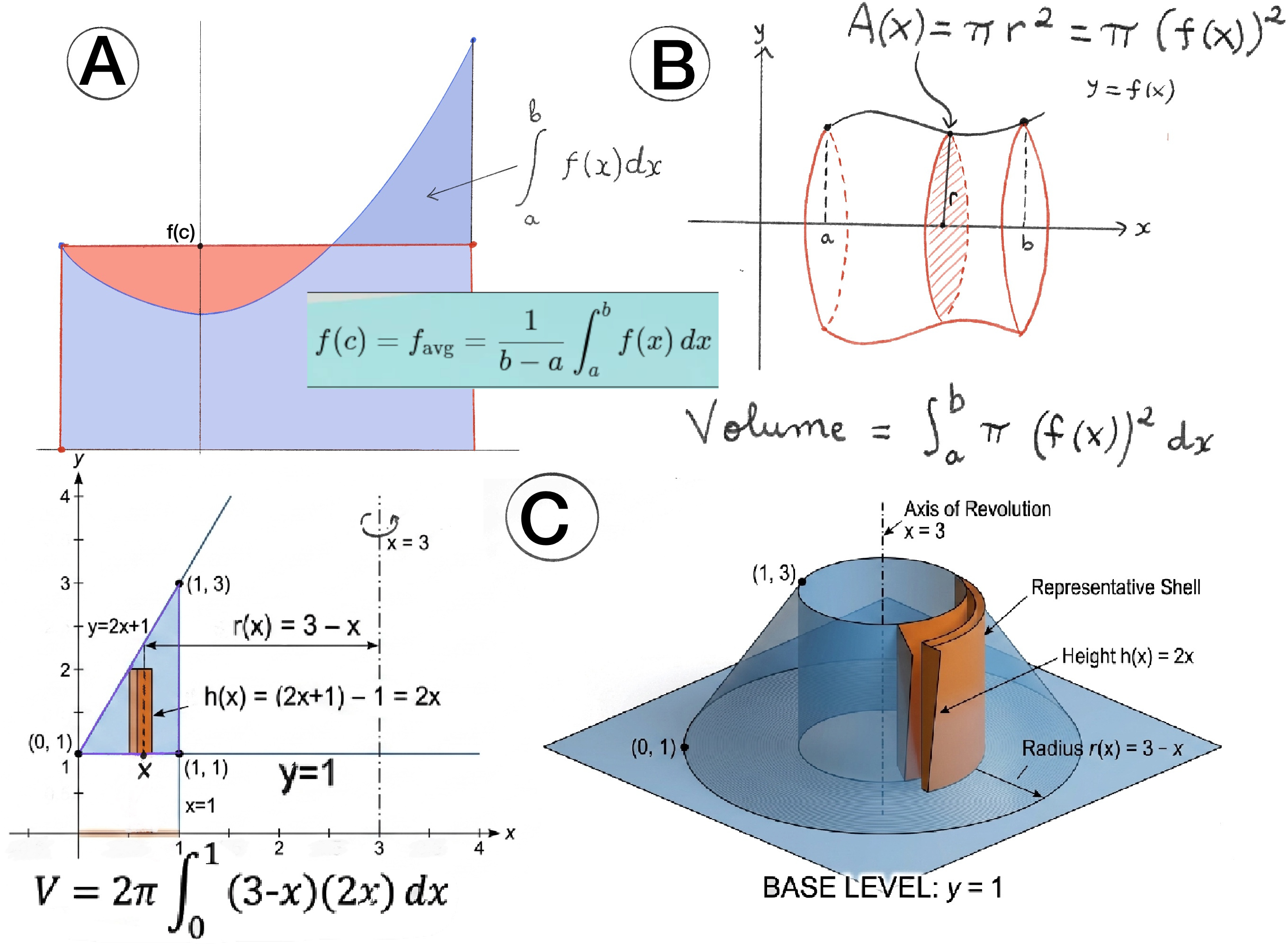
To find the total volume, we integrate this area over the given interval: $\boxed{V = \int_{a}^{b} A(x) \,dx = \pi \int_{a}^{b} [f(x)]^2 \,dx}$
Let’s find the volume of a sphere with radius $a$. We can generate this sphere by rotating a semi-circle around the x-axis (Figure 1.c).
If we center the circle at $(a, 0)$ so it touches the origin, its formula is: $(x - a)^2 + y^2 = a^2$
Isolating $y^2$ gives us the squared radius for our disks: $y^2 = a^2 - (x - a)^2 \implies y^2 = a^2 - (x^2 - 2ax + a^2)$
Simplify, $y^2 = 2ax - x^2$
Now, we integrate from $x = 0$ to $x = 2a$: $V = \pi \int_{0}^{2a} (2ax - x^2) \,dx = \pi \left[ ax^2 - \frac{x^3}{3} \right]_{0}^{2a}$
Evaluating the bounds (limits) of this definite integral gives: $V = \pi \left( 4a^3 - \frac{8a^3}{3} \right) = \pi \left( \frac{12a^3}{3} - \frac{8a^3}{3} \right) = \frac{4}{3}\pi a^3$
Futhermore, V(x) is the volume of a ball’s portion of width x, e.g., V(a) =[the volume of half of the ball] $\pi(ax^2-\frac{x^3}{3})\bigg|_{0}^{a} = \pi(a^3-\frac{a^3}{3}) = \frac{2}{3}\pi a^3$, that is obviously half the volume of the whole ball (the volume of a hemisphere).
Sometimes, slicing perpendicular to the axis of rotation creates complicated cross-sections (like washers with holes). The Shell Method is a great alternative used when the axis of rotation is parallel to the axis of integration.
Instead of slicing the solid perpendicular to the axis of rotation creating cross-sections (flat disks), we now slice it parallel to the axis of rotation, creating “shells.”
Instead of slicing the solid into flat disks, we slice it into hollow, cylindrical “shells” (think of the layers of an onion or a set of nesting dolls). We can visualize the solid as composed of cylindrical shells. Let a solid be formed by revolving a region R, bounded by $x = a$ and $x = b$, around the vertical axis, the volume of a single infinitesimally thin shell is its circumference multiplied by its height and thickness:
Summing these shells gives the total volume: $\boxed{V = 2\pi \int_{a}^{b} r(x) h(x) \,dx}$
Let’s calculate the volume of the solid formed by rotating a triangular region —determined by the vertices $(0, 1)$, $(1, 1)$, and $(1, 3)$— about the vertical line $x = 3$ (Figure C).
Find the height $h(x)$: The triangle’s top edge connects $(0, 1)$ to $(1, 3)$. The slope is $\frac{3 - 1}{1 - 0} = 2$, so the line is $y = 2x + 1$.
The bottom edge is the flat line $y = 1$. The height of the shell at any point $x$ is the difference between the top and bottom: $h(x) = (2x + 1) - 1 = 2x$
Find the radius $r(x)$: We are rotating around $x = 3$. For any point $x$ inside the triangle (where $x$ ranges from $0$ to $1$), the distance to the rotation axis is: $r(x) = 3 - x$
Set up and solve the integral: $V = 2\pi \int_{0}^{1} (3 - x)(2x) \,dx = 2\pi \int_{0}^{1} (6x - 2x^2) \,dx = 2\pi \left[ 3x^2 - \frac{2x^3}{3} \right]_{0}^{1}$.
$V = 2\pi \left( 3 - \frac{2}{3} \right) = 2\pi \left( \frac{7}{3} \right) = \frac{14\pi}{3} \approx 14.66 \text{ units}^3$.
Not all solids of revolution are solid all the way to their axis of rotation. When a region is bounded by two distinct functions—say $f(x)$ on top and $g(x)$ on the bottom —revolving that region creates a cavity in the middle of the 3D shape.
Because of this cavity, the cross-sectional slices used to approximate the volume are not solid disks, but washers (disks with a hole in the center). To find the area of a single washer, we calculate the area of the entire outer circle and subtract the area of the empty inner circle: $A = \pi R^2 - \pi r^2$
By integrating this area across the interval $[a, b]$, we sum up all the infinitesimally thin washers to find the total volume: $\boxed{V = \pi \int_{a}^{b} (R(x)^2 - r(x)^2) dx}$
Suppose $f$ and $g$ are continuous, non-negative functions where $f(x) \geq g(x)$ over $[a, b]$. If we revolve the region bounded above by $f$ and below by $g$, on the left by x = a, and on the right by x = b about the x-axis, the outer radius is $R(x) = f(x)$ and the inner radius is $r(x) = g(x)$. The volume becomes: $\boxed{V = \pi \int_{a}^{b} (f(x)^2 - g(x)^2) dx}$
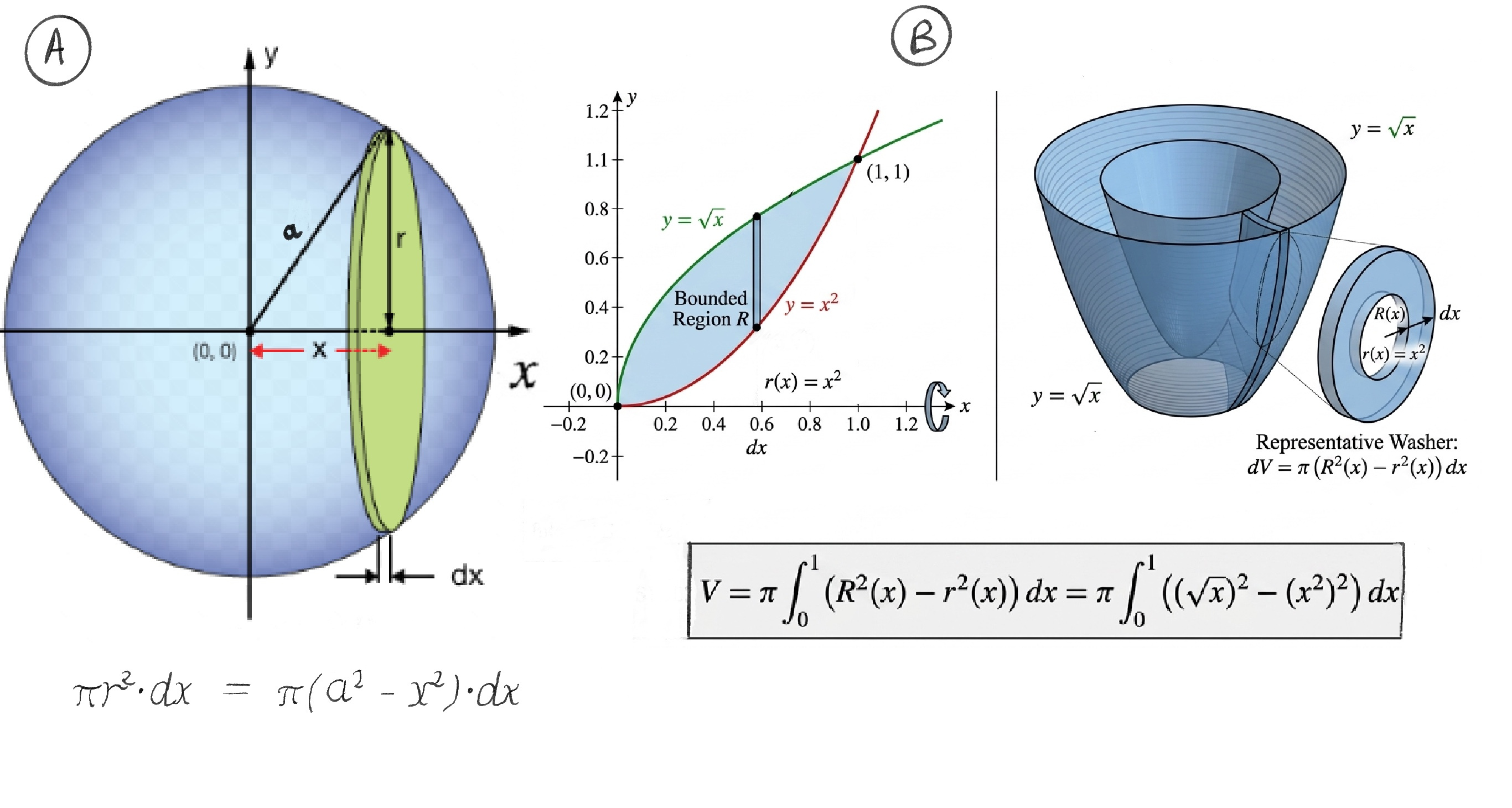
Find the bounds of integration (x-intercepts):
Set the functions equal to each other to find where they intersect: $\sqrt{x} = x^2 \implies x = x^4 \implies x^4 - x = 0$.
Factoring, $x(x^3 - 1) = 0$.
In the first quadrant, the intersections are at $x = 0$ and $x = 1$.
Identify the outer and inner radii:
Between $0$ and $1$, $\sqrt{x}$ is the upper curve and $x^2$ is the lower curve.
Outer radius $R(x) = \sqrt{x}$. Inner radius $r(x) = x^2$
Set up and evaluate the integral:
$V = \pi \int_{0}^{1} (R(x)^2 - r(x)^2) dx = \pi \int_{0}^{1} \left( (\sqrt{x})^2 - (x^2)^2 \right) dx = \pi \int_{0}^{1} (x - x^4) dx$.
Evaluating the bonds of integration gives, $V = \pi \left[ \frac{x^2}{2} - \frac{x^5}{5} \right]_{0}^{1} = \pi \left( \frac{1}{2} - \frac{1}{5} \right) = \pi \left( \frac{5 - 2}{10} \right) = \frac{3\pi}{10} \text{ units}^3$.
Let’s calculate the volume of a sphere of radius $a$ by integrating vertically along the x-axis from $-a$ to $a$ (Figure iii).

The x‑ and y‑axes in the previous plot were intentionally swapped from their usual positions — the y‑axis was placed where the x‑axis normally goes, and the x‑axis where the y‑axis normally goes. In Figure A below, both axes appear in their standard, conventional orientation.
If we slice the sphere at a specific x-coordinate, the cross-section is a circle. We can find the radius $r$ of this circular slice using the Pythagorean theorem: $x^2 + r^2 = a^2 \implies r = \sqrt{a^2 - x^2}$
The area of the cross-section is $A(x) = \pi r^2 = \pi(a^2 - x^2)$.
Now, we just need to integrate this area from the bottom of the sphere to the top: $V = \int_{-a}^{a} \pi(a^2 - x^2) dx = \pi \left[ a^2x - \frac{x^3}{3} \right]_{-a}^{a}$
$V = \pi \left( a^3 - \frac{a^3}{3} \right) - \pi \left( -a^3 - \frac{-a^3}{3} \right) = \pi \left( \frac{2a^3}{3} \right) - \pi \left( -\frac{2a^3}{3} \right) = \frac{4\pi a^3}{3}$
A right circular cylinder of height $h$ and radius $r$ has identical circular cross-sections no matter where you slice it horizontally (Figure i).
Integrating along the vertical height ($x$ from $0$ to $h$), the cross-sectional area function is a constant $A(x) = \pi r^2$.
$V = \int_{0}^{h} A(x) dx = \int_{0}^{h} \pi r^2 dx = \pi r^2 [x]_{0}^{h} = \pi r^2 h$
A pyramid is a polyhedron for which the base is a polygon and all lateral faces are triangles (Figure iv). Consider a square pyramid with base side length $a$ and height $h$. If we orient the y-axis vertically starting at the tip ($x=0$), every horizontal slice is a square.
Let $s(x)$ be the side length of the square cross-section at depth $x$. By similar triangles, the ratio of the cross-section’s side length to its depth is equal to the ratio of the base’s side length to the total height: $\frac{s}{x} = \frac{a}{h} \implies s = \frac{a x}{h}$
The area of the square cross-section is $A(x) = s^2 = \frac{a^2 x^2}{h^2}$.
Integrate this from the tip to the base, we get: $V = \int_{0}^{h} s^2 dx = \int_{0}^{h} \frac{a^2 x^2}{h^2} dx = \frac{a^2}{h^2} \int_{0}^{h} x^2 dx$
$V = \frac{a^2}{h^2} \left[ \frac{x^3}{3} \right]_{0}^{h} = \frac{a^2}{h^2} \left( \frac{h^3}{3} \right) = \frac{a^2 h}{3}$

JustToThePoint Copyright © 2011 - 2026 Anawim. ALL RIGHTS RESERVED. Bilingual e-books, articles, and videos to help your child and your entire family succeed, develop a healthy lifestyle, and have a lot of fun. Social Issues, Join us.
This website uses cookies to improve your navigation experience.
By continuing, you are consenting to our
use of cookies, in accordance with our Cookies Policy and
Website Terms and Conditions of use.