
|
 |

|
|
|
|
|
|
Success is not final, failure is not fatal: it is the courage to continue that counts, Winston Churchill
You’ve gotta dance like there’s nobody watching, Love like you’ll never be hurt, Sing like there’s nobody listening, And live like it’s heaven on earth, William W. Purkey

Antiderivatives are fundamental concepts in calculus, acting as the inverse operation of derivatives.
Given a function $f(x)$, an antiderivative (also known as an indefinite integral) $F$ is the function that can be differentiated to obtain the original function. This means $F' = f$. For example, $x^3 - x + 7$ is the antiderivative of $3x^2 - 1$.
Symbolically, this inverse relationship is written as: $F(x) = \int f(x) \, dx$
The overarching process of finding these antiderivatives is known as integration.
The Fundamental Theorem of Calculus bridges the gap between antiderivatives and geometric area. It states that the definite integral of a function $f$ over an interval is equal to the change in any of its antiderivatives $F$ between the ends of that interval.
Mathematically, if $F'(x) = f(x)$, then: $\boxed{\int_{a}^{b} f(x) \, dx = F(b) - F(a) = F(x) \bigg\vert{}_{a}^{b}}$
For a continuous function $f(x)$ with an antiderivative $F(x)$, the definite integral is exactly $F(b) - F(a)$.
$\int_{-1}^{1} x^2 \, dx = \left[ \frac{x^3}{3} \right]_{-1}^{1} = \frac{1^3}{3} - \frac{(-1)^3}{3} = \frac{1}{3} - \left(-\frac{1}{3}\right) = \frac{2}{3} \approx 0.667$
$\int_{0}^{2} (x^2 + 1)dx = \left( \frac{1}{3}x^3 + x \right) \bigg\vert{}_{0}^{2} = \left( \frac{1}{3}(2)^3 + 2 \right) - (0) = \frac{14}{3}$
$\int_{0}^{3} (x^2 + 4)dx = \left( \frac{1}{3}x^3 + 4x \right) \bigg\vert{}_{0}^{3} = \left( \frac{1}{3}(3)^3 + 4(3) \right) - (0) = 9 + 12 = 21$
$\int_{0}^{1} x^4dx = \left( \frac{x^5}{5} \right) \bigg\vert{}_{0}^{1} = \frac{1}{5} - 0 = \frac{1}{5}$
$\int_{0}^{\pi} \sin(x)dx = -\cos(x) \bigg\vert{}_{0}^{\pi} = -\cos(\pi) - (-\cos(0)) = -(-1) - (-1) = 2$
$\int_{0}^{\frac{\pi}{4}} \sin(2x)dx = -\frac{1}{2}\cos(2x) \bigg\vert{}_{0}^{\frac{\pi}{4}} = -\frac{1}{2}\cos\left(2 \cdot \frac{\pi}{4}\right) + \frac{1}{2}\cos(0) = 0 + \frac{1}{2}(1) = \frac{1}{2}$
Using identities.
To evaluate $\int_{0}^{\frac{\pi}{2}} \sin(x)\cos(x)dx$, recall the double-angle identity for sine: $\sin(2x) = 2\sin(x)\cos(x)$.
$\int_{0}^{\frac{\pi}{2}} \frac{1}{2}\sin(2x)dx = -\frac{1}{4}\cos(2x) \bigg\vert{}_{0}^{\frac{\pi}{2}} = -\frac{1}{4}\cos(\pi) + \frac{1}{4}\cos(0) = -\frac{1}{4}(-1) + \frac{1}{4}(1) = \frac{1}{2}$
The standard definite integral calculates net signed area (where area below the $x$-axis is negative). To find the total geometric area between a function and the $x$-axis, you must force all area to be positive
Problem: Find the total area between $f(x) = x - 2$ and the $x$-axis over the interval $[0, 6]$, Figure 1.
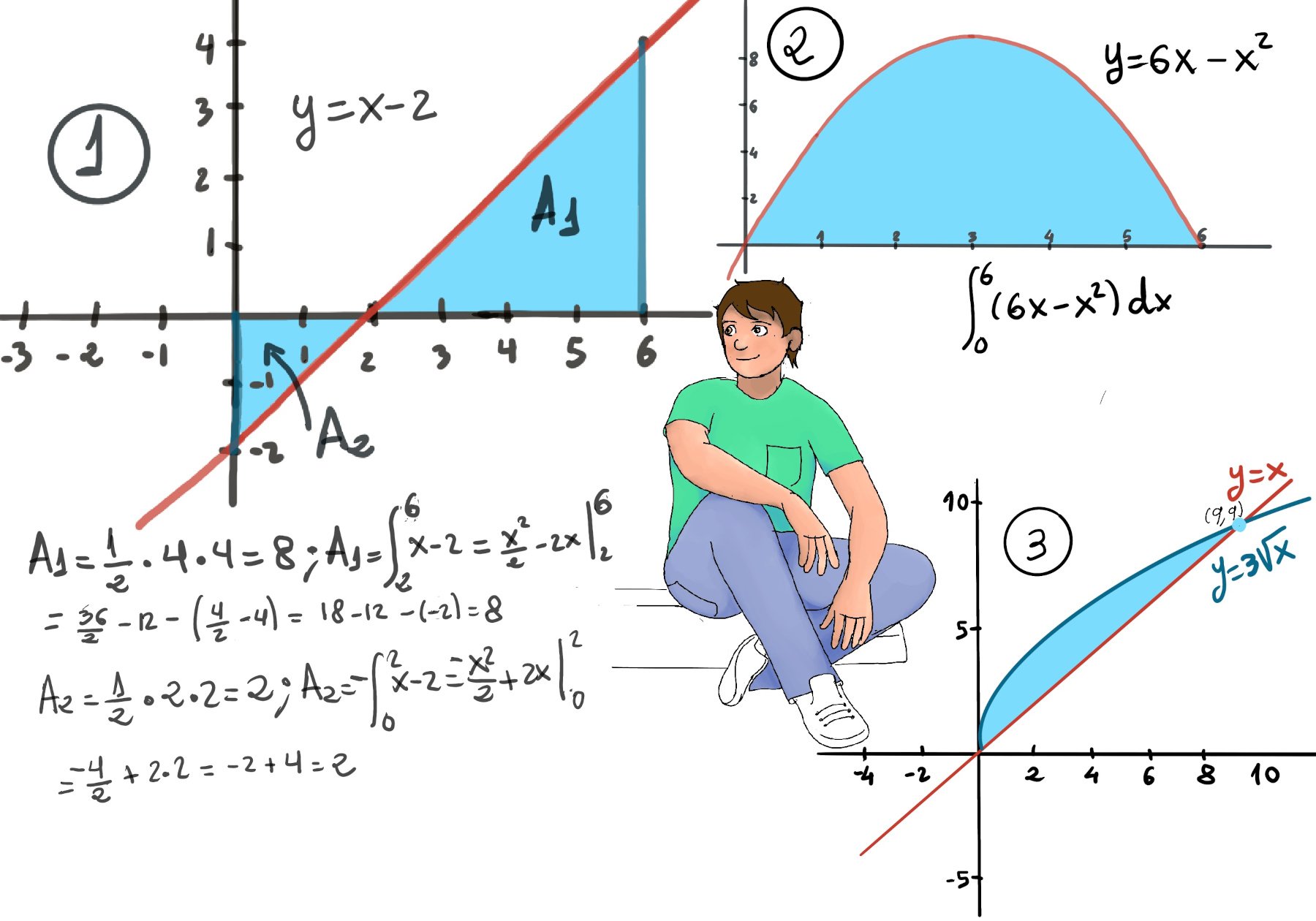
Calculate the x-intercepts.
Set the function to zero to find where it crosses the axis: $x - 2 = 0 \Rightarrow x = 2$.
The $x$-intercept is $(2, 0)$.
Split the interval.
Divide the total area into the subinterval below the $x$-axis $[0, 2]$ and the subinterval above it $[2, 6]$.
The total area formula becomes: $\int_{0}^{6} \vert{}x - 2\vert{}dx = \left\vert{} \int_{0}^{2} (x - 2)dx \right\vert{} + \int_{2}^{6} (x - 2)dx$
Evaluate the areas.
Because $f(x) = x - 2$ forms straight lines, you can use basic geometric formulas for triangles ($Area = \frac{1}{2} \cdot \text{base} \cdot \text{height}$) instead of integrating:
$\star$ Area 1 (below axis): Base is $2$, height is $2$. $A_1 = \frac{1}{2}(2)(2) = 2$
$\star$ Area 2 (above axis): Base is $4$, height is $4$. $A_2 = \frac{1}{2}(4)(4) = 8$
Total Area: $2 + 8 = 10$.
When a curve sits entirely above the $x$-axis for a given interval, the definite integral and the total geometric area are identical.
Problem: Find the area of the region bounded by $y = 6x - x^2$ and $y = 0$ (the $x$-axis), Figure 2.
Find the intersection limits.
Calculate the $x$-intercepts of $f(x) = 6x - x^2$ by setting it to $0$: $6x - x^2 = x(6 - x) = 0$
The intercepts (and our bounds of integration) are $x = 0$ and $x = 6$.
Set up and evaluate the integral.
Integrate the function from $0$ to $6$:
$\int_{0}^{6} (6x - x^2)dx = \left( 3x^2 - \frac{1}{3}x^3 \right) \bigg\vert{}_{0}^{6} = \left( 3(6)^2 - \frac{1}{3}(6)^3 \right) - \left( 3(0)^2 - \frac{1}{3}(0)^3 \right) = (108 - 72) - 0 = 36$
To find the area wedged between two different functions, you must integrate the difference between the “upper” curve and the “lower” curve.
Problem: Find the area of the region bounded by $y = 3\sqrt{x}$ and $y = x$, Figure 3.
Find the points of intersection.
Set the equations equal to each other to find where the bounds close: $x = 3\sqrt{x}$
Square both sides: $x^2 = 9x \Rightarrow x^2 - 9x = 0 \Rightarrow x(x - 9) = 0$
The curves intersect at $x = 0$ and $x = 9$. By testing a point between them (like $x=4$), we see that $3\sqrt{4} = 6$ and $y=4$, so $y = 3\sqrt{x}$ is the upper curve.
Integrate the difference.
Set up the integral as (Upper Curve) $-$ (Lower Curve): \
$\int_{0}^{9} (3\sqrt{x} - x)dx = \left( 3 \cdot \frac{x^{3/2}}{3/2} - \frac{x^2}{2} \right) \bigg\vert{}_{0}^{9}$
Simplify: $= \left( 2x^{3/2} - \frac{x^2}{2} \right) \bigg\vert{}_{0}^{9}$
Evaluate at the bounds: $= \left( 2(9)^{3/2} - \frac{81}{2} \right) - (0) = 2(27) - 40.5 = 54 - 40.5 = 13.5$
Integration by substitution, often called $u$-substitution, is a technique used to evaluate integrals that contain a composite function. It is the integral equivalent of the chain rule for derivatives.
The core idea is to simplify the integral by defining a new variable, $u$, which replaces a part of the original expression.
Here are several examples of how this technique is applied, broken down step-by-step.
Evaluate $\int_{0}^{2} 2xe^{x^2}dx$
Choose a suitable substitution.
We look for an expression whose derivative is also present in the integrand.
Let’s choose the exponent: $u = x^2$
Find the differential $du$ and update limits.
Take the derivative of $u$ with respect to $x$: $du = 2x \, dx$
Since this is a definite integral, we must also change our limits of integration from $x$-values to $u$-values:
$\star$ Lower limit: When $x = 0$, $u_1 = 0^2 = 0$
$\star$ Upper limit: When $x = 2$, $u_2 = 2^2 = 4$
Rewrite and evaluate.
Substitute $u$ and $du$ back into the integral: $\int_{0}^{2} 2xe^{x^2}dx = \int_{0}^{4} e^{u} \, du$
Evaluate the simpler integral: $e^u \bigg\vert{}_{0}^{4} = e^4 - e^0 = e^4 - 1 \approx 53.598$
Evaluate $\int_{0}^{1} x\sqrt{1-x^2} \, dx$
Choose substitution.
Let $u = 1 - x^2$
Find differential and update limits.
$du = -2x \, dx \implies x \, dx = -\frac{1}{2} \, du$
$\star$ Lower limit: When $x = 0$, $u_0 = 1 - 0^2 = 1$
$\star$ Upper limit: When $x = 1$, $u_1 = 1 - 1^2 = 0$
Rewrite and evaluate.
$\int_{1}^{0} \sqrt{u} \left(-\frac{1}{2}\right) du = -\frac{1}{2} \int_{1}^{0} u^{\frac{1}{2}} \, du = -\frac{1}{2} \left[ \frac{u^{\frac{3}{2}}}{\frac{3}{2}} \right]_{1}^{0} = -\frac{1}{3} u^{\frac{3}{2}} \bigg\vert{}_{1}^{0} = 0 - \left(-\frac{1}{3}(1)\right) = \frac{1}{3}$

JustToThePoint Copyright © 2011 - 2026 Anawim. ALL RIGHTS RESERVED. Bilingual e-books, articles, and videos to help your child and your entire family succeed, develop a healthy lifestyle, and have a lot of fun. Social Issues, Join us.
This website uses cookies to improve your navigation experience.
By continuing, you are consenting to our
use of cookies, in accordance with our Cookies Policy and
Website Terms and Conditions of use.