
|
 |

|
|
|
|
|
|
Calculus is the most powerful weapon of thought yet devised by the wit of man, Wallace B. Smith
The derivative of a function at a chosen input value, when it exists, is the slope of the tangent line to the graph of the function at that point. It is the instantaneous rate of change, which can be understood as the ratio of the instantaneous change in the dependent variable ($y$) to that of the independent variable ($x$).
Definition of Differentiability. A function $f(x)$ is differentiable at a point $a$ of its domain if its domain contains an open interval containing $a$, and the following limit exists: $\boxed{f'(a) = \lim_{h \to 0} \frac{f(a+h) - f(a)}{h} = L}$
Formal ($\epsilon-\delta$) Definition. More formally, we say the limit equals $L$ if, for every positive real number $\epsilon > 0$, there exists a positive real number $\delta > 0$, such that for every $h$ satisfying $0 < |h| < \delta$, the following inequality holds: $\left| L - \frac{f(a+h) - f(a)}{h} \right| < \epsilon$
Before discussing function bounds, we must establish a foundational rule about sequences and intervals, relying on the Bolzano-Weierstrass theorem, which states that each infinite bounded sequence in $\mathbb{R}^n$ has a convergent subsequence.
Theorem. If $\{x_n\}_{n=1}^\infty$ is a convergent sequence and $a \le x_n \le b$ for all $n \in \mathbb{N}$, then $a \le \lim_{n \to \infty} x_n \le b$. In other words, the limit of a sequence bounded by a closed interval must lie within that closed interval.
Proof by Contradiction:
Let $\lim_{n \to \infty} x_n = c$. For the sake of contradiction, assume that $c \notin [a, b]$.
Without loss of generality, suppose that $c < a$.
Because $c < a$, the distance between them is strictly positive. Let’s define our limit margin $\epsilon$ as half of this distance: $\epsilon = \frac{a - c}{2} > 0$.
By the formal definition of a limit, since $\lim_{n \to \infty} x_n = c$, there exists some integer $N$ such that for all $n \ge N$, $|x_n - c| < \epsilon$.
This inequality can be rewritten as: $-\epsilon < x_n - c < \epsilon$
We isolate $x_n$ on the right side: $x_n < c + \epsilon$
Substitute our chosen $\epsilon = \frac{a - c}{2}$ and we get $x_n < c + \frac{a - c}{2} = \frac{a + c}{2}$
Because we assumed $c < a$, the average of $a$ and $c$ must be strictly less than $a$. Therefore, $x_n < a$
However, our initial premise stated that $x_n \ge a$ for all $n \in \mathbb{N}$. We have reached a contradiction ($x_n < a$ and $x_n \ge a$). Thus, our assumption was false, and $c$ must belong to $[a, b]$. $\blacksquare$

Definition. A function $f(x)$ is bounded if for all $x$ in its domain, there exists a real number $M$ such that $|f(x)| \le M$, i.e., $\forall x \in \mathbb{Dom(f)}, \exists M \in \mathbb{R}: |f(x)| \le M$
Boundedness Theorem. Let $I = [a, b]$ be a closed bounded interval, and let $f: I \to \mathbb{R}$ be continuous on $I$. Then, $f$ is bounded on $I$.
Proof:
Suppose, for the sake of contradiction, that the function $f$ is not bounded on $[a,b]$. This means for any natural number $n \in \mathbb{N}$, there exists some input $x_n \in [a,b]$ such that $|f(x_n)| > n$.
Because the interval $[a,b]$ is obviously bounded, the sequence of inputs $\{x_n\}_{n=1}^\infty$ is also bounded.
By the Bolzano-Weierstrass theorem, because $\{x_n\}$ is bounded, there exists a convergent subsequence $\{x_{n_k}\}$ that converges to a limit, let’s call it $x_0$.
By our previous theorem regarding limits in closed intervals, because $[a,b]$ is closed, the limit $x_0$ must belong to $[a,b]$.
Since $f$ is continuous on the entire interval $[a,b]$, it is continuous at $x_0$.
There is a fundamental theorem of continuity: If $f: \mathbb{R} \to \mathbb{R}$ is continuous at a point $x_0 \in \mathbb{R}$ and $\{x_n\}$ is a real sequence converging to $x_0$, the sequence $\{f(x_n)\}$ converges to $f(x_0)$.
Therefore, the sequence of outputs $\{f(x_{n_k})\}$ converges to the finite value $f(x_0)$.
Because every convergent sequence is necessarily bounded, $\{f(x_{n_k})\}$ must be bounded.
However, by our initial assumption, $|f(x_n)| > n$ for all $n$. This applies to our subsequence as well:
$|f(x_{n_k})| > n_k \ge k$
As $k \to \infty$, $|f(x_{n_k})| \to \infty$. This implies that $\{f(x_{n_k})\}$ diverges. ⊥ Therefore, $f$ must be bounded on $[a,b]$. $\blacksquare$

The Boundedness Theorem strictly requires two conditions: the function must be continuous, and the interval must be closed and bounded. If either condition fails, the theorem does not apply.
Consider the function on the closed interval $[0, 1]$:
$$f(x) = \begin{cases} \frac{1}{x}, & 0 < x \le 1 \\\\ 0, & x = 0 \end{cases}$$$f(x)$ is not bounded on $[0, 1]$. Why? Because f is not continuous at x = 0, hence f manages to escape to infinity as 0 is not there to keep f in check.
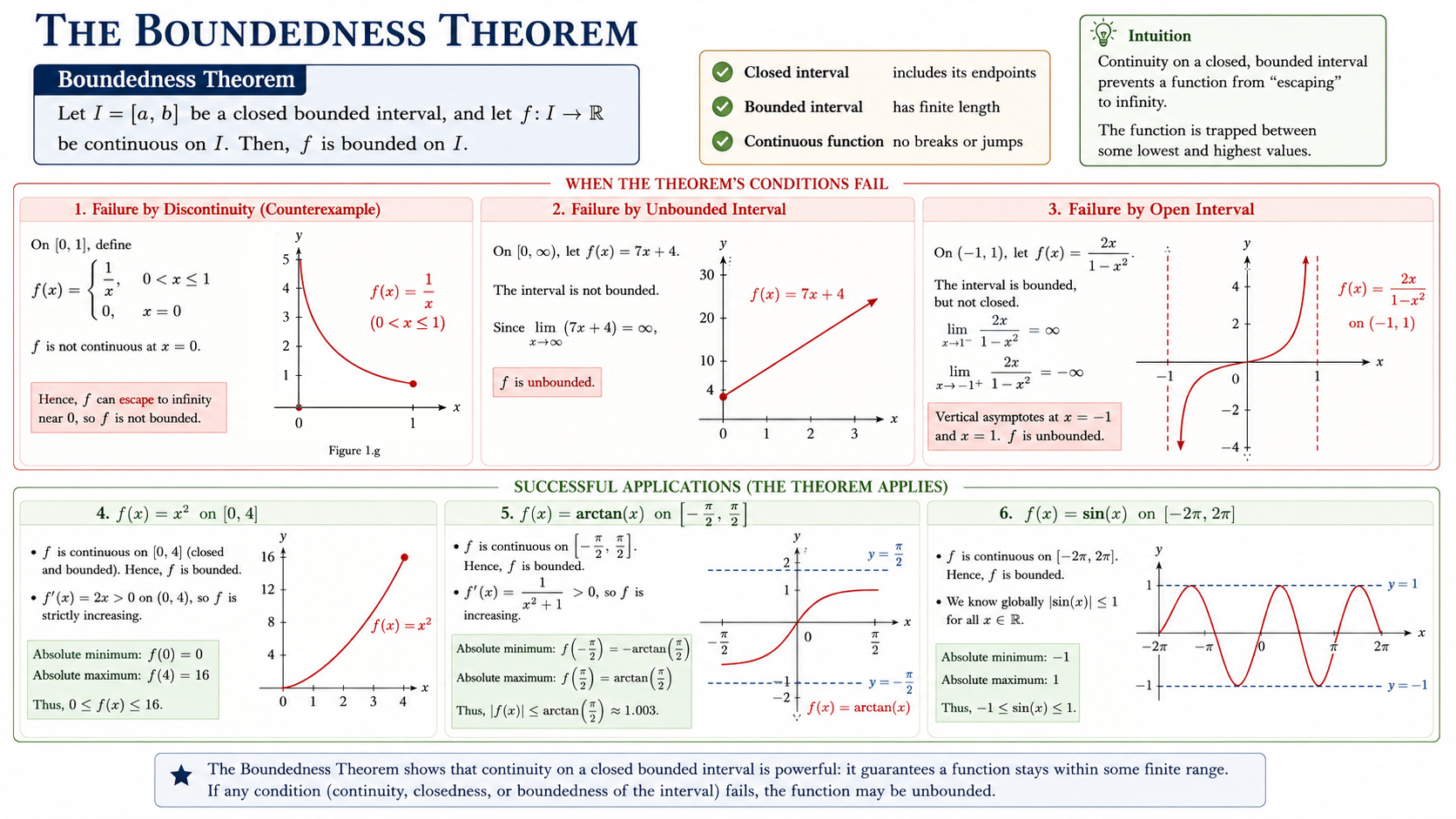
Therefore, we can deduce that if continuity fails, the conclusion of the Boundedness Theorem does not necessarily follow.
Let $f: [0, \infty) \to \mathbb{R}$ be defined by $f(x) = 7x + 4$.
This does not satisfy the conditions of the theorem. While $f$ is perfectly continuous, the interval $[0, \infty)$ is not bounded.
Because $\lim_{x \to \infty} (7x + 4) = \infty$, the function is unbounded.
Let $f: (-1, 1) \to \mathbb{R}$ be defined by $f(x) = \frac{2x}{1-x^2}$.
The interval $(-1, 1)$ is bounded, but it is not closed (it does not include its endpoints). Thus, the theorem fails.
Furthermore:
The function escapes to infinity, revealing vertical asymptotes at $x = -1$ and $x = 1$.
$f$ is continuous on all real numbers, hence continuous on the closed bounded interval $[0, 4]$. By the theorem, it is bounded. We can verify this: $f'(x) = 2x > 0$ on $(0, 4)$, meaning $f$ is strictly increasing. Therefore, its absolute maximum occurs at the right endpoint: $|f(x)| \le f(4) = 16$.
$f$ is continuous on the closed bounded interval $\left[\frac{-\pi}{2}, \frac{\pi}{2}\right]$, so it is bounded. We can verify: $f'(x) = \frac{1}{x^2+1} > 0$, so $f$ is increasing. Thus, $|f(x)| \le \arctan\left(\frac{\pi}{2}\right) \approx 1.003$.
Note: The arctangent function itself naturally has horizontal asymptotes of $\pm \frac{\pi}{2}$ on the infinite domain, but on this specific closed interval, it is strictly bounded by $\approx \pm 1.003$.
$f$ is continuous on the closed interval $[-2\pi, 2\pi]$, so it must be bounded. We know this is true globally, as $|\sin(x)| \le 1$ for all $x \in \mathbb{R}$.

JustToThePoint Copyright © 2011 - 2026 Anawim. ALL RIGHTS RESERVED. Bilingual e-books, articles, and videos to help your child and your entire family succeed, develop a healthy lifestyle, and have a lot of fun. Social Issues, Join us.
This website uses cookies to improve your navigation experience.
By continuing, you are consenting to our
use of cookies, in accordance with our Cookies Policy and
Website Terms and Conditions of use.