
|
 |

|
|
|
|
|
|
If you can’t be kind, at least be vague, Judith Martin
Definition. In mathematics, a sequence is an enumerated collection of objects in which repetitions are allowed and order matters. Sequences of real numbers are typically denoted by $\{a_n\}_{n=1}^\infty$.
Examples of sequences:
The limit of a sequence is the value that the terms of the sequence “tend to” as the index grows infinitely large, denoted as $\lim_{n \to \infty} a_n = L$. If such a limit exists and is a finite real number, the sequence is called convergent. A sequence that does not converge is said to be divergent.
Formal Definition of Convergence. We say $\lim_{n \to \infty} a_n = L$ if for every $\epsilon > 0$, there exists an integer $N \in \mathbb{N}$ such that for all $n \ge N$, it is true that $|a_n - L| < \epsilon$.
Definition. A subsequence is a sequence that can be derived from an original sequence by deleting some of the terms without changing the order of the remaining terms. This is equivalent to choosing infinitely many values from the given sequence, where each successive choice is made by taking a strictly larger index (and by doing so, looking farther away in the sequence).
Given an original sequence $\{a_n\}_{n=1}^\infty \subseteq \mathbb{R}$, we select a strictly increasing sequence of natural numbers $\{n_k\}_{k=1}^\infty \subseteq \mathbb{N}$ (such that $n_1 < n_2 < n_3 < \dots$). The resulting sequence $\{a_{n_k}\}_{k=1}^\infty \subseteq \mathbb{R}$ is called a subsequence.
Theorem. Every subsequence of a convergent sequence converges, and it converges to the same limit.
Proof. Suppose we have a sequence $\{a_n\}_{n=1}^\infty$ such that $\lim_{n \to \infty} a_n = L$. Let $\{a_{n_k}\}_{k=1}^\infty$ be an arbitrary subsequence.
By the definition of convergence for the original sequence, given any $\epsilon > 0$, there exists $N \in \mathbb{N}$ such that for all $n \ge N$, $|a_n - L| < \epsilon$.
By the definition of a subsequence, $\{n_k\}_{k=1}^\infty$ is a strictly increasing sequence of natural numbers ($n_1 < n_2 < \dots$). Because it is strictly increasing and composed of integers, $n_k \ge k$ for all $k$.
Therefore, we can choose $K = N$. For all $k \ge K$, it is guaranteed that $n_k \ge N$. Consequently, the terms of the subsequence satisfy $|a_{n_k} - L| < \epsilon$.
This fulfills the definition of convergence, meaning $\lim_{k \to \infty} a_{n_k} = L$. $\blacksquare$
Bolzano-Weierstrass Theorem. Every infinite, bounded sequence in $\mathbb{R}^n$ has a convergent subsequence.
Proof (in $\mathbb{R}$ via the Bisection Method).
Suppose $\{a_n\}_{n=1}^\infty$ is a bounded sequence. By definition, there exists a real number $M > 0$ such that $|a_n| \le M$ for all $n \in \mathbb{N}$. This means every term of the sequence lies within the closed interval $[-M, M]$.
We divide this interval into two equal halves: $[-M, 0]$ and $[0, M]$. Because the sequence has infinitely many terms, at least one of these two halves must contain infinitely many terms of the sequence. (If both contained only finitely many, the entire sequence would be finite).
Let $I_1$ be the half-interval that contains infinitely many terms. We pick one term from the sequence that falls inside $I_1$ and label it $a_{n_1}$. The length of $I_1$ is $M$.
We iterate this process. We divide $I_1$ into two equal sub-intervals. At least one sub-interval must contain infinitely many terms of the sequence. We call this sub-interval $I_2$. We pick a term $a_{n_2} \in I_2$ making sure that the index $n_2 > n_1$ (this guarantees we are forming a valid subsequence). The length of $I_2$ is $\frac{M}{2}$.
Repeating this process infinitely creates a sequence of nested, closed intervals:
$I_1 \supseteq I_2 \supseteq I_3 \supseteq \dots \supseteq I_k \supseteq \dots$
where $a_{n_k} \in I_k$, with indices $n_1 < n_2 < \dots < n_k$, and the length of the $k$-th interval is $\text{length}(I_k) = \frac{M}{2^{k-1}}$.
By the Nested Interval Theorem for real numbers (which states that any sequence of nested, bounded, closed, nonempty intervals has a non-empty intersection), we know that:
$\bigcap_{i=1}^\infty I_i \neq \emptyset$
Pick an element $L$, $L \in \bigcap_{i=1}^\infty I_i \neq \emptyset$, so $L \in I_k$ for all $k$. We claim that our constructed subsequence converges to $L$: $\lim_{k \to \infty} a_{n_k} = L$.
To prove this, let $\epsilon > 0$. We need to find an integer $K$ such that for all $k \ge K$, $|a_{n_k} - L| < \epsilon$.
Because both $a_{n_k}$ and $L$ belong to the same interval $I_k$, the distance between them cannot exceed the length of that interval:
$|a_{n_k} - L| \le \text{length}(I_k) = \frac{M}{2^{k-1}}$
Since $\lim_{k \to \infty} \frac{M}{2^{k-1}} = 0$, we can choose $K$ large enough so that $\frac{M}{2^{K-1}} < \epsilon$.
Thus, for all $k \ge K$, we have $|a_{n_k} - L| \le \frac{M}{2^{k-1}} \le \frac{M}{2^{K-1}} < \epsilon$.
This satisfies the formal definition of convergence, proving that the bounded sequence has a convergent subsequence. $\blacksquare$
This generates the sequence: $-1, 1, -1, 1, -1, 1, \dots$
This sequence does not converge because it constantly oscillates between $-1$ and $1$, never settling on a single limit $L$. However, it is clearly bounded (by $M = 1$). Therefore, by the Bolzano-Weierstrass theorem, it must contain a convergent subsequence. In fact, it contains two obvious ones:
By extracting only the even-indexed terms, we get the subsequence $a_{2n} = (-1)^{2n}$. This yields the sequence $1, 1, 1, 1, \dots$, which clearly converges to $1$.
By extracting only the odd-indexed terms, we get the subsequence $a_{2n-1} = (-1)^{2n-1}$. This yields the sequence $-1, -1, -1, -1, \dots$, which clearly converges to $-1$.
The sequence $\{\sin(n)\}_{n=1}^\infty$ does not converge. Because $n$ grows by increments of 1 (which is not a rational multiple of $\pi$), the sequence steps semi-randomly around the unit circle, oscillating indefinitely between -1 and 1.
However, because the sequence is bounded between -1 and 1, the Bolzano-Weierstrass Theorem guarantees that it must have a convergent subsequence.
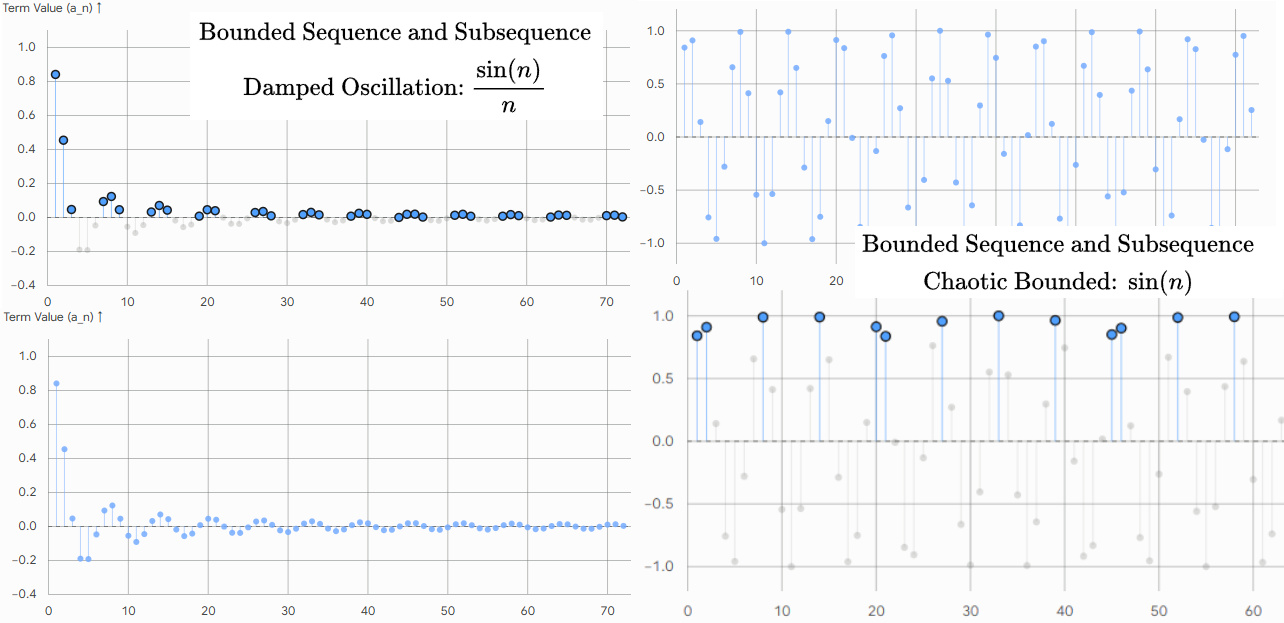
We can constructively find a subsequence that converges to 0 by hunting for integer values of $n$ that are extremely close to multiples of $2\pi$.
If we can find an integer $p$ and an integer $q$ such that $\frac{p}{q} \approx 2\pi$, then $p \approx 2\pi q$. Because the sine function has a period of $2\pi$, taking the sine of this integer $p$ gives: $\sin(p) \approx \sin(2\pi q) = 0$
To find these “best fit” integers, we turn to continued fractions
Recall: A continued fraction is an expression obtained through an iterative process of representing a number as the sum of its integer part and the reciprocal of another number, then writing this other number as the sum of its integer part and another reciprocal, and so on.
This is how you find the continued fraction for any number at all, let’s call it $x_0$.
Let $a_0$ be the largest integer that does not exceed $x_0$, meaning $a_0 = \lfloor x_0 \rfloor$.
Let $b_0$ be the fractional remainder, meaning $b_0 = x_0 - a_0$.
We can write $x_0 = a_0 + b_0 = a_0 + \frac{1}{x_1}$, where $x_1 = \frac{1}{b_0}$.
Repeat the process for $x_1$: find its integer part $a_1 = \lfloor x_1 \rfloor$ and its remainder $b_1$, and set $x_2 = \frac{1}{b_1}$.
In general, the number is represented as:
$$x_0 = a_0 + \frac{1}{a_1 + \frac{1}{x_2}} = \cdots $$$x_0 = \pi \approx 3.14159... \implies a_0 = 3, b_0 = 0.14159...$
$x_1 = \frac{1}{0.14159...} \approx 7.0625... \implies a_1 = 7, b_1 = 0.0625...$
$x_2 = \frac{1}{0.0625...} \approx 15.996... \implies a_2 = 15$
This yields the continued fraction for $\pi$, denoted as $[3; 7, 15, 1, 292, \dots]$:
$$\pi = 3 + \frac{1}{7 + \frac{1}{15 + \frac{1}{1 + \frac{1}{292 + \dots}}}}$$We want to find rational approximations for $2\pi$.
So, the continued fraction for $2\pi$ begins as $[6; 3, 1, 1, 7, 2, 146, 3, \dots]$
$$2\pi = 6 + \frac{1}{3 + \frac{1}{1 + \frac{1}{1 + \frac{1}{7 + \dots}}}}$$By truncating this infinite fraction at different steps, we get a sequence of rational approximations called convergents:
Continuing this, the sequence of convergent fractions for $2\pi$ is: $6, \frac{19}{3}, \frac{25}{4}, \frac{44}{7}, \frac{333}{53}, \frac{710}{113}, \frac{103993}{16551}, \frac{312689}{49766}, \dots$
As established earlier, if $\frac{p}{q} \approx 2\pi$, then the numerator $p \approx 2\pi q$. We can ignore the denominators and create a strictly increasing sequence of integers $n$ from these numerators:
$\{n_k\}_{k=1}^\infty = \{6, 19, 25, 44, 333, 710, 103993, 312689, \dots\}$
Let’s test this subsequence inside our sine function:
Intuition: By selecting indices that are mathematically forced to stay close to multiples of $2\pi$, this subsequence $\sin(n_k)$ get smaller and smaller (it converges to zero).
To prove this, we need to use The Diophantine Approximation Theorem. If $\frac{p_k}{q_k}$ is the $k$-th convergent of an irrational number $x$, the distance between the true value $x$ and the fraction is bounded by the square of its denominator.
Applying this to our irrational number $x = 2\pi$, we get: $\left| 2\pi - \frac{p_k}{q_k} \right| < \frac{1}{q_k^2}$
We want to know how close our numerator $p_k$ is to $2\pi q_k$. Let’s manipulate the previous inequality by multiplying the entire expression by $q_k$: $q_k \cdot \left| 2\pi - \frac{p_k}{q_k} \right| < q_k \cdot \frac{1}{q_k^2}$
Simplify, $\left| 2\pi q_k - p_k \right| < \frac{1}{q_k}$
Because the absolute value is symmetric, this is exactly the same as: $\left| p_k - 2\pi q_k \right| < \frac{1}{q_k}$
Let’s define the difference between our integer $p_k$ and the perfect multiple of $2\pi$ as an error term, $\epsilon_k$: $\epsilon_k = p_k - 2\pi q_k$
So we know that $|\epsilon_k| < \frac{1}{q_k}$.
As we calculate deeper and deeper convergents (as $k \to \infty$), the denominators $q_k$ of the fractions grow infinitely large.
Because $q_k \to \infty$, the fraction $\frac{1}{q_k} \to 0$.
By the Squeeze Theorem, since our error term $|\epsilon_k|$ is trapped between 0 and $\frac{1}{q_k}$: $\lim_{k \to \infty} \epsilon_k = 0$
Because the sine function is continuous, the limit of the sine is the sine of the limit. We want to find the limit of our subsequence $\sin(p_k)$: $\lim_{k \to \infty} \sin(p_k) =[\text{Sine is periodic}]= \lim_{k \to \infty} \sin(p_k - 2\pi q_k)$
Substitute our error term $\epsilon_k$: $= \lim_{k \to \infty} \sin(\epsilon_k)$
Pass the limit inside the continuous sine function: $= \sin\left(\lim_{k \to \infty} \epsilon_k\right) = \sin(0) = 0 \blacksquare$
The Bolzano-Weierstrass theorem only guarantees a convergent subsequence if the original sequence is bounded. If a sequence is unbounded, it might have a convergent subsequence, but it is not guaranteed.
No convergent subsequence: The sequence $\{2n\}_{n=1}^\infty = 2, 4, 6, 8, \dots$ is unbounded and strictly increasing. It does not have any convergent subsequences.
Has a convergent subsequence: The alternating, growing sequence $\{((-1)^n + 1)n\}_{n=1}^\infty$ generates the terms $0, 4, 0, 8, 0, 12, \dots$. This sequence is unbounded overall, but it clearly possesses a convergent subsequence. If we take only the odd indices, $\{((-1)^{2n-1} + 1)(2n-1)\}_{n=1}^\infty$, we get the sequence $0, 0, 0, 0, \dots$ which converges perfectly to 0.

JustToThePoint Copyright © 2011 - 2026 Anawim. ALL RIGHTS RESERVED. Bilingual e-books, articles, and videos to help your child and your entire family succeed, develop a healthy lifestyle, and have a lot of fun. Social Issues, Join us.
This website uses cookies to improve your navigation experience.
By continuing, you are consenting to our
use of cookies, in accordance with our Cookies Policy and
Website Terms and Conditions of use.