The factory of the future will have only two employees, a man and a dog. The man will be there to feed the dog. The dog will be there to keep the man from touching the equipment, Warren Bennis
The development of full artificial intelligence could spell the end of the human race, Stephen Hawking.
Mathematical Series Review
A finite series is given by all the terms of a finite sequence added together. For example, the sum of the sequence $\{3, 5, 7, \dots, 21\}$ is written as: $\sum_{k=1}^{10} (2k+1) = 120$.
An infinite series is the sum of an infinite sequence of numbers. It is represented in the form $\sum_{n=1}^\infty a_n = a_1 + a_2 + a_3 + \dots$ where $a_n$ represents the terms of the sequence, and $n$ is the index that ranges from $1$ to infinity.
Convergence and Divergence
Definition. A series is convergent (or converges) if the sequence of its partial sums tends to a limit. More precisely, if we define the $n$-th partial sum as $S_n = \sum_{k=1}^n a_k = a_1 + a_2 + \dots + a_n$, the series converges if: $L = \lim_{n \to \infty} S_n$ exists and is a finite number.
Formally, this means there exists a number $L$ such that for every arbitrarily small positive number $\varepsilon$, there is a sufficiently large integer $N$, such that for all $n \geq N$, $\vert{}S_n - L\vert{} < \varepsilon$. If the series is convergent, the number $L$ is called the sum of the series.
On the contrary, any series that is not convergent (where the limit of $S_n$ does not exist or approaches infinity) is said to be divergent (or to diverge).
Convergence Tests
Divergence Test ($n$-th Term Test). If $\lim_{n \to \infty} a_n \neq 0$, then $\sum_{n=1}^\infty a_n$ diverges.
If the limit is 0, this test is inconclusive; the series might converge or diverge.
Integral Test. If $f(x)$ is a positive, continuous, and decreasing function on the interval $[1, \infty)$, then the series $\sum_{n=1}^\infty f(n)$ converges if and only if the improper integral $\int_{1}^{\infty} f(x) dx$ converges.
Direct Comparison Test. Let $\{a_n\}$ and $\{b_n\}$ be positive sequences where $a_n \leq b_n$ for all $n \geq N$, for some integer $N$.
- If the “larger” series $\sum_{n=1}^\infty b_n$ converges, then the “smaller” series $\sum_{n=1}^\infty a_n$ converges.
- If the “smaller” series $\sum_{n=1}^\infty a_n$ diverges, then the “larger” series $\sum_{n=1}^\infty b_n$ diverges.

Absolute vs. Conditional Convergence
Absolute Convergence: An infinite series is said to converge absolutely if the absolute values of its terms form a convergent series (i.e., $\sum_{n=1}^\infty \vert{}a_n\vert{} = L$ for some real number $L$).
Theorem: If a series converges absolutely, it also converges in the normal sense.
Conditional Convergence: A series is conditionally convergent if it converges normally, but does not converge absolutely, e.g., $\sum_{n=1}^\infty \frac{(-1)^n}{\sqrt{n}}$.
Alternating Series
Definition. An alternating series is a series whose terms alternate in sign, i.e., $\sum_{n=0}^\infty (-1)^na_n = a_0 -a_1 + a_2 -a_3 + ···$ where either all $a_n$ are positive or all $a_n$ are negative.
Theorem. Alternating Series Test. It states that an alternating series converges if the following two conditions are met:
- $|a_n|$ decreases monotonically, i.e., $|a_{n+1}| \leq |a_n|$.
- $\lim_{n \to \infty} a_n = 0$.
Other authors express it as follows. Suppose that we have a series $\sum_{n=0}^\infty a_n$ and either $a_n = (-1)^nb_n$ or $a_n = (-1)^{n+1}b_n$, let’s also suppose that
- $b_n$ positive, $b_n \gt 0, \forall n$
- $\{ b_n \}$ is a decreasing sequence
- $\lim_{n \to \infty} b_n = 0$, then, the alternating series $\sum_{n=0}^\infty a_n$ converges.
Proof of the Alternating Series Test
- Without loss of generality, assume the series is $\sum_{n=1}^\infty (-1)^{n-1} b_n = b_1 - b_2 + b_3 - b_4 + \dots$ where $b_n \geq 0$, $b_n \geq b_{n+1}$, and $\lim_{n \to \infty} b_n = 0$.
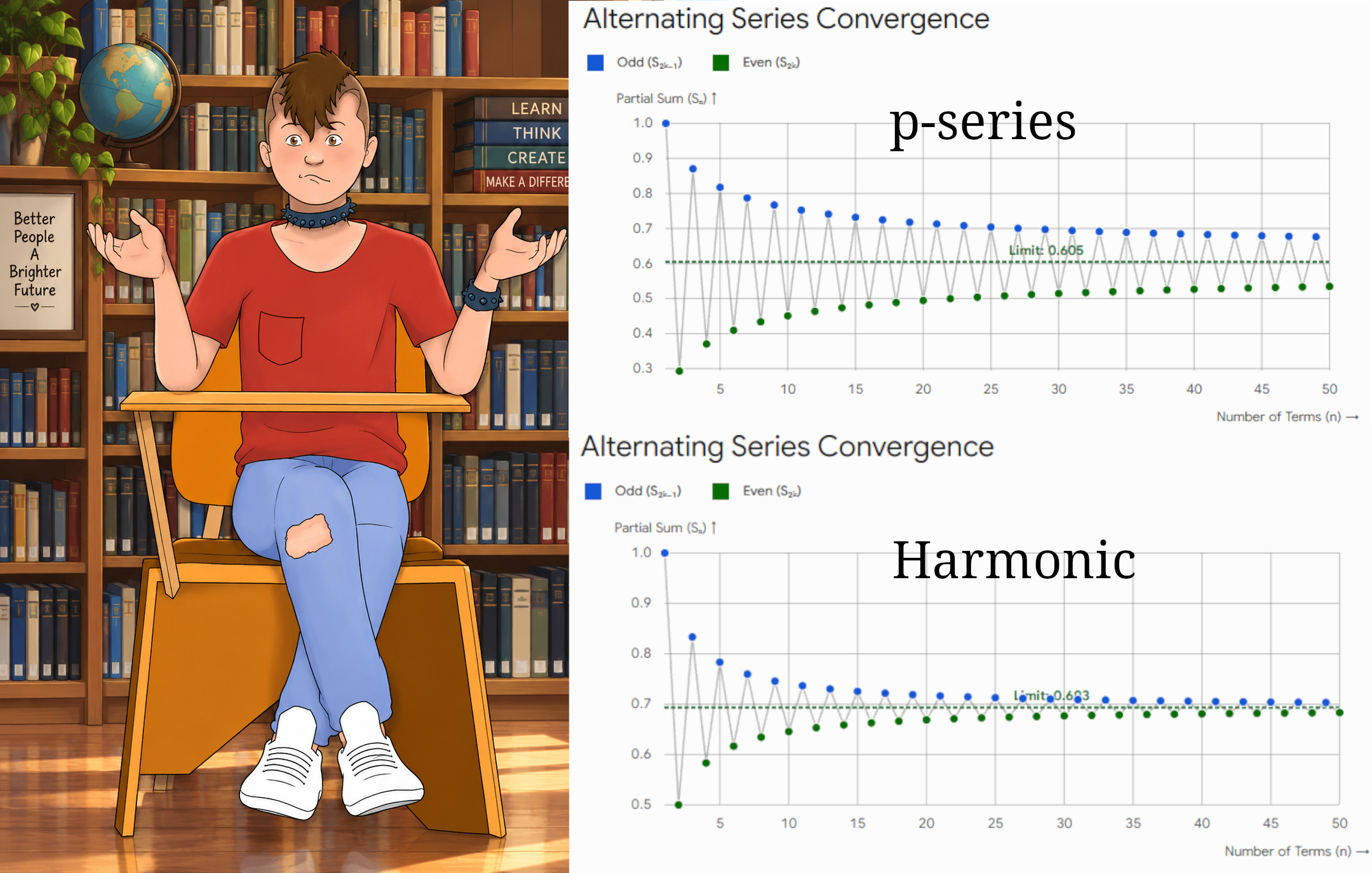
- We can examine the partial sums by splitting them into odd and even terms.
- Odd partial sums decrease monotonically.
$S_{2m+3} = S_{2m+1} - b_{2m+2} + b_{2m+3}$. Because the terms are decreasing ($b_{2m+2} \geq b_{2m+3}$), the quantity $(-b_{2m+2} + b_{2m+3}) \leq 0$. Therefore, $S_{2m+3} \leq S_{2m+1}$.
- Even partial sums increase monotonically.
$S_{2m+2} = S_{2m} + b_{2m+1} - b_{2m+2}$. Because $b_{2m+1} \geq b_{2m+2}$, the quantity $(b_{2m+1} - b_{2m+2}) \geq 0$. Therefore, $S_{2m+2} \geq S_{2m}$.
- Since $b_n \geq 0$, we know $S_{2m+1} - S_{2m} = b_{2m+1} \geq 0$, meaning every odd sum is greater than the even sum right before it.
- Putting it all together: $S_2 \leq S_4 \leq \dots \leq S_{2m} \leq S_{2m+1} \leq \dots \leq S_3 \leq S_1$.
- By the Monotone Convergence Theorem, since the odd sums decrease and are bounded below (by $S_2$), they converge to a limit $L_1$. Similarly, the even sums increase and are bounded above (by $S_1$), converging to a limit $L_2$.
- Finally, let’s find the difference between these limits: $\lim_{m \to \infty} (S_{2m+1} - S_{2m}) = \lim_{m \to \infty} b_{2m+1} =[\text{By assumption }, \lim_{n \to \infty} b_n = 0] 0$
$\lim_{m \to \infty} (S_{2m+1} - S_{2m}) = \lim_{m \to \infty} S_{2m+1} -\lim_{m \to \infty}-S_{2m} = L_1-L_2 = 0 \implies L_1 = L_2 \blacksquare$
Solved exercises
- Determine convergence or divergence of the series $\sum_{n=1}^\infty \frac{(-1)^n}{n}$
$\sum_{n=1}^\infty \frac{(-1)^n}{n} = -1 + \frac{1}{2} +\frac{-1}{3}+\frac{1}{4}+···$
To apply the Alternating Series Test, $a_n = (-1)^n b_n, b_n = \frac{1}{n}$
- Limit condition: $\lim_{n \to \infty} b_n = \lim_{n \to \infty}\frac{1}{n} = 0$
- $\{ b_n \}$ is a decreasing sequence, $\frac{1}{n+1} \leq \frac{1}{n}$.
- Conclusion: By the Alternating Series Test, $\sum_{n=1}^\infty \frac{(-1)^n}{n}$ is convergent.
- Determine convergence or divergence of the series $\sum_{n=1}^\infty \frac{(-1)^n}{\sqrt{n}}$
$\sum_{n=1}^\infty \frac{(-1)^n}{\sqrt{n}} = \frac{-1}{\sqrt{1}}+\frac{1}{\sqrt{2}}+\frac{-1}{\sqrt{3}}+\frac{1}{\sqrt{4}}+···$
To apply the Alternating Series Test, $a_n = (-1)^n b_n, b_n = = \frac{1}{\sqrt{n}}$
- Limit condition: $\lim_{n \to \infty} b_n = \lim_{n \to \infty}\frac{1}{\sqrt{n}} = 0$
- $\{ b_n \}$ is a decreasing sequence. $\frac{1}{\sqrt{n+1}} \leq \frac{1}{\sqrt{n}}$.
- By the Alternating Series Test, $\sum_{n=1}^\infty \frac{(-1)^n}{\sqrt{n}}$ is convergent.
- However, if we take the absolute value, $\sum_{n=1}^\infty |a_n| = \sum_{n=1}^\infty |\frac{(-1)^n}{\sqrt{n}}| = \sum_{n=1}^\infty \frac{1}{\sqrt{n}}$, this is a p-series where $p = \frac12 \lt 1 \implies$ [Theorem (p-series)] $\sum_{n=1}^\infty |a_n|$ diverges.
- Conclusion. $\sum_{n=1}^\infty \frac{(-1)^n}{\sqrt{n}}$ is conditionally convergent.
- Determine convergence or divergence of the series $\sum_{n=1}^\infty (-1)^{n+1}·\frac{5n+3}{2n-7}$
To apply the Alternating Series Test, $a_n = (-1)^{n+1} b_n, b_n = \frac{5n+3}{2n-7}$
- Limit condition: $\lim_{n \to \infty} b_n = \lim_{n \to \infty}\frac{5n+3}{2n-7} =[L'Hôpital, \infty/ \infty] = \frac{5}{2} \neq 0$ ⇒ Since one of the conditions of the Alternating Series Test is not satisfied, we cannot conclude whether the series $\sum_{n=1}^\infty (-1)^{n+1}·\frac{5n+3}{2n-7}$ converges or diverges.
- Because the terms $b_n$ approach $\frac{5}{2}$, the alternating sequence $a_n$ approaches both $\frac{5}{2}$ and $-\frac{5}{2}$ as $n$ goes to infinity.
- Since $\lim_{n \to \infty} a_n \neq 0$, the series diverges by the Divergence Test. The AST is inconclusive, but the Divergence Test gives us a definitive answer.
- Determine convergence or divergence of the series $\sum_{n=1}^\infty (-1)^{n}·\frac{3n-1}{2n+1}$
To apply the Alternating Series Test, $a_n = (-1)^{n+1} b_n =\frac{3n-1}{2n+1}$
- Limit condition: $\lim_{n \to \infty} b_n = \lim_{n \to \infty}\frac{3n-1}{2n+1} =[L'Hôpital, \infty/\infty] = \frac{3}{2} \neq 0$ ⇒ Since one of the conditions of the Alternating Series Test is not satisfied, we cannot conclude whether the series $\sum_{n=1}^\infty (-1)^{n}·\frac{3n-1}{2n+1}$ converges or diverges.
- Just like the previous example, the limit of the general term does not equal zero. The series diverges by the Divergence Test.
- Determine convergence or divergence of the series $\sum_{n=1}^\infty (-1)^n\frac{n}{(n^2+2)}$
To apply the Alternating Series Test,$a_n = (-1)^{n+1} b_n =\frac{n}{(n^2+2)}$
- Limit condition: $\lim_{n \to \infty} b_n = \lim_{n \to \infty}\frac{n}{(n^2+2)} =[L'Hôpital, \infty/\infty] = \lim_{n \to \infty}\frac{1}{2n} = 0$.
- $\{ b_n \}$ is a decreasing sequence. Using the quotient rule:
$f'(x) = \frac{1(x^2+2) - x(2x)}{(x^2+2)^2} = \frac{2 - x^2}{(x^2+2)^2}$
For $x \geq \sqrt{2}$, $f'(x) < 0$, which means the sequence $b_n$ is strictly decreasing for $n \geq 2$.
- Conclusion: By the Alternating Series Test, $\sum_{n=1}^\infty (-1)^{n}·\frac{3n-1}{2n+1}$ is convergent.
- Determine convergence or divergence of the series $\sum_{n=2}^\infty \frac{(-1)^{n}}{3\ln(n)}$
- Important Domain Note: At $n = 1$, $\ln(1) = 0$, which makes the first term undefined ($\frac{1}{0}$). Therefore, this series must start at $n = 2$.
To apply the Alternating Series Test (AST), write $a_n = (-1)^n b_n$ where $b_n = \frac{1}{3\ln(n)}$ for $n \ge 2$.
- Check the Limit. $\lim_{n \to \infty} b_n = \lim_{n \to \infty} \frac{1}{3\ln(n)} = 0$
Because $\ln(n) \to \infty$ as $n \to \infty$, the denominator grows without bound, making the limit $0$.
- Check Monotonicity (Decreasing Terms). We check if $b_{n+1} \le b_n$ for all $n \ge 2$:
Since $\ln(x)$ is a strictly increasing function for $x > 0$: $n < n+1 \implies \ln(n) < \ln(n+1) \implies 3\ln(n) < 3\ln(n+1)$
Taking the reciprocal flips the inequality: $\frac{1}{3\ln(n+1)} < \frac{1}{3\ln(n)} \implies b_{n+1} < b_n$
Thus, $\{b_n\}$ is strictly decreasing for all $n \ge 2$.
- Conclusion. By the Alternating Series Test, the series $\sum_{n=2}^\infty \frac{(-1)^{n}}{3\ln(n)}$ converges.
- Is it Absolutely or Conditionally Convergent?
Let’s test absolute convergence: $\sum_{n=2}^\infty \left\vert{} \frac{(-1)^n}{3\ln(n)} \right\vert{} = \sum_{n=2}^\infty \frac{1}{3\ln(n)}$.
For $n \ge 2$, we know $n > \ln(n)$, which implies $\frac{1}{\ln(n)} > \frac{1}{n}$.
Since the harmonic series $\sum_{n=2}^\infty \frac{1}{3n}$ diverges ($p$-series with $p=1$), by the Direct Comparison Test, $\sum_{n=2}^\infty \frac{1}{3\ln(n)}$ also diverges.
$\therefore$ The series is conditionally convergent.
- Determine convergence or divergence of the series $\sum_{n=1}^\infty (-1)^{n} \cdot \frac{\ln(n)}{n}$
- To apply the Alternating Series Test, write $a_n = (-1)^n b_n$ where $b_n = \frac{\ln(n)}{n}$ for $n \ge 1$.
- Check the Limit.
Since $\lim_{n \to \infty} \frac{\ln(n)}{n}$ is an indeterminate form of type $\left[\frac{\infty}{\infty}\right]$, apply L’Hôpital’s Rule: $\lim_{n \to \infty} b_n = \lim_{x \to \infty} \frac{\ln(x)}{x} \overset{\text{L'H}}{=} \lim_{x \to \infty} \frac{\frac{1}{x}}{1} = \lim_{x \to \infty} \frac{1}{x} = 0$
- Check Monotonicity (Eventual Monotonicity). Evaluating the first few terms of $b_n$:
$b_1 = \frac{\ln(1)}{1} = 0$, $b_2 = \frac{\ln(2)}{2} \approx 0.347$, $b_3 = \frac{\ln(3)}{3} \approx 0.366$, $b_4 = \frac{\ln(4)}{4} \approx 0.347$, etc.
Notice that $b_n$ increases from $n = 1$ to $n = 3$, but then begins to decrease!
To prove where it strictly decreases, differentiate $f(x) = \frac{\ln(x)}{x}$ using the Quotient Rule:
$f'(x) = \frac{\frac{1}{x} \cdot x - \ln(x) \cdot 1}{x^2} = \frac{1 - \ln(x)}{x^2}$
For $f'(x) < 0$, we need the numerator to be negative: $1 - \ln(x) < 0 \implies \ln(x) > 1 \implies x > e \approx 2.718$
Since $e \approx 2.718$, $f'(x) < 0$ for all $x > e$. For integers, this means $b_n$ is strictly decreasing for all $n \ge 3$.
The Eventual Monotonicity Rule: The Alternating Series Test does not require $b_n$ to decrease from the very first term ($n=1$). It only requires $b_n$ to be monotonically decreasing eventually (i.e., for $n \ge N$).
Because adding or subtracting a finite number of terms (here, $a_1$ and $a_2$) has no effect on infinite convergence: $\sum_{n=1}^\infty (-1)^n \frac{\ln(n)}{n} = a_1 + a_2 + \sum_{n=3}^\infty (-1)^n \frac{\ln(n)}{n}$
- Conclusion. Since the tail $\sum_{n=3}^\infty (-1)^n \frac{\ln(n)}{n}$ satisfies both conditions of the AST, it converges. Adding the finite terms $a_1$ and $a_2$ yields a finite sum. Therefore, the full series converges.
- Is it Absolutely or Conditionally Convergent?
Test absolute convergence: $\sum_{n=1}^\infty \left\vert{} (-1)^n \frac{\ln(n)}{n} \right\vert{} = \sum_{n=1}^\infty \frac{\ln(n)}{n}$.
For $n \ge 3$, $\ln(n) > 1$, which gives: $\frac{\ln(n)}{n} > \frac{1}{n}$
Since $\sum_{n=3}^\infty \frac{1}{n}$ diverges (Harmonic Series), by the Direct Comparison Test, $\sum_{n=1}^\infty \frac{\ln(n)}{n}$ diverges.
$\therefore$ The series is conditionally convergent.
Bibliography
This content is licensed under a Creative Commons Attribution-NonCommercial-ShareAlike 4.0 International License and is based on MIT OpenCourseWare [18.01 Single Variable Calculus, Fall 2007].
- NPTEL-NOC IITM, Introduction to Galois Theory.
- Algebra, Second Edition, by Michael Artin.
- LibreTexts, Calculus and Calculus 3e (Apex). Abstract and Geometric Algebra, Abstract Algebra: Theory and Applications (Judson).
- Field and Galois Theory, by Patrick Morandi. Springer.
- Michael Penn, and MathMajor.
- Contemporary Abstract Algebra, Joseph, A. Gallian.
- YouTube’s Andrew Misseldine: Calculus. College Algebra and Abstract Algebra.
- MIT OpenCourseWare 18.01 Single Variable Calculus, Fall 2007 and 18.02 Multivariable Calculus, Fall 2007.
- Calculus Early Transcendentals: Differential & Multi-Variable Calculus for Social Sciences.