
|
 |

|
|
|
|
|
|
For every problem there is always, at least, a solution which seems quite plausible and reasonable. It is simple and clean, direct, neat, and very nice, and yet it is plainly wrong, #Anawim, justtothepoint.com
The derivative of a function at a chosen input value, when it exists, is the slope of the tangent line to the graph of the function at that point. It is the instantaneous rate of change —the exact ratio of the instantaneous change in the dependent variable ($y$) to that of the independent variable ($x$).
Definition. A function $f(x)$ is differentiable at a point $a$ of its domain if its domain contains an open interval containing $a$, and the following limit exists: $\boxed{f'(a) = L = \lim_{h \to 0} \frac{f(a+h) - f(a)}{h}}$
Formal Definition: More rigorously, for every positive real number $\epsilon > 0$, there exists a positive real number $\delta > 0$, such that for every $h$ satisfying $0 < |h| < \delta$, the difference between the secant slopes at points sufficiently near a are guaranteed to be ε-close to the derivative: $\left| L - \frac{f(a+h) - f(a)}{h} \right| < \epsilon$
A critical point is a point in the domain of the function where the function is either not differentiable or the derivative is equal to zero ($f'(x) = 0$). The value of the function at a critical point (the $y$-value) is called a critical value.
The squeeze or sandwich theorem. If a function f lies between two functions g and h, and the limits of each of them at a particular point are both equal to L, then the limit of f at that particular point is also equal to L.
The Extreme Value Theorem. If f is a continuous function on an closed interval $[a, b]$, then f has both maximum and minimum values on $[a, b]$. It states that if a function is continuous on a closed bounded interval, then it is guaranteed to hit a highest point and a lowest point somewhere within that interval (either at a peak/valley or at the endpoints a or b).
Fermat’s Theorem. If a function $f(x)$ is defined on the interval $(a, b)$, has a local extremum (a relative maximum or minimum) at $x = c$, and $f'(c)$ exists, then $x = c$ is a critical point of $f(x)$ and $f'(c) = 0$.
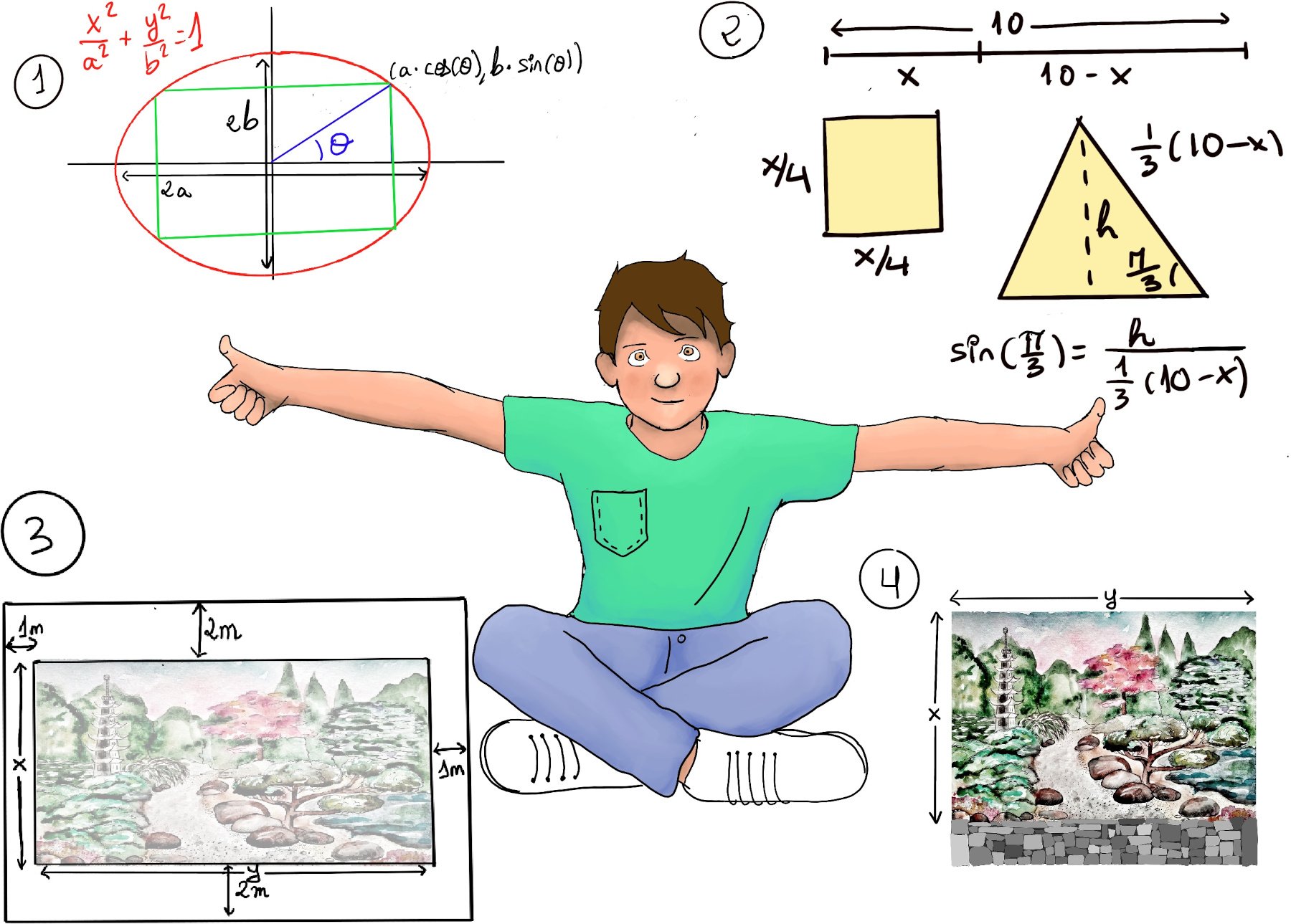
The Problem: Construct a rectangular garden using a rock wall for one side and 100 meters of wire fencing for the other three sides. Find the dimensions that maximize the enclosed area.
Understand and represent the Problem (Figure 4).
Let $x$ be the width (the two sides perpendicular to the wall) and $y$ be the length (the side parallel to the wall).
Because the rock wall serves as one of the $y$ sides, we only need to fence the other three.
Constraint (Fencing): $2x + y = 100$
Form the Objective Function
We want to maximize the area ($A$).
Area Formula: $A = x \cdot y$
Substitute the constraint ($y = 100 - 2x$) into the area formula to get a function of a single variable: $\boxed{A(x) = x(100 - 2x) = 100x - 2x^2}$
Find Critical Points
Take the first derivative of the area function with respect to $x$ and set it to zero to find the critical points: $\frac{dA}{dx} = 100 - 4x = 0$
$4x = 100 \implies x = 25$
Verify the Maximum
Use the Second Derivative Test to confirm this point is a maximum.
$\star$ If $f''(a) < 0$, the curve is concave down, making the point a local maximum.
$\star$ If $f''(a) > 0$, the curve is concave up, making the point a local minimum.
Taking the second derivative: $\frac{d^2A}{dx^2} = -4$
Because $-4$ is always less than zero, the function is everywhere concave down. Therefore, $x = 25$ is a local maximum.
Interpret the Results
To maximize the garden’s area, set the width $x = 25$ meters. The length parallel to the wall will be $y = 100 - 2(25) = 50$ meters.
The maximum area is $25 \cdot 50 = 1250$ square meters.
The Problem: A box with a square base and an open top must have a volume of 42,592 cubic meters. Find the dimensions that minimize the amount of material used (surface area).
Understand and represent the Problem (the diagram is shown in Figure 1.c.).
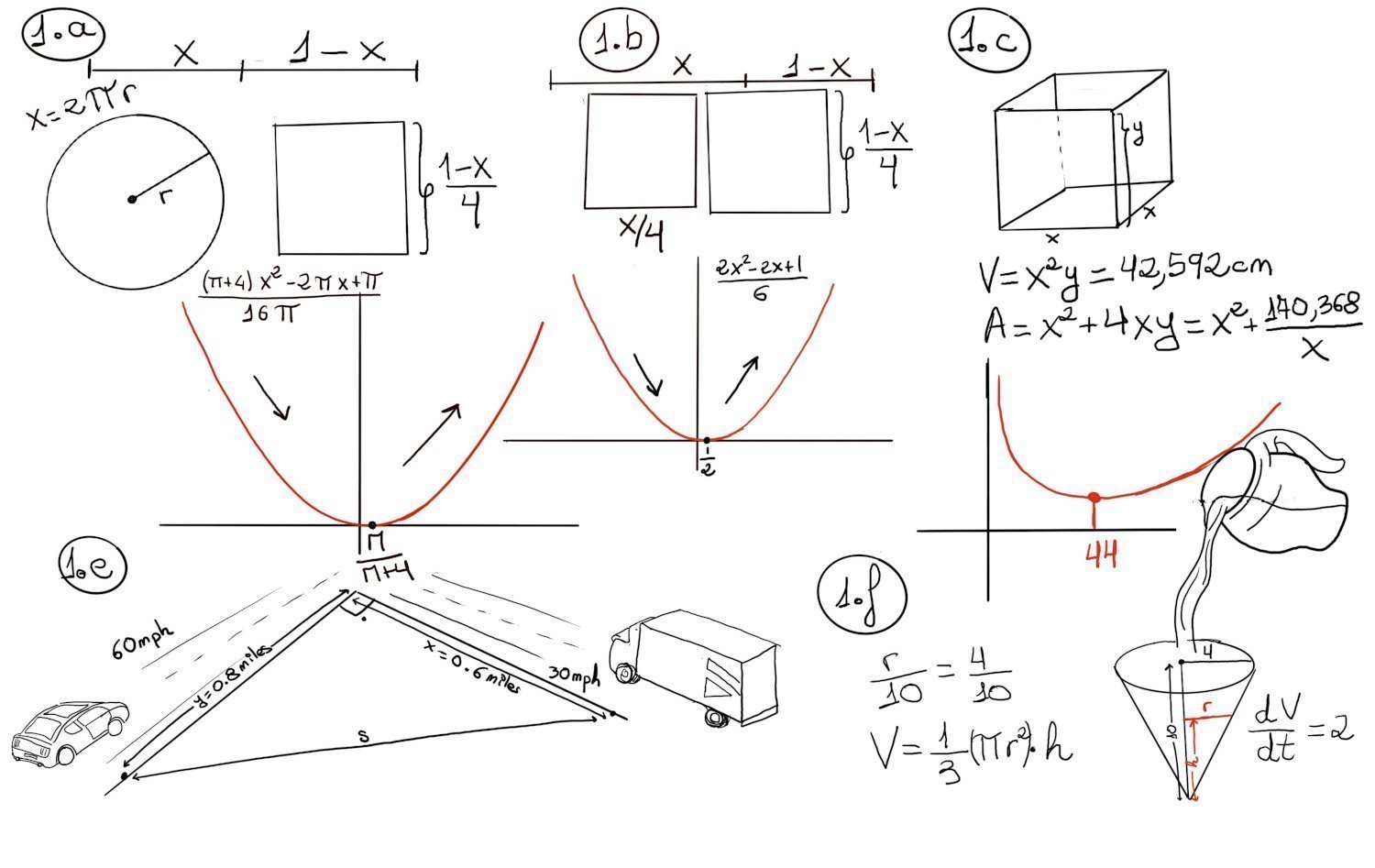
Let $x$ be the length of the square base sides, and $y$ be the height of the box.
Constraint (Volume): $V = x^2y = 42,592$
Solve for $y$ to use it later: $y = \frac{42,592}{x^2}$
Form the Objective Function
We want to minimize the surface area ($A$). The box has one square base ($x^2$) and four identical sides ($xy$), with no top.
Surface Area Formula: $A = x^2 + 4xy$
Substitute the volume constraint into the surface area equation: $\boxed{A(x) = x^2 + 4x\left(\frac{42,592}{x^2}\right) = x^2 + \frac{170,368}{x}}$
Find Critical Points
Take the first derivative and set it to zero: $\frac{dA}{dx} = 2x - \frac{170,368}{x^2} = 0 \implies 2x = \frac{170,368}{x^2}$
Multiply both sides by $x^2$: $2x^3 = 170,368 \implies x^3 = 85,184$
$x = \sqrt[3]{85,184} \approx 44$
Verify the Minimum
Use the Second Derivative Test: $\frac{d^2A}{dx^2} = 2 + \frac{340,736}{x^3}$
Since $x = 44$ is positive, the second derivative will be strictly positive ($> 0$), meaning the graph is concave upward.
This confirms $x = 44$ is a minimum.
Interpret the Results.
The base of the box should be 44 meters by 44 meters. The height is $y = \frac{42,592}{44^2} = 22$ meters.
The minimal amount of material required is $44^2 + 4(44)(22) = 5,808$ square meters.
The Problem: What is the maximum volume you can get for an open box constructed by removing squares of size $x$ from each corner of a 6m by 6m piece of paper and folding up the sides?
Understand and represent the Problem (Figure iv).
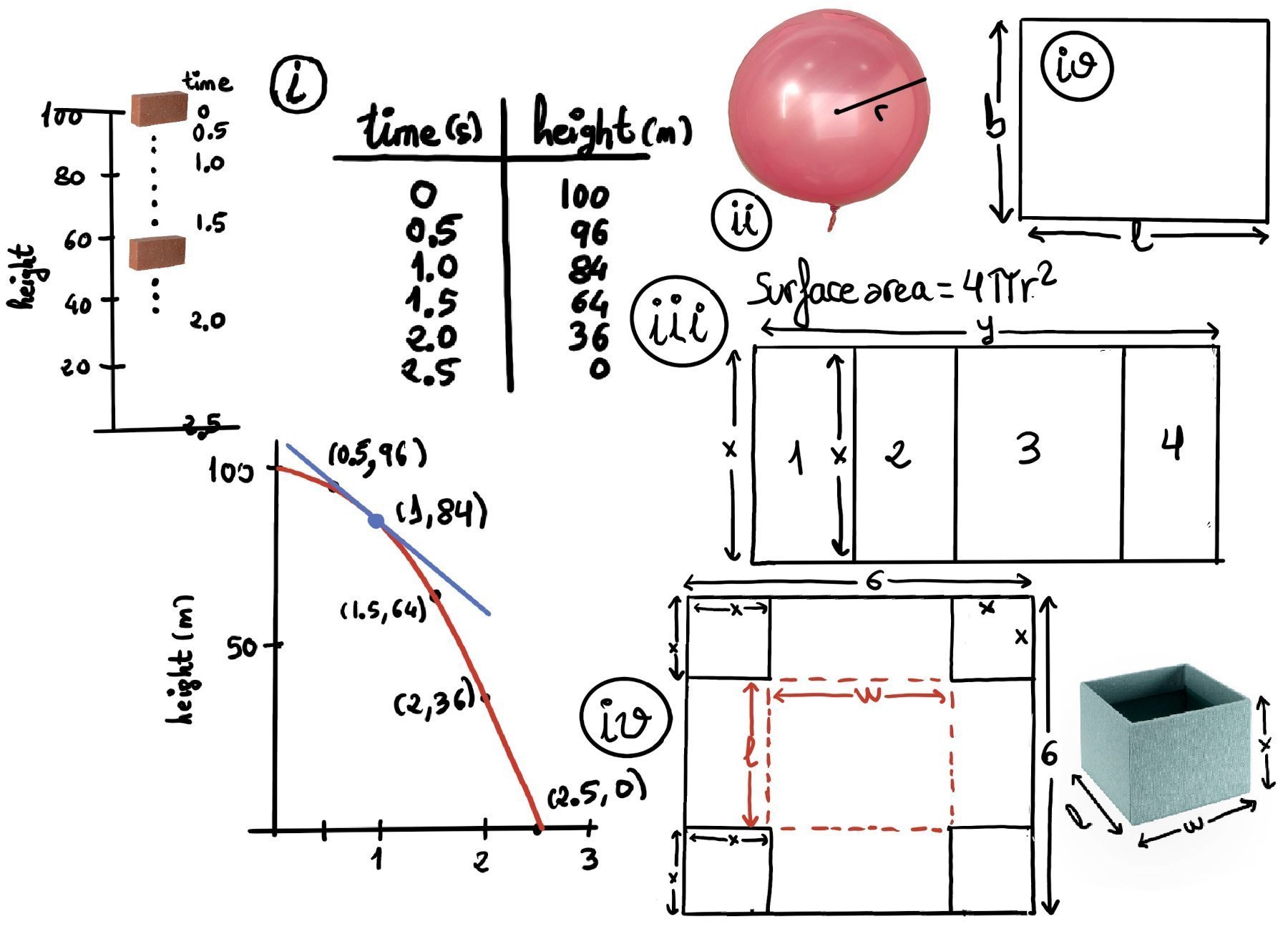
When you cut a square of side $x$ from all four corners, you lose $2x$ from both the total length and width of the paper.
Base dimensions: The new length and width are both $(6 - 2x)$.
Height: When folded, the height is $x$.
Form the Objective Function
Volume Formula: $V(x) = \text{length} \cdot \text{width} \cdot \text{height}$
$\boxed{V(x) = (6 - 2x)(6 - 2x)x = (36 - 24x + 4x^2)x = 36x - 24x^2 + 4x^3}$
Find Critical Points
Take the first derivative and set it to zero: $\frac{dV}{dx} = 36 - 48x + 12x^2 = 0$
Divide the entire equation by 12 to simplify: $x^2 - 4x + 3 = 0$
Then, we can factor the quadratic equation: $(x - 3)(x - 1) = 0$. This gives us two mathematical critical points, namely $x = 3$ and $x = 1$.
However, $x = 3$ is impossible: The original paper is 6 meters wide. If you cut 3-meter squares from both corners of the same edge, you have cut away the entire 6 meters ($3 + 3 = 6$). There would be no paper left to form the base. Therefore, $x = 1$ is our only viable critical point.
Verify the Maximum.
Take the second derivative: $\frac{d^2V}{dx^2} = -48 + 24x$
Test our valid critical point ($x = 1$): $\frac{d^2V}{dx^2}(1) = -48 + 24(1) = -24$
Because $-24 < 0$, the function is concave down at this point, confirming a maximum.
Interpret the Results.
To maximize the volume of the folded box, cut 1-meter squares from each corner.
The maximum volume is $V(1) = (6 - 2(1))^2 \cdot 1 = 4^2 \cdot 1 = 16$ cubic meters.
The Problem: A rectangular flower garden with an area of $30\text{ m}^2$ is surrounded by a border that is 1 meter wide on two opposite sides and 2 meters wide on the other two opposite sides. Find the dimensions of the garden that minimize the total combined area (garden + borders).
Understand and Represent the Problem (Figure 3).
Let $x$ be the width of the garden and $y$ be its length.
Constraint (Garden Area): $x \cdot y = 30 \implies y = \frac{30}{x}$
Total Dimensions: The border adds 2 meters to each $y$-side (so the total width is $x + 4$) and 1 meter to each $x$-side (so the total length is $y + 2$).
Form the Objective Function.
We want to minimize the total combined area ($A$): $A = (x + 4)(y + 2)$
Substitute $y = \frac{30}{x}$ into the equation: $A(x) = (x + 4)\left(\frac{30}{x} + 2\right)$
Expand the expression: $\boxed{A(x) = 30 + 2x + \frac{120}{x} + 8 = 2x + 38 + \frac{120}{x}}$
Find Critical Points.
Take the first derivative and set it to zero: $\frac{dA}{dx} = 2 - \frac{120}{x^2} = 0$
$\frac{120}{x^2} = 2 \implies 2x^2 = 120 \implies x^2 = 60$
$x = \sqrt{60} \approx 7.746\text{ m}$
Verify the Minimum.
Use the Second Derivative Test: $\frac{d^2A}{dx^2} = \frac{240}{x^3}$
At $x = \sqrt{60}$, the second derivative is positive ($\frac{240}{(\sqrt{60})^3} > 0$). Because the curve is concave upward, $x = \sqrt{60}$ is a local minimum.
Interpret the Results.
To minimize the combined area, the garden dimensions should be: Width: $x = \sqrt{60} \approx 7.75\text{ m}$, Length: $y = \frac{30}{\sqrt{60}} \approx 3.87\text{ m}$
The Problem: Find the area of the largest rectangle that can be inscribed in the ellipse $\frac{x^2}{a^2} + \frac{y^2}{b^2} = 1$.
Understand and Represent the Problem (Figure 1)
For a rectangle to be inscribed, its sides must be parallel to the axes. The vertices touching the ellipse will be at $(\pm x, \pm y)$.
Using parametric equations, any point on the ellipse can be defined by an angle $\theta$ (where $0 \le \theta \le 2\pi$):$x(\theta) = a \cdot \cos(\theta)$, $y(\theta) = b \cdot \sin(\theta)$
Form the Objective Function.
The rectangle has a total length of $2x$ and a width of $2y$.
Area Formula: $A = (2x)(2y) = 4xy$
Substitute the parametric definitions: $A(\theta) = 4(a \cdot \cos(\theta))(b \cdot \sin(\theta)) = 4ab \cdot \cos(\theta)\sin(\theta)$
Using the double-angle trigonometric identity ($2\sin(\theta)\cos(\theta) = \sin(2\theta)$), we can also simplify the function: $\boxed{A(\theta) = 2ab \cdot \sin(2\theta)}$
Find Critical Points.
Take the derivative with respect to $\theta$ and set it to zero: $\frac{dA}{d\theta} = 2ab \cdot 2\cos(2\theta) = 4ab \cdot \cos(2\theta) = 0$
Assuming $a \neq 0$ and $b \neq 0$, we set: $\cos(2\theta) = 0 \implies 2\theta = \frac{\pi}{2} \implies \theta = \frac{\pi}{4}$
Verify the Maximum.
Use the Second Derivative Test: $\frac{d^2A}{d\theta^2} = -8ab \cdot \sin(2\theta)$
At $\theta = \frac{\pi}{4}$, the second derivative is $-8ab \cdot \sin(\frac{\pi}{2}) = -8ab$. Since $a$ and $b$ are positive lengths, $-8ab < 0$. This confirms a maximum.
Interpret the Results.
The maximum area is: $A\left(\frac{\pi}{4}\right) = 2ab \cdot \sin\left(2 \cdot \frac{\pi}{4}\right) = 2ab \cdot \sin\left(\frac{\pi}{2}\right) = 2ab$
Example: For the ellipse $\frac{x^2}{4} + y^2 = 1$, $a = 2$ and $b = 1$. The maximum inscribed rectangle area is $2(2)(1) = 4$.
The Problem: A wire $10\text{m}$ long is cut into two pieces. One piece is bent into a square, and the other is bent into an equilateral triangle. Where should the cut be made to (a) minimize and (b) maximize the total enclosed area?
Understand and Represent the Problem (Figure 2).
Let $x$ be the length of the wire used for the square. Consequently, $(10 - x)$ is the length used for the triangle.
Square: Perimeter is $x$, so each side is $\frac{x}{4}$.
Triangle: Perimeter is $(10 - x)$, so each side is $\frac{10 - x}{3}$. The height $h$ of an equilateral triangle is $\frac{\sqrt{3}}{2} \cdot \text{base}$, which means $h = \frac{\sqrt{3}}{2} \cdot \frac{10 - x}{3} = \frac{\sqrt{3}(10 - x)}{6}$.
Form the Objective Function.
We need to sum the areas of the square ($A_1$) and the triangle ($A_2$).
$A_1 = \left(\frac{x}{4}\right)^2 = \frac{x^2}{16}$
$A_2 = \frac{1}{2} \cdot \text{base} \cdot h = \frac{1}{2} \left(\frac{10 - x}{3}\right) \left(\frac{\sqrt{3}(10 - x)}{6}\right) = \frac{\sqrt{3}(10 - x)^2}{36}$
Total Area: $\boxed{A(x) = \frac{x^2}{16} + \frac{\sqrt{3}(10 - x)^2}{36}}$
Find Critical Points.
Take the derivative and set it to zero: $\frac{dA}{dx} = \frac{x}{8} - \frac{2\sqrt{3}(10 - x)}{36} = \frac{x}{8} - \frac{\sqrt{3}(10 - x)}{18} = 0$
$\frac{x}{8} = \frac{\sqrt{3}(10 - x)}{18}$
Cross-multiply to solve for $x$: $18x = 8\sqrt{3}(10 - x) \implies 18x = 80\sqrt{3} - 8\sqrt{3}x$
$x(18 + 8\sqrt{3}) = 80\sqrt{3} \implies x = \frac{80\sqrt{3}}{18 + 8\sqrt{3}} \approx 4.35\text{ m}$
Verify Extrema.
Second Derivative Test (for minimum): $\frac{d^2A}{dx^2} = \frac{1}{8} + \frac{\sqrt{3}}{18}$. Since this is always positive, $x \approx 4.35$ is a local minimum.
Boundary Test (for maximum): Because the domain is restricted to $x \in [0, 10]$, we must test the endpoints to find the absolute maximum.
If $x = 0$ (all triangle): $A(0) = \frac{\sqrt{3}(10)^2}{36} \approx 4.81\text{ m}^2$
If $x = 10$ (all square): $A(10) = \frac{10^2}{16} = 6.25\text{ m}^2$
Interpret the Results
(a) Minimum Area: Cut the wire at $x \approx 4.35\text{ m}$ to use for the square (leaving $\approx 5.65\text{ m}$ for the triangle). The area is minimized at $\approx 2.71\text{ m}^2$.
(b) Maximum Area: The area is maximized in the boundaries. Do not cut the wire at all. Use the entire 10 meters for the square ($x = 10$) to yield a maximum area of $6.25\text{ m}^2$.
The Problem: A box with a square base and open top must have a fixed volume $V$. Find the dimensions that minimize the amount of material used.
Understand and Represent the Problem.
Let $x$ be the length of the base sides, and $y$ be the height.
Constraint (Volume): $V = x^2y \implies y = \frac{V}{x^2}$
Form the Objective Function.
We want to minimize the surface area ($A$).
$A = x^2 \text{ (base)} + 4xy \text{ (four sides)}$
Substitute the volume constraint: $\boxed{A(x) = x^2 + 4x\left(\frac{V}{x^2}\right) = x^2 + \frac{4V}{x}}$
Find Critical Points.
Take the derivative and set it to zero: $\frac{dA}{dx} = 2x - \frac{4V}{x^2} = 0$
$2x = \frac{4V}{x^2} \implies 2x^3 = 4V \implies x^3 = 2V$
$x = \sqrt[3]{2V}$
Verify the Minimum.
Use the First or Second Derivative Test. Using the second derivative: $\frac{d^2A}{dx^2} = 2 + \frac{8V}{x^3}$
For any positive value of $x$ and $V$, this evaluates to a positive number ($>0$), meaning the curve is concave upward. Thus, $x = \sqrt[3]{2V}$ is a minimum.
Interpret the Results.
To minimize material, the base side $x$ must be $\sqrt[3]{2V}$. The height $y$ is: $y = \frac{V}{x^2} = \frac{V}{(2V)^{2/3}} = \frac{V}{2^{2/3}V^{2/3}} = 2^{-2/3}V^{1/3}$
Interesting proportional takeaway: If we take the ratio of the base side to the height ($\frac{x}{y}$), we get: $\frac{x}{y} = \frac{2^{1/3}V^{1/3}}{2^{-2/3}V^{1/3}} = 2^{1/3} \cdot 2^{2/3} = 2^1 = 2$
This proves that for any fixed volume, the most material-efficient open-top square box will always have a base length that is exactly twice its height.

JustToThePoint Copyright © 2011 - 2026 Anawim. ALL RIGHTS RESERVED. Bilingual e-books, articles, and videos to help your child and your entire family succeed, develop a healthy lifestyle, and have a lot of fun. Social Issues, Join us.
This website uses cookies to improve your navigation experience.
By continuing, you are consenting to our
use of cookies, in accordance with our Cookies Policy and
Website Terms and Conditions of use.