
|
 |

|
|
|
|
|
|
Work hard in silence, let your success be your noise, Anonymous.
The flux of a vector field $\vec{F}$ across a surface $S$ is a mathematical formulation that measures how much of the field “flows” through the surface. Imagine $\vec{F}$ as a flowing fluid (like wind or water) and $S$ as an imaginary net. The flux calculates the total amount of fluid passing through the net per unit of time.
If the fluid moves perfectly parallel to the net, nothing passes through, and the flux is zero. If it moves perfectly perpendicular to the net, the flux is maximized. To capture this mathematically, we take the dot product of the vector field $\vec{F}$ and the unit normal vector $\hat{\mathbf{n}}$ (a vector of length 1 pointing perpendicular to the surface).
This is expressed as the surface integral: $\boxed{\text{Flux} = \iint_{S} \vec{F} \cdot \hat{\mathbf{n}} \, dS = \iint_{S} \vec{F} \cdot d\vec{S}}$ where, $d\vec{S} = \hat{\mathbf{n}} \, dS$ is the vector area element, capturing both the infinitesimal area of a patch on the surface ($dS$) and its perpendicular orientation ($\hat{\mathbf{n}}$).
Depending on the geometry of the surface, establishing the normal vector $\hat{\mathbf{n}}$ and the differential area $dS$ takes different forms:


🧩 Understanding the Geometry. We want to calculate the flux of the vector field $\vec{F} = z\vec{k}$ through the portion of the paraboloid $z = f(x, y) = x^2 + y^2$ that lies above the unit disk in the xy-plane. \ We are analyzing the portion of a circular paraboloid that opens upwards, with its vertex at the origin, and has circular cross-sections perpendicular to the $z$-axis. \ The normal vector to the surface is pointing upwards (Figure 03). The vector field $\vec{F} = z\hat{\mathbf{k}}$ represents a field that points in the positive z-direction, with a magnitude that increases with z. In other words, the higher the point on the surface, the stronger the vector field at that point.
🧭 Surface Element and Normal Vector For a surface defined explicitly by $z = f(x,y)$, the surface element vector is: $\hat{\mathbf{n}}dS = \pm\langle -f_x, -f_y, 1\rangle dxdy$
Taking the partial derivatives of $f(x, y) = x^2 + y^2$: $f_x = \frac{\partial}{\partial x}(x^2+y^2) = 2x, f_y = \frac{\partial}{\partial y}(x^2+y^2) = 2y$
Therefore, $\hat{\mathbf{n}} dS = \langle -2x, -2y, 1\rangle dxdy$. Since the surface is oriented upwards, we choose the positive sign for the normal vector.
Set Up the Flux integral. The flux through the surface S is given by the surface integral: Flux = $\int \int_{S} \vec{F} \cdot \hat{\mathbf{n}} dS$ =[Substitute $\vec{F} = z\vec{k} = \langle0, 0, z\rangle$ and $\hat{\mathbf{n}}dS = \langle -2x, -2y, 1\rangle d xdy$, we have:] Flux = $\int \int_{S}\langle0, 0, z\rangle \cdot \langle-2x, -2y, 1\rangle dxdy $
Simplifying the dot product: $\operatorname{Flux} = \int \int_{S} zdxdy$ =[Given that $z = x^2 + y^2$ on the surface] $\int \int_{S} (x^2+y^2)dxdy$
Converting to Polar Coordinates. We are projecting the surface S onto the xy-plane to define our domain of integration D. $\operatorname{Flux} = \int \int_{D} (x^2+y^2)dxdy$.
To evaluate this double integral, it’s convenient to switch to polar coordinates because the region of integration (the unit disk) is circular. The relationships between Cartesian and polar coordinates are: $x = r\cos(\theta), y = r\sin(\theta), x^2 + y^2 = r^2, dA = dxdy= rdrd\theta.$
The region of integration is $0 \le r \le1$ and $0 \le \theta \le 2\pi$. The integral becomes: $\int_{0}^{2\pi} \int_{0}^{1} (r^2)rdrd\theta = \int_{0}^{2\pi} \int_{0}^{1} r^3drd\theta$
Evaluating the inner integral: $\int_{0}^{1} r^3 \, dr = \left[ \frac{r^4}{4} \right]_{0}^{1} = \frac{1}{4}$
Evaluating the outer integral: $\int_{0}^{2\pi} \frac{1}{4} \, d\theta = \left[ \frac{1}{4}\theta \right]_{0}^{2\pi} = \frac{\pi}{2}$
Conclusion🎉: The flux of the vector field $\vec{F} = z\mathbf{k}$ through the specified paraboloid is $\frac{\pi}{2}$.
Often, a surface cannot be easily written as $z = f(x,y)$. Instead, we describe it using a parametric equation with two parameters, $u$ and $v$. The position of any point on the surface is defined by the vector-valued function: $\vec{r}(u, v) = \langle x(u, v), y(u, v), z(u, v) \rangle$ where $x(u, v), y(u, v)$ are functions that describe the coordinates of the surface in terms of the parameters $u$ and $v$.
Consider an infinitesimally small patch on this surface defined by tiny changes in our parameters, $du$ and $dv$. This small patch can be approximated by a flat parallelogram. The sides of this parallelogram are formed by the tangent vectors generated by partial derivatives:
The partial derivative $\frac{\partial \vec{r}}{\partial u}$ represents how the position vector $\vec{r}$ changes as the parameter u changes, giving us the tangent vector to the surface in the direction of increasing u. Similarly, $\Delta u$ corresponds to the small change in the parameter u. The product $\frac{\partial \vec{r}}{\partial u}\Delta u$ is a vector describing the change in position along the surface $S$ in the direction of $u$. This vector has $x, y$, and $z$ components, representing the changes in the coordinates of a point on the surface as “$u$” changes.
The area of the parallelogram formed by these two tangent vectors is given by the magnitude of their cross product. The cross product itself gives a vector that is perpendicular to the surface at that point, with a magnitude equal to the area of the parallelogram.
$\pm\hat{\mathbf{n}}dS = (\frac{\partial \vec{r}}{\partial u}\Delta u) \times (\frac{\partial \vec{r}}{\partial v}\Delta v) =(\frac{\partial \vec{r}}{\partial u} \times \frac{\partial \vec{r}}{\partial v})\Delta u\Delta v$
Conclusion. Thus, the surface element vector can be expressed as: $\pm\hat{\mathbf{n}}dS = (\frac{\partial \vec{r}}{\partial u} \times \frac{\partial \vec{r}}{\partial v})\Delta u\Delta v$. To calculate the Flux of a vector field $\vec{F}$ over the entire surface $\operatorname{S} = \int \int_{D} \vec{F} \cdot d\vec{S} = \int \int_{D} \vec{F} \cdot \hat{\mathbf{n}}dS = \int \int_{D} \vec{F} \cdot (\frac{\partial \vec{r}}{\partial u}x\frac{\partial \vec{r}}{\partial v})dudv$.
This integral sums up the contributions of the flux through all the infinitesimal surface elements.

Understanding the Problem. The flux of a vector field $\vec{F}$ across a surface $S$ measures how much of the vector field passes through the surface in the direction of the outward normal vector. Specifically, it calculates the component of the vector field that is perpendicular to the surface at each point, summed (integrated) over the entire surface.
Parametrization of the Surface. To compute the flux, we first need to parametrize the surface $z = 1 - x^2 - y^2$ for $z \ge 0$. The surface is the upper half of a circular paraboloid opening downwards (upside-down bowl🥣), with its vertex at $(0, 0, 1)$. The condition $z \ge 0$ ensures we are only considering the upper portion of this paraboloid.
Since the surface is radially symmetric, it’s convenient to express the coordinates $(x, y, z)$ in terms of polar coordinates $(r, \theta)$ where: $x = r\cos(\theta), y =r\sin(\theta), z = 1 −r^2$.
The “shadow” (projection) of this bowl-shaped surface with its vertex at $(0, 0, 1)$ is a unit disk, meaning the radial coordinate r (corresponding to the radius in the polar coordinate system) ranges from 0 to 1, and the angular coordinate $\theta$ (corresponding to the angle in the polar coordinate system) ranges from $0$ to $2\pi$.
Express the Vector Field in Terms of the Parameters.
The position vector $\vec{r}(r,\theta)$ of a point on the surface in terms of the parameters $r$ and $\theta$ is given by: $\vec{r}(u,v)=\langle r\cos(\theta), r\sin(\theta), 1-r^2 \rangle$
Plug these values in the vector field. $\vec{F}(r, \theta) = \langle r\cos(\theta), r\sin(\theta), 1-r^2\rangle$
Compute the Partial Derivatives. To find the vector area element $d\vec{S}$, we need to compute the partial derivatives of $\vec{r}(r, \theta)$ with respect to the parameters $r$ and $\theta$: $\frac{\partial \vec{r}}{\partial r} = \langle \cos(\theta), sin(\theta), -2r \rangle, \frac{\partial \vec{r}}{\partial \theta} = \langle - r\sin(\theta), r\cos(\theta), 0\rangle$.
Compute the Cross Product. The cross product of $\frac{\partial \vec{r}}{\partial u} \times \frac{\partial \vec{r}}{\partial v}$ gives a vector perpendicular to the surface, which represents the surface element vector $d\vec{S}$:
$\frac{\partial \vec{r}}{\partial r}x\frac{\partial \vec{r}}{\partial \theta} = \begin{vmatrix}\vec{i} & \vec{j} & \vec{k}\\\ cos(\theta) & sin(\theta) & -2r\\\ -rsin(\theta) & rcos(\theta) & 0\end{vmatrix}\vert$.
$= \mathbf{i}\big(0 - (-2r^2\cos\theta)\big) - \mathbf{j}\big(0 - (2r^2\sin\theta)\big) + \mathbf{k}\big(r\cos^2\theta - (-r\sin^2\theta)\big)$
$= \langle 2r^2\cos\theta, 2r^2\sin\theta, r(\cos^2\theta + \sin^2\theta) \rangle = \langle 2r^2\cos\theta, 2r^2\sin\theta, r \rangle$.
Check orientation: The $z$-component is $r$. Since $r \ge 0$, this vector points upwards, which matches our desired orientation.
Set Up and Calculate the flux.
The flux is calculated by integrating the dot product of the vector field $\vec{F}$ and the vector area element $d\vec{S}$:
$\operatorname{Flux} = \int \int_{D} \vec{F} \cdot d\vec{S} = \int \int_{D} \vec{F} \cdot \hat{\mathbf{n}}dS = \int \int_{D} \vec{F} \cdot (\frac{\partial \vec{r}}{\partial r} \times \frac{\partial \vec{r}}{\partial \theta})drd\theta$
$= \int \int_{D} \langle r\cos(\theta), r\sin(\theta), 1-r^2\rangle \langle 2r^2\cos(\theta), 2r^2\sin(\theta), r\rangle drd\theta = \int_{0}^{2\pi} \int_{0}^{1} (2r^3\cos^2(\theta)+2r^3\sin^2(\theta)+r-r^3) drd\theta$.
Factor out $2r^3$ from the first two terms and apply the Pythagorean identity: $= \int_{0}^{2\pi} \int_{0}^{1} (2r^3+r-r^3) drd\theta = \int_{0}^{2\pi} \int_{0}^{1} (r^3+r) drd\theta$
Evaluate the inner integral (over $r$): $\int_{0}^{1} (r^3+r) dr = \frac{r^4}{4}+\frac{r^2}{2}\bigg\vert_{0}^{1} = \frac{1}{4}+\frac{1}{2} = \frac{3}{4}$
Outer Integral (over $\theta$): $\operatorname{Flux} = \int_{0}^{2\pi} \frac{3}{4}d\theta = \frac{3}{4}\theta\bigg\vert_{0}^{2\pi} = \frac{3 (2\pi)}{4} = \frac{3\pi}{2}$.
Conclusion. Thus, the flux of the vector field $\vec{F}=\langle x, y, z\rangle$ across the surface $z = 1 -x^2 -y^2$, where $z \ge 0$ is $\frac{3\pi}{2}$.
Solution:

Parametrization of the Surface.
The flux measures how much of the vector field passes through the surface in the direction of the outward normal vector.
To calculate the flux, we first need to parametrize the surface of the upper hemisphere. The upper hemisphere can be conveniently described using polar coordinates because of its symmetry.
Domain: The “shadow” of the hemisphere on the xy-plane is a unit disk (we parametrize the surface by projecting it onto the $xy$-plane), meaning the radial coordinate u (corresponding to the radius in the polar coordinate system) ranges from 0 to 1, and the angular coordinate v (corresponding to the angle in the polar coordinate system) ranges from $0$ to $2\pi$.
From the sphere’s equation, $x^2+y^2+z^2=1 \implies z=\sqrt{1-x^2-y^2} = \sqrt{1-(u\cos(v))^2-(u sin(v))^2}=\sqrt{1-u^2}$.
Parametrization: The position vector $\vec{r}(u,v)$ of a point on the surface in terms of the parameters u and v is given by: $\vec{r}(u,v)=\langle u\cos(v), u\sin(v), \sqrt{1-u^2} \rangle$.
Plug these values in the vector field. $\vec{F}(\vec{r}(u, v)) = \langle -y, -x, 1 \rangle = \langle -u\sin(v), -u\cos(v), 1 \rangle$.
Compute the Partial Derivatives. We need to find the partial derivatives of $\vec{r}(u,v)=\langle u\cos(v), u\sin(v), \sqrt{1-u^2}\rangle$ with respect to u and v:
$\frac{\partial \vec{r}}{\partial u} = \langle \cos(v), \sin(v), \frac{-u}{\sqrt{1-u^2}}\rangle, \frac{\partial \vec{r}}{\partial v} = \langle -u\sin(v), u\cos(v), 0\rangle$. $\frac{\partial \vec{r}}{\partial u}$ This vector points in the direction of increasing u, with v held constant.
Compute the Cross Product.
The cross product of $\frac{\partial \vec{r}}{\partial u}x\frac{\partial \vec{r}}{\partial v}$ gives a vector perpendicular to the surface, which represents the surface element vector $d\vec{S}$:
$\vec{r}_u \times \vec{r}_v = \begin{vmatrix} \mathbf{i} & \mathbf{j} & \mathbf{k} \\ \cos(v) & \sin(v) & \frac{-u}{\sqrt{1 - u^2}} \\ -u\sin(v) & u\cos(v) & 0 \end{vmatrix}$
$= \mathbf{i}\left(0 - \frac{-u^2\cos(v)}{\sqrt{1 - u^2}}\right) - \mathbf{j}\left(0 - \frac{u^2\sin(v)}{\sqrt{1 - u^2}}\right) + \mathbf{k}\left(u\cos^2(v) + u\sin^2(v)\right)= \left\langle \frac{u^2\cos(v)}{\sqrt{1 - u^2}}, \frac{u^2\sin(v)}{\sqrt{1 - u^2}}, u \right\rangle$
Check orientation: The $z$-component is $u$. Since $u \ge 0$, the normal vector points upwards and outwards, satisfying the problem statement.
Calculate the flux.
$\operatorname{S} = \int \int_{D} \vec{F} \cdot d\vec{S} = \int \int_{D} \vec{F} \cdot \hat{\mathbf{n}}dS = \int \int_{D} \vec{F} \cdot (\frac{\partial \vec{r}}{\partial u}x\frac{\partial \vec{r}}{\partial v})dudv$
$\int_{0}^{2\pi}\int_{0}^{1} \langle-u\sin(v), -u\cos(v), 1\rangle \langle\frac{u^2\cos(v)}{\sqrt{1-u^2}}, \frac{u^2\sin(v)}{\sqrt{1-u^2}}, u\rangle dudv = \int_{0}^{2\pi}\int_{0}^{1} (-u\sin(v)\frac{u^2\cos(v)}{\sqrt{1-u^2}}+-u\cos(v) \frac{u^2\sin(v)}{\sqrt{1-u^2}}+1(u))dudv$
$= \int_{0}^{2\pi}\int_{0}^{1} (\frac{-2u^3sin(v)cos(v)}{\sqrt{1-u^2}}+u)dudv = \int_{0}^{2\pi} sin(v)cos(v)dv\int_{0}^{1}\frac{-2u^3}{\sqrt{1-u^2}}du + \int_{0}^{2\pi}\int_{0}^{1}ududv$
We can split this into two separate integrals based on the terms: $\text{Integral 1} = \int_{0}^{2\pi} \sin(v)\cos(v) \, dv \int_{0}^{1} \frac{-2u^3}{\sqrt{1 - u^2}} \, du$
$\text{Integral 2} = \int_{0}^{2\pi} \int_{0}^{1} u \, du \, dv$
Since $\sin(v)\cos(v)$ is odd over $[0, 2\pi]$, the integral of this term over v is zero. We are left only with Integral 2:
$\int_{0}^{2\pi}\int_{0}^{1} ududv =\int_{0}^{2\pi} \frac{u^2}{2}\bigg\vert_{0}^{1}dv = \frac{1}{2}$.
$\int_{0}^{2\pi} \frac{1}{2}dv = \frac{1}{2}v\bigg\vert_{0}^{2\pi} = \frac{1}{2}2\pi=\pi$
The flux of the vector field $\vec{F} = \langle −y, −x, 1\rangle$ across the upper hemisphere of the unit sphere with an outward-pointing normal is $\pi$.
Description of the problem. We are tasked with finding the flux of the vector field $\vec{F}= \langle x, z, 0 \rangle$ across the paraboloid $z = x^2 + y^2$, a circular paraboloid that opens upwards with its vertex at the origin, and has circular cross-sections perpendicular to the z-axis. As you move upwards along the z-axis, the cross-sections become larger circles. The paraboloid extends infinitely upwards.
Parametrization of the Surface. To calculate the flux, we first need to parametrize the surface of the paraboloid. A natural parametrization in this case uses cylindrical coordinates because of the symmetry of the paraboloid.
Domain: The “shadow” of the paraboloid (the projection) on the xy-plane is a circular region.
$\star$ $u$ is the radial distance from the origin to a point in the xy-plane. It ranges from 1 (the inner radius is 1) to 3 (the outer radius is 3). The coordinates $(x,y)$ in the xy-plane can be expressed in polar form as: $x = u\cos(v), y = u\sin(v)$.
$\star$ $v$ is the angle around the $z$-axis, measured in the xy-plane. It ranges from $0$ to $2\pi$.
Given these, we can find z using the equation of the paraboloid: $x^2+y^2=z \implies z = u^2\cos^2(u)+u^2\sin^2(v) =u^2.$
Our parameterized surface is: $\vec{r}(u,v)=\langle u\cos(v), u\sin(v), u^2 \rangle$.
We calculate the flux using the surface integral: $\int \int_{D} \vec{F} \cdot d\vec{S} = \int \int_{D} \vec{F}\cdot \hat{\mathbf{n}}dS = \int \int_{D} \vec{F}\cdot (\frac{\partial \vec{r}}{\partial u} \times \frac{\partial \vec{r}}{\partial v})dudv$
Compute the Surface Area Element $dS$. Plug these values in the vector field. $\vec{F}(\vec{r}(u, v)) = \langle x, z, 0\rangle = \langle u\cos(v), u^2, 0 \rangle$.
Compute the Partial Derivatives. We need to find the partial derivatives of $\vec{r}$ with respect to $u$ and $v$:
$\frac{\partial \vec{r}}{\partial u} = \langle\cos(v), sin(v), 2u\rangle, \frac{\partial \vec{r}}{\partial v} = \langle-usin(v), ucos(v), 0\rangle$
Compute the Cross Product
$\frac{\partial \vec{r}}{\partial u} \times \frac{\partial \vec{r}}{\partial v} = \begin{vmatrix}\vec{i} & \vec{j} & \vec{k}\\\ \cos(v) & \sin(v) & 2u\\\ -u\sin(v) & u\cos(v) & 0\end{vmatrix} = \langle -2u^2\cos(v), -2u^2\sin(v), u\rangle$. Since $1 \le u \le 3$, the $z$-component of the cross product $u$ is positive, indicating that the vector $\langle -2u^2\cos(v), -2u^2\sin(v), u\rangle$ points inward (towards the inside of the paraboloid). Because we need an outward-pointing normal vector, we multiply the vector by −1.
Calculate the flux. We calculate the flux using the formula:
$\operatorname{S} = \int \int_{D} \vec{F} \cdot d\vec{S} = \int \int_{D} \vec{F} \cdot \hat{\mathbf{n}}dS = \int \int_{D} \vec{F}\cdot (\frac{\partial \vec{r}}{\partial u} \times \frac{\partial \vec{r}}{\partial v})dudv$
We are going to introduce a minus because the orientation: $-\int_{0}^{2\pi}\int_{1}^{3} \langle u \cos(v), u^2, 0 \rangle \cdot \langle-2u^2\cos(v), -2u^2\sin(v), u\rangle dudv = -\int_{0}^{2\pi}\int_{1}^{3} (-2u^3\cos^2(v)-2u^4\sin(v))dudv$
Separate and evaluate the integral with respect to $u$: $\int_{0}^{2\pi} (\frac{u^4}{4}\cos^2(v) + \frac{u^5}{5}\sin(v))\bigg\vert_{1}^{3}dv =$
=$2\int_{0}^{2\pi} (\frac{81}{4}-\frac{1}{4})cos^2(v)+(\frac{3^5}{5}-\frac{1}{5})sin(v)dv$
Recall that integrating $\sin(v)$ over a full period $[0, 2\pi]$ yields $0$, so the second term vanishes, $\int_{0}^{2\pi} sin(v)dv = 0, \frac{81}{4}-\frac{1}{4} = 20$
= $40\int_{0}^{2\pi} cos^2(v)dv =$ [Use the identity $\cos^2(v)=\frac{1+\cos(2v)}{2}] 40(\frac{1}{2}\int_{0}^{2\pi}dv +\frac{1}{2}\int_{0}^{2\pi}cos(2v)dv) = $
Recall that $\int_{0}^{2\pi} cos(2v)dv = 0$
= $20\int_{0}^{2\pi}dv = 20v\bigg\vert_{0}^{2\pi} = 20·2\pi = 40\pi.$ Thus, the flux of $\vec{F}= \langle x, z, 0 \rangle$ across the paraboloid $z = x^2 + y^2, 1 \le z \le 9$ with outward-pointing normal is $40\pi$.
Problem Recap and Surface Description
We are tasked with calculating the flux of $\vec{F} = \langle x, y, 5 \rangle$ across the surface of a solid bounded by:
$\star$ Cylinder surface. $x^2+z^2 = 1$, which is a cylinder with radius 1 and centered along the $y$-axis. Every plane perpendicular to the y-axis intersects the cylinder in a circle of radius 1.
$\star$ Bottom surface. The plane $y = 0$ is the bottom cap of the cylinder.
$\star$ Top surface. The plane $x + y = 2$ which intersects the cylinder, forming an inclined plane surface.
The objective is to compute the flux of the vector field through these surfaces, taking into account that the normal vector must point outward.
Flux Integral. The flux of the vector field $\vec{F}$ across a surface S is given by the surface integral: $\int \int_{D} \vec{F}·d\vec{S} = \int \int_{D} \vec{F} \cdot \hat{\mathbf{n}}dS = \int \int_{D} \vec{F} \cdot (\frac{\partial \vec{r}}{\partial u} \times \frac{\partial \vec{r}}{\partial v})dudv$
Parametrization of the Cylinder Surface
To compute the flux across the curved surface of the cylinder, we parameterize this surface using cylindrical coordinates.
We parameterize the curved surface of the cylinder. Given $x^2 + z^2 = 1$, we can use $\vec{r}(\theta,y)=\langle \cos(\theta), y, \sin(\theta) \rangle$ where: $\theta$ varies between $0$ and $2\pi$ (it represents the angle around the $y$-axis), $y$ varies along the height of the cylinder, that is, between $0$ (the bottom plane, y = 0) and $2 -x = 2 - \cos(\theta)$ (the top plane, $x + y = 2$).
Compute the Partial Derivatives. We need to find the partial derivatives of $\vec{r}$ with respect to $\theta$ and $y$ respectively: $\frac{\partial \vec{r}}{\partial \theta} = \langle -\sin(\theta), 0, \cos(\theta)\rangle, \frac{\partial \vec{r}}{\partial y} = \langle 0, 1, 0 \rangle$
Compute the Cross Product. $\frac{\partial \vec{r}}{\partial \theta} \times \frac{\partial \vec{r}}{\partial y} = \begin{vmatrix}\vec{i} & \vec{j} & \vec{k}\\\ -\sin(\theta) & 0 & \cos(\theta)\\\ 0 & 1 & 0\end{vmatrix} = \langle-\cos(\theta), 0, -sin(\theta)\rangle$. This normal vector points inward, e.g., $\theta = 0, \langle-\cos(\theta), 0, -\sin(\theta)\rangle = \langle-1, 0, 0\rangle$, toward the axis of the cylinder. Since we require an outward-pointing normal, we reverse the direction by multiplying by −1: $\langle\cos(\theta), 0, sin(\theta)\rangle.$
Calculate the flux We calculate the flux using the formula:
$\operatorname{S}_1 = \int \int_{D} \vec{F} \cdot d\vec{S} = \int \int_{D} \vec{F} \cdot \hat{\mathbf{n}}dS = \int \int_{D} \vec{F}·(\frac{\partial \vec{r}}{\partial \theta} \times \frac{\partial \vec{r}}{\partial y})dA =$
$\int \int_{D} \langle\cos(\theta), y, 5\rangle \cdot \langle\cos(\theta), 0, \sin(\theta)\rangle dA = \int_{0}^{2\pi}\int_{0}^{2-\cos(\theta)} (\cos^2(\theta)+5\sin(\theta))dyd\theta$
Evaluate the Inner Integrals: $\int_{0}^{2-\cos(\theta)} (\cos^2(\theta)+5\sin(\theta))dy = \cos^2(\theta)y+5\sin(\theta)y\bigg\vert_{0}^{2-\cos(\theta)} =\cos^2(\theta)(2-\cos(\theta))+5\sin(\theta)(2-\cos(\theta))$
Evaluate the Outer Integrals:
Surface 2: The Bottom Cap ($S_2$).
The plane is $y=0$. The vector field in this surface is $\vec{F} = \langle x, 0, 5\rangle$, and the normal vector $\hat{\mathbf{n}} = \langle 0, -1, 0\rangle$ (the outward-pointing normal vector for this surface), $d\vec{S}_2 = \langle 0, -1, 0 \rangle \,dx\,dz$.
Therefore, $\text{Flux}_{S_2} = \iint_{S_2} \langle x, 0, 5 \rangle \cdot \langle 0, -1, 0 \rangle \,dx\,dz = \iint_{S_2} 0 = 0$.
Surface 3: The Slanted Top Cap ($S_3$). The plane is $y = 2-x$.
We want to treat it as a surface given as a graph over the $xz$-plane: $y = f(x,z), \quad \text{with} \quad f(x,z) = 2 - x$
So the parametrization is $\vec r(x,z) = \langle x,\ f(x,z),\ z\rangle = \langle x,\ 2 - x,\ z\rangle$, with $(x,z)$ ranging over the disk $x^2 + z^2 \le 1$.
Compute the tangent vectors: $\vec r_x = \frac{\partial \vec r}{\partial x} = \langle 1,\ -1,\ 0\rangle$, $\vec r_z = \frac{\partial \vec r}{\partial z} = \langle 0,\ 0,\ 1\rangle.$ Then, the oriented area element is $d\vec S = \vec r_x \times \vec r_z dxdz$.
Compute the cross product: $\vec r_x \times \vec r_z = \begin{vmatrix} \mathbf{i} & \mathbf{j} & \mathbf{k} \\\ 1 & -1 & 0 \\\ 0 & 0 & 1 \end{vmatrix} = \langle -1,\ -1,\ 0\rangle$
So one oriented area element is: $d\vec{S}_3 = \langle -1, -1, 0 \rangle \,dx\,dz$.
This normal points downward in $y$ (negative $y$-component). But the interior of the solid lies below the plane $y = 2-x$, so the outward normal should point away from the interior, i.e. upward in $y$.
So we flip the sign: $d\vec{S}_3 = \langle 1, 1, 0 \rangle \,dx\,dz$.
$\text{Flux}_{S_3} = \iint_{D} \langle x, 2-x, 5 \rangle \cdot \langle 1, 1, 0 \rangle dxdz = \iint_{D} (x + 2 - x + 0) \,dx\,dz = \iint_{D} 2 \,dA$
Since the domain $D$ is the unit circle $x^2+z^2 \le 1$ (which has an area of $\pi$), the integral evaluates to $2 \times \pi = 2\pi$.Total Flux: $\text{Flux}_{S_1} + \text{Flux}_{S_2} + \text{Flux}_{S_3} = 2\pi + 0 + 2\pi = \mathbf{4\pi}$.
Because the cylinder with its two caps forms a fully closed solid volume $V$, we can bypass surface parameterization entirely by using Gauss’s Divergence Theorem: $\iint_{S} \vec{F} \cdot d\vec{S} = \iiint_{V} (\nabla \cdot \vec{F}) \,dV$
When dealing with surfaces in three-dimensional space, it’s often necessary to compute surface area elements, which are infinitesimal areas on the surface. These surface elements can be determined using the normal vector to the surface.
Normal vector to the Surface. A normal vector to a surface is a vector that is perpendicular (orthogonal) to the surface at a given point. When we know a normal vector $\vec{N}$ to a surface (not necessarily a unit vector), we can use it to determine the surface area element. For example:
The gradient $\nabla g$ points in the direction of the steepest ascent of the function g, and hence is perpendicular to the surface.
Relation Between $\Delta S$ and $\Delta A$
In flux integrals, distinguishing between the scalar area element $dS$ (a magnitude of area) and the vector area element $d\vec{S}$ (area combined with a normal direction, $\hat{\mathbf{n}}dS$) is critical. But where does the formula for these elements actually come from?
Consider a slanted, curved surface $S$. Let’s focus on a tiny, flat patch of that surface with area $\Delta S$, which has a normal vector $\vec{N}$. If we shine a light straight down from the z-axis, this patch casts a shadow on the flat xy-plane. Let’s call the area of that shadow $\Delta A$ (which is $dx\,dy$).
Because the patch is tilted, the shadow $\Delta A$ is smaller than the true surface area $\Delta S$. Trigonometry tells us the relationship is strictly governed by the angle $\alpha$ between the patch’s normal vector $\vec{N}$ and the vertical z-axis vector $\mathbf{\hat{k}}$: $\Delta A = \Delta S \vert{}\cos(\alpha)\vert{}$ where $\cos(\alpha)$ is the cosine of the angle between the normal vector $\vec{N}$ to the surface and the z-axis $\hat{\mathbf{k}}$. This is illustrated in Figure A.
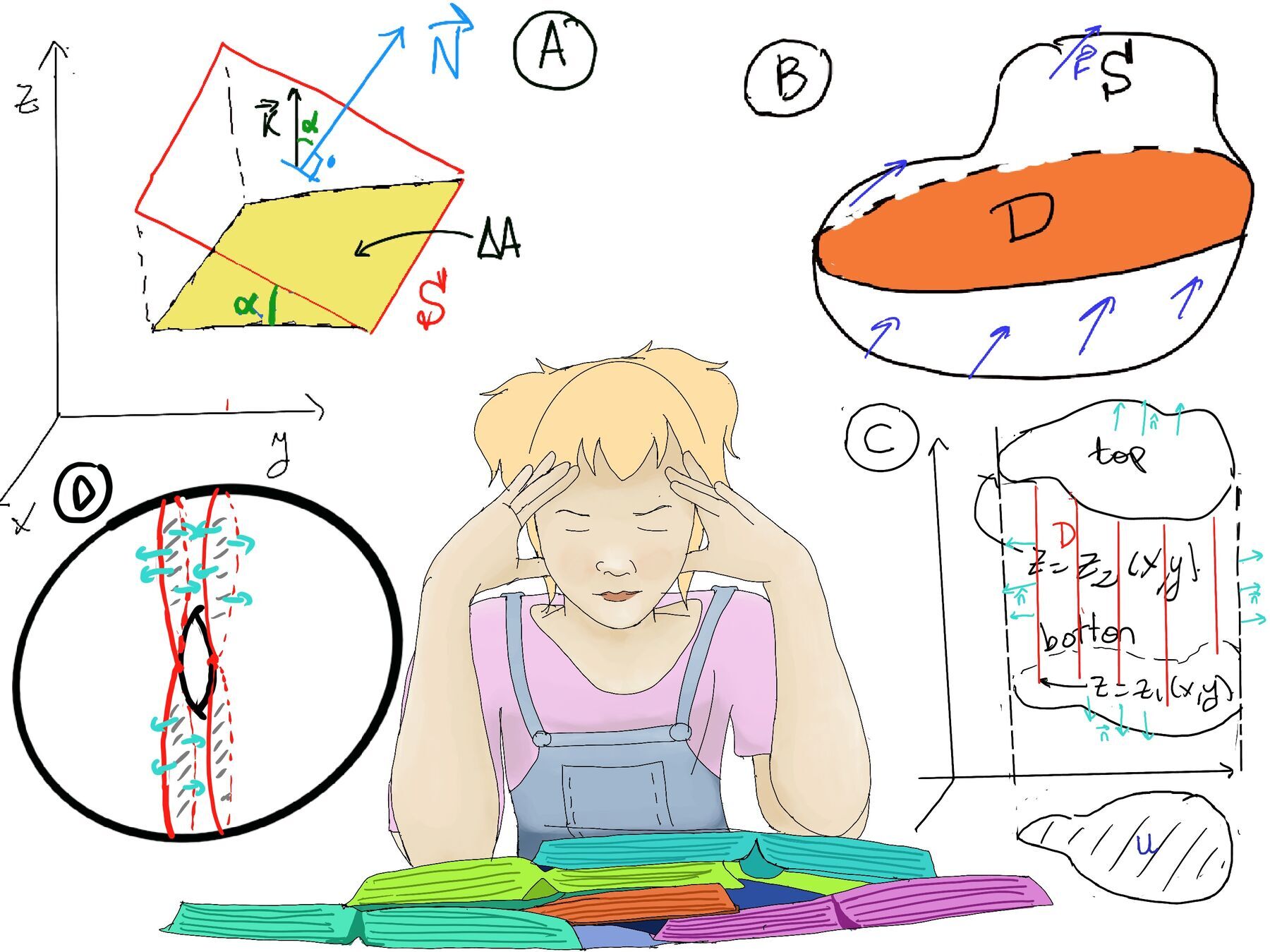
The angle $\alpha$ can be computed using the dot product between the normal vector $\vec{N}$ and the unit vector $\hat{\mathbf{k}}$. Recall that $\vec{u} \cdot \vec{v}=\vert \vec{u} \vert \vert\vec{v}\vert \cos(\theta)$ where $\theta$ is the angle between the vectors $u$ and $v$. For our case, $\cos(\alpha) = \frac{\vec{N} \cdot \hat{\mathbf{k}}}{\vert\vec{N}\vert\vert\mathbf{k}\vert} = \frac{\vec{N}\cdot \hat{\mathbf{k}}}{\vert\vec{N}\vert}$, hence $\Delta S = \frac{1}{\cos(\alpha)}\Delta A = \frac{\vert\vec{N}\vert}{\vec{N} \cdot \hat{\mathbf{k}}}\Delta A$
Area Element with Unit Normal Vector. $\hat{\mathbf{n}}dS = \hat{\mathbf{n}}\frac{\vert\vec{N}\vert}{\vec{N} \cdot \hat{\mathbf{k}}}dA$ [Since $\hat{\mathbf{n}}$ is a unit vector perpendicular to the surface, i.e., $\hat{\mathbf{n}} = \frac{\vec{N}}{\vert\vec{N}\vert}$, the expression simplifies to] $\pm\frac{\vec{N}}{\vec{N}\cdot \hat{\mathbf{k}}}dA$. Finally, we obtain $\hat{\mathbf{n}}dS = \pm\frac{\vec{N}}{\vec{N} \cdot \hat{\mathbf{k}}}dxdy$. The sign depends on the orientation of the surface.
Consider a specific surface S defined explicitly as $z = f(x, y)$ or can also be written as an implicit function $g(x, y, z) = z - f(x, y) = 0$.
The normal vector to this surface is given by the gradient of g: $\vec{N} = \nabla g = \langle-\frac{\partial f}{\partial x}, -\frac{\partial f}{\partial y}, 1\rangle = \langle-f_x, -f_y, 1\rangle$.
We compute the surface area element, $\hat{\mathbf{n}}dS = \frac{\vec{N}}{\vec{N} \cdot \hat{\mathbf{k}}}dxdy = \frac{\langle-f_x, -f_y, 1\rangle}{\langle-f_x, -f_y, 1\rangle \cdot \hat{\mathbf{k}}}dxdy = \frac{\langle-f_x, -f_y, 1\rangle}{\langle-f_x, -f_y, 1\rangle \cdot \langle0, 0, 1\rangle}dxdy = \frac{\langle-f_x, -f_y, 1\rangle}{1}dxdy = \langle-f_x, -f_y, 1\rangle dxdy.$
Therefore, the formula for the surface area element for the surface $z = f(x, y)$ is: $dS = \langle-f_x, -f_y, 1 \rangle dxdy$

JustToThePoint Copyright © 2011 - 2026 Anawim. ALL RIGHTS RESERVED. Bilingual e-books, articles, and videos to help your child and your entire family succeed, develop a healthy lifestyle, and have a lot of fun. Social Issues, Join us.
This website uses cookies to improve your navigation experience.
By continuing, you are consenting to our
use of cookies, in accordance with our Cookies Policy and
Website Terms and Conditions of use.