
|
 |

|
|
|
|
|
|
Mistakes are a great educator when one is honest enough to admit them and willing to learn from them, Aleksandr Solzhenitsyn.
Before we can master the complex mechanics of fluid dynamics, electromagnetism, or orbital mechanics, we must understand the mathematical language that describes them: vector fields and flux.
In mathematics and physics, we use fields to describe quantities that vary continuously throughout space.
Definition: A vector field in three-dimensional space assigns a specific vector to every single point in that space. Mathematically, a vector field $\vec{F}$ is represented by a vector-valued function $\vec{F}(x,y,z) = \langle P(x,y,z), Q(x,y,z), R(x,y,z) \rangle$, where $P$, $Q$, and $R$ are scalar functions dictating the vector’s components along the x, y, and z axes.
In Physics, a force field is a map that shows the distribution of forces over a particular area of space. Examples include magnetic fields (represent the force exerted by a magnet or current on moving charges), electric fields (represent the force experienced by a charged particle in the presence of other charges), velocity fields, gradient fields, and gravitational fields.
The gravitational force is a classic example of a vector field. The gravitational attraction is the force that objects with mass exert on each other. Newton’s law of universal gravitation states that every particle (a small object that can be described by several properties, such as volume, density, or mass) in the universe attracts every other particle in the universe with a force that is directly proportional to the product of their masses and inversely proportional to the square of the distance between them.
The gravitational force $\vec{F}$ exerted by a massive body $M$ at the origin onto a smaller test mass $m$ is given by: $\vec{F} = -\frac{GMm}{r^2}\hat{\mathbf{r}}$ where:
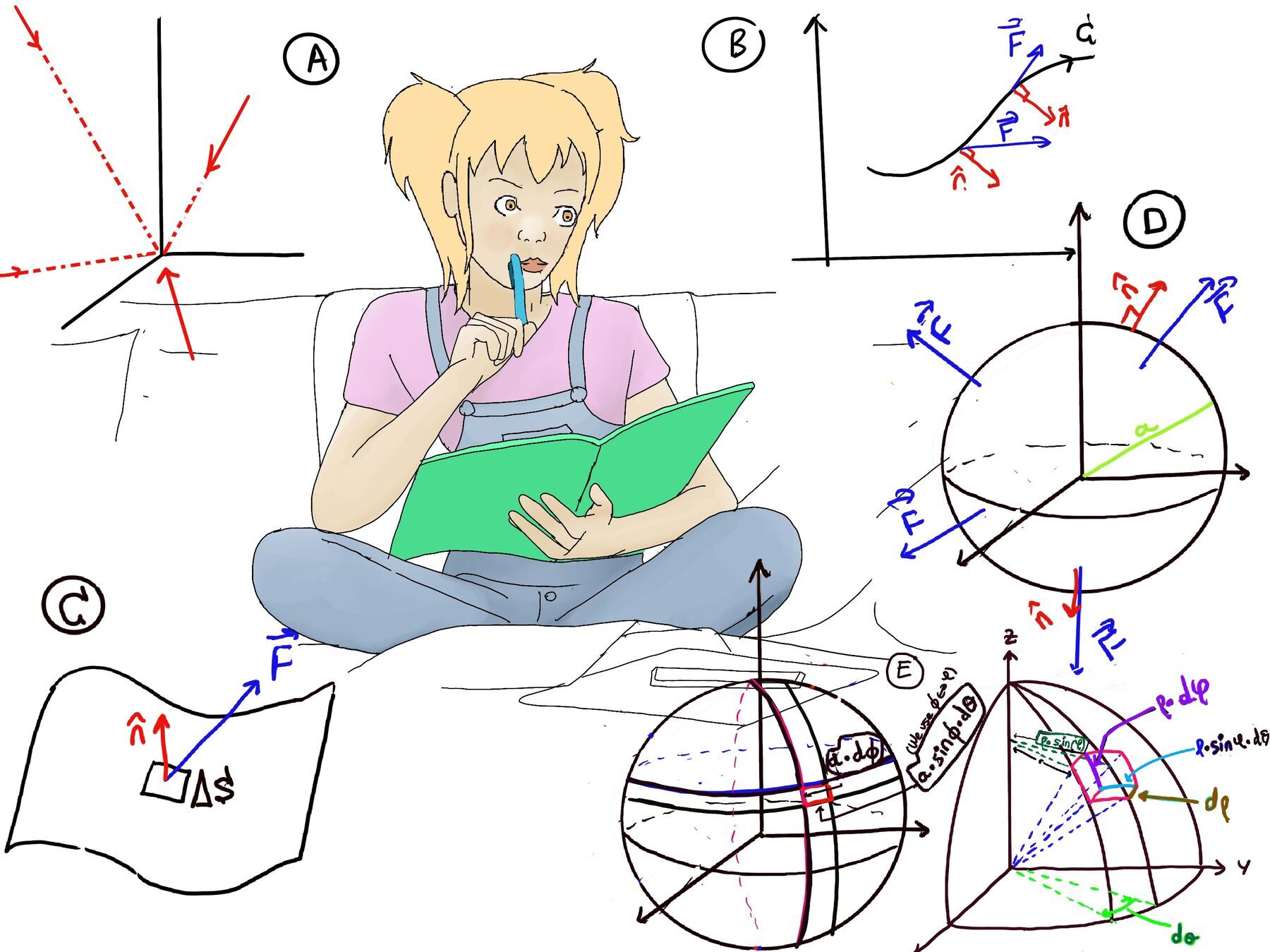
The magnitude of the gravitational force can also be expressed as: $|\vec{F}| \propto \frac{c}{r^2}$ where $|\vec{F}|$ is the magnitude of the gravitational force, c is a constant representing the strength of the gravitational force (it depends on the masses involved) and r is the distance between the two objects (Figure A).
In a Cartesian coordinate system, the distance is $\rho = \sqrt{x^2+y^2+z^2}$, and the outward unit vector is $\hat{\mathbf{r}} = \frac{\langle x, y, z \rangle}{\rho}$. If we group the constants $c = GMm$, we can rewrite the gravitational force vector field as:
$$\vec{F}(x,y,z) = -\frac{c}{\rho^2} \left( \frac{\langle x, y, z \rangle}{\rho} \right) = \frac{-c \langle x, y, z \rangle}{\rho^3}$$
Flux quantifies how much of a vector field flows through a given surface or curve.
Imagine a river. If you place a net into the water, the flux measures the exact volume of water passing through that net every single second. If you hold the net perfectly perpendicular to the current, maximum water flows through (maximum flux). If you turn the net parallel to the current, no water flows through the mesh (zero flux).
In two dimensions, the flux of a vector field $\vec{F}$ across a curve C is defined as the dot product of the vector field and the unit normal vector $\hat{\mathbf{n}}$ to the curve. This is expressed mathematically as $\int_{C} \vec{F} \cdot \hat{\mathbf{n}}ds$ where $\hat{\mathbf{n}}$ is the unit normal vector, an arrow of length 1 pointing perpendicularly outward from the curve, and $ds$ is an infinitesimally small piece of the curve’s length.
When moving from 2D to 3D, the concept of flux naturally extends from curves to surfaces. For a surface S in 3D space, we want to determine how much fluid passes through $S$ per unit time.

Take a small surface element $dS$ on a surface $S$. At that point, the surface has a unit normal vector $\hat{\mathbf{n}}$. A vector field $\vec{F}$ (such as the velocity of fluid flow or an electric field) hits this patch. But, $\vec{F}$ generally points in some arbitrary direction. However, only the part of $\vec{F}$ that points through the surface contributes to flux. That perpendicular component is: $\vec{F} \cdot \hat{\mathbf{n}}$. This dot product tells you:
positive → field crosses in the direction of $\hat{\mathbf{n}}$.
negative → field crosses in the opposite direction.
zero → field is tangent; nothing crosses.
Multiply by the area: $(\vec{F} \cdot \hat{\mathbf{n}}) dS $. This quantity is the amount of fluid (or field) passing through the tiny patch $dS$ per unit time. It is literally a volume flow rate through that infinitesimal piece.
Instead of writing the normal and the area separately, we often combine them: $d\vec{S} = \hat{\mathbf{n}} dS.$
This is a vector pointing perpendicular to the surface, whose magnitude is the area of the patch.
Then, flux through the patch becomes: $\vec{F} \cdot d\vec{S}$.
To get the total flux through the entire surface $S$, you integrate: $\iint_S \vec{F} \cdot \hat{\mathbf{n}} dS \quad\text{or}\quad \iint_S \vec{F} \cdot d\vec{S}.$
This integral slices the surface into infinitely many tiny patches, computes how much of the field crosses each patch, and sums all contributions.
Conceptually: Flux = total amount of field crossing the surface per unit time.
In the context of vector fields in space, flux is represented by a surface integral, not a line integral. It measures how much of the vector field crosses a given surface.
Definition: For a vector field $\vec{F}$ and a surface $S$ with a unit normal vector $\hat{\mathbf{n}}$, the flux across $S$ is the surface integral: $\boxed{\text{Flux} = \iint_{S} \vec{F} \cdot \hat{\mathbf{n}} \, dS = \iint_{S} \vec{F} \cdot d\vec{S}}$
Let’s break down this elegant formula:
Flux is a measure of how much of a vector field passes through a given surface. The vector field $\vec{F}$ represents a radial field, meaning that at each point in space, the vector points directly away from the origin.
The flux of a vector field $\vec{F}$ through a surface S is given by the surface integral: $\int \int_{S} \vec{F} \cdot \hat{\mathbf{n}}dS = \int \int_{S} \vec{F} \cdot \vec{dS}$ where $\vec{dS} = \hat{\mathbf{n}}dS$ is the vector area element and $\hat{\mathbf{n}}$ is the unit normal vector to the surface S at each point.
Determining the Unit Normal vector. On the surface of the sphere, the position vector $\vec{r} = \langle x, y, z \rangle$ points radially outward from the origin and is normal to the surface. Therefore, the unit normal vector $\hat{\mathbf{n}}$ (Figure D) at any point on the sphere is given by $\hat{\mathbf{n}} = \frac{\langle x, y, z \rangle}{\vert \langle x, y, z \rangle \vert}$.
Since the radius of the sphere is $a$, we have $a = \sqrt{x^2+y^2+z^2} = \vert \langle x, y, z \rangle \vert $, and so $\hat{\mathbf{n}} = \frac{1}{a} \langle x, y, z \rangle$.
Calculating the Dot product $\vec{F}·\hat{\mathbf{n}}$. The normal vector and our vector field are parallel to each other, so their dot product is quite simple, $\vec{F} \cdot \hat{\mathbf{n}} = \langle x, y, z \rangle \cdot \left( \frac{1}{a}\langle x, y, z \rangle \right) = \frac{x^2 + y^2 + z^2}{a}$
Since we are evaluating this on the surface of the sphere, we substitute $x^2 + y^2 + z^2 = a^2$: $\vec{F} \cdot \hat{\mathbf{n}} = \frac{a^2}{a} = a$
Therefore, the flux through the surface S of the sphere is then given by the integral: $\int \int_{S} \vec{F}·\hat{\mathbf{n}}·dS =[\text{Substituting the result from the dot product:}] \int \int_{S} adS$
Because $a$ is constant over the surface of the sphere, it can be factored out of the integral: $a\int \int_{S} dS = a \cdot Area(S)$ =[The surface area $S$ of a sphere with radius a is $4\pi a^2$] $a \times 4\pi a^2 = 4\pi a^3$.
This result is intuitive because the vector field pushes perfectly perpendicular to the sphere everywhere, and its magnitude at the surface is exactly $a$, the total flux is simply the field strength ($a$) multiplied by the total area ($4\pi a^2$).
The flux of a vector field through a surface S is a measure of how much of the field passes through that surface. The vector field points in the z-direction, through the surface of a sphere with radius a centered at the origin.
The flux through a surface S is given by the surface integral: $\int \int_{S} \vec{F} \cdot \hat{\mathbf{n}} dS = \int \int_{S} \vec{F} \cdot \vec{dS}$ where $\vec{dS} = \hat{\mathbf{n}}dS$ is the vector area element and $\hat{\mathbf{n}}$ is the unit normal vector to the surface.
Normal vector. On the surface of the sphere, the position vector $\vec{r} = \langle x, y, z \rangle$ points radially outward from the origin and is normal to the surface. Therefore, the unit normal vector $\hat{\mathbf{n}}$ (Figure D) at any point on the sphere is given by $\hat{\mathbf{n}} = \frac{\langle x, y, z \rangle}{\vert \langle x, y, z \rangle \vert}$ =[Since the radius of the sphere is a, we have $a = \sqrt{x^2+y^2+z^2} = \vert \langle x, y, z \rangle \vert$] $\frac{1}{a} \langle x, y, z \rangle $
Calculating the dot product $\vec{F} \cdot \hat{\mathbf{n}}$. Given that $\vec{F} = z\vec{k}$, $\vec{F} \cdot \hat{\mathbf{n}} = \langle 0, 0, z \rangle \cdot \frac{\langle x, y, z \rangle}{a} = \frac{z^2}{a}$.
Therefore, the flux through the surface S of the sphere is then: $\int \int_{S} \vec{F} \cdot \hat{\mathbf{n}}dS = \int \int_{S} \frac{z^2}{a}dS$
To calculate the flux, we need to integrate $\frac{z^2}{a}$ over the surface of the sphere. To do this, we use spherical coordinates (r, θ, φ).
We need to evaluate $\iint_{S} \frac{z^2}{a} \, dS$. Using spherical coordinates $(r, \theta, \phi)$, we lock our radius at $r=a$.
So, the integral becomes:
$\int \int_{S} \frac{z^2}{a}dS = \int_{0}^{2\pi} \int_{0}^{\pi} \frac{a^2\cos^2(φ)}{a}a^2\sin(\phi)\, d\phi \, d\theta = a^3\int_{0}^{2\pi} \int_{0}^{\pi} \cos^2(\phi)\sin(\phi)\, d\phi\, d\theta =$
Evaluate the inner integral. Let’s isolate the $\phi$ integration: $\int_{0}^{\pi} \cos^2(\phi)\sin(\phi) d\phi$
We use u-substitution. Let $u = \cos(\phi)$. The derivative is $du = -\sin(\phi)d\phi$, which means $\sin(\phi)d\phi = -du$.
Next, we change our limits of integration: When $\phi = 0$, $u = \cos(0) = 1$. When $\phi = \pi$, $u = \cos(\pi) = -1$
Substitute these into the integral: $\int_{1}^{-1} u^2 (-du) = -\int_{1}^{-1} u^2 du$
Using the properties of integrals, we can flip the limits by removing the negative sign: $\int_{-1}^{1} u^2 du = \left[ \frac{u^3}{3} \right]_{-1}^{1} = \frac{(1)^3}{3} - \frac{(-1)^3}{3} = \frac{1}{3} - \left(-\frac{1}{3}\right) = \frac{2}{3}$
Evaluate the outer integral. Now we return to our main equation and integrate with respect to $\theta$: $\text{Flux} = a^3 \int_{0}^{2\pi} \frac{2}{3} d\theta = a^3 \left( \frac{2}{3}\theta \right) \bigg\vert{}_{0}^{2\pi} = \frac{4\pi a^3}{3}$
In multivariable calculus, surface integrals are used to calculate various quantities over surfaces, such as flux. To work effectively with surface integrals, it’s important to understand the different surface elements dS and their associated unit normal vectors $\hat{\mathbf{n}}$ for different types of surfaces. Below, we outline some common surfaces, detailing their respective surface elements and normal vectors:
The unit normal vector $\hat{\mathbf{n}}$ for this plane is perpendicular to the surface. Since the plane is horizontal, the normal vector points either straight up or straight down, depending on the orientation. These directions correspond to: $\hat{\mathbf{n}} = \pm \vec{k}$ where $\vec{k}$ is the unit vector in the z-direction. The positive sign indicates the vector pointing upward, and the negative sign indicates the vector pointing downward, $d\vec{S} = \pm\langle 0, 0, 1 \rangle dx\,dy$.
The unit normal vector $\hat{\mathbf{n}}$ for this plane is perpendicular to the surface and can point either in the positive or negative x-direction: $\hat{\mathbf{n}} = \pm\vec{i}$ where $\vec{i}$ is the unit vector in the x direction. The choice of sign depends on whether the vector points towards the positive or negative x-axis, $d\vec{S} = \pm\langle 1, 0, 0 \rangle dy\,dz$
The unit normal vector $\hat{\mathbf{n}}$ at any point on the surface of the sphere is radial, meaning that it points radially outward from the center or inward towards the center, depending on the orientation, and can be expressed as: $\hat{\mathbf{n}} = \pm \frac{\langle x, y, z \rangle }{a}$. Vector area element: $d\vec{S} = \pm \frac{\langle x,y,z\rangle}{a} a^2\sin\phi\, d\phi\, d\theta$.
The unit normal vector $\hat{\mathbf{n}}$ at any point on the curved surface of the cylinder is $\hat{\mathbf{n}} = \pm \frac{1}{a}\langle x, y, 0 \rangle$. This indicates that the normal vector points radially outward or inward from the z-axis, depending on the orientation. Vector area element: $d\vec{S} = \pm \frac{\langle x,y,0\rangle}{a}\, a\, d\theta\, dz$.
Parametrizing the surface. We have a surface described as a height over the $xy$-plane: $z = f(x,y)$.
To do vector calculus on it, rewrite it as a parametric surface using $x$ and $y$ as the two parameters: $\vec{r}(x,y) = \langle\, x,\; y,\; f(x,y) \,\rangle$.
Tangent vectors. Differentiate $\vec{r}$ with respect to each parameter:
$\vec{r}_x = \frac{\partial \vec{r}}{\partial x} = \left\langle\, 1,\; 0,\; \frac{\partial f}{\partial x} \,\right\rangle = \langle 1, 0, f_x \rangle$
$\vec{r}_y = \frac{\partial \vec{r}}{\partial y} = \left\langle\, 0,\; 1,\; \frac{\partial f}{\partial y} \,\right\rangle = \langle 0, 1, f_y \rangle$.
These two vectors lie flat against the surface — they point in the direction of increasing $x$ and increasing $y$, while staying tangent to the surface (hence the $f_x$, $f_y$ components in the $z$-direction).
A vector perpendicular to both tangent vectors is obtained by the cross product: $\vec{r}_x \times \vec{r}_y = \begin{vmatrix}
\hat{\imath} & \hat{\jmath} & \hat{k} \\
1 & 0 & f_x \\
0 & 1 & f_y
\end{vmatrix}$
Expanding: $\hat{\imath}: (0)(f_y) - (f_x)(1) = -f_x$
$\hat{\jmath}: -\big[(1)(f_y) - (f_x)(0)\big] = -f_y$.
$\hat{k}: (1)(1) - (0)(0) = 1$.
So: $\boxed{\;\vec{r}_x \times \vec{r}_y = \langle -f_x,\; -f_y,\; 1 \rangle\;}$
This is the unnormalized normal vector to the surface. Notice the $z$-component is $+1$, which means it points upward (positive $z$-direction) when $f_x = f_y = 0$ (a flat horizontal surface).
Vector area element. When you move a tiny step $dx$ in the $x$-direction and $dy$ in the $y$-direction on the parameter plane, the corresponding patch of surface is spanned by the vectors $\vec{r}_x\,dx$ and $\vec{r}_y\,dy$. Its vector area is their cross product: $d\vec{S} = (\vec{r}_x \times \vec{r}_y)\, dx\, dy = \langle -f_x,\; -f_y,\; 1 \rangle\, dx\, dy$.
So: $\boxed{\;d\vec{S} = \langle -f_x,\; -f_y,\; 1 \rangle\, dx\, dy\;}$
This is the vector area element — a vector whose magnitude is the area of the infinitesimal patch and whose direction is normal to the surface.
The $\pm$ accounts for the choice of orientation. The cross product $\vec{r}_x \times \vec{r}_y$ gives one orientation; if you swap the order ($\vec{r}_y \times \vec{r}_x$) or want the normal pointing downward, you get the opposite sign.
Unit normal vs. vector area element. Be careful to distinguish these:
| Quantity | Formula | Meaning |
|---|---|---|
| Vector area element $d\vec{S}$ | $\langle -f_x, -f_y, 1 \rangle \, dx\, dy$ | Normal vector whose magnitude = area |
| Unit normal $\hat{\mathbf{n}}$ | $\dfrac{\langle -f_x, -f_y, 1 \rangle}{\sqrt{f_x^2 + f_y^2 + 1}}$ | Purely a direction, length 1 |
| Scalar area element $dS$ | $\sqrt{f_x^2 + f_y^2 + 1}\, dx\, dy$ | Just the area (always positive) |
The relation between them is exactly: $d\vec{S} = \hat{\mathbf{n}}\, dS = \underbrace{\frac{\langle -f_x, -f_y, 1 \rangle}{\sqrt{f_x^2 + f_y^2 + 1}}}_{\hat{\mathbf{n}}} \cdot \underbrace{\sqrt{f_x^2 + f_y^2 + 1}\, dx\, dy}_{dS} = \langle -f_x, -f_y, 1 \rangle\, dx\, dy$
🧱 A parametric surface $\vec r(u,v)$ maps a tiny rectangle in the $(u, v)$-plane to a tiny curved parallelogram on the surface. If you move a tiny amount $du$ in the $u$-direction, the surface moves by $\frac{\partial \vec r}{\partial u}\, du.$ Analogously, if you move a tiny amount $dv$ in the $v$-direction, the surface moves by $\frac{\partial \vec r}{\partial v}\, dv.$ These two vectors span the infinitesimal parallelogram on the surface.
Note: Keep $v$ fixed and compare the surface point at $u$ with the nearby point at $u+du$. Their displacement is $\vec r(u+du,v)-\vec r(u,v).$ By the definition of the partial derivative, $\frac{\partial \vec r}{\partial u} =\lim_{du\to 0} \frac{\vec r(u+du,v)-\vec r(u,v)}{du}.$
For a tiny but nonzero $du$, this gives the approximation $\vec r(u+du,v)-\vec r(u,v) \approx \frac{\partial \vec r}{\partial u}\,du.$
So $\frac{\partial \vec r}{\partial u}$ is the direction and rate of change of the position vector as $u$ changes; multiplying by $du$ gives the small displacement.
🧮 The area of a parallelogram spanned by vectors $\vec{a}$ and $\vec{b}$ is $|\vec a \times \vec b|$. But flux needs more than area — it needs direction. The cross product gives a vector whose: magnitude = area of the parallelogram, direction = perpendicular to the parallelogram.
Thus, the vector $\frac{\partial \vec r}{\partial u}\times \frac{\partial \vec r}{\partial v}$ is the oriented area element.
🌊 Flux through a surface is defined as: $\iint_S \vec F\cdot d\vec S.$ The dot product $\vec F\cdot d\vec S$ measures: how much of $\vec F$ is perpendicular to the surface multiplied by the area with the correct sign (outward vs inward).
A scalar area $dS$ would lose orientation. A normal vector $\hat n$ alone would lose area.
Flux needs both simultaneously, and the cross product provides exactly that.
🧭 The cross product gives a normal, but not necessarily the outward normal. For closed surfaces (sphere, cylinder, etc.), we choose the sign so that: + gives the outward normal; − gives the inward normal. Flux depends on this orientation.
🧩 Deep geometric intuition. Think of the surface as made of tiny “gates.” Each gate has: a size (area); and a direction it faces (normal).
The vector $d\vec S$ is the mathematical object that encodes both.
The flux integral simply adds up how much of the field passes through each gate in the direction the gate faces.
The cross product is the only construction that gives the correct gate vector.
However, in many calculus and physics problems, surfaces are not given parametrically. Instead, they are defined explicitly as a function of $x$ and $y$, such as $z = f(x, y)$. In this article, we will visually and mathematically derive the shortcut formula for $d\vec{S}$ for explicit functions, and apply it to a complex flux problem.
Consider a surface $S$ defined by $z = f(x, y)$. Let $D$ be the “shadow” or projection of this surface down onto the $xy$-plane.
If we take a tiny, infinitesimal rectangle in the domain $D$ with side lengths $\Delta x$ and $\Delta y$, this rectangle projects upward to a small patch on the curved surface $S$.
If $\Delta x$ and $\Delta y$ are sufficiently small, we can approximate this curved surface patch as a flat parallelogram resting on the tangent plane of the surface.
What is the area ($\Delta S$) and the normal vector ($\hat{\mathbf{n}}$) of this parallelogram?
In linear algebra, the area of a parallelogram defined by two vectors $\vec{u}$ and $\vec{v}$ is exactly the magnitude of their cross product: $\Delta S = \vert{}\vec{u} \times \vec{v}\vert{}$. Furthermore, the direction of the cross product gives us the vector perpendicular to that parallelogram. Therefore, combining the normal vector and the area gives us the vector surface element: $\boxed{\Delta S \hat{\mathbf{n}} = \pm (\vec{u} \times \vec{v})}$

💣The magnitude of the cross product of two vectors is the area of the parallelogram they enclose, and its direction is perpendicular to the plane containing those vectors, $\vec{u}x\vec{v} = ±\hat{\mathbf{n}}dS.$
Let’s define the vectors that form the sides of this parallelogram.
Vector $\vec{u}$ represents a tiny step along the surface purely in the $x$-direction, from $(x, y)$ to $(x + \Delta x, y)$. Using a first-order Taylor expansion (the linear approximation of the function), the change in the $z$-height is approximately the partial derivative with respect to $x$ multiplied by the step size: $f(x + \Delta x, y) - f(x, y) \approx f_x \Delta x$
Thus, the vector $\vec{u}$ in 3D space is: $\vec{u} \approx \langle \Delta x, 0, f_x \Delta x \rangle = \Delta x \langle 1, 0, f_x \rangle$.
Analogously, vector $\vec{v}$ represents a tiny step purely in the $y$-direction: $f(x, y + \Delta y) - f(x, y) \approx f_y \Delta y$. $\vec{v} \approx \langle 0, \Delta y, f_y \Delta y \rangle = \Delta y \langle 0, 1, f_y \rangle$
Now, we take the cross product $\vec{u} \times \vec{v}$ to find the normal vector and area simultaneously. We set this up using a determinant:
$$\vec{u} \times \vec{v} = \begin{vmatrix} \mathbf{\hat{i}} & \mathbf{\hat{j}} & \mathbf{\hat{k}} \\ \Delta x & 0 & f_x \Delta x \\ 0 & \Delta y & f_y \Delta y \end{vmatrix}$$By factoring out $\Delta x$ from the second row and $\Delta y$ from the third row, we get:
$$\vec{u} \times \vec{v} = (\Delta x \Delta y) \begin{vmatrix} \mathbf{\hat{i}} & \mathbf{\hat{j}} & \mathbf{\hat{k}} \\ 1 & 0 & f_x \\ 0 & 1 & f_y \end{vmatrix}$$Evaluating the determinant:
This results in the vector $\langle -f_x, -f_y, 1 \rangle \Delta x \Delta y$.
Taking the infinitesimal limit where $\Delta x \to dx$ and $\Delta y \to dy$, we arrive at the fundamental formula for the vector surface element of an explicitly defined function: $\boxed{d\vec{S} = \hat{\mathbf{n}} \, dS = \pm \langle -f_x, -f_y, 1 \rangle dx\,dy}$
Note: The $\pm$ sign dictates orientation. Choosing the positive version $\langle -f_x, -f_y, 1 \rangle$ yields an upward-pointing normal (because the $z$-component is $+1$). Negating it yields $\langle f_x, f_y, -1 \rangle$, which is the downward-pointing normal.
Find the flux of the vector field $\vec{F} = \langle x^2y, -3xz, 4y^3 \rangle$ across the portion of the surface $z = x^2+y^2-9$ that lies above the domain $[0, 2] \times [0, 1]$ in the $xy$-plane and oriented downward (Figure iii).

Understand the Geometry and Orientation. The flux of a vector field through a surface represents the amount of the field passing through the surface. The surface $z = x^2+y^2-9$ is a paraboloid that opens upwards, has its vertex at $(0, 0, -9)$, and has circular cross-sections perpendicular to the z-axis. We are evaluating the flux through a specific rectangular patch of this bowl. The problem specifies a downward orientation.
Vector Field Simplification. To integrate over the $xy$-plane, our vector field must be expressed entirely in terms of $x$ and $y$. We substitute $z = x^2+y^2-9$ into the vector field $\vec{F} = \langle x^2y, -3xz, 4y^3 \rangle$: $\vec{F} = \langle x^2y, -3x(x^2+y^2-9), 4y^3 \rangle =[\text{This simplifies to:}] \langle x^2y, -3x^3-3xy^2+27x, 4y^3 \rangle$
Surface Normal Vector. As we have previously stated, for a surface defined by $z = f(x, y)$, the surface normal vector $\hat{\mathbf{n}}$ and the surface element dS are given by: $\hat{\mathbf{n}}dS = ±\langle -f_x, -f_y, 1\rangle dxdy$ where $f(x, y) = x^2+y^2 -9, f_x=\frac{\partial f}{\partial x} = 2x, f_y=\frac{\partial f}{\partial y} = 2y$ are the partial derivatives with respect to x and y, respectively.
Since the surface is oriented downwards, we use the negative sign: $\hat{\mathbf{n}}dS = -\langle -f_x, -f_y, 1\rangle dxdy = -\langle -2x, -2y, 1\rangle dxdy = \langle 2x, 2y, -1\rangle dxdy$
Set up and Calculate the flux. We calculate the flux through the surface over the region $D = [0, 2] × [0, 1]$ using the formula:
$\operatorname{Flux} =\int \int_{D} \vec{F} \cdot d\vec{S} = \int \int_{D} \vec{F} \cdot \hat{\mathbf{n}}dS = \int_{0}^{2} \int_{0}^{1} \langle x^2y, -3x^3-3xy^2+27x, 4y^3\rangle \cdot \langle 2x, 2y, -1\rangle dxdy$
First, compute the dot product: $\int_{0}^{2} \int_{0}^{1} (2x^3y-6x^3y-6xy^3+54xy-4y^3)dydx = \int_{0}^{2} \int_{0}^{1} (-4x^3y-6xy^3+54xy-4y^3)dydx$
Inner integral: $\int_{0}^{1} (-4x^3y-6xy^3+54xy-4y^3)dy = -4x^3\frac{y^2}{2}-6x\frac{y^4}{4}+54x\frac{y^2}{2}-4\frac{y^4}{4}\bigg|_{0}^{1} = -4x^3\frac{1}{2}-6x\frac{1}{4}+54x\frac{1}{2}-4\frac{1}{4} = -2x^3 -\frac{3x}{2}+27x-1$
Outer integral: $\int_{0}^{2} -2x^3 -\frac{3x}{2}+27x-1 dx = -2\frac{x^4}{4}-\frac{3}{2}\frac{x^2}{2}+27\frac{x^2}{2}-x\bigg|_{0}^{2} = -2·\frac{16}{4}-\frac{3}{2}2+27·2-2 = -8-3 +54-2 = 41.$
Conclusion: The total flux across this section of the paraboloid is $41$. Physically, if this vector field represented the flow of a fluid, a net total of 41 units of fluid per second is flowing downward across that specific boundary.

JustToThePoint Copyright © 2011 - 2026 Anawim. ALL RIGHTS RESERVED. Bilingual e-books, articles, and videos to help your child and your entire family succeed, develop a healthy lifestyle, and have a lot of fun. Social Issues, Join us.
This website uses cookies to improve your navigation experience.
By continuing, you are consenting to our
use of cookies, in accordance with our Cookies Policy and
Website Terms and Conditions of use.