
|
 |

|
|
|
|
|
|
When you have eliminated the impossible, whatever remains, however improbable, must be the truth — Sherlock Holmes
Before we dive into one of the most profound theorems in calculus, let’s establish our foundation.
A vector field is an assignment of a vector $\vec{F}$ to each point $(x, y)$ in space. In two dimensions, this looks like $\vec{F} = M\hat{\mathbf{i}} + N\hat{\mathbf{j}}$ where $M$ and $N$ are functions of $x$ and $y$. In three dimensions, we add a vertical component: $\vec{F} = P\hat{\mathbf{i}} + Q\hat{\mathbf{j}} + R\hat{\mathbf{k}}$.
A vector field can be visualized as a space filled with arrows, each attached to a point. These arrows represent vectors with specific magnitudes and directions, e.g., currents in an ocean or prevailing winds.
Work is defined as the energy transferred when a force acts on an object and displaces it along a path. In the context of vector fields, we calculate the work done by a force field along a curve or trajectory $C$ using a line integral. The work done by a force field $\vec{F}$ along a curve $C$ is: $\operatorname{W} = \int_{C} \vec{F} \cdot d\vec{r} = \int_{C} M\,dx + N\,dy = \int_{C} \vec{F} \cdot \hat{\mathbf{T}}ds$, where $d\vec{r} = \langle dx, dy, dz \rangle$ is an infinitesimal vector tangent to the curve and $\hat{\mathbf{T}}$ is the unit tangent vector. The dot product guarantees we only calculate the force pushing exactly in the direction of motion.
A vector field is conservative if there exists a scalar function $f$ such that $\vec{F} = \nabla f$ (the vector field is its gradient). This scalar function is known or referred to as the potential function associated with the vector field.
Theorem. Fundamental Theorem of Calculus for Line Integrals. If $\vec{F}$ is a conservative vector field in a simply-connected region of space (i.e., a region with no topological holes or tunnels), and if $f$ is a scalar potential function for $\vec{F}$ in that region, then $\int_{C} \vec{F} \cdot d\vec{r} = \int_{C} \nabla f \cdot d\vec{r} = f(P_1)-f(P_0)$ where $P_0$ and $P_1$ are the initial and final points of the curve $C$, respectively.
Theorem. The curl of a conservative field is the zero vector, $\vec{0}$. Conversely, if $\operatorname{curl}(\vec{F}) = \nabla \times \vec{F} = \vec{0}$, the components $P, Q$, and $R$ have continuous first-order partial derivatives, and its domain is open and simply-connected, the vector field is conservative.
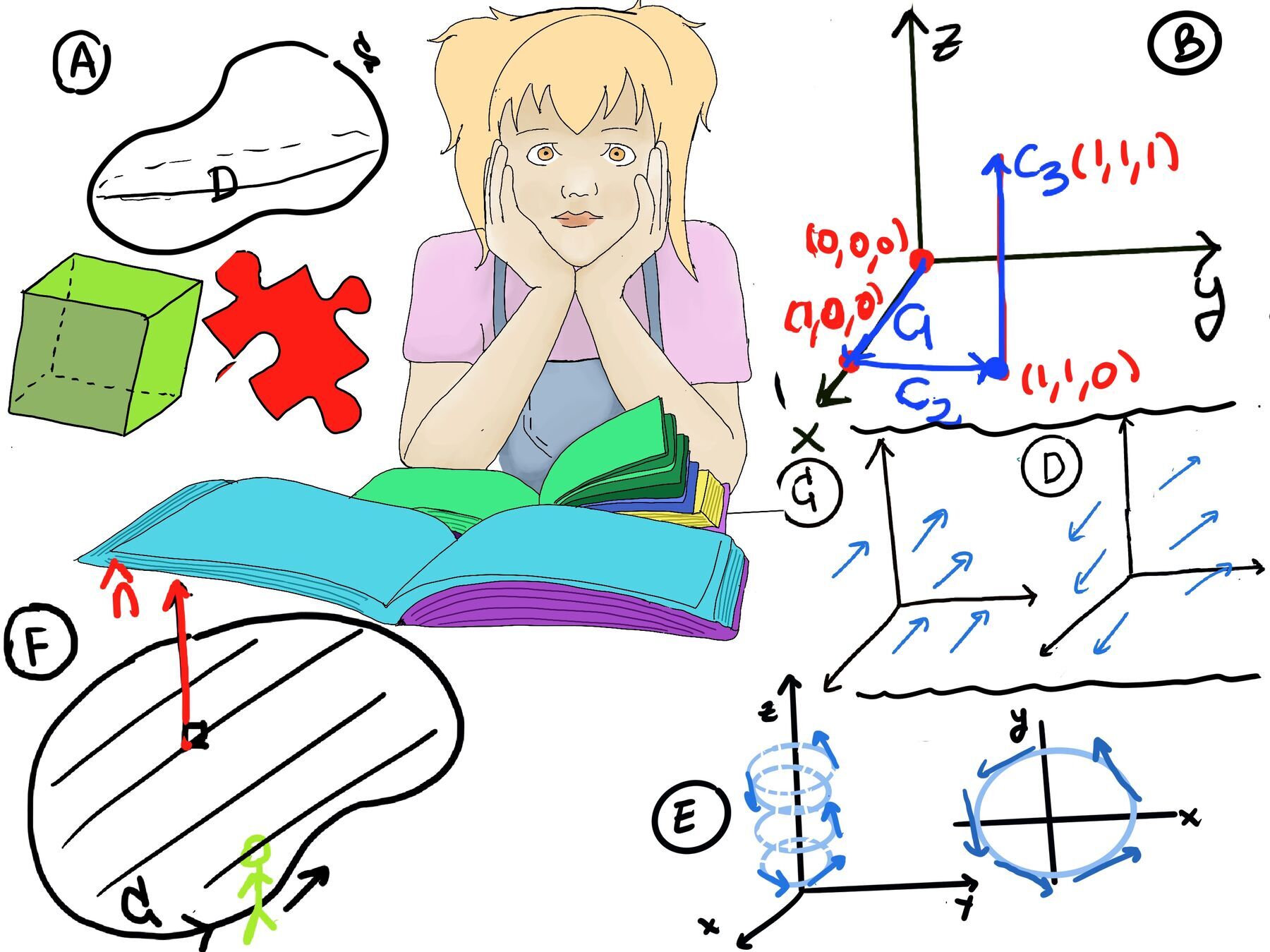
Given a continuously differentiable vector field $\vec{F}$, an oriented smooth surface $S$, and a simple, closed boundary curve $C$ that encloses $S$, Stokes’ Theorem asserts that: $\oint_C \vec{F} \cdot d\vec{r} = \iint_{S} (\nabla \times \vec{F}) \cdot \hat{\mathbf{n}} \, dS$ where:
Stokes’ Theorem is one of the crowning achievements of vector calculus. It provides a profound bridge between the macroscopic circulation of a vector field along a boundary curve and the sum of the microscopic rotations (the curl) across the surface bounded by that curve.
In this guide, we will solve several complex integrals by leveraging Stokes’ Theorem, and we will explore how it connects to the physical concept of path-independent fields.
Compute the work (line integral) of the vector field $\vec{F} = z\hat{\mathbf{i}}+x\hat{\mathbf{j}}+y\hat{\mathbf{k}}$ around the unit circle in the $xy$-plane, oriented counterclockwise (Figure B).

The boundary curve $C$ is the unit circle in the $xy$-plane, described by the equation $x^2 + y^2 = 1$. This calculation can be approached in two different ways:
The line integral we want to compute is: $\oint_C \vec{F} \cdot d\vec{r} = \oint_C z\,dx + x\,dy + y\,dz$
$\frac{1}{2}t +\frac{1}{4}\sin(2t)\bigg|_{0}^{2\pi} = \frac{1}{2}2\pi + \frac{1}{4}\sin(4\pi) -\frac{1}{2}(0) -\frac{1}{4}\sin(0) = \pi + 0 -0 -0 = \pi.$
We could have simplified the calculations, since we already know that the integral of $\cos(2t)$ over a full period $[0, 2\pi]$ is zero.
Let’s use Stokes’ theorem, taking the surface of the paraboloid $z = 1 - x^2 - y^2$ as our chosen surface (Figure C).
According to Stokes’ theorem, the circulation around the curve $C$ is equal to the flux of the curl of $\vec{F}$ through the surface $S$: $\oint_C \vec{F} \cdot d\vec{r} = \iint_{S} (\nabla \times \vec{F}) \cdot \hat{\mathbf{n}} \, dS$
We begin by calculating the curl of $\vec{F}$. $(\nabla \times \vec{F}) = \begin{vmatrix} \hat{\mathbf{i}} & \hat{\mathbf{j}} & \hat{\mathbf{k}} \\ \frac{\partial}{\partial x} & \frac{\partial}{\partial y} & \frac{\partial}{\partial z} \\ z & x & y \end{vmatrix} = (1-0)\hat{\mathbf{i}} - (0-1)\hat{\mathbf{j}} + (1-0)\hat{\mathbf{k}} = \langle 1, 1, 1 \rangle$
Find the normal vector $\mathbf{\hat{n}}\,dS$:
Given our surface $z = g(x, y) = 1 - x^2 - y^2$, we can define a function $f(x, y, z) = z - g(x, y) = z - 1 + x^2 + y^2 = 0$. The differential surface area vector is: $\mathbf{\hat{n}} \, dS = \langle -g_x, -g_y, 1 \rangle \, dx \, dy = \langle 2x, 2y, 1 \rangle \, dx \, dy$
Recall that the gradient $\nabla f$ is like finding the slope of the surface in the $x, y$, and $z$ directions: $\nabla f = \langle \frac{\partial f}{\partial x}, \frac{\partial f}{\partial y}, \frac{\partial f}{\partial z}\rangle =\langle 2x, 2y, 1\rangle $. This gradient vector $\langle 2x, 2y, 1\rangle$ points perpendicular to the surface. The normal vector gives us the direction perpendicular to the surface. We normally use the form $\hat{\mathbf{n}}dS$, which incorporates both the normal vector direction and the differential area, $\hat{\mathbf{n}}dS = \langle 2x, 2y, 1\rangle \, dx \, dy$.
Set up the surface integral: $\iint_{S} (\nabla \times\vec{F})\hat{\mathbf{n}} \cdot \, dS = \int \int_{S} \langle 1, 1, 1\rangle \cdot \langle 2x, 2y, 1\rangle dxdy = \iint_{D} (2x+2y+1)\, dx\, dy$
This double integral is evaluated over region $D$, which is the “shadow” of the surface on the $xy$-plane, namely the unit disk (Figure D), so it is easy to switch to polar coordinates.
By symmetry, the integral of $2x$ over a disk centered at the origin is zero (the positive right half cancels the negative left half). The same is true for $2y$. The only term that survives is the constant $1$. Integrating $1$ over the unit disk simply gives the area of the disk: $\pi(1)^2 = \pi$.
Another way of seeing it is switching to polar coordinates ($x = r\cos(\theta), y = r\sin(\theta), dxdy = r\,dr\,d\theta\,$): $\int \int_{S} (\nabla \times\vec{F})\cdot \hat{\mathbf{n}}dS = \int \int_{S} \langle 1, 1, 1\rangle \cdot \langle 2x, 2y, 1\rangle dx\,dy = \int \int_{S} (2x+2y+1)dxdy = \int_{0}^{2\pi}\int_{0}^{1} (2r^2\cos(\theta)+2r^2\sin(\theta) + r)dr\, d\theta$
Due to symmetry, the integrals involving $\cos(\theta)$ and $\sin(\theta)$ will cancel out over a full period 0 to $2\pi$: $\int_{0}^{2\pi}\int_{0}^{1} r \, dr \, d\theta = \int_{0}^{2\pi} \left[ \frac{r^2}{2}\right]_{0}^{1} = \int_{0}^{2\pi} \frac{1}{2}d\theta = \frac{1}{2}\theta\bigg|_{0}^{2\pi} = \pi$.
Evaluate the surface integral $\iint_{S} (\nabla \times\vec{F}) \cdot \hat{\mathbf{n}} \, dS$ where the vector field is $\vec{F} = z^2\hat{\mathbf{i}}-3xy\hat{\mathbf{j}}+x^3y^3\hat{\mathbf{k}}$, and the surface $S$ is the upper part of the paraboloid $z = 5-x^2-y^2$ above the plane $z = 1$. The surface $S$ is oriented upward (Figure 2)

If we were to evaluate this surface integral directly, calculating $\nabla \times \vec{F}$ would result in a messy combination of polynomials, making the double integral incredibly tedious. Instead, we use Stokes’ Theorem in reverse. By transforming the surface integral into a line integral around the boundary $C$, the calculation becomes much simpler: $\iint_{S} (\nabla \times \vec{F}) \cdot \mathbf{\hat{n}} \, dS = \oint_C \vec{F} \cdot d\vec{r}$
Determining the Boundary Curve C
The boundary curve $C$ is where the paraboloid intersects the plane $z = 1$. Setting $z = 1$ in the equation of the surface $z = 5 -x^2 - y^2$, we get: $1 = 5 -x^2 - y^2 \implies x^2 + y^2 = 4, z = 1$. This is the equation of a circle with radius $2$ at $z = 1$.
Parametrizing the Boundary Curve C
The parametrization of the curve $C, x^2 + y^2 = 4$, is $\vec{r}(t) = \langle 2\cos(t), 2\sin(t), 1\rangle$ where $0 \leq t \leq 2\pi$ and $t$ is the parameter.
Vector Field Along the Curve: $\vec{F}(\vec{r}(t)) = \langle 1, -3(2\cos(t))(2\sin(t)), 8\cos^3(t) \cdot 8\sin^3(t)\rangle = \langle 1, -12\cos(t)\sin(t), 64\cos^3(t)\sin^3(t)\rangle $
Compute the Line Integral.
Calculating the differential displacement: $d\vec{r} = \frac{d\vec{r}}{dt}dt = \langle -2\sin(t), 2\cos(t), 0\rangle dt$
$\oint_C \vec{F} \cdot d\vec{r} = \int_{0}^{2\pi} \langle 1, -12\cos(t)\sin(t), 64\cos^3(t)\sin^3(t)\rangle \cdot \langle -2\sin(t), 2\cos(t), 0\rangle dt = \int_{0}^{2\pi} (-2\sin(t) -24\sin(t)\cos^2(t))dt$
We can solve this purely through symmetry. The function $\sin(t)$ integrates to $0$ over the full period $[0, 2\pi]$ because its positive half $[0, \pi]$ exactly cancels its negative half $[\pi, 2\pi]$. The same cancellation argument applies to $\sin(t)\cos^2(t)$.
Thus, the line integral is: $\oint_C \vec{F} \cdot d\vec{r} = 0$. By Stokes’ Theorem, the circulation $\oint_C \vec{F} \cdot d\vec{r}$ is equal to the surface integral of the curl of $\vec{F}$ over the surface $S$, hence: $\iint_{S} (\nabla \times\vec{F})\cdot \hat{\mathbf{n}} \, dS = 0.$
Evaluate $\oint_C \vec{F} \cdot d\vec{r}$, where $\vec{F} = z^2\hat{\mathbf{i}} + y^2\hat{\mathbf{j}} + x\hat{\mathbf{k}}$ and $C$ is the boundary of the triangle with vertices $A(1, 0, 0)$, $B(0, 1, 0)$, and $C(0, 0, 1)$, oriented counter-clockwise when viewed from above (Figure A).
Instead of computing three separate line integrals for the three edges of the triangle, Stokes’ Theorem allows us to cap this boundary with a flat triangular surface $S$ and integrate the curl of $\vec{F}$ over it. Recall: According to Stokes’ theorem, the circulation around the curve $C$ is equal to the flux of the curl of $\vec{F}$ through the surface $S$, where $S$ is any surface with boundary curve $C$. $\oint_C \vec{F} \cdot d\vec{r} = \iint_{S} (\nabla \times\vec{F}) \cdot \hat{\mathbf{n}} \, dS$

Define the surface $S$. Now, all we have is the boundary curve for the surface that we’ll need to use in the surface integral. In this case, the simplest choice is the plane defined by the three points $A(1, 0, 0), B(0, 1, 0)$, and $C (0, 0, 1)$.
$\vec{AB} = B - A = (-1, 1, 0), \quad \vec{AC} = C - A = (-1, 0, 1)$.
Take the cross product to find the normal vector: $\hat{\mathbf{n}} = \vec{AB} \times \vec{AC} = \begin{vmatrix} \hat{\mathbf{i}} & \hat{\mathbf{j}} & \hat{\mathbf{k}} \\ -1 & 1 & 0 \\ -1 & 0 & 1 \end{vmatrix} = \langle 1, -(-1), 1 \rangle = \langle 1, 1, 1 \rangle$.
The general equation of a plane is given by $ax + by + cz = d$, where $(a, b, c)$ is the normal vector. Using $A = (1, 0, 0)$ to find $d$: $1 \cdot 1 + 1 \cdot 0 + 1 \cdot 0 = d \implies d = 1$.
Therefore, the equation of the plane is $x +y +z = 1$. The normal vector is ⟨1, 1, 1⟩. Since the z-component is positive (+1), the normal vector points upwards. By the Right-Hand Rule, an upward normal vector correctly corresponds to the counter-clockwise orientation of the boundary curve C.
Calculate the Surface Integral. $\nabla \times \vec{F} = \begin{vmatrix} \hat{\mathbf{i}} & \hat{\mathbf{j}} & \hat{\mathbf{k}} \\ \frac{\partial}{\partial x} & \frac{\partial}{\partial y} & \frac{\partial}{\partial z} \\ z^2 & y^2 & x \end{vmatrix} = \left(\frac{\partial R}{\partial y} - \frac{\partial Q}{\partial z}\right)\hat{\mathbf{i}} - \left(\frac{\partial R}{\partial x} - \frac{\partial P}{\partial z}\right)\hat{\mathbf{j}} + \left(\frac{\partial Q}{\partial x} - \frac{\partial P}{\partial y}\right)\hat{\mathbf{k}} = \langle 0 - 0, -(1 - 2z), 0 - 0 \rangle = \langle 0, 2z - 1, 0 \rangle$
Surface Integral: $\oint_C \vec{F} \cdot d\vec{r} = \int \int_{S} (\nabla \times\vec{F}) \cdot \hat{\mathbf{n}}dS = \iint_{S} \langle 0, 2z-1, 0\rangle ·\langle 1, 1, 1\rangle dS = \int \int_{S} (2z-1)dS = \int \int_{S} (2z-1)dx\, dy$
We are going to convert the tilted triangular surface to a double integral over the $xy$-region (Figure B). The projection of the surface onto the $xy$-plane is the triangular region bounded by the lines $x = 0, y = 0$, and $x + y = 1$.
Thus, the double integral becomes: $\int_{0}^{1}\int_{0}^{1-x} \left(2(1-x-y) - 1\right) \, dy\,dx = \int_{0}^{1}\int_{0}^{1-x} (1 - 2x - 2y) \, dy\,dx$
Compute the inner integral with respect to $y$: Compute the inner integral with respect to $y$: $\int_{0}^{1-x} (1 - 2x - 2y) \, dy = \left[y - 2xy - y^2\right]_{0}^{1-x}$
Simplifying the expression: $-x+1-2x(-x+1)-(x^2-2x+1) = -x+1+2x^2-2x-x^2+2x-1 = x^2-x$
Now, integrate with respect to $x$: $\int_{0}^{1} (x^2 - x) \, dx = \left[\frac{1}{3}x^3 - \frac{1}{2}x^2\right]_{0}^{1} = \frac{1}{3} - \frac{1}{2} = \frac{2}{6} - \frac{3}{6} = -\frac{1}{6}$
Thus, the value of the line integral is $\oint_C \vec{F} \cdot d\vec{r} =\frac{-1}{6}$.
As we have previously explored, Stokes’ Theorem serves as a profound bridge in vector calculus, connecting the macroscopic circulation of a vector field along a boundary curve to the microscopic rotation (the curl) across the surface bounded by that curve.
But Stokes’ Theorem offers another incredibly powerful application: determining when a vector field is path-independent. A line integral is path-independent if the total work done by the field as you move from point $A$ to point $B$ depends only on those endpoints, and not on the specific winding journey taken between them.
For a continuously differentiable vector field $\vec{F}$, if the curl is zero ($\nabla \times \vec{F} = \vec{0}$), we might be tempted to instantly conclude the field is path-independent. However, there is a strict topological catch. This conclusion is only valid if the spatial region where the field operates is simply-connected.
To understand simple connectivity, we must look at the behavior of closed paths (loops) within a space.
Definition: A spatial region $D$ is called simply-connected if every closed loop inside $D$ can be continuously deformed and contracted into a single point without ever leaving the region $D$.
The Lasso Analogy: Imagine standing inside the region $D$ and throwing a magical lasso to form a loop. If the region is simply-connected, you can always pull the lasso tight until it shrinks down to a single point in your hand, without the rope snagging on any missing holes, poles, or barriers that don’t belong to the region. In other words, the contraction happens entirely inside the region.
When a space is simply-connected, it means it contains no “holes” that pass completely through it.
Dimensionality and geometry drastically alter whether a space is simply-connected. Let’s look at a few critical examples:
Entire 3D Space $\mathbb{R}^3$. This is simply-connected. Imagine the infinite empty space around you. Any loop you draw can easily be contracted to a point because there are no obstacles or holes whatsoever.
The Solid Ball (3D Ball): Simply-connected. If you restrict your universe to the inside of a solid ball, any loop drawn inside can be shrunk to a point without crossing the boundary of the ball.
A Solid Torus (Doughnut): Not simply-connected. If you wrap a loop around the central void of the doughnut, you cannot pull that loop tight to a single point without the loop ripping through the empty space in the middle—which is outside the region of the doughnut.
3D Space minus the z-axis ($\mathbb{R}^3 - \{z\text{-axis}\}$): Not simply-connected. Removing an infinitely long line creates an impassable infinitely long pole. A loop circling this axis is snagged; it cannot be shrunk to a point without passing through the forbidden missing axis.
Boundary Case: 3D Space minus the origin ($\mathbb{R}^3 \setminus \{0\}$): This is simply-connected! You might instinctively think removing a point creates a “hole.” But in 3D, a point is not a significant obstacle. If you have a lasso looping around the missing origin, you can simply slide the loop up or down (in the z-direction), slip it over the missing point, and pull it tight.
Note: In 2D space, removing a point $\mathbb{R}^2 \setminus \{(0,0)\}$ makes the region NOT simply-connected, because the loop is trapped on the flat 2D plane and cannot slip “over” the hole. Dimensionality matters!

Recall the formula for Stokes’ Theorem for a surface $S$ bounded by a closed curve $C$: $\oint_C \vec{F} \cdot d\vec{r} = \iint_S (\nabla \times \vec{F}) \cdot \hat{\mathbf{n}} \, dS$
For this equation to hold, the surface $S$ must lie entirely within the domain of the vector field $\vec{F}$. If a region is simply-connected, it guarantees that for any closed loop $C$ you draw, there exists at least one bubble-like surface $S$ spanning that loop that remains entirely inside the safe region.
If the region is not simply-connected (like a doughnut), a loop might circle a hole. Any surface $S$ attempting to span that loop would be forced to pierce through the hole—entering territory where the vector field $\vec{F}$ might be undefined, completely breaking the mathematics of the theorem.
If a vector field $\vec{F}$ has continuous partial derivatives in a simply-connected region $D$ and its curl is zero everywhere in $D$ ($\nabla \times \vec{F} = \vec{0}$), then $\vec{F}$ is a conservative gradient field, and the line integral $\int_C \vec{F} \cdot d\vec{r}$ is path-independent. This means that the value of the line integral only depends on the endpoints of the path, not on the specific path taken between them.
Proof.
Assume that $\nabla \times \vec{F} = \vec{0}$ in a simply-connected region.
We want to prove that the line integral of $\vec{F}$ is path-independent. By definition, this means that for any two arbitrary paths, $C_1$ and $C_2$, that start at the exact same point $P_0$ and end at the exact same point $P_1$, the work done is identical: $\int_{C_1} \vec{F} \cdot d\vec{r} = \int_{C_2} \vec{F} \cdot d\vec{r}$
🧩 Step 1. Construct a closed loop. To leverage Stokes’ Theorem, we need a closed boundary. We can form a closed loop $C$ by traveling from $P_0$ to $P_1$ along path $C_1$, and then traveling backwards from $P_1$ to $P_0$ along path $C_2$.
Mathematically, traveling a path in reverse negates the line integral. We denote the reversed path as $-C_2$. Therefore, our total closed loop is $C = C_1 \cup (-C_2)$.
Because integrals are additive, the line integral around this total closed loop $C$ is: $\oint_C \vec{F} \cdot d\vec{r} = \int_{C_1} \vec{F} \cdot d\vec{r} + \int_{-C_2} \vec{F} \cdot d\vec{r}$
Applying the path-reversal property ($\int_{-C_2} = -\int_{C_2}$), we get: $\oint_C \vec{F} \cdot d\vec{r} = \int_{C_1} \vec{F} \cdot d\vec{r} - \int_{C_2} \vec{F} \cdot d\vec{r}$
🧩 Step 2: Apply Stokes’ Theorem.
Here is where the topology becomes essential. Because the region $D$ is simply-connected, the closed loop $C$ can be spanned by a surface $S$ that lies entirely within $D$. In other words, there exists a surface $S$ that lies entirely within $D$ with $C$ as its boundary.
Because $S$ is entirely within $D$, we know that $\vec{F}$ is well-defined and its curl is zero everywhere on $S$. We apply Stokes’ Theorem: $\oint_C \vec{F} \cdot d\vec{r} = \iint_S (\nabla \times \vec{F}) \cdot \hat{\mathbf{n}} \, dS$
Substitute our assumption that $\nabla \times \vec{F} = \vec{0}$ and we get $\oint_C \vec{F} \cdot d\vec{r} = \iint_S (\vec{0}) \cdot \hat{\mathbf{n}} \, dS = 0$.
🧩 Step 3: Conclude Path Independence.
We now equate our geometric breakdown of the loop from Step 1 to the result of Stokes’ Theorem from Step 2: $\int_{C_1} \vec{F} \cdot d\vec{r} - \int_{C_2} \vec{F} \cdot d\vec{r} = 0$
🎉 $\int_{C_1} \vec{F} \cdot d\vec{r} = \int_{C_2} \vec{F} \cdot d\vec{r} \quad \blacksquare$
Thus, the line integral of $\vec{F}$ is entirely path-independent.
In vector calculus, any field whose line integrals are path-independent is, by definition, a conservative vector field. This guarantees there exists some scalar potential function $f(x,y,z)$ such that $\vec{F} = \nabla f$.
What happens if $\nabla \times \vec{F} = \vec{0}$, but the region is not simply-connected? We cannot assume path-independence.
Consider the classic “vortex field”, representing the magnetic field around an infinite wire carrying a current along the $z$-axis: $\vec{F}(x,y,z) = \left\langle \frac{-y}{x^2+y^2}, \frac{x}{x^2+y^2}, 0 \right\rangle$
If you calculate the curl of this field, you will find that $\nabla \times \vec{F} = \vec{0}$ everywhere.
However, notice the denominators: $x^2 + y^2$. This field is undefined whenever $x=0$ and $y=0$ simultaneously (which is the entire z-axis). Therefore, the domain of this field is $\mathbb{R}^3 - \{z\text{-axis}\}$.
As we established earlier, this region is not simply-connected. If we integrate this field along a circular path $C$ in the $xy$-plane wrapping around the z-axis, the result is exactly $2\pi$, not $0$. Stokes’ Theorem fails here because any surface $S$ bounded by the circle $C$ must pierce through the z-axis, exactly where the field mathematically blows up and ceases to exist.
This counterexample proves why the topological requirement of a simply-connected region is not just academic pedantry—it is the structural foundation that holds Stokes’ Theorem together.

JustToThePoint Copyright © 2011 - 2026 Anawim. ALL RIGHTS RESERVED. Bilingual e-books, articles, and videos to help your child and your entire family succeed, develop a healthy lifestyle, and have a lot of fun. Social Issues, Join us.
This website uses cookies to improve your navigation experience.
By continuing, you are consenting to our
use of cookies, in accordance with our Cookies Policy and
Website Terms and Conditions of use.