
|
 |

|
|
|
|
|
|
Pure mathematics is, in its way, the poetry of logical ideas, Albert Einstein.
A bank is a place that will lend you money if you can prove that you don’t need it, Bob Hope.

Spherical coordinates are a powerful system used to represent points in three-dimensional space using three parameters: a radial distance $\rho$ (rho), the polar angle $\phi$, and the azimuthal angle $\theta$. In other words, it describes or specifies the position of a point in a three-dimensional space by three numbers $(\rho, \phi, \theta)$. This system is particularly effective for problems involving spherical symmetry, such as those involving spheres or radial distributions. Understanding spherical coordinates provides a powerful tool for solving complex problems in multivariable calculus and physics.
This article uses the standard mathematical calculus convention: $\rho$ for radial distance, $\theta$ for azimuthal angle, and $\phi$ for polar angle. Be aware that many physics textbooks swap the symbols for $\theta$ and $\phi$ (Figure i).
The easiest way to understand spherical coordinates is to imagine the Earth:
Colatitude is the complement of the latitude.

To convert a point from spherical $(\rho, \theta, \phi)$ to Cartesian $(x, y, z)$, we can use basic trigonometry.
First, look at the vertical triangle formed with the $z$-axis. The vertical height is $z = \rho \cos(\phi)$. The horizontal projection onto the $xy$-plane is $r = \rho \sin\phi$.
By substituting this $r$ into our standard cylindrical conversion formulas ($x = r \cos(\theta)$, $y = r \sin(\theta)$), we get the complete transformation equations: $\begin{aligned} x &= \rho \sin\phi \cos\theta \\ y &= \rho \sin\phi \sin\theta \\ z &= \rho \cos\phi \end{aligned}$
These relationships describe how a point in spherical coordinates maps onto the $x$, $y$, and $z$ axes of Cartesian coordinates. The inverse transformations are given by, $\rho = \sqrt{x^2 + y^2 + z^2}, \phi = \arccos\left(\frac{z}{\sqrt{x^2 + y^2 + z^2}}\right)$, and $\tan(\theta) = \frac{y}{x}$ (adjusted based on the $(x,y)$ quadrant).
When setting up triple integrals in spherical coordinates, you cannot simply use $dV = d\rho \, d\phi \, d\theta$. Because the grid lines curve and spread out the further you get from the origin, the volume of a “differential wedge” changes depending on its location.
Imagine a tiny 3D curved brick in space. Its three side lengths are:
Multiplying these three dimensions together yields the proper volume element (which can also be rigorously derived using the Jacobian determinant): $\boxed{dV = \rho^2 \sin\phi \, d\rho \, d\phi \, d\theta}$

In rectangular (Cartesian) coordinates, the cylinder is aligned with the z-axis, and its equation is defined by the following constraints: \
The cylinder has a radius of 2, which means that $x^2 + y^2 \le 4$ (this represents the circular cross-section of the cylinder).
The height of the cylinder is 3, which means z ranges from 0 to 3.
Explanation of the limits:
Thus, the volume of the cylinder can be calculated using the following triple integral: $V = \int_{-2}^{2} \int_{-\sqrt{4-x^2}}^{\sqrt{4-x^2}} \int_{0}^{3} dzdydx$
Cylindrical coordinates $(r, \theta, z)$ are naturally suited for problems involving cylinders. The volume element in cylindrical coordinates is $dV = rdzdrd\theta$, and the equations of the cylinder in these coordinates are:
The volume of the cylinder can be calculated using the following triple integral in cylindrical coordinates: $\int_{0}^{2\pi} \int_{0}^{2} \int_{0}^{3} rdzdrd\theta$
In spherical coordinates $(\rho, \phi, \theta)$, the integral setup for the volume of a cylinder is more complex because spherical coordinates are not inherently suited for cylindrical shapes. The volume element in spherical coordinates is $dV = \rho^2 \sin(\phi)d\rho d\phi d\theta.$
Forcing a cylinder into spherical coordinates is a masterclass in geometry. Imagine standing at the origin and looking up. If you look straight up, your line of sight hits the flat roof of the cylinder ($z=3$). If you lower your gaze, you eventually look at the vertical walls of the cylinder ($r=2$).
Because the “boundary surface” changes depending on your angle, we must split the integral into two parts. The transition happens exactly at the corner where the roof meets the wall. Looking at a 2D cross-section, this forms a right triangle with an opposite side (radius) of $2$, and an adjacent side (height) of $3$. Therefore, the transition angle is $\phi = \arctan(\frac{2}{3})$.
Part 1: Volume Contribution from the Top of the Cylinder
The integral representing the volume from this part is: $V_{\text{top}} = \int_{0}^{2\pi} \int_{0}^{\arctan(\frac{2}{3})} \int_{0}^{3\sec(\phi)} \rho^2\sin(\phi) \, d\rho \, d\phi \, d\theta$
Part 2: Volume Contribution from the Side of the Cylinder (the Walls)
$V_{\text{side}} = \int_{0}^{2\pi} \int_{\arctan(\frac{2}{3})}^{\frac{\pi}{2}} \int_{0}^{2\csc(\phi)} \rho^2\sin(\phi) \, d\rho \, d\phi \, d\theta$
The total volume of the cylinder is the sum of these two integrals.
The gravitational force is a fundamental force that attracts any two objects with mass. According to Newton’s law of universal gravitation, the force between two point masses is directly proportional to the product of their masses and inversely proportional to the square of the distance between their centers. The formula for the gravitational force is: $F = G\frac{m_1m_2}{r^2}$
where:
The goal is to calculate the gravitational force $\vec{F}$ exerted by an object on a mass m located at the origin.
To calculate the gravitational force exerted by a small differential mass ΔM located at coordinates $(x, y, z)$ on a mass $m$ at the origin, we use the formula:
$\vert \vec{F} \vert = G\frac{\Delta M \cdot m}{\rho^2},\text{ and the direction is given by } dir(\vec{F}) = \frac{\langle x, y, z \rangle}{\rho}$ (the direction of the pull is the unit vector pointing from the origin to the tiny chunk of mass $\Delta M$) where:
Multiplying the magnitude by the direction vector gives the vector force: $\vec{F} = \frac{G \cdot \Delta M \cdot m}{\rho^3}\langle x, y, z \rangle$ (Figure C).
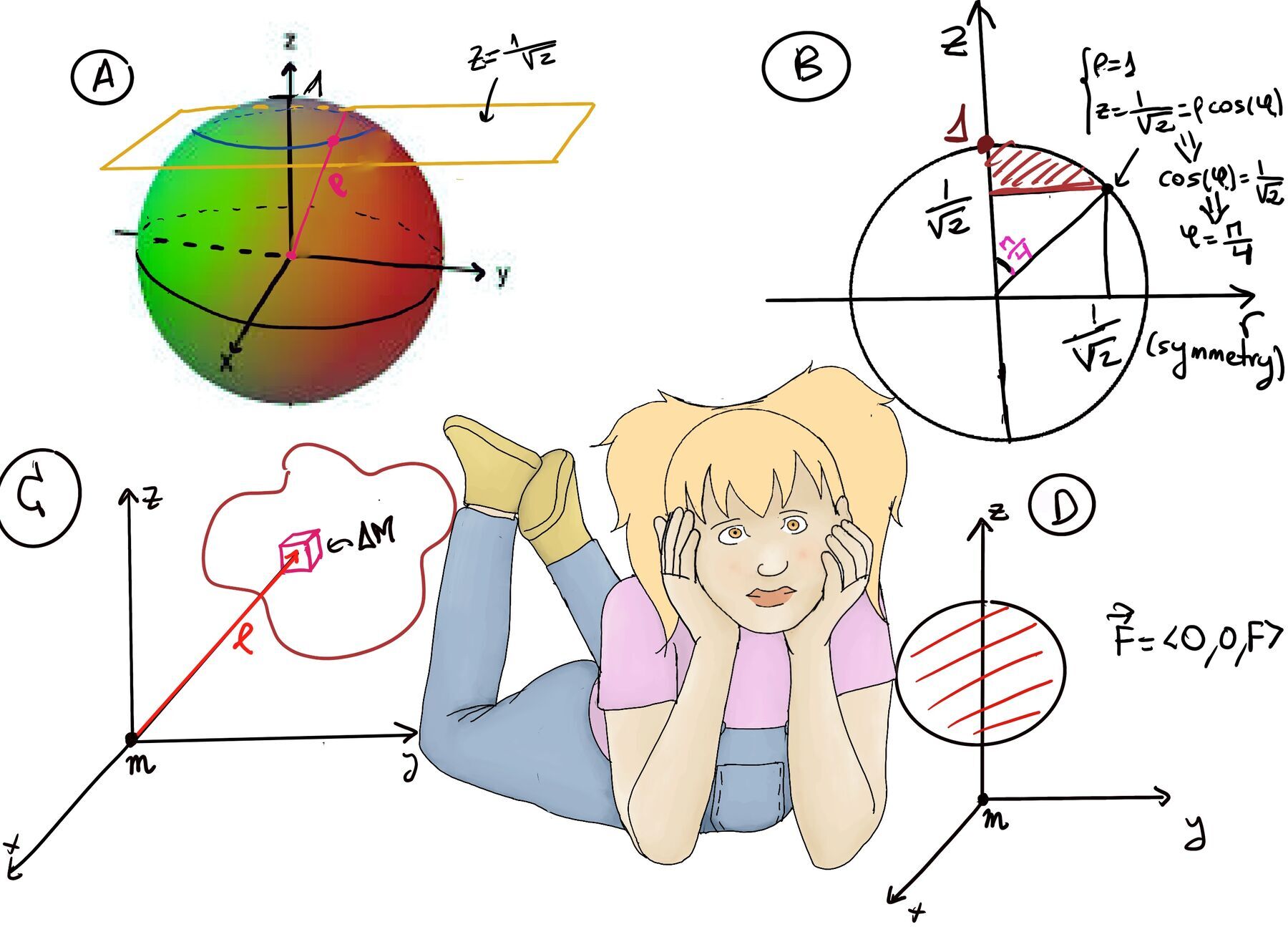
To find the gravitational force exerted by the entire object, we integrate this gravitational force over the entire volume occupied by the object.
Given that $\Delta M = \delta \cdot \Delta V$, where $\delta$ is the density and $\Delta V$ is the volume element, we can express the total gravitational force as: $\vec{F} = \int \int \int \frac{G·m·⟨x, y, z⟩}{\rho^3}δdV$
This integral can be complex, so it is useful to simplify by using spherical coordinates. In spherical coordinates, $z = \rho\cos(\phi)$, and the volume element is $dV = \rho^2 \sin(\phi) d\rho d\phi d\theta$. If we place the solid in a way that the z-axis is an axis of symmetry, the gravitational force will be directed along the z-axis (the x and y components will perfectly cancel each other out) -Figure D-, that is, it will reduce the force vector to $\vec{F} = \langle 0, 0, F_z \rangle$. In other words, the net force only pulls straight up or down along the z-axis.
Therefore, the integral simplifies to: $F_z = \int \int \int \frac{G \cdot m \cdot z}{\rho^3}\delta dV$
Let’s switch to spherical coordinates! We know $z = \rho\cos(\phi)$ and $dV = \rho^2\sin(\phi) \, d\rho \, d\phi \, d\theta$
$F_z = G m \int \int \int \frac{\rho \cos(\phi)}{\rho^3}\delta \cdot \rho^2\sin(\phi) d\rho d\phi d\theta = G m \int \int \int \delta \cdot \cos(\phi) \sin(\phi)d\rho d\phi d\theta.$
Notice how the $\rho^3$ in the denominator is perfectly canceled by the $\rho \cdot \rho^2$ in the numerator!
Application: Force of a Solid Hemisphere
Let’s apply this beautifully simplified formula to calculate the force exerted by a uniform solid hemisphere of radius $R$ resting on the xy-plane above the mass $m$.
Limits: $0 \le \rho \le R$, $0 \le \phi \le \frac{\pi}{2}$, and $0 \le \theta \le 2\pi$.
$F_z = Gm\delta \int_{0}^{2\pi} d\theta \int_{0}^{\frac{\pi}{2}} \cos(\phi)\sin(\phi) \, d\phi \int_{0}^{R} d\rho$
Evaluating each piece independently:
Multiplying them together: $F_z = Gm\delta (2\pi) \left(\frac{1}{2}\right) (R) = \pi G m \delta R$
We can make this even more elegant. The total mass $M$ of a hemisphere is its volume times its density: $M = \frac{2}{3}\pi R^3 \delta$. Solving for density gives $\delta = \frac{3M}{2\pi R^3}$.
Substituting this into our force equation: $F_z = \pi G m \left( \frac{3M}{2\pi R^3} \right) R = \frac{3GmM}{2R^2}$
This final equation is incredible. It reveals that the gravitational pull of a solid hemisphere on a point at its base is exactly $1.5$ times the pull if all that mass were simply concentrated into a point mass at a distance $R$. Spherical coordinates made this advanced physics proof a walk in the park!

JustToThePoint Copyright © 2011 - 2026 Anawim. ALL RIGHTS RESERVED. Bilingual e-books, articles, and videos to help your child and your entire family succeed, develop a healthy lifestyle, and have a lot of fun. Social Issues, Join us.
This website uses cookies to improve your navigation experience.
By continuing, you are consenting to our
use of cookies, in accordance with our Cookies Policy and
Website Terms and Conditions of use.