
|
 |

|
|
|
|
|
|
Logic will get you from A to B. Imagination will take you everywhere, Albert Einstein.
Definition. A vector $\vec{AB}$ is a geometric object or quantity that has both magnitude (or length) and direction. Vectors in an n-dimensional Euclidean space can be represented as coordinates vectors in a Cartesian coordinate system.
Definition. The magnitude of the vector $\vec{A}$, also known as length or norm, is given by the square root of the sum of its components squared, $|\vec{A}|~ or~ ||\vec{A}|| = \sqrt{a_1^2+a_2^2+a_3^2}$, e.g., $\vert{}\vert{}\langle 3, 2, 1 \rangle\vert{}\vert{} = \sqrt{3^2+2^2+1^2} = \sqrt{14}$, $\vert{}\vert{}\langle 3, -4, 5 \rangle\vert{}\vert{} = \sqrt{3^2+(-4)^2+5^2} = \sqrt{50} = 5\sqrt{2}$, or $\vert{}\vert{}\langle 1, 0, 0 \rangle\vert{}\vert{} = \sqrt{1^2+0^2+0^2} = \sqrt{1} = 1$.
Vector Addition: The sum of two vectors is the sum of their components, $\vec{A}+ \vec{B} = (a_1+b_1)\vec{i}+(a_2+b_2)\vec{j}+(a_3+b_3)\vec{k} = \langle a_1+b_1, a_2+b_2, a_3+b_3 \rangle$.
Vector Subtraction: The subtraction of two vectors is similar to addition and is also done component-wise, it is given by simply subtracting their corresponding components (x, y, and z in 3D), $\vec{A} - \vec{B} = (a_1-b_1)\vec{i}+(a_2-b_2)\vec{j}+(a_3-b_3)\vec{k} = \langle a_1-b_1, a_2-b_2, a_3-b_3 \rangle$.
Scalar multiplication is the multiplication of a vector by a scalar, a real number, changing its magnitude without altering its direction (unless the scalar is negative, which reverses the direction). It is effectively multiplying each component of the vector by the scalar value, $c\vec{A} = (ca_1)\vec{i}+(ca_2)\vec{j}+(ca_3)\vec{k} = \langle ca_1, ca_2, ca_3 \rangle$.
The dot or scalar product is a fundamental operation between two vectors. It produces a scalar quantity that represents the projection of one vector onto another. The dot product is the sum of the products of their corresponding components: $\vec{A}·\vec{B} = \sum a_ib_i = a_1b_1 + a_2b_2 + a_3b_3.$, e.g. $\vec{A}·\vec{B} = \sum a_ib_i = \langle 2, 2, -1 \rangle \cdot \langle 5, -3, 2 \rangle = (2 \cdot 5) + (2 \cdot -3) + (-1 \cdot 2) = 10 - 6 - 2 = 2.$
Geometrically, it is the product of their magnitudes multiplied by the cosine of the angle $\theta$ between them, $\boxed{\vec{A} \cdot \vec{B} = \vert{}\vert{}\vec{A}\vert{}\vert{} \cdot \vert{}\vert{}\vec{B}\vert{}\vert{} \cos(\theta)}$
The projection of $\vec{a}$ onto $\vec{b}$ is $proj_{\vec{b}}\vec{a} = \frac{\vec{a}·\vec{b}}{||\vec{b}||^2}\vec{b}$.
The cross product, denoted by $\vec{A} \times \vec{B}$, is a binary operation on two vectors in three-dimensional space. It yields a new vector that is perpendicular (orthogonal, at a right angle) to both original vectors and has a magnitude equal to the area of the parallelogram formed by the two input vectors.
The cross product $\vec{A}x\vec{B}$ can be computed using the determinant of a $3 \times 3$ matrix formed by the standard basis vectors ($\hat{\mathbf{i}}, \hat{\mathbf{j}}, \hat{\mathbf{k}}$) and the components of the two vectors: $\vec{A} \times \vec{B} = det(\begin{smallmatrix} \hat{\mathbf{i}} & \hat{\mathbf{j}} & \hat{\mathbf{k}} \\\ a_1 & a_2 & a_3\\\ b_1 & b_2 & b_3\end{smallmatrix}) =|\begin{smallmatrix}a_2 & a_3\\\ b_2 & b_3\end{smallmatrix}|\vec{i}-|\begin{smallmatrix}a_1 & a_3\\\ b_1 & b_3\end{smallmatrix}|\vec{j}+|\begin{smallmatrix}a_1 & a_2\\\ b_1 & b_2\end{smallmatrix}|\vec{k}$.
Example: If $\vec{A} = \langle 1, 2, 3 \rangle$ and $\vec{B} = \langle 4, 5, 6 \rangle$: $\vec{A} \times \vec{B} = \begin{vmatrix} \hat{\mathbf{i}} & \hat{\mathbf{j}} & \hat{\mathbf{k}} \\ 1 & 2 & 3 \\ 4 & 5 & 6 \end{vmatrix} = (2\cdot 6 - 3\cdot 5)\hat{\mathbf{i}} - (1\cdot 6 - 3\cdot 4)\hat{\mathbf{j}} + (1\cdot 5 - 2\cdot 4)\hat{\mathbf{k}} = -3\hat{\mathbf{i}} + 6\hat{\mathbf{j}} - 3\hat{\mathbf{k}} = \langle -3, 6, -3 \rangle$
Matrices offers an efficient way for solving systems of linear equations. Utilizing matrices, we can represent these equations more concisely and conveniently. For instance, consider the system of equations:
$\begin{cases} x + y + z = 7 \\ 3x -2y -z = 4 \\ x + 6y + 5z = 24 \end{cases}$
This can be written in matrix form as: A · X = U where: $A = \bigr(\begin{smallmatrix}1 & 1 & 1\\\ 3 & -2 & -1\\\ 1 & 6 & 5\end{smallmatrix}\bigl), X = \bigr(\begin{smallmatrix}x_1\\ x_2\\ x_3\end{smallmatrix}\bigl), B = \bigr(\begin{smallmatrix}7\\\ 4\\\ 24\end{smallmatrix}\bigl)$.
A system of $n$ linear equations with $n$ variables can be written in matrix form as $AX = B$:
For a square matrix $A$ over a field (such as $\mathbb{R}$ or $\mathbb{C}$):
The matrix inverse $A^{-1}$ is calculated as: $\boxed{A^{-1} = \frac{1}{\det(A)} \operatorname{adj}(A)}$ where $\operatorname{adj}(A) = C^T$ is the adjugate matrix (the transpose of the cofactor matrix $C$). The cofactor elements are $C_{ij} = (-1)^{i+j} M_{ij}$, where $M_{ij}$ is the determinant of the $(n-1) \times (n-1)$ submatrix formed by removing both the row $i$ and the column $j$.

In geometry, understanding the relationship between points, lines, and planes is fundamental. For example, two non-parallel lines intersect at a point, and two non-parallel planes intersect at a line.
A key difference between 2D and 3D space: Unlike in $\mathbb{R}^2$ where the equation $y = mx + b$ describes a line, in $\mathbb{R}^3$, this identical equation describes a plane because the $z$-coordinate is unrestricted and can take any value.
A line in three-dimensional space can be visualized as the path or trajectory of a moving point. Imagine a point $Q(t)$ moving along a line at a constant speed. At time $t = 0$, it starts at an initial point $Q_0$. At $t = 1$, it reaches another point $Q_1$. Because it moves at a constant speed, the vector from the starting point to its position at time $t$ is proportional to the elapsed time, meaning $\vec{Q_0Q(t)} = t\vec{Q_0Q_1}$
Let’s break it down with an example:
For our example, the coordinates Q(t) at any time t are give by: Q(t) = $\bigl(\begin{smallmatrix}-1\\\ 2\\\ 2\end{smallmatrix}\bigr)+t\bigl(\begin{smallmatrix}2\\\ -1\\\ 3\end{smallmatrix}\bigr)$
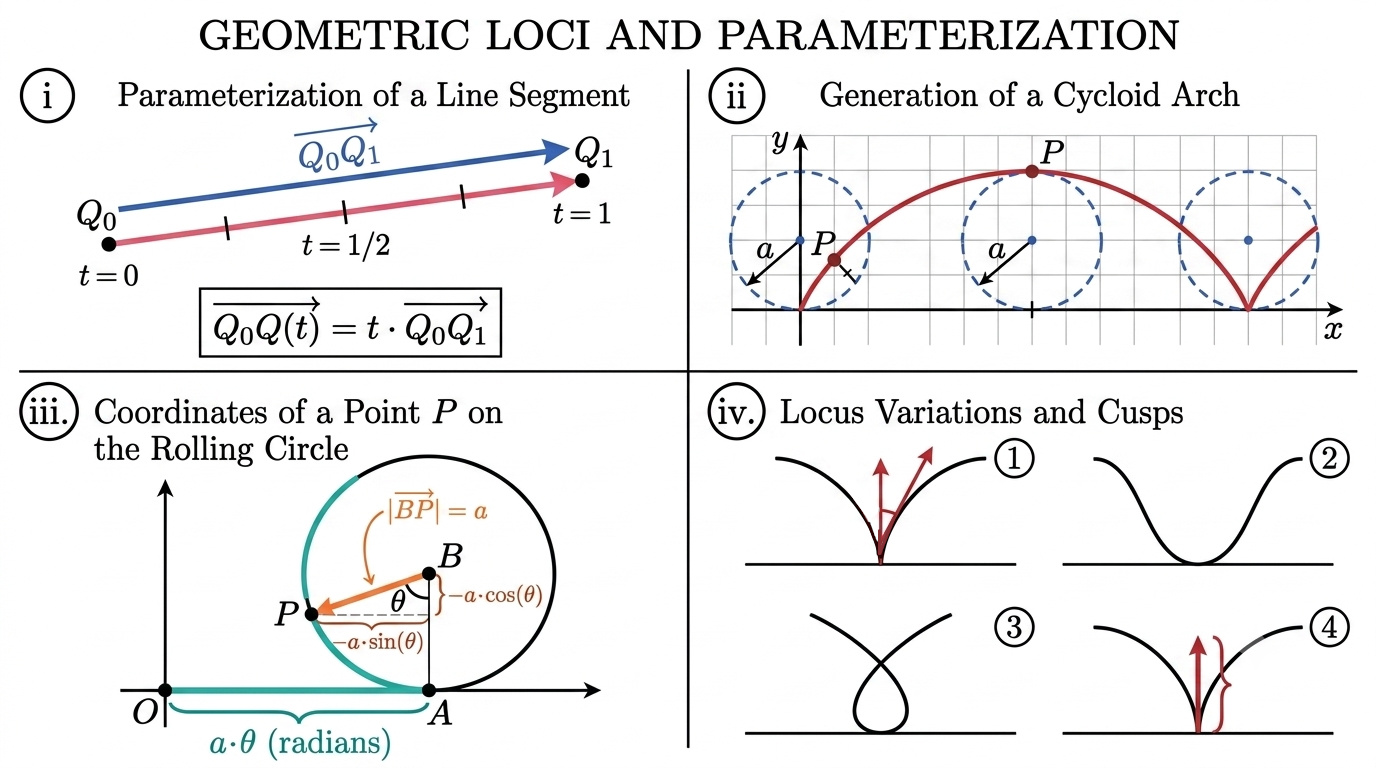
This results in the following set of parametric equations:
$\begin{cases} x(t) = -1 + 2t \\ y(t) = 2 + t \\ z(t) = 2 - 3t \end{cases}$
Consider the plane given by $x + 2y + 4z = 7$. Does our line from the previous section intersect this plane?
When testing for intersections algebraically, three outcomes are possible:
A parametric equation defines a group of quantities as functions of one or more independent variables called parameters. In simpler terms, it is a set of equations where each equation describes one of the coordinates (or other dependent variables) in terms of an independent variable, known as the parameter, e.g., x = x(t), y = y(t), that defines or specifies the (dependent) variables x and y as functions of a parameter or independent variable t.
Parametric equations are often used to describe motions and paths in the plane or in space, where the x, y, and z coordinates vary with some other parameter, such as t (time) or even $\theta$ (for example, a particular angle).
Sketch the curves described by the following parametric equations:
The Parabola: $x = t + 2$, $\quad y = t^2$, $\quad -2 \le t \le 2$ (Illustration B).
Plotting points for whole values of $t$ from $-2$ to $2$ gives us $(0,4), (1,1), (2,0), (3,1),$ and $(4,4)$, e.g., $t = −2, x =− 2 + 2 = 0$ and $y = (-2)^2 = 4$.
Plot these points and connect them smoothly to see the parabolic shape. The parabola opens upwards and shifted to the right by 2 units along the x-axis.
The Square Root Curve: $x = \sqrt{t}$, $\quad y = 3t + 1$, $\quad t \ge 0$ (Illustration C).
At $t=0$, we start at $(0,1)$. At $t=1$, we hit $(1,4)$. By $t=4$, we are at $(2,13)$, and at $t=9$, we reach $(3,28)$.
The curve starts at the y-axis, $(0,1)$, and climbs upwards steeply as t increases, forming a rightward-opening shape.
The Circle: $x = 4\cos(t)$, $\quad y = 4\sin(t)$, $\quad 0 \le t \le 2\pi$ (Illustration D).
Because $\sin$ and $\cos$ oscillate between -1 and 1, multiplying by 4 just scales the path. This creates a perfect circle with a radius of 4 centered at the origin, drawn (or moving) in a counterclockwise direction.

Eliminating the parameter involves rewriting parametric equations as a single Cartesian equation in terms of x and y. This process can help you understand the graph of a curve more clearly by relating the variables directly without the intermediary parameter $t$ or $\theta$.
Let’s work through the examples provided and clarify each step.
Given parametric equations: $x = 2t$ (i), $y = t^2$ (ii).
Solve the first equation for $t$, getting $t = \frac{x}{2}$. Substitute this expression into the second equation: $y = \left(\frac{x}{2}\right)^2 = \frac{x^2}{4}$
This Cartesian form $y = \frac{x^2}{4}$ makes it instantly clear that the curve is a standard parabola opening upwards.
Given parametric equations: $x = \sin(\theta) + 2$ (i), $y = \cos(\theta) - 3$ (ii).
Rather than trying to isolate $\theta$ directly using inverse functions (which is quite messy), isolate the trigonometric functions themselves: $\sin(\theta) = x - 2$, $\cos(\theta) = y + 3$
Next, we use the Pythagorean identity: $\sin^2(\theta) + \cos^2(\theta) = 1$: $(x - 2)^2 + (y + 3)^2 = 1$
By eliminating the parameter $\theta$, we reveal the standard Cartesian equation for a circle with a radius of $1$, centered at the coordinates $(2, -3)$.

| t | x | y |
|---|---|---|
| 0 | 5 | -1 |
| $\pi/2$ | 3 | 1 |
| $\pi$ | 1 | -1 |
| $3\pi/2$ | 3 | -3 |
| $2\pi$ | 5 | -1 |

JustToThePoint Copyright © 2011 - 2026 Anawim. ALL RIGHTS RESERVED. Bilingual e-books, articles, and videos to help your child and your entire family succeed, develop a healthy lifestyle, and have a lot of fun. Social Issues, Join us.
This website uses cookies to improve your navigation experience.
By continuing, you are consenting to our
use of cookies, in accordance with our Cookies Policy and
Website Terms and Conditions of use.