
|
 |

|
|
|
|
|
|
Learn everything you can, anytime you can, from anyone you can – there will always come a time when you will be grateful you did, Sarah Caldwell.
A vector field is an assignment of a vector $\vec{F}$ to each point in a given space. In a two-dimensional plane, a vector field assigns a 2D vector to every point $(x, y)$, typically expressed as: $\vec{F}(x, y) = M(x, y)\vec{i} + N(x, y)\vec{j} = \langle M, N \rangle$ where $M$ and $N$ are scalar functions of $x$ and $y$.
A vector field on a plane can be visualized as a collection of arrows, each attached to a point on the plane. These arrows represent vectors with specific magnitudes and directions. These fields allow us to model environments where there is a magnitude and direction at every location —such as gravitational forces, magnetic fields, or the velocity of fluid flows.
In physics, work is defined as the energy transferred when a force acts upon an object, displacing it along a path.. In the context of vector fields, we calculate the work done by a force field along a curve or trajectory C using a line integral. The work $W$ done by a force field $\vec{F}$ moving a particle along a parameterized curve $C$ is defined by the dot product of the force and the infinitesimal displacement vector $d\vec{r}$: $W = \int_{C} \vec{F} \cdot d\vec{r} = \int_{C} Mdx + Ndy = \int_{C} (\vec{F} \cdot \hat{\mathbf{T}}) ds$, where $\hat{\mathbf{T}}$ is the unit tangent vector to the curve at any point, and $ds$ is the infinitesimal arc length.
Before analyzing vector fields deeply, we must rigorously define the spaces in which they exist.

Connected Region. A region $D$ is path-connected if you can move from any point in $D$ to any other point in $D$ via a continuous path that lies entirely within the region. It consists of a single, unbroken piece. A filled circle is path-connected because you can move from any point inside the circle to any other point without leaving the circle.
A curve C is simple if it does not intersect itself, except possibly at its endpoints. This means that the curve does not cross over itself. A circle (a closed loop) is a simple curve because it does not intersect itself.
Simple (Open): A straight line, a crescent arc, or an “S” shape.
Simple (Closed): A circle, a perfect square, or an oval. It forms a clean boundary with an obvious “inside” and “outside”. \ Not Simple: A figure-8, a clover, or a spiral that loops back across an older path. These shapes cross over themselves, creating an intersection point where $t_1 \neq t_2$ but the physical location is still identical.
Simply Connected Region. An open, connected region $D$ is simply connected if any simple closed curve (a loop that doesn't cross itself) drawn within $D$ can be continuously shrunk to a single point without ever leaving $D$. Colloquially, this means the region has no “holes.”
The interior of a circle is simply connected because any loop drawn inside the circle only encloses points within the circle, and there are no holes.
Let’s classify several domains based on these topological properties:
$D = \{(x, y) \mid x^2 + y^2 \leq 1 \text{ or } 4 \leq x^2 + y^2 \leq 9\}$.
It is not open because it includes the boundaries. The use of $\leq$ means the region includes its rigid boundaries.
It is not connected because it consists of two disjoint parts: a small (isolated) disk of radius 1 centered at the origin, and an annulus (ring) between radii 2 and 3. You cannot move from the smaller disk to the annulus without leaving the region.
It is not simply connected because it is not connected and also has a hole between the two parts of the region (Refer to Figure C for a visual representation and aid in understanding it)
$D = \{(x, y) \mid 4 \lt x^2 + y^2 \lt 9\}$.
D is open because it excludes the boundaries (The strict inequalities $<$ exclude the boundaries), so for any point in the region, you can find a small disk around it that stays entirely within the region.
It is connected because you can move from any point within the annulus to any other point within it without leaving the region. It is a single, continuous annulus (ring).
It is not simply connected because it has a “hole” in the middle (the area inside the circle of radius 2). If you draw a closed loop that wraps around the origin, you cannot shrink that loop to a point without crossing outside the region (Refer to Figure D for a visual representation and aid in understanding it)
The gradient of a scalar function $f(x,y)$, denoted $\nabla f$, is a vector field that points in the direction of the greatest rate of change (the direction in which the function increases more quickly) of the function, and its magnitude is the rate of change or increase in that direction.
The components of the gradient are the partial derivatives of the function with respect to each variable. Mathematically, the gradient is represented as: $\nabla f = \left\langle \frac{\partial f}{\partial x_1},\frac{\partial f}{\partial x_2},\cdots \frac{\partial f}{\partial x_n} \right\rangle$ where $\frac{\partial f}{\partial x_i}$ denotes the partial derivative of $f$ with respect to the $i$-th variable.
A vector field $\vec{F}$ is called conservative if it can be expressed as the gradient of some scalar function f. In other words, there exist a function f such that: $\vec{F} = \nabla f$, then $\vec{F}$ is a conservative vector field, and f is known or referred to as the potential function of the vector field.
When a vector field is conservative, the work done by the field along a path from one point to another $\int_{C} \vec{F}d\vec{r}$ depends only on the endpoints of the path, not on the path taken. This property simplifies the computation of line integrals significantly.
The Fundamental theorem of Calculus for Line Integral provides a powerful tool for evaluating line integrals of conservative vector fields. This theorem is the multivariable equivalent of the Fundamental Theorem of Calculus.
It states: If $\vec{F}$ is a conservative vector field (meaning $\vec{F} = \nabla f$) on an open region containing a smooth curve $C$, the line integral of $\vec{F}$ along $C$ depends only on the initial point $P_0$ and the final point $P_1$ of the curve $C$: $\boxed{\int_{C} \vec{F} \cdot d\vec{r} = \int_{C} \nabla f \cdot d\vec{r} = f(P_1) - f(P_0)}$
This is a profoundly and immensely useful result because it allows us to calculate the work done by a complex vector field purely by evaluating the scalar potential function at the endpoints, bypassing (entirely ignoring) the chaotic or winding path the particle took to get there (the need to evaluate the integral along this path).
Proof:
The significance and main idea of conservative vector fields lies in their path independence, which means that the work done by the vector field along any path between two points depends only on the endpoints and not on the path taken. For a conservative vector field $\vec{F}= \nabla f$, and any two paths or curves $C_1$ and $C_2$ that share the same start at $P_0$ and end at $P_1$, the work done along both paths will be the same, $\int_{C_1} \nabla f \cdot d\vec{r} = \int_{C_2} \nabla f \cdot d\vec{r}$.
Furthermore, if the curve is closed (meaning it loops back so that $P_0 = P_1$), the work done by a conservative field is strictly zero: $\oint_{C} \vec{F} \cdot d\vec{r} = f(P_0) - f(P_0) = 0$
Let’s dive into the problem where we analyze the work done by the vector field $\vec{F}= y\vec{i}+x\vec{j} = \langle y, x \rangle$ as we move along a path C composed of three segments $C_1, C_2$, and $C_3$ ($C = C_1 + C_2 + C_3$) in the unit circle (Figure D)
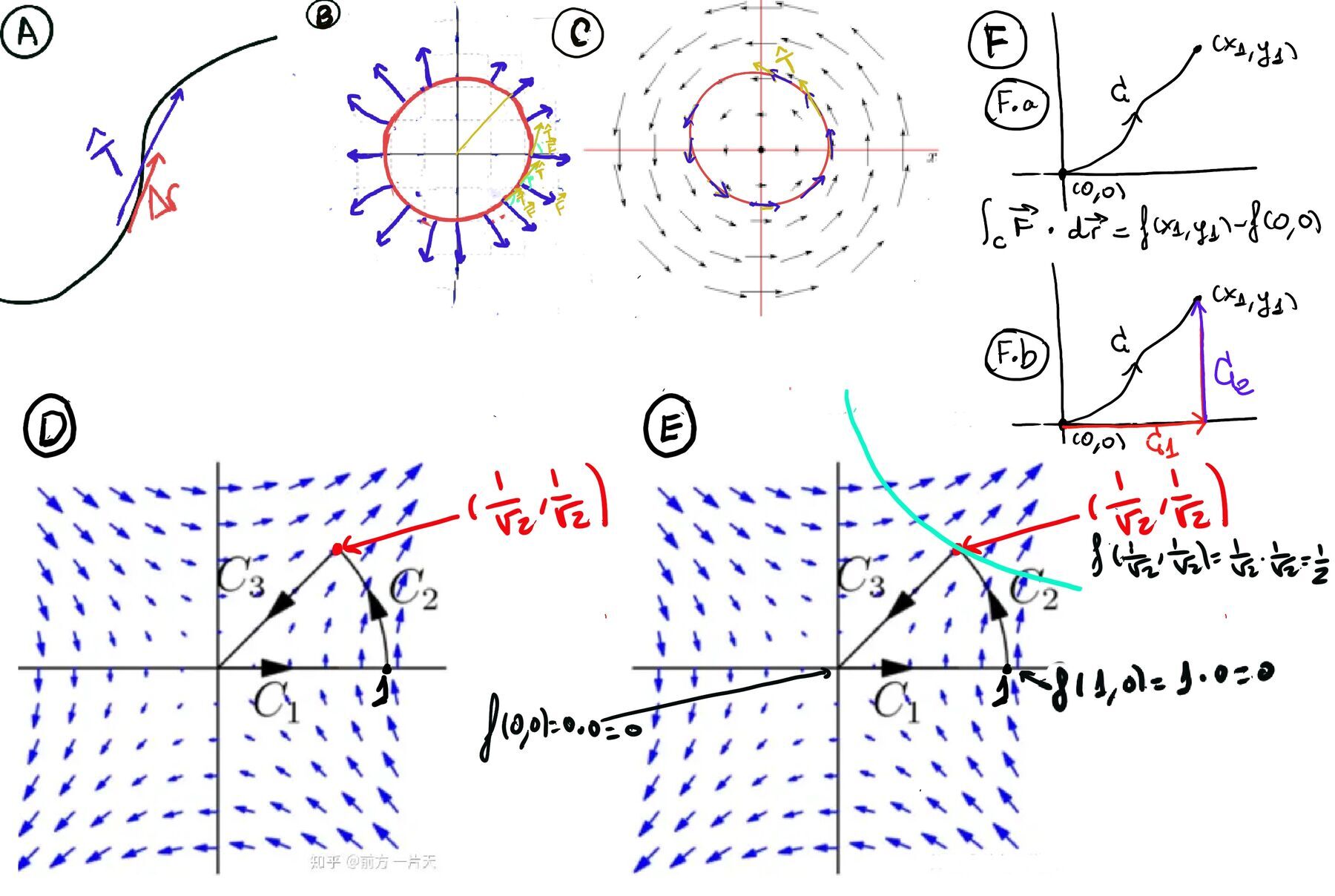
In this section, we’ll explore a counterexample of a non-conservative vector field, specifically $\vec{F} = -y\vec{i}+x\vec{j} = \langle -y, x \rangle$ and demonstrate why it is not conservative by evaluating the work done by this force field along the unit circle.
Key Observations:
There is a vital nuance when translating mathematical conservative fields to physical reality. In mathematics, we say $\vec{F} = \nabla f$, where $f$ is the potential function.
In physics, a force is conservative if it is the negative gradient of a physical potential energy function $V$ (or $U$): $\vec{F} = -\nabla V$. For example, in a gravitational system, the gravitational field $\vec{g}$ is related to the gravitational potential $V$ by $\vec{g} = -\nabla V$ where $\vec{g}$ is the gravitational field (the force experienced by objects due to gravity, approximately $9.8 m/s^2$ directed downwards) and V is the gravitational potential. The negative sign indicates that the force points in the direction of decreasing potential.
Why the negative sign? It represents the natural tendency of physical systems to move toward states of lower potential energy. If you hold a boulder on a hill, the gravitational force points down (in the direction of decreasing $V$).
By the Fundamental Theorem of Line Integrals, the work done by a conservative force moving an object from $P_1$ to $P_2$ is: $W = \int_{P_1}^{P_2} \vec{F} \cdot d\vec{r} = \int_{P_1}^{P_2} -\nabla V \cdot d\vec{r} = -(V(P_2) - V(P_1)) = -\Delta V$. The work done by the field equals the negative change in potential energy.
Simultaneously, the foundational Work-Energy Theorem from Newtonian mechanics states that the net work done on an object equals its change in Kinetic Energy ($K$): $W = \Delta K$
Equating the two expressions for work yields the crowning jewel of classical mechanics —The Conservation of Energy: $\Delta K = -\Delta V \implies \boxed{\Delta K + \Delta V = 0}$
In a system governed entirely by conservative forces (like gravity or electrostatics), the total mechanical energy ($E = K + V$) remains eternally constant. Energy is never lost; it simply oscillates between kinetic motion and potential position, governed beautifully by the gradient of the field.
When studying vector calculus, you will often hear a vector field described in several different ways: as a “conservative force,” a “gradient field,” or a field with an “exact differential.”
In mathematics, these are not separate concepts. Provided the vector field $\vec{F}$ is continuous and defined on an open, path-connected region in space, these terms are mathematically synonymous. If a vector field satisfies one of these properties, it automatically satisfies the others.
Here are the five fundamental equivalent properties of a conservative vector field, moving from physical intuition to rigorous mathematical testing.
Zero Work Over Closed Loops (Conservative Force). A force field $\vec{F}$ is considered conservative if the net work done by the force in moving an object around any closed loop $C$ is exactly zero.
Mathematically, a curve is closed if its starting point and ending point are the same ($P_0 = P_1$).
Thus, this property is expressed as a closed contour integral: $\boxed{\oint_{C} \vec{F} \cdot d\vec{r} = 0}$.
Physical Intuition: If you move a mass through a gravitational field (a conservative force) and return it to the exact same spot, the gravity takes as much energy away during the ascent as it gives back during the descent. The net energy expenditure by the field (the total work by the force) over the whole round-trip is zero.
Path independence. A vector field is path-independent if the line integral between any two points depends solely on the locations of the endpoints, and not on the specific trajectory taken between them.
In other words, the work done by the force in moving an object from one point to another is the same, regardless of the path taken between the two points.
If you have two distinct paths, $C_1$ and $C_2$, that both start at point $A$ and end at point $B$, then: $\boxed{\int_{C_1} \vec{F} \cdot d\vec{r} = \int_{C_2} \vec{F} \cdot d\vec{r}}$
We can rigorously prove that zero work on closed loops guarantees path independence.
Consider a closed loop formed by traveling from $A$ to $B$ along path $C_1$, and then returning from $B$ to $A$ along path $C_2$ in reverse. We denote the reversed path as $-C_2$. The total closed loop is $C = C_1 \cup (-C_2)$.
By Property 1, the integral over the closed loop $C$ is zero: $\oint_{C} \vec{F} \cdot d\vec{r} = \int_{C_1} \vec{F} \cdot d\vec{r} + \int_{-C_2} \vec{F} \cdot d\vec{r} = 0$
Because reversing the direction of a line integral negates its value ($\int_{-C_2} = -\int_{C_2}$), we get $\int_{C_1} \vec{F} \cdot d\vec{r} - \int_{C_2} \vec{F} \cdot d\vec{r} = 0 \implies \int_{C_1} \vec{F} \cdot d\vec{r} = \int_{C_2} \vec{F} \cdot d\vec{r}$
The Gradient Field (Potential Function). A vector field $\vec{F}$ is a gradient field if it can be expressed as the gradient of a scalar potential function $f$. In mathematical terms, this means $\vec{F} = \nabla f$, where f is a scalar function.
For a 2D field $\vec{F} = \langle M, N \rangle$, this means there exists a scalar surface $f(x,y)$ such that the components of $\vec{F}$ are strictly its partial derivatives: $\vec{F} = \left\langle \frac{\partial f}{\partial x}, \frac{\partial f}{\partial y} \right\rangle$
How Property 2 implies Property 3:
If a field is path-independent, the work done in moving from a fixed reference point $P_0$ to any variable point $P(x,y)$ is a uniquely defined value.
We can actually define our scalar potential function $f(x,y)$ precisely as this integral: $f(x,y) = \int_{P_0}^{(x,y)} \vec{F} \cdot d\vec{r}$.
By the Fundamental Theorem of Line Integrals, evaluating the work is as simple as subtracting the potential function at the endpoints: $\int_{C} \vec{F} \cdot d\vec{r} = f(P_1) - f(P_0)$
Exact Differential Forms. In the language of differential forms, the expression $M dx + N dy$ is called an exact differential if it is the total differential $df$ of some scalar function $f(x, y)$.
By the multivariable chain rule, the total differential of $f$ is: $df = \frac{\partial f}{\partial x}dx + \frac{\partial f}{\partial y}dy$
Therefore, $M dx + N dy$ is exact if and only if $M = \frac{\partial f}{\partial x}$ and $N = \frac{\partial f}{\partial y}$. This directly implies that the vector field $\vec{F} = \langle M, N \rangle$ is a gradient field ($\vec{F} = \nabla f$).
If a differential is exact, then the line integral of $\vec{F}$ over any path C can be evaluated by simply finding the difference in the potential function values at the endpoints of the path.
The Component Test (Irrotational Fields)
Properties 1 through 4 are theoretically elegant, but how do you actually look at a vector field $\vec{F} = \langle M, N \rangle$ and know if it has a potential function?
This brings us to the fifth property: the Cross-Partial Derivative Test.
By Clairaut’s Theorem on equality of mixed partial derivatives, if $M = f_x$ and $N = f_y$, then taking the derivative of $M$ with respect to $y$, and $N$ with respect to $x$, must yield the same result ($f_{xy} = f_{yx}$).
Therefore, a field is conservative if: $\frac{\partial N}{\partial x} = \frac{\partial M}{\partial y} \implies \frac{\partial N}{\partial x} - \frac{\partial M}{\partial y} = 0$.
In 3D, this is equivalent to saying the curl of the vector field is zero ($\nabla \times \vec{F} = \vec{0}$). Such fields are called irrotational.
There is a vital catch here. While properties 1 through 4 are equivalent on any open connected region, Property 5 requires a stricter condition: the region must be simply connected (meaning it has no topological “holes”). If a domain has a hole —like the plane with the origin removed —a vector field can pass the cross-partial test but still fail to be conservative!

JustToThePoint Copyright © 2011 - 2026 Anawim. ALL RIGHTS RESERVED. Bilingual e-books, articles, and videos to help your child and your entire family succeed, develop a healthy lifestyle, and have a lot of fun. Social Issues, Join us.
This website uses cookies to improve your navigation experience.
By continuing, you are consenting to our
use of cookies, in accordance with our Cookies Policy and
Website Terms and Conditions of use.