
|
 |

|
|
|
|
|
|
There are $11_2$ kinds of people: those who understand binary, and those who don’t.
Without pain, without sacrifice, we would have nothing — Fight Club.
Arithmetic is built on a simple premise: taking two objects and combining them to create a third. When we add two numbers, multiply two matrices, or compose two functions, we are engaging in the most fundamental action in abstract algebra: the binary operation.
A binary operation on a set $G$ is a rule that assigns to each ordered pair of elements from $G$ a uniquely determined element that also belongs to $G$.
Mathematically, a binary operation (often denoted by symbols like $*$, $\circ$, $\cdot$, or $+$) is a function from the Cartesian product $G \times G$ back into $G$: $* : G \times G \to G$
For a rule to qualify as a true binary operation on a set, it must pass a strict three-part checklist:
Standard Arithmetic: Addition and multiplication are binary operations on the natural numbers ($\mathbb{N}$), integers ($\mathbb{Z}$), rationals ($\mathbb{Q}$), reals ($\mathbb{R}$), and complex numbers ($\mathbb{C}$).
Vectors and Matrices: Vector addition is a binary operation on $\mathbb{R}^n$. Matrix multiplication is a binary operation on $M_n(\mathbb{R})$ (the set of square $n \times n$ matrices). Similarly, the scalar cross product (or determinant) on $\mathbb{R}^2$ is a binary operation $a \times b = a_1b_2 -a_2b_1$ whose magnitude satisfies $\vert{}a \times b \vert{} = \lVert a \rVert \lVert b \rVert \lVert \sin(\theta) \rVert$ where $\theta$ is the angle between $a$ and $b$.
The Division Failure: Division is not a binary operation on the integers $\mathbb{Z}$, because it fails closure (e.g., $2/3 \notin \mathbb{Z}$). More subtly, division is not a binary operation on the real numbers $\mathbb{R}$ because it fails totality (e.g., $1/0$ is undefined, so the function cannot process pairs containing zero).
The Fix: We can make division a binary operation by removing zero. Division is a valid binary operation on the non-zero real numbers, denoted $\mathbb{R}^*$.
The Scalar Failure: Scalar multiplication of a vector ($\lambda \cdot \vec{v}$) is a valid operation, but it is not a binary operation on $\mathbb{R}^n$. The inputs come from two different sets (a scalar from $\mathbb{R}$ and a vector from $\mathbb{R}^n$). A binary operation requires both inputs and the output to belong to the exact same set.
Let $X^X=\{f \mid f:X\to X\}$. Function composition $\circ : X^X \times X^X \to X^X$ is a binary operation on $X^X$.
A binary operation is simply a rule, formula or method of combining the elements of a set, two at a time, in such a way that their combination is also a member of the set. This condition is called closure.
Definition. Let $*$ be a binary operation on a large set $S$, and we select a smaller subset $H \subset S$. We say that $H$ is closed under $*$ if performing the operation on any two elements of $H$ always produces an element that is still inside $H$ (the restriction of $*$ to $H$ is a binary operation on $H$). Equivalently, $\forall a, b \in H, \quad a*b \in H.$
Examples:
$\mathbb{R}$ is closed under addition in $\mathbb{C}$. Likewise, $\mathbb{Q}$ is closed under addition in $\mathbb{R}$, $\mathbb{Z}$ is closed under addition in $\mathbb{Q}$, and $\mathbb{N}$ is closed under addition in $\mathbb{Z}$. Equivalently, $\mathbb N \subseteq \mathbb Z \subseteq \mathbb Q \subseteq \mathbb R \subseteq \mathbb C$ and each set is closed under addition.
Subtraction is not a binary operation on $\mathbb N$, e.g, $2-3 = -1 \notin \mathbb N$. On the other hand, $\mathbb Z$ is closed under subtraction (and therefore also $\mathbb Q$, $\mathbb R$, and $\mathbb C$ are).
Let $Q^\times = \mathbb{Q} \setminus\{0\}$ and similarly define $\mathbb{R}^\times$ and $\mathbb{C}^\times$.
Then, multiplication and division are binary operations on $\mathbb{Q}^\times$, $\mathbb{R}^\times$, and $\mathbb{C}^\times$. However, $\mathbb{Z}$ is not closed under ordinary division. For example, $2/3\notin\mathbb Z$.
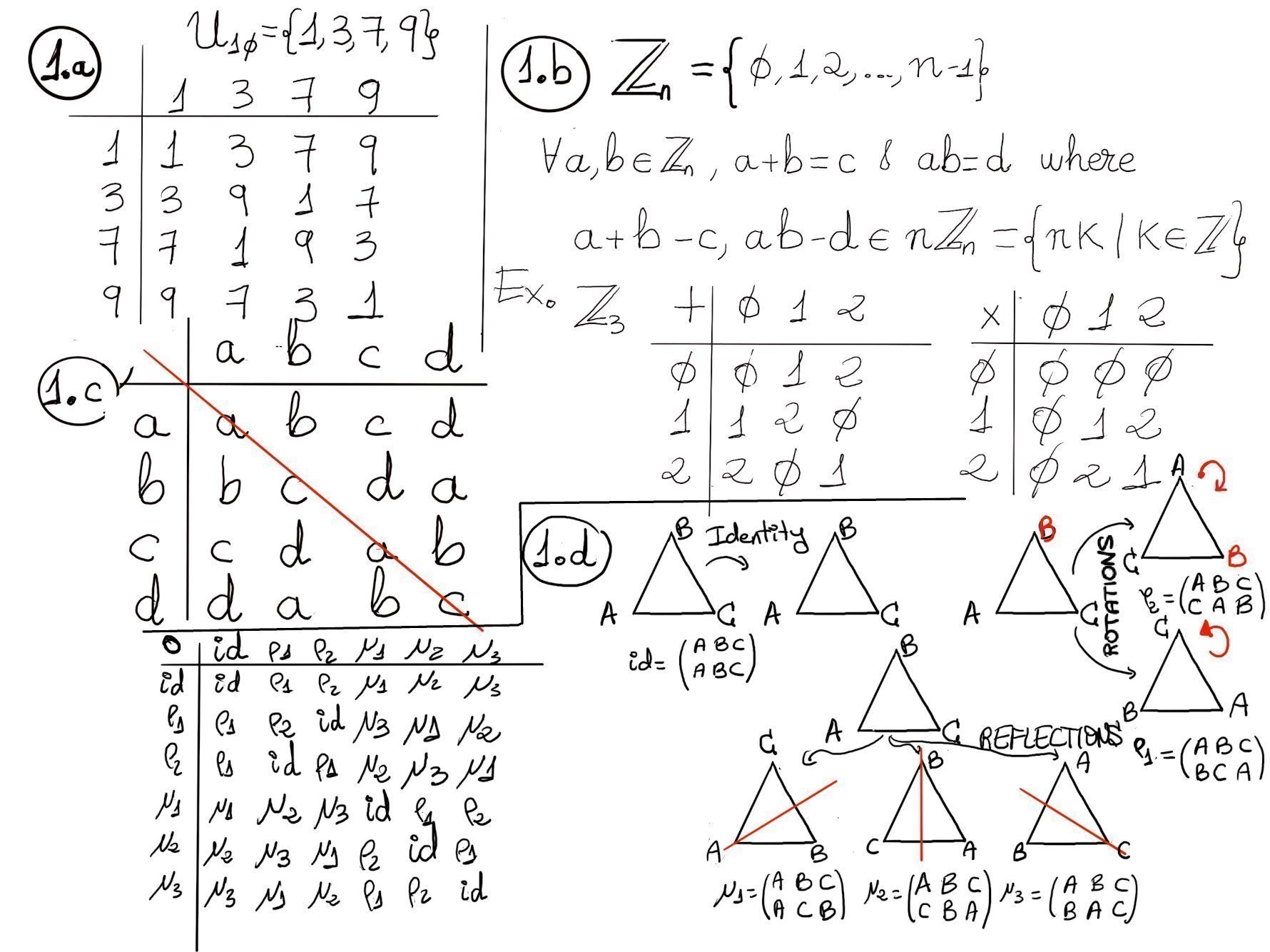
For finite sets, we can completely map out a binary operation using a grid called a Cayley Table. To find $a * b$, you locate $a$ on the left row header and $b$ on the top column header. The intersection gives the result.
A Group is an abstraction of the basic rules of algebra.
Why do we need these specific rules? Consider the simplest high school algebra problem: solve for $x$ in the equation $x + 2 = 5.$ You likely solve this without thinking, but let’s break down the exact mathematical machinery required to justify every single step:
Without these specific properties, basic algebra completely collapses. Mathematicians packaged these exact properties together into a single, profound structure.
A Group is a non-empty set $G$ paired with a binary operation $*$ that perfectly satisfies four fundamental axioms:
Notice what is missing from this list: Commutativity. The definition of a group does not require that $a * b = b * a$. If a group happens to satisfy this extra condition, we give it a special name: an Abelian Group, named after mathematician Niels Henrik Abel. For example, addition on the integers is an Abelian group, but matrix multiplication is not.
Groups appear everywhere in mathematics, taking on wildly different forms. Below, we explore the most famous examples, ranging from basic number systems to the geometry of symmetry.
The most familiar groups are the numbers we use every day.
The Additive Groups: The integers $\mathbb{Z}$, rational numbers $\mathbb{Q}$, real numbers $\mathbb{R}$, and complex numbers $\mathbb{C}$ are all infinite Abelian (commutative) groups under addition. For all of them, the identity element is $0$, and the inverse of $a$ is $-a$.
Counterexample: The natural numbers $(\mathbb{N}, +)$ do not form a group because they lack inverses. There is no natural number you can add to $4$ to get $0$ (since $-4 \notin \mathbb{N}$).
The Multiplicative Groups: If we switch to multiplication, $\mathbb{Z}, \mathbb{Q}, \mathbb{R},$ and $\mathbb{C}$ are not groups, because the number $0$ has no multiplicative inverse (you cannot divide by zero).
The Fix: We can create multiplicative groups by removing zero. We denote these as $\mathbb{Q}^*$, $\mathbb{R}^*$, and $\mathbb{C}^*$. In these groups, the identity is $1$, and the inverse of $a$ is $\frac{1}{a}$.
Failure of Subtraction: Is $(\mathbb{Z}, -)$ a group? No! Subtraction utterly fails the Associativity axiom. For example: $4 - (3 - 7) = 4 - (-4) = 8$. However, $(4 - 3) - 7 = 1 - 7 = -6$. Because obviously $8 \neq -6$, subtraction cannot form a group.
Irrational numbers under multiplication is not a group, e.g., $\sqrt{2} \times \sqrt{2} = 2 \notin \mathbb{R} \setminus \mathbb{Q}$, so it is not closed under multiplication.
Imagine a clock face with $n$ hours. This is the geometric intuition behind Modular Arithmetic.
The set of integers modulo $n$, denoted $\mathbb{Z}_n$ or $\mathbb{Z}/n\mathbb{Z}$, is the set of equivalence classes based on remainders when divided by $n$, $a \equiv b \iff n \mid (b -a)$, that is, $\{[0], [1], [2], \dots, [n-1]\}$.
$(\mathbb{Z}_n, +)$ is always an Abelian group. The identity is $[0]$, and the inverse of $[k]$ is $[-k]$ (which is equivalent to $[n-k]$).
What about multiplication? The set $(\mathbb{Z}_n, \cdot)$ is not a group because $[0]$ has no inverse. Even if we remove $[0]$, it still might not be a group! For example, in $\mathbb{Z}_6$, what is the multiplicative inverse of $[2]$? There is no number $k$ such that $2k \equiv 1 \pmod 6$.
An element $a \in \mathbb{Z}_n$ only has a multiplicative inverse if it shares no common factors with $n$. By Bézout’s Identity, if $\gcd(a, n) = 1$, there exists an inverse $a^{-1}$ such that $a \cdot a^{-1} \equiv 1 \pmod n$.
The Group of Units, denoted $U(n)$ or $\mathbb{Z}_n^*$, is the set of all elements in $\mathbb{Z}_n$ that are relatively prime to $n$. Under multiplication, $U(n)$ always forms a perfect Abelian group. For example, $U(10)$.
The numbers strictly less than $10$ that are coprime to $10$ are $\{1, 3, 7, 9\}$. Thus, $U(10) = \{[1], [3], [7], [9]\}$.
Let’s check the inverses. Since $[3] \cdot [7] = [21] \equiv [1] \pmod{10}$, we know that $[3]^{-1} = [7]$ and $[7]^{-1} = [3]$.
The Euclidean algorithm is used to calculate inverses in U(n) because it computes a linear combination $ak + bn = 1 \implies ak \equiv 1 \pmod n$, and therefore $k = a^{-1}$.
Groups are the mathematical language of Symmetry.
The Dihedral Group $D_n$ is the group of all rigid symmetries of a regular polygon with $n$ vertices. The elements of the group are physical transformations (rotations and reflections) that leave the shape looking unchanged. In other words, the rigid motions taking a regular n-gon back to itself.
The group operation is simply performing one transformation after another (function composition). $D_n$ always contains exactly $2n$ elements: $n$ rotations and $n$ reflections.
We can define the entire infinite family of these groups using just two abstract generators: a rotation $r$ (by $\frac{360}{n}$ degrees) and a reflection $s$. $D_n = \langle r, s \mid r^n = e, s^2 = e, rs = sr^{-1} \rangle = \{e, r, r^2, \dots, r^{n-1}, s, rs, r^2s, \dots, r^{n-1}s \}$.
Notice that they do not commute! The Dihedral groups are non-Abelian. $D_3$ is the symmetry group of the equilateral triangle (6 elements), and $D_4$ is the symmetry group of the square (8 elements).
If we take a set of $n$ distinct objects $X$, how many ways can we shuffle them?
The Symmetric Group of degree $n$, denoted $S_n$, is the group of all possible bijections (permutations) from a set of $n$ elements to itself. The group operation is standard function composition.
Because the number of ways to shuffle $n$ objects is $n!$, the size of the group is $\vert{}S_n\vert{} = n!$.
We can represent permutations using Cauchy’s Two-Line Notation. The top row is the input, and the bottom row is the output. Let $f, g \in S_6$:
$$f = \begin{pmatrix} 1 & 2 & 3 & 4 & 5 & 6 \\ 2 & 1 & 4 & 3 & 6 & 5 \end{pmatrix}, \quad g = \begin{pmatrix} 1 & 2 & 3 & 4 & 5 & 6 \\ 5 & 4 & 3 & 2 & 1 & 6 \end{pmatrix}$$To compose them, we evaluate $(f \circ g)(x) = f(g(x))$, working from right to left.
Let’s track the number $1$: $g$ maps $1 \to 5$, and then $f$ maps $5 \to 6$. Therefore, the composition maps $1 \to 6$. Repeating this for all numbers gives:
$$f \circ g = \begin{pmatrix} 1 & 2 & 3 & 4 & 5 & 6 \\ 6 & 3 & 4 & 1 & 2 & 5 \end{pmatrix}$$Note: Advanced mathematicians streamline this using Cycle Notation, writing $f = (1\ 2)(3\ 4)(5\ 6)$, which tracks the path of elements as they cycle through the permutation.
Groups also govern linear algebra.
Let $F$ be a field (like $\mathbb{R}$ or $\mathbb{C}$). The General Linear Group of degree $n$, denoted $GL_n(F)$, is the set of all $n \times n$ invertible matrices with entries in $F$, operating under standard matrix multiplication.
The operation is defined as $\begin{pmatrix} a_1 & b_1 \\ c_1 & d_1 \end{pmatrix} \cdot \begin{pmatrix} a_2 & b_2 \\ c_2 & d_2 \end{pmatrix} = \begin{pmatrix} a_1a_2 + b_1c_2 & a_1b_2 + b_1d_2 \\ c_1a_2 + d_1c_2 & c_1b_2 + d_1d_2 \end{pmatrix}$
Why must the matrices be invertible? Because the group axioms require that every element has an inverse! In linear algebra, a matrix is invertible if and only if its determinant is non-zero ($\det(A) \neq 0$).
For example, $GL_2(\mathbb{R})$ is the group of all $2 \times 2$ matrices with real entries and non-zero determinants.
Because matrix multiplication famously depends on the order of the matrices ($AB \neq BA$), the General Linear Group is indeed non-Abelian.
We mentioned earlier that the non-zero complex numbers $\mathbb{C}^*$ form a group under multiplication. Its identity is $1$, and $\forall z \in \mathbb{C}^*, z^{-1}=\frac{a-bi}{a^{2}+b^{2}}$. But there is a profound geometric truth hidden inside this group.
Every complex number $z = x + iy$ can be plotted on a 2D plane and written in polar coordinates: $z = r(\cos\theta + i\sin\theta) = re^{i\theta}$ where $r$ is the magnitude (distance from the origin) and $\theta$ is the angle from the positive $x$-axis.
So a complex number is not just a point; it is like an instruction: “Stretch by $r$ and rotate by $\theta$”.
When you multiply two complex numbers, their magnitudes multiply, and their angles add together. Suppose $z_1=r_1e^{i\theta_1}, \qquad z_2=r_2e^{i\theta_2}.$ Multiplying gives $z_1z_2 = (r_1e^{i\theta_1})(r_2e^{i\theta_2}) = (r_1r_2)e^{i(\theta_1+\theta_2)}.$
Lengths multiply: $|z_1z_2|=|z_1||z_2|$. Angles add: $\arg(z_1z_2) = \arg(z_1)+\arg(z_2).$
Consider the number $i=e^{i\pi/2}.$ Its magnitude is 1, and its angle is $90^\circ.$ Multiply any complex number by $i$: $z \mapsto iz$.
The magnitude stays the same because $|i|=1.$ The angle changes: $\arg(iz) = \arg(z)+\frac{\pi}{2}.$
So multiplication by $i$ rotates every point by $90^\circ$ counterclockwise.
Unit complex numbers are rotations. The numbers $e^{i\theta}$ all have magnitude 1.
Multiplying by one gives $z \mapsto e^{i\theta}z.$ Since $|e^{i\theta}|=1$, the length of $z$ does not change. Only the angle changes: $\arg(e^{i\theta}z) = \theta+\arg(z)$.
Therefore: $e^{i\theta}$ represents a rotation by angle $\theta$. This means the circle $S^1=\{e^{i\theta}\mid \theta\in\mathbb{R}\}$ is exactly the group of all planar rotations.
The structure of $\mathbb{C}^*$. Every nonzero complex number can be uniquely written as $z=re^{i\theta},$ with $r \gt 0$. So $\mathbb{C}^*$ naturally splits into: (i) a scaling factor $r$ and (ii) a rotation factor $e^{i\theta}$. Symbolically: $\mathbb{C}^* \cong \mathbb{R}_{>0}\times S^1.$ In words, every nonzero complex multiplication is a combination of a scaling and a rotation. That is why $\mathbb{C}^*$ is not merely a group of numbers. It is the algebraic realization of all possible scalings and rotations of the plane.
In abstract algebra, a group represents the symmetries of a mathematical object. When that object is a Vector Space, its symmetries are captured by a specific, powerful group known as the Automorphism Group.
Before we define this group, let us briefly decode the Greek terminology used to classify mathematical mappings (morphisms):
Definition: Let $V$ be a vector space over a field $F$. The Automorphism Group of $V$, denoted $\text{Aut}(V)$, is the set of all bijective linear transformations from $V$ to itself, operating under function composition.
Mathematically, $\phi \in \text{Aut}(V)$ if and only if $\phi: V \to V$ is a bijection, and it preserves vector addition and scalar multiplication. For any vectors $v, w \in V$ and any scalars $\alpha, \beta \in F$: $\phi(\alpha v + \beta w) = \alpha\phi(v) + \beta\phi(w)$
To prove that the set of all automorphisms forms a group under function composition ($\circ$), we must verify the core group axioms: Closure, Identity, and Inverses. Associativity is automatically inherited because function composition is universally associative.
1. Closure. If we compose two automorphisms, is the result another automorphism? Let $\phi, \psi \in \text{Aut}(V)$. Since the composition of two bijections is always a bijection, we only need to prove that their composition $\phi \circ \psi$ is strictly linear. Let $v, w \in V$ and $\alpha, \beta \in F$:
$$\begin{aligned} (\phi \circ \psi)(\alpha v + \beta w) &= \phi\Big(\psi(\alpha v + \beta w)\Big) \\ &= \phi\Big(\alpha\psi(v) + \beta\psi(w)\Big) \quad &\text{[Since } \psi \text{ is linear]} \\ &= \alpha\phi\Big(\psi(v)\Big) + \beta\phi\Big(\psi(w)\Big) \quad &\text{[Since } \phi \text{ is linear]} \\ &= \alpha(\phi \circ \psi)(v) + \beta(\phi \circ \psi)(w) \end{aligned}$$Because the composition flawlessly preserves the linear structure, it is a valid automorphism. The group is closed.
2. Identity Element. The identity element is the Identity Transformation, $\text{id}_V : V \to V$, defined by $\text{id}_V(v) = v$. It is trivially bijective and linear, mapping every vector exactly to itself.
3. Inverses. If $\phi \in \text{Aut}(V)$, because it is bijective, we know a function inverse $\phi^{-1} : V \to V$ perfectly exists. But is this inverse function linear?
Let $x, y \in V$. Because $\phi$ is surjective, there exist specific vectors $v, w \in V$ such that $\phi(v) = x$ (meaning $v = \phi^{-1}(x)$) and $\phi(w) = y$ (meaning $w = \phi^{-1}(y)$).
Let’s test the linearity of the inverse mapping:
$$\begin{aligned} \phi^{-1}(\alpha x + \beta y) &= \phi^{-1}\Big(\alpha\phi(v) + \beta\phi(w)\Big) \\ &= \phi^{-1}\Big(\phi(\alpha v + \beta w)\Big) \quad &\text{[Since } \phi \text{ is linear]} \\ &= \alpha v + \beta w \quad &\text{[The inverse cancels the function]} \\ &= \alpha\phi^{-1}(x) + \beta\phi^{-1}(y) \end{aligned}$$The inverse of a linear bijection is guaranteed to be a linear bijection! Therefore, every element has a valid inverse inside the set. $\blacksquare$
Abstract vector spaces can be difficult to conceptualize. How do we actually compute with $\text{Aut}(V)$?
If our vector space $V$ is finite-dimensional (for example, $\mathbb{R}^n$), then every single linear transformation from $V$ to $V$ can be perfectly represented by an $n \times n$ matrix.
For the transformation to be bijective, no dimensions can be flattened or destroyed, which means the matrix must have a non-zero determinant. Therefore, the group of automorphisms of $\mathbb{R}^n$ is structurally identical (isomorphic) to the General Linear Group, $GL_n(\mathbb{R})$!
Every time you multiply two invertible matrices together, you are algebraically computing the composition of two automorphisms in a vector space.

JustToThePoint Copyright © 2011 - 2026 Anawim. ALL RIGHTS RESERVED. Bilingual e-books, articles, and videos to help your child and your entire family succeed, develop a healthy lifestyle, and have a lot of fun. Social Issues, Join us.
This website uses cookies to improve your navigation experience.
By continuing, you are consenting to our
use of cookies, in accordance with our Cookies Policy and
Website Terms and Conditions of use.