
|
 |

|
|
|
|
|
|
Everyone with telekinetic powers, raise my hand — Emo Phillips
When we deal with finite sets, counting elements is trivial. But how do we measure the “size” of a set when its elements stretch on forever? In the late 19th century, Georg Cantor revolutionized mathematics by demonstrating that we shouldn’t count elements to compare sets; instead, we should pair them up.
Definition: The empty set $\emptyset$ is finite and has cardinality $\vert{}\emptyset\vert{} = 0$. A non-empty set $S$ is called finite and has cardinality $\vert{}S\vert{} = n \in \mathbb{N}$ if and only if there exists a perfect bijection from $S$ to the set $\{1, 2, \dots, n\}$.
If $X$ and $Y$ are finite sets, the existence of a bijection means they have the exact same number of elements.
We extend this exact logic to infinite sets. Two sets $X$ and $Y$ have the same cardinality if and only if there exists a bijection between them.
For any sets $A, B,$ and $C$, the rules of bijections give us an equivalence relation for cardinalities:
Is $\mathbb{R}$ the largest infinity? No. In fact, there is no largest infinity. For any set, you can always create a strictly larger set by taking its Power Set.
Theorem (Cantor’s Theorem): Let $A$ be a set, and $\mathcal{P(A)}$ be its power set. Then $\vert{}A\vert{} < \vert{}\mathcal{P}(A)\vert{}$. Recall that for any set $A$, the power set of $A$, written $\mathbb{P(A)}$, is the collection of all subsets of $A$.
Proof:
First, we can easily define an injective function $f: A \to \mathcal{P}(A)$ by mapping every element to a subset containing only itself: $f(a) = \{a\}$. Because an injection exists, we know $\vert{}A\vert{} \le \vert{}\mathcal{P}(A)\vert{}$.
To prove it is strictly less, we must prove no bijection exists.
For the sake of contradiction, assume a bijection $f: A \to \mathcal{P}(A)$ does exist. This means every element $a \in A$ pairs perfectly with a specific subset of $A$.
Let us construct a very specific subset of $A$, called $D$: $D = \{a \in A \mid a \notin f(a)\}$. Notice: The proof does not require $D$ to be nonempty. The empty set is still a member of the power set.
This set $D$ contains all elements that are not inside the subset they map to.
Because $D$ is a subset of $A$, $D \in \mathcal{P}(A)$. Because $f$ is a bijection, there must be some specific element $y \in A$ that perfectly maps to $D$, meaning $f(y) = D$.
Now, we ask the fatal logical question: Is $y$ an element of $D$?
We denote the cardinality of the natural numbers $\mathbb{N}$ by the Hebrew letter Aleph-null ($\aleph_0$).
Definition: Let $A$ be an arbitrary set. $A$ is said to be countably infinite if $\vert{}A\vert{} = \vert{}\mathbb{N}\vert{}$, meaning there exists a bijection $f: \mathbb{N} \to A$.
If a set is countably infinite, the bijection allows us to systematically arrange its elements into an infinite, discrete list: $a_1, a_2, a_3, \dots$ where every element will eventually be reached.
In the finite world, if you remove an element from a set, the set gets smaller. In the infinite world, this intuition completely collapses.
A defining characteristic of an infinite set is that a proper subset can have the exact same cardinality as the whole set.
For example, the integers ($\mathbb{Z}$) contain more numbers than the natural numbers ($\mathbb{N}$)? Intuitively, $\mathbb{Z}$ contains all positive numbers, negative numbers, and zero, making it roughly “twice as large.” Yet, mathematically, they are exactly the same size.
Theorem: $\vert{}\mathbb{N}\vert{} = \vert{}\mathbb{Z}\vert{} = \aleph_0$.
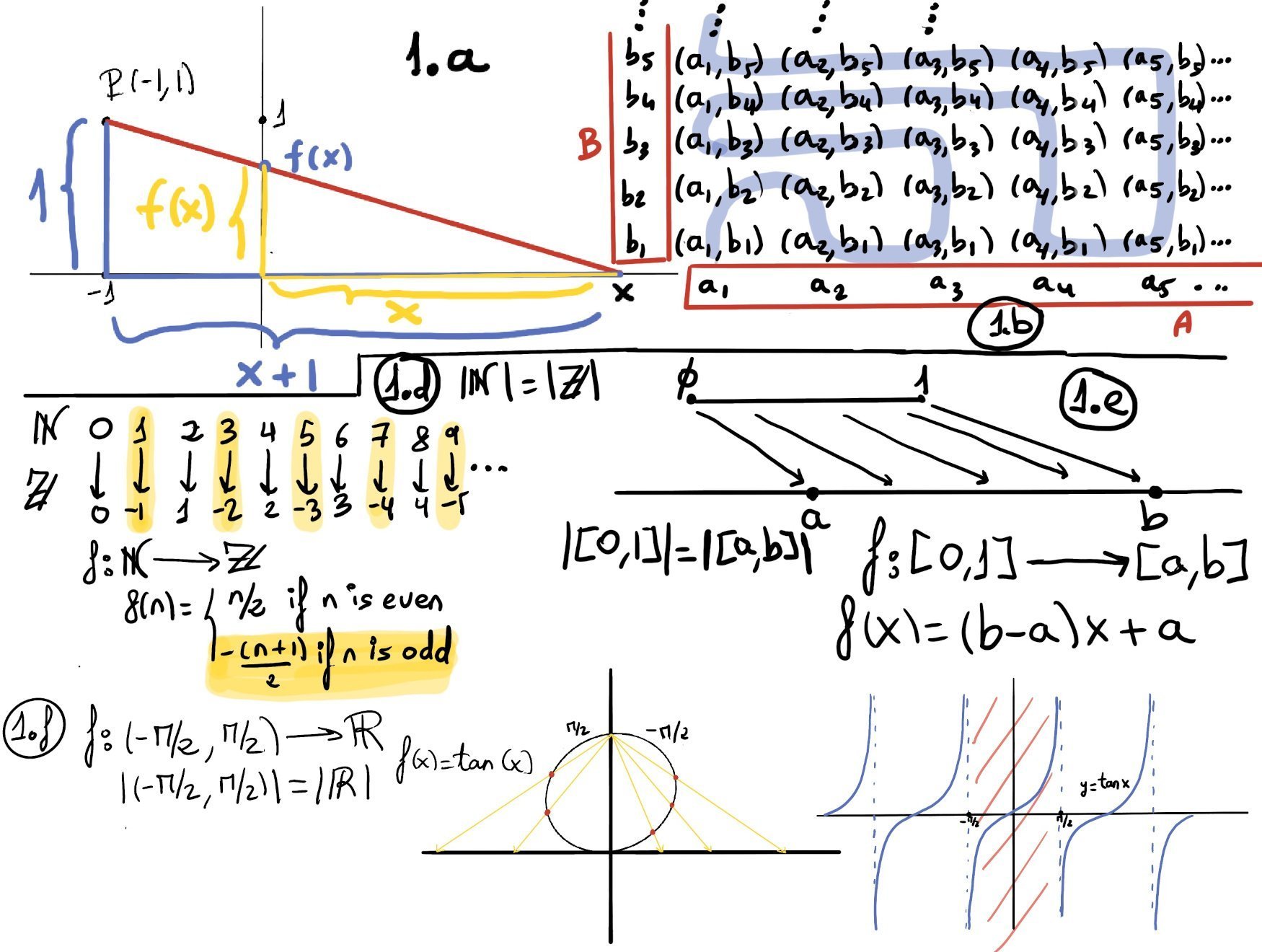
Proof: We can establish a bijection by alternating between positive and negative numbers. We map: $1 \leftrightarrow 0, \quad 2 \leftrightarrow 1, \quad 3 \leftrightarrow -1, \quad 4 \leftrightarrow 2, \quad 5 \leftrightarrow -2 \dots$
We can write this as a precise piecewise function $f: \mathbb{N} \to \mathbb{Z}$:
$f(n) = \begin{cases} \frac{n}{2}, & \text{if } n \text{ is even} \\ \frac{1-n}{2}, & \text{if } n \text{ is odd} \end{cases}$
This function is a flawless bijection. No integer is skipped, and no integer is hit twice.
The rationals $\mathbb{Q}$ are countable, even though there are infinitely many of them, $|\mathbb Q|=\aleph_0$.
At first this seems impossible because between any two integers there are infinitely many fractions. For example, between $0$ and $1$ alone we already have $ \dots, \frac12,\ \frac13,\ \frac14,\ \frac15,\dots$ so it feels as though there should be “more” rationals than naturals.
The surprising fact is that infinite sets can have proper subsets of the same size. Just as $|\mathbb N| = |2\mathbb N|$, we also have $|\mathbb N| = |\mathbb Q|$ (Figure 1a).
The “string” analogy expresses the existence of a bijection $\mathbb N \longleftrightarrow \mathbb Q$.
Imagine every rational number attached to a tangled string. If you pull the string straight, the rationals line up in a sequence: $q_0,\ q_1,\ q_2,\ q_3,\ \dots$ where every rational appears exactly once.
Then you can define $n \mapsto q_n$. This gives a bijection with $\mathbb N.$
The hard part is showing that such a listing exists. A common construction is to arrange all positive rationals in a grid: $\begin{array}{ccccc} 1/1 & 1/2 & 1/3 & 1/4 & \cdots\\ 2/1 & 2/2 & 2/3 & 2/4 & \cdots\\ 3/1 & 3/2 & 3/3 & 3/4 & \cdots\\ 4/1 & 4/2 & 4/3 & 4/4 & \cdots\\ \vdots & \vdots & \vdots & \vdots \end{array}$
Every positive rational appears somewhere as $\frac{m}{n}$. Now traverse the grid diagonally: $1/1, \quad 1/2,\,2/1, \quad 3/1,\,2/2,\,1/3, \quad \dots$ and skip duplicates such as $2/2 = 1/1,\qquad 2/4 = 1/2.$
This produces an infinite list containing every positive rational exactly once. Then, insert $0$ and alternate positive and negative rationals: $0, \frac11, -\frac11, \frac12, -\frac12, \frac21, -\frac21, \dots$ giving a sequence of all rational numbers.
Notice how different this is from Cantor’s theorem:
So despite the rationals being dense on the number line, they are still only “the first size” of infinity, whereas the reals form a strictly larger infinity. This is one of the most surprising consequences of Cantor’s theory of cardinality.
Bijections aren’t just for discrete numbers; they apply to continuous geometry as well.
Any two closed intervals have the same cardinality. For any real numbers $a < b$, $\vert{}[0, 1]\vert{} = \vert{}[a, b]\vert{}$.
We can prove this with a linear scaling function $f: [0, 1] \to [a, b]$ defined by $f(x) = (b - a)x + a$ (Figure 1.e).
This function stretches the interval length by $(b-a)$ and shifts it by $a$. It is a perfect bijection.
A finite segment has the same cardinality as the infinite Real Line. $\vert{}(-\frac{\pi}{2}, \frac{\pi}{2})\vert{} = \vert{}\mathbb{R}\vert{}$ (Figure 1.f).
We prove this using trigonometry. The function $f: (-\frac{\pi}{2}, \frac{\pi}{2}) \to \mathbb{R}$ defined by: $f(x) = \tan(x)$ is strictly increasing (hence injective) and spans from $-\infty$ to $\infty$ between its vertical asymptotes (hence surjective).
A geometric projection mapping $(0, \infty) \to (0, 1)$.
Let’s build a bijection geometrically. Imagine the interval $(0, \infty)$ lying on the positive x-axis, and the interval $(0, 1)$ lying on the positive y-axis.
Place an observer at the point $P(-1, 1)$. If the observer looks at any point $x$ on the positive x-axis, their line of sight must perfectly cross the y-axis at some unique point $y \in (0,1)$.
Let’s find the formula for this intersection. The line passes through $P(-1, 1)$ and $X(x, 0)$.
The slope is $m = \frac{0 - 1}{x - (-1)} = \frac{-1}{x+1}$. The equation of the line is $Y - 0 = \frac{-1}{x+1}(X - x)$.
The y-intercept (where $X = 0$) gives our mapping function: $f(x) = \frac{x}{x+1}$
Proof of Bijection:
Definition. Let $A$ be an arbitrary set. Then, $A$ is said to be countably infinite if $|\mathbb N| = \lvert A\rvert$, that is, if there exists a bijection $f: \mathbb N \to A$. $A$ is said to be uncountable if $A$ is infinite and $|\mathbb N| \ne \lvert A\rvert$, that is, if there exists no bijection $f: \mathbb N \to A$.
If $A$ is countably infinite, there exists a bijection $f: \mathbb N \to A$. It allows us to list the elements of $A$ as an infinite list $f(1), f(2), f(3), \dots$, i.e., the set elements can be arranged in an infinite list $a_1, a_2, a_3, \dots$.
Can we combine infinite sets and keep them countable? The short answer is yes.
Theorem: If $A$ and $B$ are both countably infinite, then their Union ($A \cup B$) and their Cartesian Product ($A \times B$) are also countably infinite.
Proof:
The Union: Because $A$ and $B$ are countable, we can write them as lists: $A = \{a_1, a_2, \dots\}$ and $B = \{b_1, b_2, \dots\}$. We can shuffle them into a single alternating list: $A \cup B = \{a_1, b_1, a_2, b_2, a_3, b_3, \dots\}$.
If the sets overlap, we simply skip elements we have already listed to maintain injectivity.
Because we can arrange the union into a discrete, indexed sequence, it is countable.
The Cartesian Product: This requires Cantor’s Pairing Function. Imagine plotting $A \times B$ on a 2D grid, where the coordinates are $(a_i, b_j)$. We cannot count row by row (because row 1 goes on infinitely, and we would never reach row 2). Instead, we weave through the grid diagonally!
This zig-zag path straightens the 2D infinite grid out into a single 1D string, ensuring every ordered pair is eventually reached. Thus, $A \times B$ is countable.
By mathematical induction, we can prove that given $n$ countably infinite sets $A_1, A_2, \dots, A_n$, their Cartesian product $\prod_{i=1}^n A_i$ is also countably infinite.
Proof by Induction:
Consider the product of $k+1$ sets. We can define a natural bijection $f$ that groups the first $k$ dimensions together:
$f(x_1, x_2, \dots, x_{k+1}) = ((x_1, \dots, x_k), x_{k+1})$. This function flawlessly maps the $(k+1)$-dimensional product to the 2-dimensional product $P_k \times A_{k+1}$.
By our inductive hypothesis, $P_k$ is countably infinite. We are given that $A_{k+1}$ is countably infinite.
Since the Cartesian product of two countably infinite sets is countably infinite (Base Case), the set $P_k \times A_{k+1}$ is countable. Because our bijection links them, the product of $k+1$ sets is countably infinite. $\blacksquare$

JustToThePoint Copyright © 2011 - 2026 Anawim. ALL RIGHTS RESERVED. Bilingual e-books, articles, and videos to help your child and your entire family succeed, develop a healthy lifestyle, and have a lot of fun. Social Issues, Join us.
This website uses cookies to improve your navigation experience.
By continuing, you are consenting to our
use of cookies, in accordance with our Cookies Policy and
Website Terms and Conditions of use.